Buying clothes for a child is a guessing game. The label says 4 years, but the child is tall for four. The next brand says 4T, the next says 104, and a third says size 5. By the time the parcel arrives, it is too short in the sleeves or too big in the shoulders. A good children’s clothing size chart takes much of the guesswork out of this.
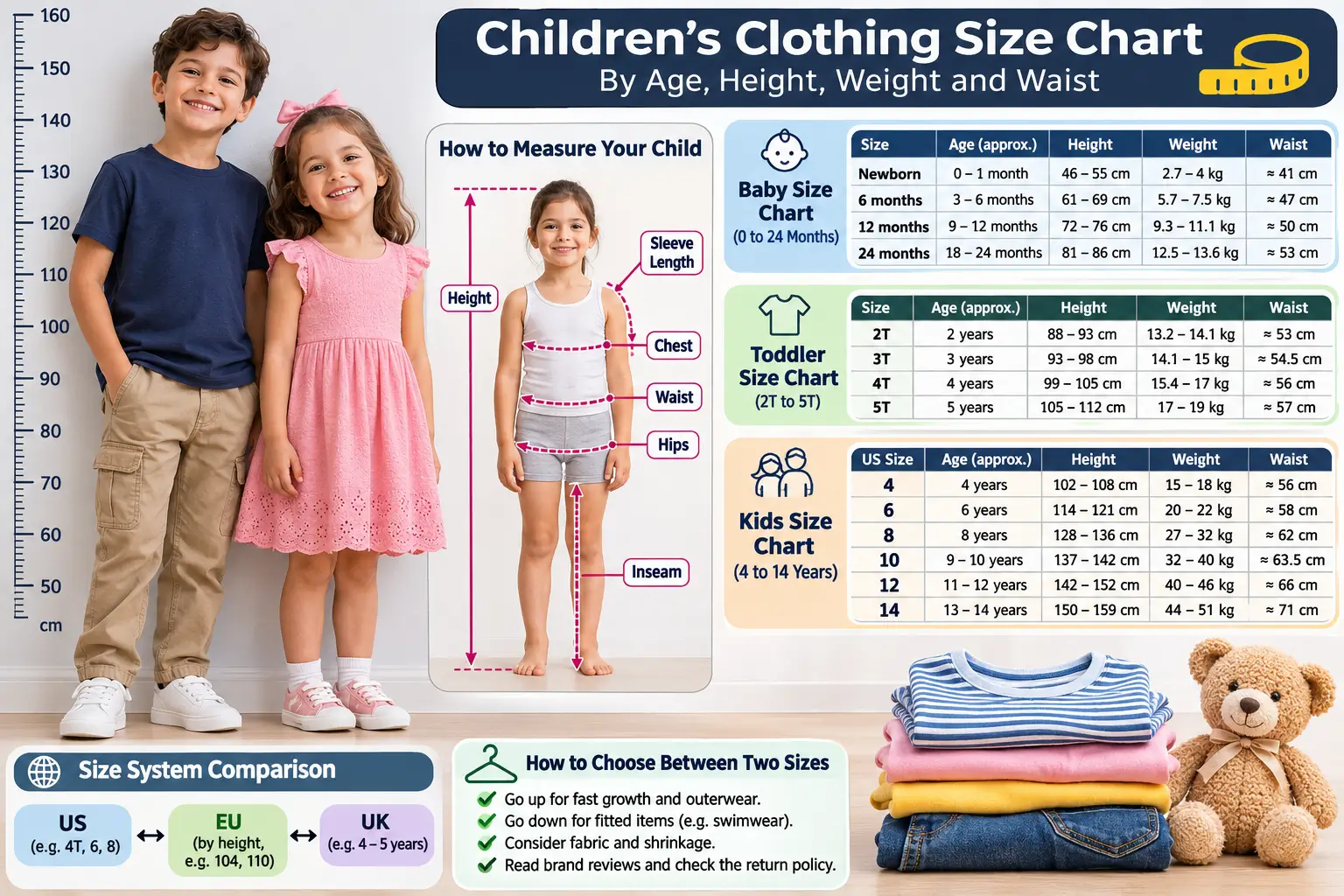
This guide gives you a size chart by age, with height, weight and waist, in metric and US units. It also shows how EU, UK and US sizes relate, how to measure a child at home, and how to choose between two sizes. You will see a worked example and the reasons why sizes differ from brand to brand. If you are curious about how garment makers measure clothes, see our guide on the measurement of top and bottom garments.
A note on accuracy. There is no single world standard for children’s sizes. Each brand sets its own chart, based on its own research and fit models. The figures below follow the published size chart of a large US children’s brand, plus the common European way of sizing by height. Use them as a guide and always check the chart of the shop you are buying from.
Why age is only a rough guide
Children of the same age can differ by 15 cm or more in height. Growth comes in spurts, and genes, nutrition and sleep all play a part. So brands set their sizes by body measurements, mostly height and weight, and show age only as a hint. If a child is between sizes, height is the best number to follow. The waist matters for trousers, and the chest matters for fitted tops and jackets.
Baby size chart (0 to 24 months)
| Size | Approx. age | Height | Weight | Waist |
|---|---|---|---|---|
| Preemie | Premature | Up to 46 cm (18 in) | Up to 2.7 kg (6 lb) | about 36 cm |
| Newborn | 0 to 1 month | 46 to 55 cm | 2.7 to 4 kg | about 41 cm |
| 3 months | 1 to 3 months | 55 to 61 cm | 4 to 5.7 kg | about 44.5 cm |
| 6 months | 3 to 6 months | 61 to 69 cm | 5.7 to 7.5 kg | about 47 cm |
| 9 months | 6 to 9 months | 69 to 72 cm | 7.5 to 9.3 kg | about 48 cm |
| 12 months | 9 to 12 months | 72 to 76 cm | 9.3 to 11.1 kg | about 50 cm |
| 18 months | 12 to 18 months | 76 to 81 cm | 11.1 to 12.5 kg | about 51.5 cm |
| 24 months | 18 to 24 months | 81 to 86 cm | 12.5 to 13.6 kg | about 53 cm |
Babies grow quickly, so a size often fits for only two or three months. Many parents buy one size up for sleepwear and outer layers.
Toddler size chart (2T to 5T)
The letter T means toddler. These sizes have more room in the seat for a nappy and are made for children who are walking.
| Size | Approx. age | Height | Weight | Waist |
|---|---|---|---|---|
| 2T | 2 years | 88 to 93 cm (35 to 36.5 in) | 13.2 to 14.1 kg | about 53 cm |
| 3T | 3 years | 93 to 98 cm | 14.1 to 15 kg | about 54.5 cm |
| 4T | 4 years | 99 to 105 cm | 15.4 to 17 kg | about 56 cm |
| 5T | 5 years | 105 to 112 cm | 17 to 19 kg | about 57 cm |
Kids size chart (4 to 14)
| US size | Approx. age | Height | Weight | Waist |
|---|---|---|---|---|
| 4 | 4 years | 102 to 108 cm | 15 to 18 kg | about 56 cm |
| 5 | 5 years | 108 to 114 cm | 18 to 20 kg | about 57 cm |
| 6 | 6 years | 114 to 121 cm | 20 to 22 kg | about 58 cm |
| 7 | 7 years | 122 to 131 cm | 23 to 27 kg | about 60 cm |
| 8 | 8 years | 128 to 136 cm | 27 to 32 kg | about 62 cm |
| 10 | 9 to 10 years | 137 to 142 cm | 32 to 40 kg | about 63.5 cm |
| 12 | 11 to 12 years | 142 to 152 cm | 40 to 46 kg | about 66 cm |
| 14 | 13 to 14 years | 150 to 159 cm | 44 to 51 kg | about 71 cm |
Notice that the height ranges of neighbouring sizes overlap. A child of 108 cm could wear a size 4 or a size 5. Children’s sizes also come in slim, regular and husky or plus fits in many brands, which change the waist and hip but keep the height the same.
European sizing: by height in centimetres
Most European shops simply put the child’s height on the label. A child who is 110 cm tall wears size 110. This is easier than age sizing because you only need one measurement.
| EU size (height in cm) | Typical age |
|---|---|
| 62 | 2 to 3 months |
| 68 | 4 to 6 months |
| 74 | 6 to 9 months |
| 80 | 9 to 12 months |
| 86 | 12 to 18 months |
| 92 | 18 to 24 months |
| 98 | 2 to 3 years |
| 104 | 3 to 4 years |
| 110 | 4 to 5 years |
| 116 | 5 to 6 years |
| 122 | 6 to 7 years |
| 128 | 7 to 8 years |
| 134 | 8 to 9 years |
| 140 | 9 to 10 years |
| 146 | 10 to 11 years |
| 152 | 11 to 12 years |
| 158 | 12 to 13 years |
| 164 | 13 to 14 years |
Sizes come in steps of 6 cm, and each size covers a child whose height is within a few centimetres of the number. If a child is 107 cm, buy 110 for a roomy fit or 104 for a snug one.
UK sizes by age and height
UK retailers often label by age, for example “4 to 5 years”, and then give a height range. Typical ranges are below. Sizes are from common UK charts and differ by shop.
| UK size (age) | Height range |
|---|---|
| 3 to 4 years | about 97 to 105 cm |
| 4 to 5 years | about 105 to 113 cm |
| 5 to 6 years | about 112 to 118 cm |
| 6 to 7 years | about 122 to 128 cm |
| 7 to 8 years | about 127 to 135 cm |
| 8 to 9 years | about 136 to 140 cm |
| 9 to 10 years | about 141 to 146 cm |
| 10 to 12 years | about 147 to 157 cm |
| 12 to 13 years | about 152 to 163 cm |
| 13 to 14 years | about 160 to 168 cm |
How to measure your child
You need a soft tape measure, a pencil and a wall. Ask the child to wear thin clothes and stand relaxed.
- Height. Stand the child barefoot against a wall with heels together. Put a flat book on the head, level with the wall, and make a pencil mark. Measure from the floor to the mark. For babies, lay them on their back, straighten the legs gently and measure from head to heel.
- Chest. Wrap the tape around the fullest part of the chest, under the armpits, with the tape level and snug but not tight.
- Waist. Measure around the natural waist, which is the narrowest point above the belly button.
- Hips. Measure around the fullest part of the hips.
- Inseam. Measure from the crotch to the ankle bone along the inside of the leg.
- Sleeve length. From the shoulder bone to the wrist with the arm slightly bent.
Write the numbers down. Then compare them with the chart of the shop or brand. If one number falls in a larger size, choose by the measurement that matters most for that garment: chest for tops, waist and inseam for trousers, height for dresses and all-in-ones.
How to choose between two sizes
- Between sizes, go up for children who are growing fast, and for trousers with an adjustable waist.
- Go down for fitted garments such as swimwear and sports tops, where a loose fit can be unsafe or uncomfortable.
- Check fabric. Stretch knits are forgiving. Stiff woven denim and cotton need more precise sizing.
- Check shrinkage. Cotton garments can shrink by a few percent in the first washes. See our guides on how to prevent clothes from shrinking and shrinkage control in garment factories.
- Read the reviews. Parents often say if a brand runs small or large.
- Check the return policy before you buy.
Worked example: choosing a size
A child is 4 years and 5 months old. She is 104 cm tall, weighs 16.5 kg and has a waist of 54 cm. You want a cotton dress and a pair of trousers for the next six months.
Step 1: find the size by height.
- US toddler chart: 4T covers 99 to 105 cm, so 104 cm fits at the top of the range.
- EU chart: size 104 is an exact match.
- UK chart: 4 to 5 years covers 105 to 113 cm. She is just below, so 3 to 4 years is the tighter fit and 4 to 5 years is the roomier one.
Step 2: check weight and waist. 16.5 kg falls inside 4T (15.4 to 17 kg). Her waist of 54 cm is a little under the 4T figure of about 56 cm, which is fine for trousers with an elastic waist.
Step 3: allow for growth. Children of this age grow roughly 5 to 7 cm a year on average, which is about 3 cm in six months. In six months she may be near 107 cm, which is at the top of 4T and the bottom of 5T.
Step 4: decide.
- For the dress, buy size 5T or EU 110. The extra length gives room to grow.
- For trousers, size 4T with a roll-up hem and adjustable waist would fit now. Size 5T would be better in three months.
Step 5: allow for shrinkage. If the cotton trousers may shrink 3 percent in length, a 55 cm inseam becomes 55 × 0.97 = 53.4 cm. That is a loss of 1.6 cm. A size up covers it.
Why sizes differ between brands
- Different fit models. Each brand uses its own set of body measurements.
- Different markets. Sizes made for Asia, Europe and North America reflect local body shapes.
- Vanity sizing. Some brands label items a size smaller to flatter buyers.
- Style. An oversized tee is meant to be loose. A fitted tee is cut close.
- Fabric. A stretch fabric needs less ease than a woven one.
- Tolerance in production. Garments are allowed to vary by a small amount, usually a centimetre or so, from the spec. Our guide on the garment spec sheet explains how that works.
For the way factories scale one pattern to a whole range of sizes, see our guide on pattern grading. For pants specifically, read our guide on pant measurements.
Safety and comfort points
- Sleepwear should fit snugly or be made of flame-resistant fabric in many countries, because loose cotton nightclothes can catch fire more easily. Check your local rules.
- Hoods and drawstrings near the neck are a risk for young children. Many safety rules limit them. Choose designs without long cords.
- Seams and tags should be soft. Look for flat seams, tagless labels and gentle fabrics for sensitive skin.
- Room for movement. A garment should let the child bend, sit and reach without pulling.
- Fastenings such as buttons and snaps should be firmly attached.
Final thoughts
A children’s clothing size chart is a helpful tool, but it is a guide, not a promise. Start with your child’s height, then check weight, waist and chest. Compare with the chart of the shop you buy from, think about growth and shrinkage, and choose the size that gives comfort now and a little room for later. When in doubt, a quick tape measure and a glance at the return policy will save time and money.
Frequently asked questions
Usually a US size 4T, an EU size 104 or a UK size 3 to 4 years. Check the child’s height, since it is a better guide than age.
Both are used. US and UK brands show age, and European brands show height. Height is the more reliable number.
T stands for toddler. These sizes have more room in the seat and shorter proportions than regular kids’ sizes.
If the child is between sizes or growing fast, yes for casual wear. For fitted items like swimwear or sports tops, choose the closer fit.
Measure height, chest, waist, hips and inseam with a soft tape, then compare them with the brand’s chart.
Each brand uses its own fit models and style rules, so the same label can mean slightly different measurements.
Growth is uneven. In the middle years, many children grow around 5 to 7 cm a year, with faster growth during early life and around puberty.