After the bananas are cut, the plant that grew them is cut down too. A banana plant gives fruit only once, so farmers fell the trunk and leave it to rot or burn it. That trunk is not a real wood stem. It is a thick bundle of leaf sheaths, full of water and long, strong fibres. For a long time these were treated as waste. Now banana fibre is turning into ropes, fabrics, paper, mats and bags.
This guide explains what banana fibre is, how it is taken from the plant, what it is like and where it is used. It includes a worked yield example, a comparison with other plant fibres, and the honest limits of the material. For where it fits in the fibre family, see our guides on the classification of textile fiber and the different types of textile fibers.
What is banana fibre
Banana fibre is a natural cellulose fibre taken from the stem of the banana plant, called the pseudostem. The name pseudostem means “false stem”. The plant is a giant herb. What looks like a trunk is a tight roll of leaf bases wrapped around each other. Fibre runs along the length of these sheaths.
It belongs to the group of bast and leaf-type fibres, along with jute, flax, sisal and abaca. Fibre is also taken from the leaf stalks, the bunch stalk and the peel, but the pseudostem is the main source.
One name needs care. Abaca, also called Manila hemp, comes from a different banana species, Musa textilis, grown mainly in the Philippines and Ecuador. It is a strong rope and paper fibre. Ordinary fruit banana plants give a softer, shorter and less strong fibre, which is the one most people mean when they say banana fibre.
Where banana fibre comes from
Bananas grow in warm, wet regions. India, the Philippines, Ecuador, Indonesia, Brazil, China and many African countries are major growers. Bangladesh, Sri Lanka, Vietnam and Thailand also grow large areas. Anywhere there is a banana farm, there is a supply of pseudostems after harvest. Exact production numbers change each year, so check a current source if you need them.
How banana fibre is made
1. Collecting the pseudostem
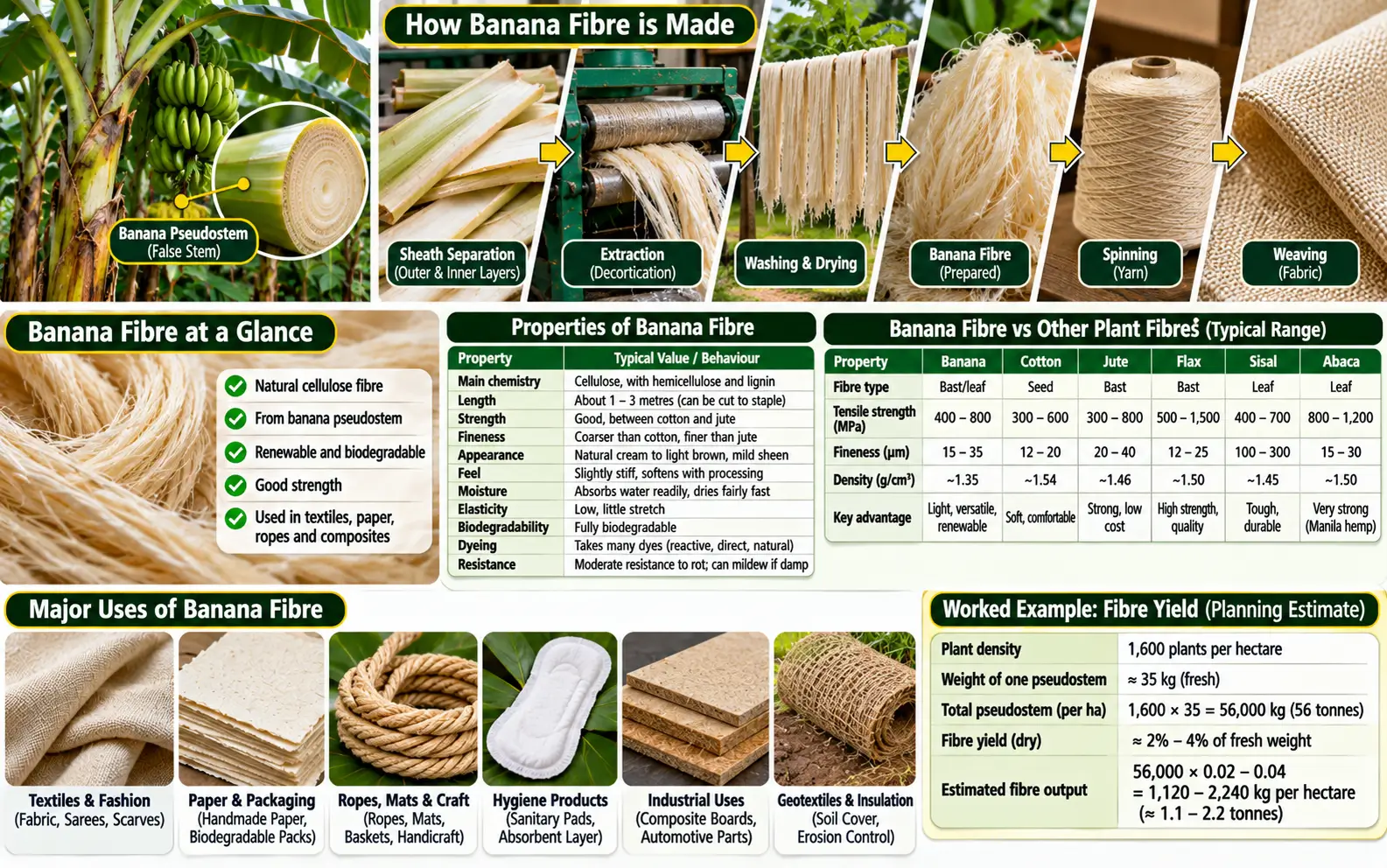
After the harvest, the trunk is cut down. The outer sheaths are separated, since each layer gives a different grade of fibre. The outer layers give coarse, strong fibre. The inner layers give finer, softer fibre.
2. Extraction
There are three common ways.
- Manual scraping. A worker places a sheath on a board and scrapes it with a blunt blade to remove the pulp. This is slow, but it gives high quality fibre.
- Machine decortication. A decorticator crushes and scrapes the sheaths between rollers and blades, then washes away the pulp. This is faster and suits small mills.
- Retting. The sheaths are soaked in water so microbes break down the glue around the fibres. It is slower and can pollute water if done in ponds without care.
3. Washing and drying
The extracted fibre is washed in clean water and dried in the shade or sun. It is combed to straighten the strands.
4. Softening and bleaching (optional)
For textiles, the fibre may be treated with mild alkali, enzymes or soft oils to make it supple. It may be bleached or dyed. Strong chemical treatment can weaken the fibre.
5. Spinning and weaving
The fibre can be spun into yarn by hand or by machine, often alone or blended with cotton, silk or other fibres. For the basic idea of turning fibre into yarn, see our guide on the yarn making process.
Properties of banana fibre
| Property | What it means |
|---|---|
| Main chemistry | Cellulose, with hemicellulose and lignin |
| Length | Long, about 1 to 3 metres in strands. Can be cut to staple |
| Strength | Good, between cotton and jute |
| Fineness | Coarser than cotton, finer than jute in the better grades |
| Look | Natural cream to light brown, with a mild sheen |
| Feel | Slightly stiff, softens with processing |
| Moisture | Absorbs water readily and dries fairly fast |
| Weight | Light |
| Elasticity | Low, so it stretches little |
| Biodegradability | Fully biodegradable |
| Dyeing | Takes many dyes, such as reactive, direct and natural dyes |
| Resistance | Moderate resistance to rot. It can mildew if stored damp |
Numbers such as strength and fineness change a lot with the plant variety, the sheath layer and the extraction method. Ask the supplier for test results.
Uses of banana fibre
Textiles and fashion
- Handwoven fabrics. Banana yarn alone or blended is woven into sarees, scarves, shawls and dress fabric. The Japanese bashōfu cloth, from the Ryukyu islands, is a famous banana-fibre textile.
- Blended yarns. Banana mixed with cotton or silk gives a cloth with a natural texture.
- Home textiles. Curtains, table mats, rugs and cushion covers.
- Bags and accessories. Hats, belts, purses and shoes.
Paper and packaging
- Handmade paper. Fibre and sheath waste make paper for notebooks, cards and gift packs.
- Tea bags and filter paper. Abaca pulp is used for strong, thin papers.
- Packaging. Light, biodegradable boxes and trays.
Rope, mats and craft
- Ropes and twine. Used in farms and homes.
- Mats and baskets. Woven from sheaths and strands.
- Craft items. Dolls, decor, wall hangings and jewellery.
Hygiene products
- Sanitary pads. Some small companies use banana fibre as the absorbent layer in biodegradable pads. Many of these projects are startups, so check the product claims.
Industrial and composite uses
- Composite boards. Fibre mixed with resin makes light panels.
- Automotive parts. Natural-fibre composites are tested in car interiors.
- Insulation and geotextile mats. Used for soil cover and erosion control.
Worked example: how much fibre can an acre or hectare give
These figures are working assumptions for planning and must be checked against your own farm and machine.
- Plant density: 1,600 plants per hectare
- Weight of a fresh pseudostem after the harvest: about 35 kg
- Fibre yield from the stem: about 1.5 percent of fresh weight
Total fresh pseudostem = 1,600 × 35 = 56,000 kg = 56 tonnes
Fibre = 56,000 × 0.015 = 840 kg per hectare
If a small decorticator handles 100 kg of sheath per hour, the time needed is 56,000 ÷ 100 = 560 machine hours for the whole hectare. At 8 hours a day, that is 70 working days, or about 12 weeks for one machine. Two machines would take about 6 weeks.
If dried fibre sells for 150 currency units per kg, 840 kg earns 126,000 units per hectare. Costs include labour, power, washing water and transport. Do a proper costing before you buy equipment. Also note that the fruit crop is the main income. Fibre is a by-product, so it adds revenue without extra land.
How banana fibre compares with other plant fibres
| Fibre | Source | Strength | Feel | Main use |
|---|---|---|---|---|
| Banana | Pseudostem | Good | Slightly stiff, softens | Craft, fabrics, paper, ropes |
| Abaca | Musa textilis | Very high | Stiff | Ropes, special papers |
| Jute | Stem bast | High | Coarse | Sacks, hessian. See jute fibre |
| Coir | Coconut husk | Moderate | Very stiff | Mats, ropes. See coconut fibre |
| Sisal | Leaf | High | Stiff | Rope, twine |
| Cotton | Seed hair | Moderate | Soft | Clothing |
| Flax | Stem bast | High | Crisp | Linen |
Grading banana fibre
Buyers usually grade the fibre by the sheath layer it came from, by length and by cleanliness.
| Grade | Source layer | Look | Typical use |
|---|---|---|---|
| Coarse | Outer sheath | Dark, thick, strong | Ropes, mats, composite boards |
| Medium | Middle sheaths | Light brown, firm | Bags, paper, craft items |
| Fine | Inner sheaths | Pale, soft, thin | Yarn for fabric, scarves, blends |
| Waste | Pulp and short pieces | Short, weak | Paper pulp, compost, boards |
Good lots are free of pulp, dust and dark spots, and are dried to a steady moisture level so they do not mould. A simple field test is to roll a strand between your fingers. If it breaks easily or feels brittle, it was over-processed or dried too hard. If it feels damp or smells sour, it needs more drying.
Market and cost points
Banana fibre is a small market compared with cotton or jute, and prices vary a lot by quality and country. Costs come from collecting stems, labour for extraction, water for washing, drying space and transport. Because the stems are heavy and wet, they should be processed close to the farm. Moving 56 tonnes of stem to get 840 kg of fibre is not sensible. This is why successful projects set up small units inside banana-growing areas, often run by farmer groups or women’s cooperatives.
Buyers pay more for consistent lots, so keep a record of the farm, the date and the method for each batch. If you sell to textile makers, offer a sample card with the fibre, a short spec and test results for length and strength. If you sell to craft makers, photos of finished items help more than numbers. In both cases, start with a few buyers and grow from there.
Banana fibre and the wider textile story
Natural fibres from farm residues are drawing attention as brands look for lower-impact materials. Banana sits with pineapple leaf, hemp, nettle and sisal in this group. Each has strengths and limits, and none replaces cotton on its own. They work best as part of a mix of fibres, used where their look and feel fit the product. To compare their properties side by side, see our guide on the properties of textile fibres.
Advantages of banana fibre
- It comes from an agricultural by-product, so it adds value to waste.
- It is renewable and biodegradable.
- It needs no extra land, water or fertiliser beyond the fruit crop.
- It is strong and long.
- It supports rural jobs, especially for women’s groups.
- It blends well with other fibres.
- It has a natural look that many buyers like.
Limitations of banana fibre
- Extraction is slow, and the fibre yield is low compared with the weight of the stem.
- Quality varies by plant, layer and method.
- The fibre is coarse and can feel stiff without softening.
- Supply is scattered across many small farms, which makes collection hard.
- Retting can pollute water.
- Spinning on cotton or wool machines needs adjustments.
- Many claims about “silk-like” feel need testing.
- It can mildew if stored wet.
Environmental points
Banana fibre looks like a clean solution, and in many ways it is. It uses waste, needs no extra farming and breaks down at the end of its life. But the benefits depend on the process. Open retting in ponds can smell and harm fish. Strong bleach and dye add chemical load. Transport from scattered farms adds emissions. A fair claim is that banana fibre can have a lower footprint than many options, if it is processed with care. Ask for data before you accept a big environmental claim. Our guide on natural dyes is useful if you want to colour it with low-impact methods.
Tips for working with banana fibre
- Use the outer sheaths for rope and mats, and the inner sheaths for fine yarn and fabric.
- Dry the fibre fully before storing it.
- Soften with a light oil or enzyme before spinning.
- Blend 20 to 50 percent banana with cotton for smoother yarn.
- Test shrinkage and colour fastness before bulk production.
- Keep the fibre length consistent when you cut it to staple.
Final thoughts
Banana fibre turns a farm waste into a useful material. It is not as soft as cotton or as cheap to extract as jute, but it is strong, light and natural, and it fits well with craft and small-scale mills. The key is good extraction, clean processing and honest testing. If you plan to work with it, start with a small batch, measure your yield and talk to buyers early about what they need.
Frequently asked questions
Banana fibre is a natural cellulose fibre taken from the stem, or pseudostem, of the banana plant. It is used for textiles, paper, rope and craft.
By scraping the sheaths by hand or by machine, sometimes after soaking them in water. The pulp is washed away, and the fibre is dried.
It is stronger than cotton and weaker than abaca. Strength varies with the plant layer and the extraction method.
No. Abaca comes from a different banana species, Musa textilis, and is stronger. Ordinary banana fibre comes from fruit-bearing banana plants.
Yes, mostly in handwoven and blended fabrics. Pure banana fibre is stiffer than cotton, so softening and blending help.
Yes. It breaks down naturally at the end of its life.
In sarees, scarves, bags, mats, ropes, handmade paper, composites and some hygiene products.