
Long before chemists made colours in a laboratory, people coloured cloth with what grew around them. They boiled roots, bark, flowers and leaves. They crushed insects and shells. They soaked fabric in vats of fermented leaves. The colours that came out of those pots filled markets, temples and palaces for thousands of years. Today the natural dye is making a comeback, because buyers and makers want colours that feel closer to nature.
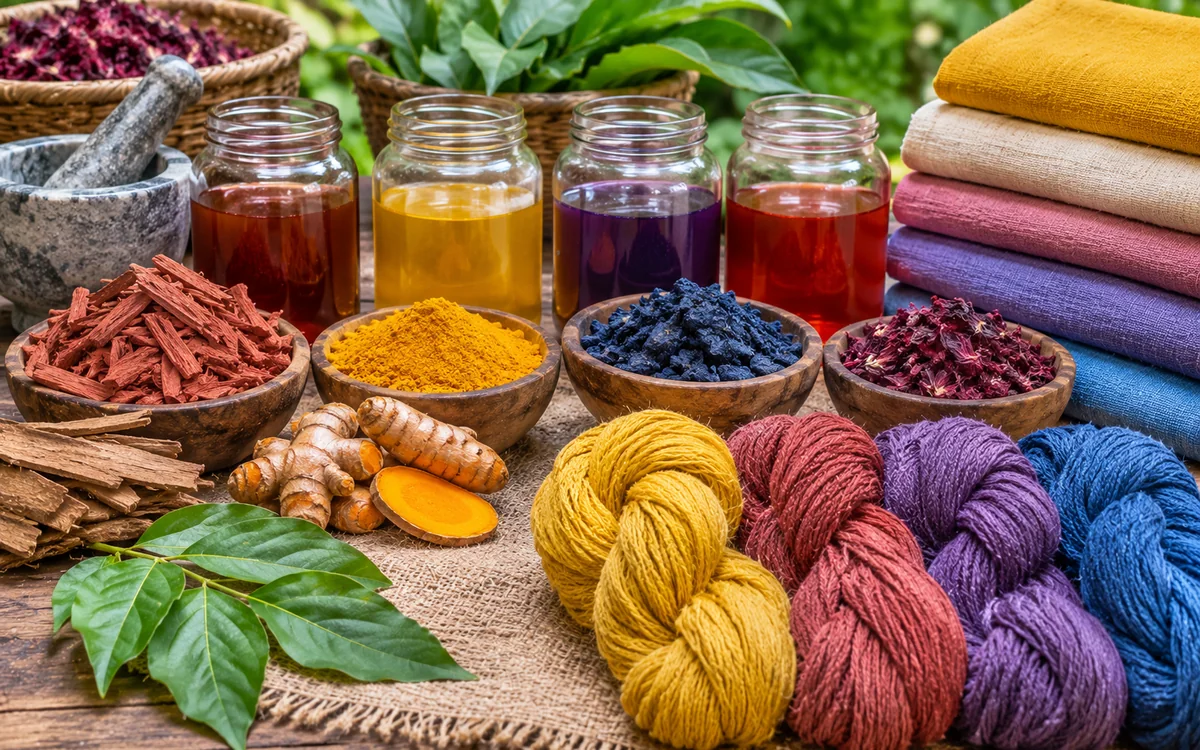
This guide explains what a natural dye is, where it comes from and which examples matter most. It covers mordants, the step-by-step dyeing method, worked quantities for a small batch, and the real strengths and limits of natural colour. If you want to compare it with factory colours, read our guides on the difference between dyes and pigments and on reactive, disperse and vat dye selection.
What is a natural dye
A natural dye is a colouring matter taken from plants, animals or minerals, with little or no chemical change before use. It is the opposite of a synthetic dye, which is made from petroleum-based raw materials in a factory. Natural dyes were the only dyes in the world until 1856, when the first synthetic dye, mauveine, was made.
Most natural dyes have these traits:
- They give soft, earthy colours rather than very bright ones.
- Many need a helper chemical called a mordant to stick to the fibre.
- They vary from batch to batch, because plants change with soil, season and age.
- They work best on natural fibres such as wool, silk, cotton and linen.
Sources of natural dyes
Plant sources
Plants are the biggest source. Colour can come from roots, bark, leaves, flowers, fruit skins or seeds.
| Part | Examples | Colour |
|---|---|---|
| Root | Madder, turmeric | Red, yellow |
| Bark | Catechu (cutch), oak, babool | Brown, tan |
| Leaves | Indigo plant, weld, henna | Blue, yellow, orange |
| Flowers | Marigold, safflower, tesu (palash) | Yellow, orange, red |
| Fruit and rind | Pomegranate rind, myrobalan | Yellow, khaki |
| Seeds | Annatto | Orange |
| Heartwood | Logwood, sappan wood | Purple, black, red |
Animal sources
- Cochineal: Made from the dried bodies of small insects that live on cactus. It gives crimson and scarlet reds.
- Lac: A resin made by lac insects on trees. It gives deep reds and purples and is used widely in South Asia.
- Murex: A sea snail that gave the ancient purple known as Tyrian purple. It is rare and costly today.
Mineral sources
Some earth pigments, such as ochre and iron oxides, give yellows, reds and browns. These are strictly pigments rather than dyes, because they sit on the surface and do not dissolve. Our guide on what pigments are covers that group.
Common examples of natural dyes
| Dye | Source | Main colouring molecule | Colour on fabric | Needs mordant |
|---|---|---|---|---|
| Indigo | Indigofera plant leaves | Indigotin | Blue | No, but needs a vat |
| Madder | Root of Rubia | Alizarin | Red, orange, pink | Yes |
| Turmeric | Root of Curcuma | Curcumin | Bright yellow | Helps |
| Weld | Reseda plant | Luteolin | Clear yellow | Yes |
| Cochineal | Insect | Carminic acid | Crimson, pink, purple | Yes |
| Lac | Insect resin | Laccaic acid | Deep red, violet | Yes |
| Logwood | Heartwood | Haematein | Purple, grey, black | Yes |
| Henna | Leaves | Lawsone | Orange, brown | Helps |
| Catechu | Wood extract | Tannin | Brown, khaki | Helps |
| Pomegranate rind | Fruit skin | Tannin | Yellow, olive | Yes |
| Marigold | Flower | Flavonoids | Yellow, orange | Yes |
Indigo is a special case. The colour in the plant leaf is a colourless sugar compound. When it is fermented and exposed to air, it turns into the blue indigotin. Indigo does not dissolve in water, so it is turned into a soluble form in an alkaline vat and then oxidised back to blue on the fabric. This vat method is the base of old and modern denim dyeing. See our article on the denim washing process to see how indigo is used on jeans.
Types of natural dyes by dyeing method
| Type | How it works | Example |
|---|---|---|
| Direct (substantive) | Sticks to fibre in plain water | Turmeric, safflower |
| Mordant | Needs a metal salt to fix | Madder, cochineal, weld |
| Vat | Reduced in alkali, then oxidised | Indigo |
| Acid (on protein fibres) | Works in a mild acid bath | Some tannin dyes on wool and silk |
What is a mordant
A mordant is a substance that helps a dye bond to the fibre. The word comes from the Latin for “to bite”. Many natural dyes dissolve in water so easily that they wash out. The mordant forms a bridge between the fibre and the dye molecule, making a bigger, less soluble complex that stays in the cloth.
Mordants also change the shade. The same dye can give very different colours with different mordants.
| Mordant | What it is | Effect on shade |
|---|---|---|
| Alum | Potassium aluminium sulfate | Keeps colours bright and clear |
| Iron (ferrous sulfate) | Iron salt | Darkens or saddens the colour toward grey, brown or black |
| Copper sulfate | Copper salt | Shifts toward green and warm brown |
| Tin (stannous chloride) | Tin salt | Brightens reds and yellows |
| Tannin | From myrobalan, oak galls or sumac | Helps cotton and gives a base for other mordants |
Chrome (potassium dichromate) was once common, but it is toxic and now avoided in careful work. Copper and tin also need careful handling and safe disposal of the used bath. Alum and iron are the gentlest choices for most small workshops.
Mordanting can be done in three ways. In pre-mordanting, the cloth is treated before dyeing. In meta-mordanting, the mordant is added to the dye bath. In post-mordanting, the cloth is treated after dyeing. Pre-mordanting is the most common for beginners.
Which fibres suit natural dyes
Protein fibres such as wool and silk take natural dyes more easily than plant fibres. Cotton, linen and viscose are harder, because their surface has fewer sites that bind the dye. They usually need a tannin pre-treatment followed by alum to get good depth. Synthetic fibres such as polyester and nylon take natural dyes poorly. If you are working with silk, our guide on what silk is made of explains why it dyes so well. For a quick overview of cotton behaviour, see the properties of cotton.
Step-by-step natural dyeing process
- Scour the fabric. Wash it in hot water with a little mild soap and soda ash to remove oils, wax and size. Rinse well. Clean cloth takes colour evenly.
- Mordant the fabric. Dissolve the mordant in warm water, add the wet fabric, heat slowly to about 80 to 90 degrees Celsius for wool and silk, or a gentle simmer for cotton. Keep it there for about an hour. Let it cool and rinse.
- Prepare the dye bath. Chop or crush the dye source, soak it, then simmer it for 30 to 60 minutes. Strain out the solids. Add water to make the bath.
- Dye the fabric. Add the wet, mordanted fabric to the bath. Heat slowly and stir often. Hold for 45 to 60 minutes. For deeper colour, leave the fabric in the cooling bath overnight.
- Rinse and wash. Rinse in cool water until it runs clear. Wash with a neutral soap.
- Dry in shade. Strong sun can fade fresh natural colour.
Care points: wool should not be heated too fast, as it can felt. Silk is best kept below about 85 degrees Celsius. Use pots that are only for dyeing and never for food.
Worked example 1: quantities for one batch
A small workshop wants to dye 500 g of cotton fabric with madder.
Step 1: tannin and alum mordant. As a common starting recipe, use tannin at 8 percent of the weight of fibre (owf) and alum at 15 percent owf.
- Tannin = 500 × 0.08 = 40 g
- Alum = 500 × 0.15 = 75 g
Step 2: liquor ratio. The liquor ratio is the ratio of fabric weight to bath volume. At 1:30, the bath volume = 500 g × 30 = 15,000 mL = 15 litres.
Step 3: dye amount. Madder root is often used at 50 to 100 percent owf for medium to deep shades, because plant material holds only a small share of real dye.
- At 60 percent owf = 500 × 0.60 = 300 g of dried root
These are starting points and not fixed rules. Different batches of root vary, so run a small test swatch first and then scale up. Record every weight, time and temperature, because you will need it to repeat the shade.
Worked example 2: cost comparison per kilogram of fabric
Natural dyes cost more raw material than synthetic dyes, because far more of the weight is not colour. Suppose a madder bath uses 60 percent owf of dried root, while a reactive dye for a similar red uses 3 percent owf of powder.
- For 1 kg of fabric, madder root = 1,000 × 0.60 = 600 g
- For 1 kg of fabric, reactive dye = 1,000 × 0.03 = 30 g
So the natural route uses 20 times more material by weight, and also needs mordant, extra water and time. If root costs 10 currency units per 100 g, the dye cost is 60 units per kilogram of fabric, before mordant and labour. A synthetic dye that costs 30 units per 100 g would cost 9 units. Prices change a lot by market and season, so use your own supplier quotes. The numbers show why natural-dyed goods sell at higher prices.
Advantages of natural dyes
- They come from renewable sources.
- They break down easily and many have low toxicity.
- They give rich, soft, depth-rich shades that are hard to copy.
- They support farmers, craft workers and local economies.
- Some bring extra properties. Certain plant extracts show mild antimicrobial or insect-repellent effects, although claims should be tested before being printed on a label.
Limitations of natural dyes
- Colour range is smaller and less bright.
- Batch-to-batch shade varies.
- Many shades have moderate wash and light fastness compared with synthetic dyes.
- They take more time, water and raw material.
- Large-scale supply of plant material is hard to manage.
- Mordants such as copper, tin and chrome can pollute water if not handled well.
Colour fastness of natural dyes
Fastness is how well a colour stands up to washing, light and rubbing. Indigo and madder on well-mordanted wool or silk can last well. Turmeric and safflower fade quickly in sunlight. Tannin-based browns are fairly steady. If you plan to sell dyed goods, test them. Our guide on colour fastness tests explains the grades and methods that buyers expect.
Uses of natural dyes
- Handloom and craft textiles: Sarees, shawls, scarves, block prints and kantha work.
- Eco-fashion and organic clothing: Brands that want low-impact, plant-coloured garments.
- Children’s and baby clothes: Where buyers prefer gentle, low-chemical dyeing.
- Food, cosmetics and medicine: Many of the same plants, such as turmeric, annatto and henna, are used here as well.
- Art and craft: Paints, inks and paper dyes.
- Denim: Natural indigo is used by some premium brands.
Natural dyes and sustainability
Natural does not automatically mean harmless. Growing dye plants needs land and water. Heavy mordant use can add metal to wastewater. A fair claim of sustainability needs three things: plant material that does not compete with food crops, mordants that are low in toxicity and a plan to treat or reuse the water. Our guide on the water treatment plant process in industry shows how dye house water is cleaned.
Natural dyes compared with synthetic dyes
| Point | Natural dye | Synthetic dye |
|---|---|---|
| Source | Plants, insects, minerals | Petroleum-based chemicals |
| Colour range | Narrow, soft | Very wide, bright |
| Repeatability | Low | High |
| Fastness | Fair to good | Good to excellent |
| Cost | Higher per kg of fabric | Lower |
| Process | Longer, more water | Faster, controlled |
| Bulk supply | Hard | Easy |
| Environmental load | Lower if managed well | Needs treatment of effluent |
Most commercial mills use synthetic dyes for volume, and natural dyes for small, special lines. Related groups are covered in our guides on acid dyes and basic dyes.
Common problems and fixes
- Uneven colour: Fabric was not scoured well, or it was added to a hot bath too fast. Scour fully and heat slowly.
- Pale colour: Not enough dye material, too little time or no mordant. Raise the owf and extend the time.
- Colour washes out: Mordant was too low or skipped. Mordant again and re-dye.
- Dull shade: Iron from tap water or pot. Use clean water and a stainless steel or enamel pot.
- Stiff, harsh wool: Heated too fast. Heat gradually.
- Spots: Dye particles stuck on the fabric. Strain the bath through a fine cloth.
Final thoughts
A natural dye gives cloth a quiet, rich colour that factory dyes struggle to copy. It also asks for patience, careful notes and respect for water. If you work with natural colour, start with wool or silk, use alum and iron as mordants, test every batch and be honest about fastness. Treated that way, natural dyeing is a craft that can sit well beside modern production.
Frequently asked questions
A natural dye is a colour taken from plants, insects or minerals, used to colour cloth, food or other goods with little chemical processing.
Common examples are indigo, madder, turmeric, weld, cochineal, lac, logwood, henna, marigold and catechu.
Many natural dyes dissolve easily and wash out. A mordant binds the dye to the fibre and often changes the final shade.
Wool and silk take natural dyes best. Cotton and linen can be dyed with a tannin and alum pre-treatment. Synthetics dye poorly.
They come from renewable sources and break down easily, but they use more water and land, and some mordants pollute. The impact depends on how they are made and used.
Some are, such as indigo and madder on well-mordanted wool or silk. Others, like turmeric, fade quickly in light. Always test.
They can, but the supply of plant material, shade control and cost make it hard. They suit small and premium lines best.

