Colour sells clothes. A shirt that is a perfect shade of blue, with no patches and no fading after ten washes, is the result of a very careful dyeing process. When it goes wrong, the whole lot can be rejected. When it goes right, no one notices, because the colour simply looks even and stays put.
This guide explains the dyeing process in textiles from start to finish. You will see what happens to fibre, yarn, fabric and garments before, during and after dyeing. It covers the batch and continuous methods, the machines, the dye classes for each fibre, and worked recipes with real quantities. For the dye families themselves, see our guides on reactive, disperse and vat dye selection, acid dyes and basic dyes.
What is dyeing
Dyeing is the process of giving colour to textile material by putting it in contact with a solution of dye, so that the dye enters the fibre and stays there. A good dyeing is even, matches the shade that was ordered and resists washing, light and rubbing.
It differs from printing. In dyeing the whole material is coloured. In printing the colour is applied only in a pattern. It also differs from pigment colouring, where the colour sits on the surface with a binder. If you want to compare, read our guide on the difference between dyes and pigments.
Stage 1: Preparation
Fabric straight from the loom or knitting machine is not ready for dye. It carries natural waxes, oils, dirt and size. Dye on dirty cloth goes on unevenly. Preparation usually includes:
- Singeing: Burning off surface hairs. Mostly for woven cotton.
- Desizing: Removing the size that was added before weaving.
- Scouring: Boiling with alkali to remove waxes and oils. See the classification and objects of scouring.
- Bleaching: Removing natural colour so the cloth is white and takes bright shades.
- Mercerising: For cotton. Treating with strong caustic soda under tension to add lustre and boost dye uptake.
- Heat setting: For synthetics. Stabilising size and shape.
The quality of preparation sets the ceiling for dyeing. Absorbency, whiteness and pH after scouring all affect shade.
Stage 2: Dyeing proper
Dyeing happens in four steps inside the bath.
- Dye in solution. The dye dissolves or disperses in water. Heat and chemicals help.
- Adsorption. Dye molecules move to the fibre surface and stick to it.
- Diffusion. Dye moves from the surface into the fibre. This is the slowest step. Heat swells the fibre and speeds it up.
- Fixation. Dye bonds to the fibre by chemical bonds, physical forces or by being trapped inside.
Control of temperature, time, pH, salt and liquor ratio decides how smoothly these steps run. Raising the temperature too fast gives patchy dyeing, because the dye rushes onto the first part of the fabric it meets.
Stage 3: Washing-off and after-treatment
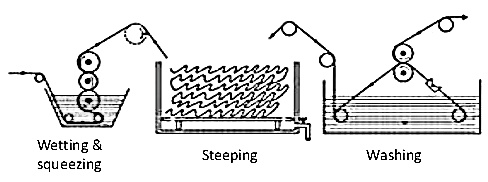
Some dye does not fix. If it stays on the surface it will bleed in the wash. Washing-off removes it by rinsing, soaping at the boil and rinsing again. After-treatments may follow, such as a cationic fixing agent for direct dyes, or reduction clearing for dark disperse shades on polyester.
Stage 4: Finishing
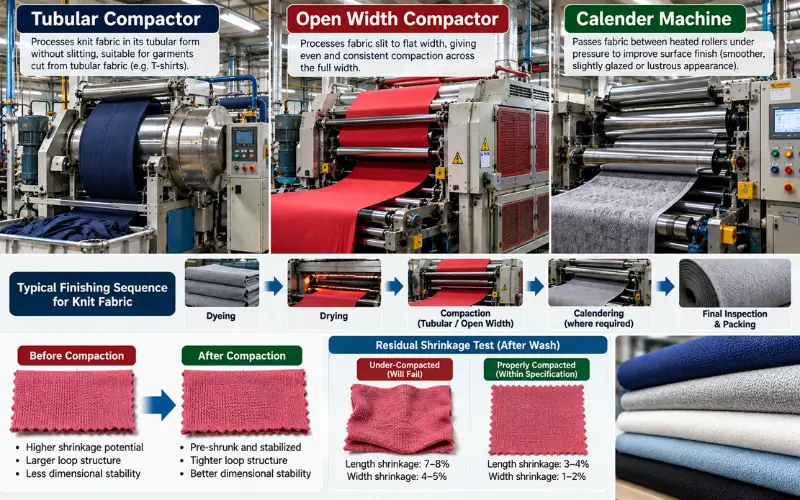
Softeners, resins, anti-crease and other finishes are applied, then the fabric is dried and compacted. Finishing can change shade slightly, so shade is checked again at the end.
Dyeing at different stages of production
| Stage | What is dyed | Typical use |
|---|---|---|
| Fibre (stock) dyeing | Loose fibre before spinning | Melange yarns, heather looks |
| Top dyeing | Wool slivers before spinning | Fine worsted blends |
| Yarn dyeing | Yarn on cones, hanks or beams | Checks, stripes, denim warps, knit patterns |
| Fabric dyeing | Woven or knit fabric | Solid colours, most garments |
| Garment dyeing | Finished sewn clothes | Soft, faded looks, quick response |
| Dope (solution) dyeing | Colour added to the polymer melt | Black polyester, outdoor fabrics |
Dyeing earlier in the process gives better colour penetration and fastness. Dyeing later gives flexibility, because the stock of plain goods can be coloured to match what sells.
Methods of dyeing
Batch (exhaust) dyeing
The material is placed in the dye bath and the dye is slowly drawn out of the water onto the fibre over time. It suits small and medium lots and many shades.
Continuous dyeing
Fabric runs through a trough of dye, is squeezed and then passes through steam or hot air to fix the colour. It suits very long runs of the same shade.
Semi-continuous dyeing
Dye is applied by padding and the fixation takes place in a separate step, such as batching on a roll for hours.
| Method | How it works | Good for |
|---|---|---|
| Exhaust | Dye drawn from bath onto goods | Knit fabrics, yarns, garments |
| Pad-dry-cure | Pad dye, dry, bake to fix | Polyester-cotton, large lots |
| Pad-steam | Pad dye, steam to fix | Vat and reactive dyes on cotton |
| Pad-batch | Pad dye with alkali, store wet on roll | Cotton, with low energy use |
| Foam or spray | Low-wet-pickup application | Water saving trials |
Dyeing machines
| Machine | Material | Notes |
|---|---|---|
| Winch | Fabric in rope form | Simple, gentle, long liquor ratio |
| Jigger | Open-width woven fabric | Fabric passes back and forth between rollers |
| Jet or soft-flow | Fabric in rope form | Fast circulation, low liquor ratio, popular for knits |
| Overflow | Delicate knits | Gentle fabric movement |
| Beam dyeing | Fabric wound on perforated beam | Fine and light wovens |
| Package dyeing | Yarn on perforated cones or springs | Dye is pumped through the package |
| Hank dyeing | Yarn in loose hanks | Bulky and soft yarns |
| Paddle or drum | Garments | Garment dyeing and washing |
| Pad mangle | Open-width fabric | Used for continuous lines |
The liquor ratio, written as 1:8 or 1:10, is the weight of the goods to the volume of the water. Modern jets run at 1:5 to 1:8. Older winches may use 1:20 or more. A lower ratio saves water, steam and chemicals.
Dye classes and the fibres they suit
| Fibre | Main dye classes | Notes |
|---|---|---|
| Cotton and viscose | Reactive, direct, vat, sulfur | Reactive gives bright, fast shades |
| Wool | Acid, metal-complex, reactive | Acid bath, mild heat |
| Silk | Acid, reactive, basic | Gentle conditions |
| Polyester | Disperse | High temperature, 130 degrees Celsius |
| Nylon | Acid, disperse | Acid bath, careful temperature |
| Acrylic | Basic (cationic) | Slow heating near 85 to 100 degrees |
| Polyester-cotton blends | Disperse and reactive in two stages | One-bath or two-bath |
| Natural-dye lines | Natural dyes with mordants | See natural dyes |
Worked example 1: reactive dyeing of cotton knit fabric
A mill dyes 100 kg of cotton knit fabric in a navy shade, using a common recipe of 4 percent dye on the weight of fabric (owf), with salt at 80 grams per litre, soda ash at 20 grams per litre and a liquor ratio of 1:8.
- Water = 100 kg × 8 = 800 litres
- Dye = 100 × 0.04 = 4 kg
- Salt = 80 g/L × 800 L = 64,000 g = 64 kg
- Soda ash = 20 g/L × 800 L = 16,000 g = 16 kg
The usual steps are:
- Fill the machine with water and add wetting agent and sequestering agent.
- Load the fabric. Run at 40 degrees Celsius for 10 minutes.
- Add the dye, run for 10 minutes.
- Add salt in steps, run 20 minutes. Salt pushes dye onto the fibre.
- Heat to 60 degrees Celsius, then add soda ash in steps. Alkali fixes the dye. Run 45 to 60 minutes.
- Drain, then rinse cold, soap hot at the boil, rinse warm and cold.
- Neutralise with acetic acid, add softener and unload.
Recipes differ between dye makers, so always follow the maker’s data sheet and run a lab dip first. Notice how much salt is needed. The effluent from this one batch carries 64 kg of salt, which is why salt-saving dyes are valued. Our article on the water treatment plant process in industry explains why salt is hard to remove.
Worked example 2: heating energy for a batch
To heat 800 litres of water from 25 to 60 degrees Celsius:
- Mass = 800 kg (1 litre of water weighs 1 kg)
- Specific heat of water = 4.18 kJ per kg per degree
- Heat = 800 × 4.18 × (60 − 25) = 800 × 4.18 × 35 = 117,040 kJ, or about 117 MJ
This is the heat that goes into the water alone. Heating the fabric, the machine and losses add more. If the same fabric were dyed at 1:12, the water would be 1,200 litres and the heat would be 175,560 kJ, which is 50 percent higher. This is a simple proof of why a low liquor ratio saves money.
Worked example 3: disperse dyeing of polyester
A mill dyes 50 kg of polyester fabric using 1.5 percent disperse dye owf at a liquor ratio of 1:7.
- Water = 50 × 7 = 350 litres
- Dye = 50 × 0.015 = 0.75 kg (750 g)
- pH is held at 4.5 to 5.5 using acetic acid.
- A dispersing agent keeps the dye from clumping.
- The bath is heated at about 1 to 2 degrees per minute to 130 degrees Celsius, held for 30 to 45 minutes, then cooled.
For dark shades, a reduction clearing step with sodium hydrosulfite and caustic soda removes loose dye from the fibre surface, which improves wash fastness.
Shade matching and quality control
Shade is judged against a standard, either by eye under a light cabinet or with a spectrophotometer. The spectrophotometer gives a number called delta E, which measures the colour difference. Many brands accept a delta E below about 1 for a pass, but the limit is set by each buyer. Matching steps are:
- The buyer sends a standard, such as a swatch or a colour code.
- The lab makes lab dips, which are small test dyeings.
- The buyer approves one dip.
- The recipe is scaled up. A bulk trial is run.
- Results are checked and the recipe is fine-tuned.
Fastness tests follow, for washing, light, rubbing and perspiration. See our guide on colour fastness tests for the methods and the grades that buyers read.
Common dyeing faults and fixes
| Fault | Likely cause | Fix |
|---|---|---|
| Patchy or uneven dyeing | Poor preparation, heating too fast, wrong dye mix | Scour well, slow the heating, test dye compatibility |
| Shade variation between lots | Different fabric, water or chemical quality | Standardise inputs, use same recipe and machine |
| Listing or crease marks | Rope creases in jet machines | Adjust load, speed, lubricant |
| Poor rubbing fastness | Surface dye not washed off | Wash off properly, use fixing agent |
| Barre in knits | Yarn variation | Use matched yarn lots |
| Tailing in woven fabric | Dye uptake differs from start to end of roll | Control padding pressure and speed |
| Dye spots | Undissolved dye | Dissolve fully and filter |
| Poor reproducibility | Weak recording | Log every parameter |
Many faults come from preparation and not from dyeing itself. When a problem appears, work backwards from the dyed fabric through each earlier step.
Environmental points
Dyeing uses water, heat, salt, alkali and sometimes metals and reducing agents. Good practice includes:
- Lower liquor ratio machines
- Right-first-time dyeing to avoid re-dyeing
- High-fixation reactive dyes and low-salt recipes
- Heat recovery from hot drains
- Reuse of final rinse water
- A working effluent treatment plant
Lab dips and small trials cost less than a failed bulk lot, in water, chemicals and time.
Final thoughts
The dyeing process is a chain of careful steps. Clean cloth goes in, the right dye is picked for the fibre, the bath is controlled for temperature, pH and salt, and the loose dye is washed away at the end. Know your recipe, record every batch and test early. A mill that does this can match shades with fewer re-dyes, use less water and give buyers colour they can trust.
Frequently asked questions
It is the process of colouring textile material by treating it with a dye solution so that the dye enters the fibre and stays fixed.
The stages are preparation, dyeing (dye in solution, adsorption, diffusion and fixation), washing-off and finishing.
Batch dyeing treats a lot of goods in a machine for a set time. Continuous dyeing runs fabric through a line, so it suits very long runs of one colour.
It is the ratio of the weight of the goods to the volume of water in the bath. At 1:8, one kilogram of fabric is dyed in eight litres of water.
Reactive dyes are the most common for cotton. Direct, vat and sulfur dyes are also used for some shades.
Disperse dyes are used for polyester, at high temperature, usually near 130 degrees Celsius.
It removes unfixed dye from the surface. Without it, the colour would bleed in the wash and rub off on other cloth.