
Dye selection looks like a simple decision from the outside: pick the shade, apply the dye, done. In practice, the choice between dye classes gets made largely by fiber type before shade even enters the conversation, and getting that first decision wrong means a recipe that either won’t fix properly to the fiber at all or will fix poorly enough that fastness testing catches the problem after a full batch has already been dyed.
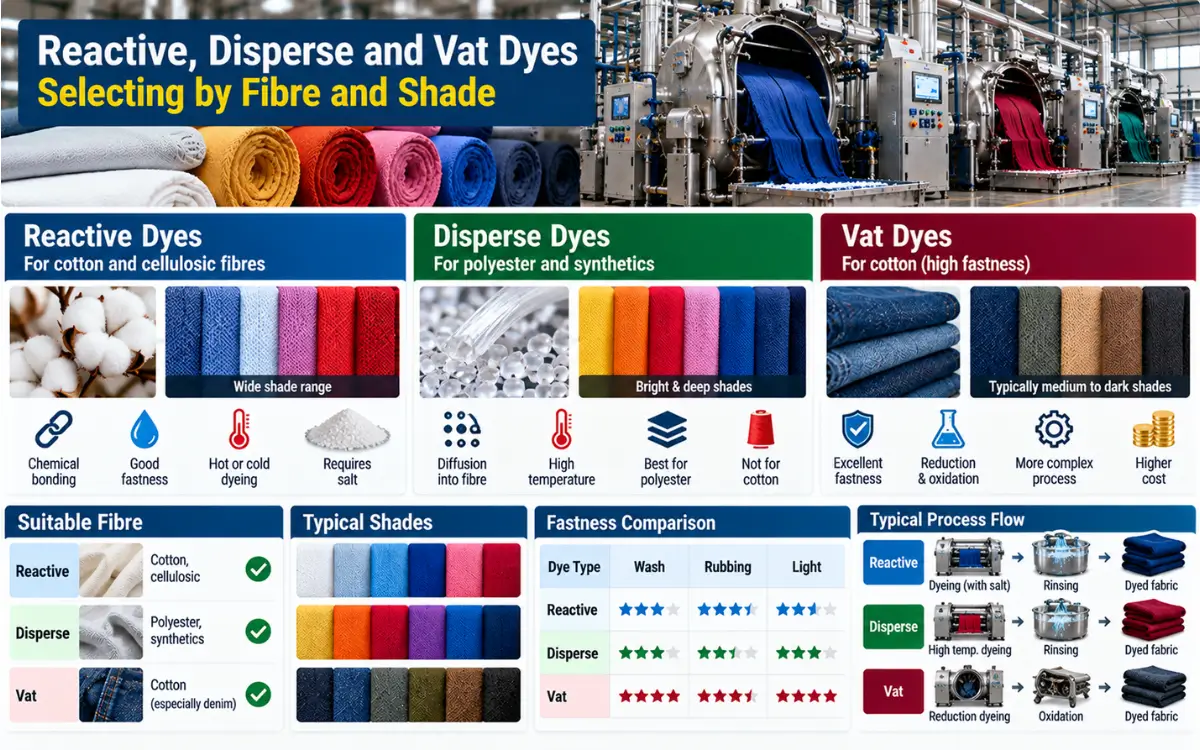
Reactive Dyes: The Default for Cotton
Reactive dyes form a covalent bond directly with cellulose fiber, which is what gives them strong wash fastness on cotton and other cellulosic fibers compared to dye classes that rely on weaker physical adsorption alone. They dominate cotton dyeing in current practice, offering a broad shade range and generally good all-around fastness properties suited to most apparel end uses.
Reactive dyeing runs in either hot or cold conditions depending on the specific dye product’s reactivity group, commonly referred to as hot brand or cold brand reactive dyes. Hot brand dyes need higher temperature to fix properly but tend to offer better level dyeing and reproducibility. Cold brand dyes fix at lower temperature, useful where energy cost or fiber sensitivity favors a cooler process, though they can be somewhat less forgiving on level dyeing consistency depending on the specific product and application conditions.
Salt drives dye exhaustion in reactive dyeing, and getting salt concentration right matters for both shade depth and consistency, too little and exhaustion suffers, too much and the risk of uneven dye uptake increases in some machine and liquor ratio combinations.
Disperse Dyes: Built for Polyester and Synthetics
Disperse dyes work fundamentally differently from reactive dyes. Rather than bonding chemically to the fiber, they’re designed as fine, poorly water-soluble particles that diffuse into the amorphous regions of synthetic fiber, primarily polyester, under heat and pressure (or with a carrier chemical at atmospheric pressure, though high-temperature high-pressure dyeing dominates current polyester dyeing practice).
Polyester’s tightly packed, hydrophobic fiber structure is exactly why it needs a dye class built to diffuse into that structure rather than bond to reactive sites the way reactive dyes do on cotton. Disperse dyes offer good fastness on polyester specifically, but they’re not a substitute for reactive dyes on cotton. Applying a disperse dye to a cotton-heavy blend without the polyester content to actually hold it will produce poor, unreliable results.
For polyester-cotton blends, dyeing often runs as a two-stage process, disperse dye for the polyester component and reactive dye for the cotton component, sequenced carefully since the high temperature disperse dyeing stage can affect how the subsequent reactive dyeing stage performs if not properly managed.
Vat Dyes: Maximum Fastness for Cotton
Vat dyes offer the strongest wash and light fastness available for cotton dyeing, which is exactly why they remain the choice for end uses where fastness requirements are particularly demanding, workwear, denim in some applications, and other products expected to hold color through extensive wear and repeated washing. This pigments overview is a useful companion read on the coloration side of this comparison.
The trade-off is process complexity. Vat dyes are insoluble in water in their natural form and need to be chemically reduced to a soluble, colorless form (the “leuco” form) to penetrate the fiber, then re-oxidized back to the insoluble colored form once inside the fiber structure. This reduction-oxidation process (traditionally using sodium hydrosulphite as the reducing agent) adds process steps and cost compared to reactive dyeing, which is part of why vat dyes get reserved for applications where their superior fastness genuinely justifies the added complexity, rather than used as a default cotton dye choice.
Fastness Ratings: What They Actually Mean for Selection
Fastness ratings, typically on a 1-to-5 scale for wash and rubbing fastness and a similar scale for light fastness, quantify how well a dyed fabric resists fading or color transfer under specific test conditions. A garment’s actual end use should drive the fastness requirement that then drives dye class selection, rather than defaulting to whichever dye class is cheapest or most familiar. A basic t-shirt with moderate wash fastness expectations can often work well with a well-chosen reactive dye. A workwear garment expected to withstand industrial laundering repeatedly over years of service life may genuinely need vat dye’s superior fastness to meet realistic performance expectations.
Shade Depth and Dye Class Interaction
Shade depth, how dark or saturated the target color is, interacts with dye class selection in ways worth planning for before a recipe is finalized. Very dark shades generally require higher dye concentration regardless of class, and at high concentration, some dye classes show more tendency toward rubbing fastness problems (crocking) than others, since more dye sitting at or near the fiber surface increases the amount available to transfer under rubbing. This is a genuine consideration in selecting between otherwise comparable dye options for very dark or saturated target shades.
A Note on Sublimation Fastness for Disperse-Dyed Polyester
Beyond the standard wash and rubbing fastness considerations covered above, disperse-dyed polyester carries a fastness concern specific to its dye class: sublimation fastness, the tendency of some disperse dyes to volatize and migrate under heat exposure, relevant during the fabric’s own finishing process and again later during garment pressing or hot storage conditions. A disperse dye with poor sublimation fastness can bleed color onto an adjacent lighter fabric during heat pressing, a defect that wouldn’t show up in standard wash fastness testing at all, since it’s a heat-driven mechanism rather than a water-driven one. For polyester products that will see garment-stage heat pressing or finishing, checking sublimation fastness specifically, not just standard wash and light fastness, is worth building into the dye selection and approval process rather than assuming standard fastness testing alone covers every failure mode disperse dyes are actually susceptible to.
Practical Selection Framework
Working through dye selection in practice usually follows this sequence: identify the fiber content first, since this eliminates most options immediately (disperse for polyester, reactive or vat for cotton, blend recipes for polyester-cotton mixes). Then establish the fastness requirement based on actual end use and any buyer specification in place. Then, within whatever dye classes remain viable after those two filters, weigh shade range, cost, and process complexity to make the final selection.
Skipping straight to shade and cost without first filtering by fiber and fastness requirement is a common way mills end up with a dye selection that technically produces the right color in the lab but fails a fastness test or a customer’s real-world wear conditions once it’s actually in a finished garment.
A Worked Comparison: Reactive Versus Vat on the Same Shade
To make the trade-off between reactive and vat dyeing concrete, consider a dark navy shade on cotton, a color commonly available in both dye classes. A reactive dye recipe for this shade might run at an illustrative dye cost of $0.35 per kilogram of fabric, a single dyeing stage, and a process cycle of roughly 90 minutes. A vat dye recipe for a comparable navy might run at an illustrative dye cost of $0.55 per kilogram, reflecting vat dye’s typically higher unit cost, plus the additional reduction and oxidation chemical cost of roughly $0.15 per kilogram, and a longer process cycle of perhaps 150 minutes given the added process steps.
On pure per-kilogram chemical cost, vat dyeing runs about $0.35 more expensive in this illustration ($0.70 versus $0.35). On machine time, the longer vat cycle reduces how many batches a given machine can complete in a working day, which has its own cost implication through the capacity planning method covered in our Processing Machinery guide. Whether that added cost is justified depends entirely on the fastness requirement: for a basic fashion top with moderate wash expectations, reactive’s lower cost and faster cycle likely wins. For a workwear garment expected to survive years of industrial laundering, vat’s superior fastness may easily justify the added per-kilogram and per-cycle cost, since a reactive-dyed workwear garment that fades within its expected service life creates a far more expensive problem, in returns, reputation, or contract non-compliance, than the incremental dye cost vat dyeing would have added.
Where Dye Selection Connects to the Rest of Wet Processing
Dye class selection doesn’t happen in isolation from the rest of the wet processing chemistry covered elsewhere. Pretreatment quality directly affects how evenly any dye class takes up on the fiber, regardless of which class is chosen. Auxiliary chemicals, salt, sequestering agents, leveling agents, need to be matched to the specific dye class in use rather than applied generically. And the chemical consumption benchmarks covered in a related guide differ meaningfully between dye classes, since vat dyeing’s added process steps carry a real cost implication worth factoring into recipe cost calculations alongside the dye’s per-kilogram price itself.
Documenting Dye Selection Rationale
Beyond making the right selection in the moment, recording why a specific dye class was chosen for a specific product, not just which dye was used, builds institutional knowledge that survives staff turnover and speeds up future decisions on similar products. A merchandising or technical team that can reference why a previous similar order used vat rather than reactive dyeing, tied to the specific fastness requirement that drove that decision, makes faster and more consistent choices on new orders than a team relying purely on individual memory or repeating whatever the most recent similar order happened to use without re-verifying that the underlying fastness requirement actually still applies.
Frequently Asked Questions
Can reactive dyes be used on polyester?
No. Reactive dyes bond to cellulose fiber and don’t work on polyester’s hydrophobic structure, which is why disperse dyes are used for polyester and blends need a two-stage process covering both fiber types.
Why would a mill choose vat dyeing when it costs more than reactive?
Vat dyes offer the strongest wash and light fastness available for cotton, which justifies the added cost and process complexity for products like workwear where fastness requirements are genuinely demanding.
What determines whether hot or cold brand reactive dye is used?
The specific dye product’s reactivity group. Hot brand dyes generally offer better level dyeing and reproducibility, while cold brand dyes fix at lower temperature, useful where energy cost or fiber sensitivity favors a cooler process.
Does dye class selection affect fabric finishing later on?
Yes. Some dye classes are more sensitive to the high temperatures used in stenter heat-setting, so a choice made at dyeing can constrain or complicate finishing steps that come later in the process.