A machine’s quoted price and its actual landed cost in Bangladesh are rarely the same number, and the gap between them catches new factory owners off guard more often than almost any other line item in a setup budget. Duty, VAT, LC charges, freight, insurance, and clearing costs all stack on top of the invoice total, and several of those charges depend on classification and licensing decisions made well before the machine ever ships.
For broader context on the sector this machinery serves, this overview of RMG sector contributions to Bangladesh is a useful companion read. A note before going further: duty, VAT, and regulatory duty rates are set by the National Board of Revenue and change with each annual budget cycle, so any specific percentage figure risks being outdated by the time you’re reading this. What follows is the structure and calculation method, which stays stable even as the specific rates move. Confirm current rates against the latest NBR tariff schedule or with a licensed customs agent before finalizing any import budget.
How Bangladesh Structures Import Charges
Imports into Bangladesh are assessed against several charges, and understanding what each one covers matters for budgeting accurately rather than being surprised by a bill that looks larger than expected.
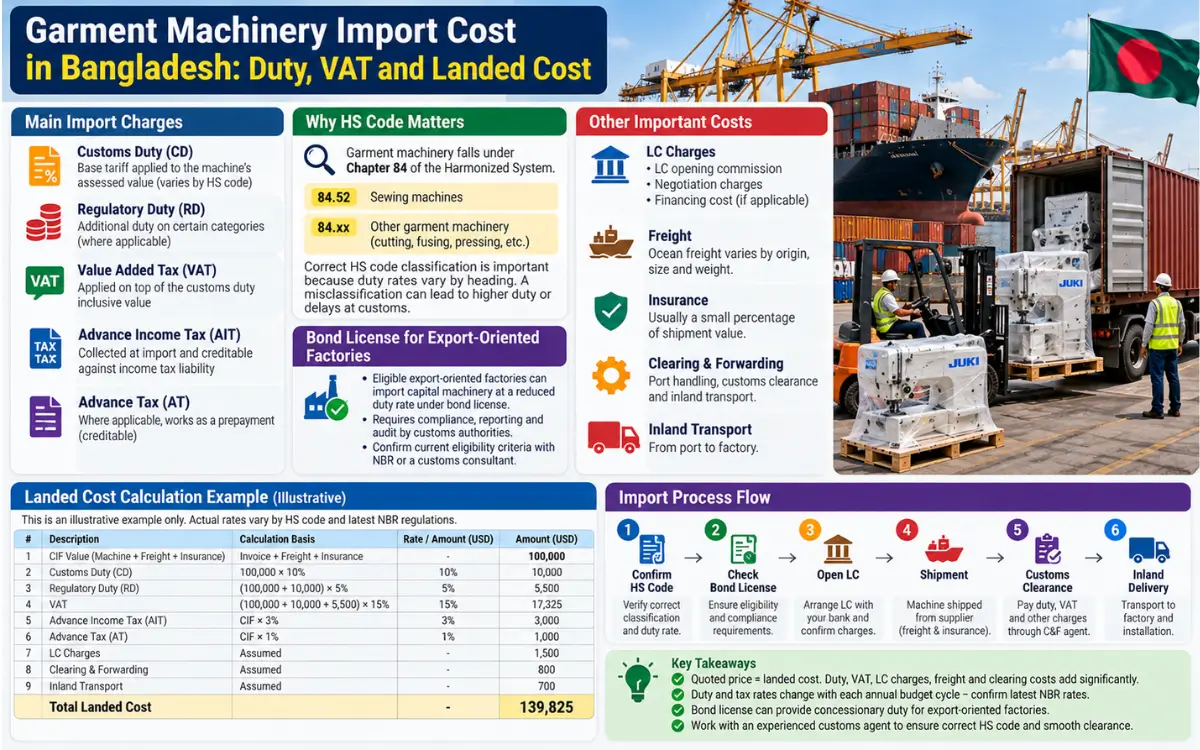
Customs Duty (CD) is the base tariff applied to the machine’s assessed value, and the rate depends on the item’s HS code classification. Regulatory Duty (RD), where applicable, is an additional duty layered on certain categories, generally used to protect domestic industry in specific sectors. VAT applies on top of the customs-duty-inclusive value. Advance Income Tax (AIT) is collected at import and is creditable against the importer’s income tax liability, functioning more like a prepayment than a pure cost. Advance Tax (AT), where it applies, works similarly. NBR publishes a Total Tax Incidence (TTI) figure for many HS codes, which is the compounded, all-in rate rather than a simple sum of the individual components, and TTI is generally the more useful figure for budgeting purposes since it reflects the actual compounding effect between duty, VAT, and other charges applied sequentially rather than on the same base value.
HS Code Classification: Why It Matters More Than People Expect
Garment machinery falls under Chapter 84 of the Harmonized System, which covers machinery and mechanical appliances broadly, with sewing machines specifically classified under heading 84.52 and most other garment production machinery, cutting equipment, fusing presses, and pressing equipment among them, falling under various headings within the same chapter depending on the specific machine’s function.
Getting the HS code classification right matters because duty rates vary by heading, and a misclassified machine can result in either overpaying duty on a machine that should have qualified for a lower rate, or an assessment dispute at customs that delays clearance while the classification gets sorted out. For anything beyond standard, well-established machine types, getting classification confirmed with a customs agent or through a binding ruling request before shipping avoids both risks.
Capital Machinery Concessions for Export-Oriented Factories
Bangladesh has historically offered concessionary duty treatment on capital machinery imported by export-oriented industries, including ready-made garment manufacturing, typically administered through a bonded warehouse license (commonly referred to as a bond license) issued to eligible export-oriented factories. Under this arrangement, qualifying capital machinery can be imported at a considerably reduced duty rate compared to the standard rate applied to non-qualifying imports, since the machinery is understood to support production destined for export rather than the domestic market.
Qualifying for and maintaining a bond license involves its own compliance obligations, including utilization reporting and periodic audit by customs authorities, and losing bond license status or failing to meet its conditions can trigger retroactive duty assessment. Any factory setup budget should account for the cost and administrative overhead of establishing and maintaining bond license status, not just the concessionary duty rate itself, and should confirm current eligibility criteria with NBR or a customs consultant, since qualifying industries and conditions can change between budget cycles.
LC Charges and Financing Costs
Most machinery imports into Bangladesh move through a letter of credit, and LC-related charges add a further layer to landed cost beyond duty and tax. This typically includes the issuing bank’s LC opening commission, negotiation charges when the exporter’s bank presents documents, and any margin or financing cost if the LC is opened against a credit facility rather than fully cash-covered. These charges vary by bank and by the importer’s relationship and credit standing, so getting an actual quote from your bank for the specific LC value and tenor involved gives a far more accurate number than a generic industry estimate.
Freight, Insurance and Clearing Costs
Ocean freight for machinery shipments varies by origin port, machine size and weight, and current shipping market conditions, which have shifted considerably in recent years. Marine insurance is typically a small percentage of shipment value but shouldn’t be skipped given the capital value involved in machinery shipments. Once the shipment arrives, clearing and forwarding costs, port handling charges, and inland transport from port to factory all add further cost before the machine is actually installed and running.
A Worked Landed Cost Example
Numbers make the calculation method above far easier to apply than a description alone, so here’s a worked example. Every rate used below is a placeholder for illustration only, not a current NBR figure, since as covered above, actual rates need to be confirmed against the current tariff schedule at the time of import.
Say a factory is importing a batch of overlock machines with a total FOB invoice value of $50,000.
Freight and insurance: Assume ocean freight and marine insurance add $3,000, bringing the CFR (cost and freight) value to $53,000.
Customs duty: Assume, for illustration, a Total Tax Incidence (TTI) of 15 percent applies to this HS code under standard (non-bond-license) treatment. That’s $53,000 × 0.15 = $7,950 in combined duty, VAT, and related charges.
Bond license concessional rate: If the factory holds valid bond license status and the machines qualify as capital machinery under that scheme, assume the concessional TTI drops to 5 percent instead. That’s $53,000 × 0.05 = $2,650, a saving of $5,300 compared to the standard rate.
LC charges: Assume the issuing bank charges 0.5 percent of invoice value for LC opening and negotiation combined: $50,000 × 0.005 = $250.
Clearing, forwarding and inland transport: Assume a flat $1,200 for port handling, clearing agent fees, and inland transport from Chattogram port to the factory.
Total landed cost (bond license scenario): $53,000 (CFR) + $2,650 (concessional duty/VAT) + $250 (LC charges) + $1,200 (clearing and transport) = $57,100, against an original FOB invoice of $50,000, meaning landed cost runs about 14 percent above invoice price even with concessional treatment.
Total landed cost (standard rate scenario): $53,000 + $7,950 + $250 + $1,200 = $62,400, about 25 percent above invoice price without bond license concessions.
That gap, roughly $5,300 in this illustration, is exactly why confirming bond license eligibility and status before finalizing an import budget matters as much as getting the HS classification right. Rebuild this same calculation with your own confirmed current rates, actual freight quote, and actual bank charges before finalizing any real machinery import budget.
Building a Realistic Landed Cost Estimate
Pulling this together, a realistic landed cost budget for imported garment machinery should account for: the machine’s FOB or CFR invoice price, ocean freight and marine insurance if not already included in the quoted price, customs duty and VAT based on correct HS classification and confirmed current rates, any applicable capital machinery concessional treatment under bond license status, LC charges from the issuing bank, and clearing, forwarding, and inland transport costs from port to factory.
Treating any one of these as a rounding error, particularly duty and VAT given how much they can affect total landed cost even under concessional treatment, is the most common way a machinery budget ends up short of what the factory actually needs to spend. Getting a detailed, current cost breakdown from a licensed customs agent or freight forwarder before finalizing any large machinery order is worth the modest advisory cost given how much it can change the total capital required.
Common Surprises That Blow Budgets
A handful of specific surprises show up often enough in Bangladeshi machinery imports that they’re worth flagging explicitly, beyond the general structure covered above. Demurrage and detention charges accrue when a shipping container isn’t cleared and returned within the shipping line’s free time allowance, and any delay in customs clearance, whether from documentation issues, classification disputes, or simple port congestion, can generate charges that weren’t in the original budget at all. Currency movement between order and payment matters for any machinery priced in a foreign currency, since the exchange rate at the time the LC is opened can differ meaningfully from the rate at the time final payment is actually made, particularly for machinery with a long lead time between order and shipment. Post-clearance VAT audits, where NBR reviews import valuations after the fact, can result in additional assessment if the declared value or classification is later found inconsistent with the audit’s findings, which is part of why accurate, well-documented classification and valuation at the time of import matters beyond just getting the shipment cleared quickly.
Working With a Customs Agent Versus Self-Filing
Factories with in-house customs expertise sometimes self-file import documentation rather than using a licensed customs agent, which can reduce agent fees but shifts the classification and compliance risk fully onto the factory’s own team. For factories without deep, current expertise in Bangladesh’s evolving tariff schedule and bond license administration, a licensed customs agent’s fee is generally a reasonable cost relative to the risk of a classification error or missed concessional treatment opportunity that a less experienced in-house team might not catch. Agent fees vary by shipment value and complexity, and getting a clear, itemized fee quote upfront, rather than a vague percentage estimate, helps avoid yet another line item that arrives as a surprise once the shipment is already in motion.
Applying for Bond License Status: What the Process Actually Involves
For factories not yet holding bond license status but planning to import capital machinery under the concessional treatment described above, it’s worth understanding that this isn’t a same-day administrative approval. The application process typically involves demonstrating genuine export-oriented production status, submitting projected import and utilization plans for the machinery being brought in under the license, and committing to the ongoing reporting obligations mentioned earlier. Lead time for a new bond license application can run into months rather than weeks, which means a factory planning a machinery import that depends on concessional treatment needs to build that lead time into its overall project timeline, ideally starting the application process well before machinery orders are finalized, rather than assuming bond license approval can be secured quickly once a shipment is already in transit.
Factories already holding bond license status for existing operations generally find adding new machinery categories or updating utilization plans a more straightforward process than a first-time application, since the underlying export-oriented status and compliance track record are already established, but even this update process benefits from advance planning rather than being treated as a formality that can be resolved after the machinery has already shipped.
A Practical Checklist Before Ordering
Before committing to a machinery import order, confirm the correct HS code classification for the specific machine model, verify current duty, VAT, and RD rates against the latest NBR tariff schedule rather than a prior year’s figures, confirm your factory’s bond license status and eligibility for any capital machinery concession that applies, get an actual LC cost quote from your bank rather than estimating, and get a current freight quote for the specific route and shipment size rather than relying on a general market rate that may have moved since it was last checked. Each of these confirmations takes real time to gather, but skipping any of them is exactly how a machinery budget ends up understated by the time the shipment actually clears customs.
Building This Into Standard Procurement Practice
For factories that import machinery regularly rather than as a one-off event, the checklist above works best as a standing procurement procedure rather than something rebuilt from scratch for every order. Maintaining a current reference of confirmed HS classifications for the machine types a factory regularly imports, a standing relationship with a customs agent familiar with the factory’s bond license status and typical shipment profile, and a documented internal process for building landed cost estimates before committing to a purchase order, turns what could otherwise be a recurring source of budget surprises into a routine, predictable part of capital planning, freeing up the kind of careful, one-off diligence this article has described for the genuinely novel imports, a new machine category or a first order from a new origin country, where it’s actually needed most.
Frequently Asked Questions
Does bond license status actually reduce machinery import cost in Bangladesh?
Yes, meaningfully, for qualifying capital machinery under export-oriented bond license treatment, though exact rates change with each NBR budget cycle and should be confirmed before finalizing any import budget.
What costs beyond the invoice price should I budget for?
Customs duty, VAT, LC charges, freight, insurance, and clearing and forwarding costs all add to landed cost, and the worked example in this article shows landed cost can run 14 to 25 percent above invoice price depending on bond license status.
How long does bond license approval take for a factory that doesn’t already have it?
Lead time can run into months rather than weeks, so the application process should start well before machinery orders are finalized rather than being treated as something that can be resolved after a shipment is already in transit.
Should I self-file customs documentation or use a licensed agent?
For factories without deep, current expertise in Bangladesh’s tariff schedule, a licensed customs agent’s fee is generally worth it relative to the risk of a classification error or a missed concessional treatment opportunity.