The types of hems in garments decide how the bottom edge of a shirt, trouser, skirt, sleeve or jacket looks, hangs and lasts. A hem seems like a small detail. Yet it touches almost every garment a factory makes, from the cheapest basic tee to the most carefully tailored jacket in the sample room. A T-shirt may have a coverstitch hem. A dress shirt may have a narrow, curved hem. A pair of dress trousers may have a blind hem that shows no stitches on the outside. Each type needs its own machine, its own folding method and its own checks.
This guide explains what a hem does, how hems are specified, and the main types, with the machines used and the fabrics they suit. It ends with a choice table, common defects and quality tips. It is written for pattern makers, merchandisers, industrial engineers and quality staff.
What a hem is and what it does
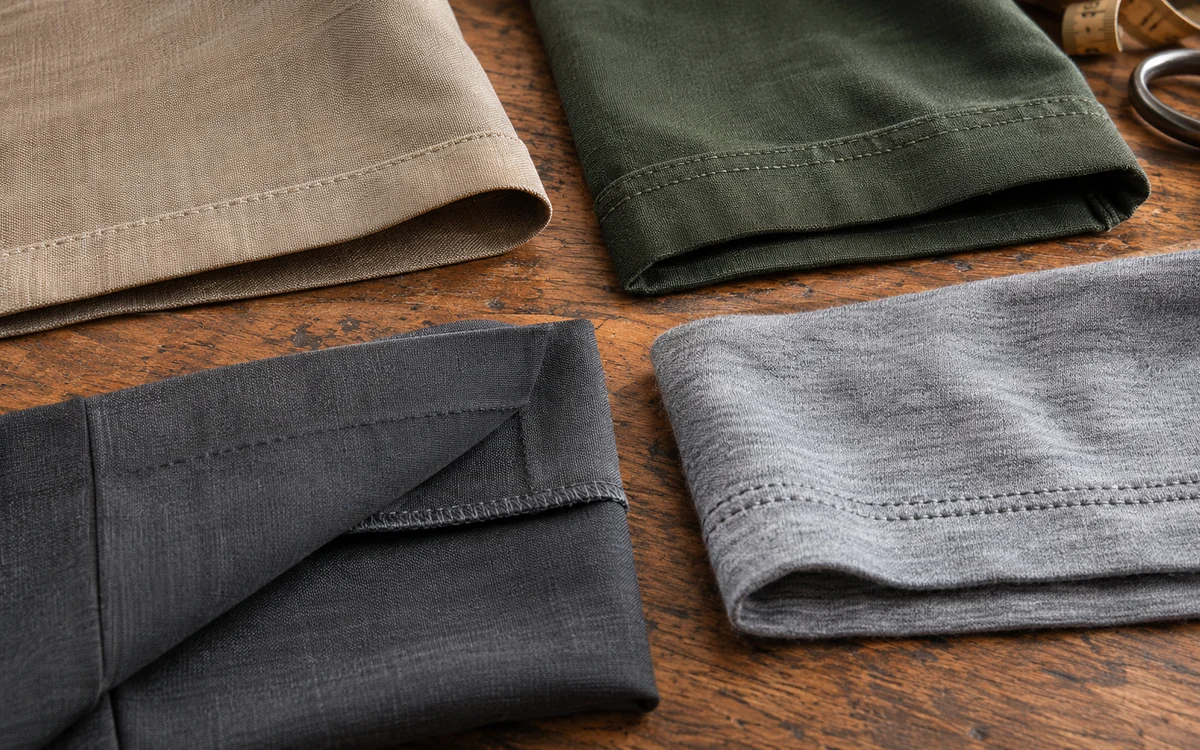
A hem is a finished edge, made by turning the raw edge of the fabric and stitching it, or by using another method to finish the edge. It appears at the bottom of garments, at sleeve openings and at other raw edges.
A hem does several jobs:
- Neatens the edge so it does not fray or curl.
- Adds weight and a clean line, which helps the garment hang well.
- Holds the length of the garment.
- Strengthens the edge against wear.
- Adds design, through its width, stitching and finish.
Hem allowance and how hems are shown in a tech pack
The hem allowance is the extra fabric added to the pattern at the bottom edge, so the hem can be folded up. The amount depends on the hem type. A single fold hem needs less allowance than a double fold hem. A rolled hem needs very little. A blind hem often needs more, since the fold has to be hidden.
In the tech pack, the hem is usually described with:
- the hem type, such as single fold, double fold or coverstitch,
- the finished hem width,
- the stitch type and stitches per inch,
- the thread, and the colour of the thread if it is a contrast,
- any tape, interlining or fusing inside the hem,
- the tolerance for hem width and length.
The buyer sets these values. Do not guess them. See garment measurement tolerance for how tolerances are written, and stitches per inch for different garments.
Single fold hem (turned and stitched)
The raw edge is turned up once and stitched. Because the raw edge stays inside, it is often finished first, usually with an overlock stitch, so it does not fray.
- Where it is used: many casual garments, trousers, skirts and work wear.
- Strengths: simple, quick and not bulky. A good choice when speed matters.
- Limits: the finished edge inside shows the overlock, and the hem is a little less neat than a double fold hem.
Double fold hem
The raw edge is turned twice, so the raw edge is enclosed inside the fold. It is then stitched near the upper fold. This is the classic neat hem on woven shirts, blouses, dresses and trousers.
- Strengths: clean on the inside, strong and does not fray.
- Limits: it uses more allowance and gives a thicker edge. In heavy fabric or at seam joins, the thickness can be a problem for the needle and can show on the outside.
- Care points: the fold width must be even, or the hem will look wavy. A hemming folder helps keep it even. See folders in the apparel industry.
Overlock and turn hem
The raw edge is first overlocked (also called serged), then folded up once and stitched. It is a single fold hem with a finished edge, and a common choice for trousers, jeans and many bottoms.
- Strengths: fast, because the overlock and the stitch can be done in separate steps, and the edge does not fray.
- Limits: the overlock thread can show through on light fabrics, and the fold adds some bulk.
See overlock sewing machine types for the machine side.
Narrow and rolled hem
The edge is rolled into a very small fold and stitched, giving a narrow, neat edge. A rolled hem can be done with a hemmer foot on a lockstitch machine, or with a special overlock setting that rolls and covers the edge.
- Where it is used: light and sheer fabrics, scarves, blouses, shirt tails, and the edges of delicate parts.
- Strengths: light and neat, with almost no bulk.
- Limits: it is hard to do on heavy fabric, and it needs a steady hand or a good attachment.
- Variation: a stretched rolled hem on a light knit gives a wavy edge, often called a lettuce edge, which is used as a design feature.
Blind hem
The hem is held with a stitch that shows very little or nothing on the outside. The machine catches only a thread or two of the outer fabric, so the stitch is almost invisible from the front. A blind stitch machine is used, and it makes a chain stitch with one thread.
- Where it is used: dress trousers, skirts, suits, jackets and dresses, where a clean outside matters.
- Strengths: a smooth, clean look from the front.
- Limits: a chain stitch can run if it is cut or snagged. Many buyers want a lock in the stitch or a stronger finish at the ends. The machine setting must be exact, or the stitch shows on the outside or the hem is loose.
Coverstitch hem for knits
A coverstitch machine uses two or more needles and a looper, and gives parallel rows of stitching on the top and a looped thread on the underside. It stretches with the fabric, so it is the usual hem on T-shirts, polos, sweatshirts, leggings and other knits.
- Strengths: stretch, strength and a neat sportswear look.
- Limits: if the fabric is stretched while sewing, the hem will ripple. If the stitch is too tight, it can break when the garment stretches.
- Related machine: a flatlock machine can also make a flat hem on knits and sportswear. See flatlock machine and lockstitch vs overlock vs flatlock.
Raw edge, bound and faced hems
Raw edge (cut edge)
Some knit fabrics do not fray, so the edge is left cut, with no fold. It is used for a modern or casual look, or in styles where a fold would show or add bulk. The fabric may curl, so the style and the fabric must suit it.
Bound hem
A strip of fabric or bias binding wraps over the raw edge and is stitched in place. It can be a plain finish or a design feature, and it is used on jackets, dresses, blouses and kidswear. It is neat and strong, but it needs more time and more material.
Faced hem
A separate piece of fabric, called a facing, is sewn to the edge, turned to the inside and held in place. It is used for curved or shaped hems, hems on heavier fabrics, and edges where a plain fold would be too bulky or would not lie flat.
Shirt tail, curved and shaped hems
A shirt tail hem is a curved hem that is higher at the sides and lower at the front and back. A curved hem is hard to fold flat, because the raw edge and the fold line are not the same length. So a narrow hem is used, or the curve is pressed and shaped before stitching. A shaped hem on a jacket or a dress may need a facing.
Some styles have a vent or a slit at the side, back or centre. The hem runs around the opening, and the end needs strengthening with a bartack or a stitch box. For more shirt hem details, see shirt hem types and stitching.
Fused and bonded hems
Instead of turning and stitching, the hem is folded and held with a fusible tape or web, which is heat bonded. Some sportswear and knitwear use bonded hems, because they are flat, light and have no stitch holes. A bonded hem can be used alone or with a stitch.
- Strengths: a flat, smooth hem with no stitch line.
- Limits: the bond depends on the right heat, pressure and time. A weak bond can open in wash, and then the whole hem is gone. Check the bond strength and the wash result. See types of interlining in garments.
Choosing a hem by fabric and garment
| Garment or fabric | Common hem choices |
|---|---|
| T-shirt, polo, sweatshirt (knit) | Coverstitch hem |
| Leggings and sportswear | Coverstitch, flatlock or bonded hem |
| Woven dress shirt | Double fold hem, narrow curved hem |
| Casual woven trousers and jeans | Overlock and turn hem, single fold hem |
| Dress trousers and skirts | Blind hem or double fold hem |
| Sheer or light fabric | Rolled or narrow hem |
| Jackets and coats | Blind hem, faced hem |
| Kidswear | Strong, simple hem with a safe finish |
| Curved or shaped edges | Faced hem or narrow hem |
| Non fraying knit, fashion styles | Raw edge |
This table is only a guide. The buyer’s tech pack decides the final choice.
Machines and stitches used
| Hem type | Common machine or stitch |
|---|---|
| Single and double fold | Lockstitch, often with a hemming folder |
| Overlock and turn | Overlock to finish the edge, then lockstitch or chain stitch to hold the fold |
| Rolled hem | Lockstitch with a hemmer foot, or a rolled hem overlock setting |
| Blind hem | Blind stitch chain stitch machine |
| Coverstitch hem | Coverstitch machine |
| Flat hem on sportswear | Flatlock machine |
| Bound hem | Binder attachment on a lockstitch or chain stitch machine |
| Bonded hem | Fusing or bonding press or machine |
The stitch families and their numbers are listed in ISO 4915 stitch classes for garments. Seam types and how they hold are covered in types of seams in garments.
Common hem defects and causes
| Defect | Likely causes |
|---|---|
| Uneven hem width | No folder or guide, operator drift, poor pressing |
| Wavy or rippled hem | Fabric stretched while sewing, too much tension, uneven feed |
| Hem puckers | Tension, thick thread, shrinkage of thread. See seam puckering in garments |
| Twisted hem or side seams that swing | Off grain cutting, uneven pull, twist in the fabric |
| Hem not level | Cutting error, uneven hemming, wrong pressing |
| Skipped stitches | Needle problem, wrong needle, thick joins at seams |
| Stitches show on the outside (blind hem) | Machine set too deep, needle too long, wrong stitch depth |
| Hem too loose or opens | Weak chain stitch, no end lock, poor bond on a bonded hem |
| Stitching off the line | No guide, poor skill, poor lighting |
| Thick or lumpy hem at seams | Bulky joins not trimmed or graded |
| Open ends or ends that run | No backstitch or lock at the ends |
| Hem edge shows through on the outside | Thread or fold shows on light fabric, wrong hem type for the fabric |
For many of these causes, see sewing defects and their root causes.
Quality tips
- Test the hem on the real fabric before bulk, with the real thread, needle and stitch.
- Press the fold before sewing where the fabric allows it, since a crisp fold is easier to sew.
- Use folders, guides or templates to keep the width even.
- Do not stretch knit fabric while sewing a hem. Let the machine feed it.
- Trim and grade thick joins where side seams cross the hem.
- Secure the ends with a backstitch, an overlap or a tack, as the style needs.
- Check hems after washing, since shrinkage can show as ripple or twist.
- Check length and width against the tolerance in the spec.
- Match the hem to the nearby details. The cuff, sleeve and bottom hems should look like they belong together. See types of cuffs in garments and types of sleeves in garments.
Final thoughts
The main types of hems in garments are single fold, double fold, overlock and turn, narrow and rolled, blind, coverstitch, raw edge, bound, faced and bonded hems. Each is made with a different machine and suits different fabrics and garments.
Choose the hem for the fabric, the garment and the buyer’s spec, write the type, width and stitch into the tech pack, and test it on real fabric before bulk. Use guides to keep the width even, avoid stretching knits, and check the hem after wash. A good hem is a small detail that customers notice quickly when it goes wrong.
Frequently asked questions
Single fold, double fold, overlock and turn, narrow or rolled, blind, coverstitch, raw edge, bound, faced and bonded hems.
A hem sewn so the stitches show very little or not at all on the outside of the garment. It is made on a blind stitch machine and is common on dress trousers, skirts and jackets.
A coverstitch hem is the usual choice, since it stretches with the fabric. A flatlock or a bonded hem is also used on sportswear.
A hem made on a coverstitch machine, with parallel rows of stitching on the top side and a looped thread on the underside. It is strong and stretchy.
A single fold hem turns the edge once, so the raw edge stays inside and is often overlocked. A double fold hem turns the edge twice, so the raw edge is enclosed.
It depends on the style, the fabric and the buyer’s tech pack. The width is written in the spec, with a tolerance, and should not be guessed.
Common causes are fabric cut off grain, fabric stretched while sewing, too much thread tension, uneven feed or thick seam joins. Check the cutting, the feeding and the tension.