Run your hand over a suede jacket or a pair of suede boots and you will feel a soft, velvety surface that seems to change colour as you brush it one way and then the other. It looks like a fabric. It feels like one. But what is suede made of, and is it a textile at all?
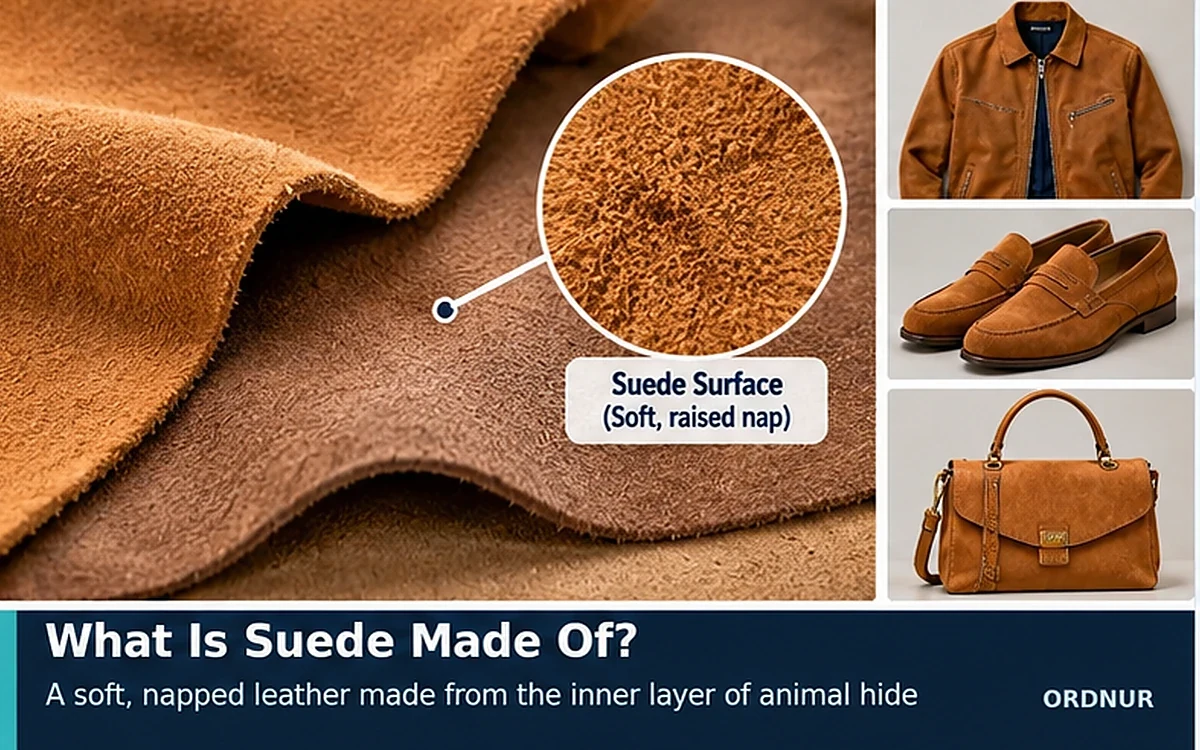
Suede is a type of leather. It is made from animal skin, and its soft nap comes from the underside of the hide rather than the outer face. This guide explains what suede is made of, how it is produced step by step, how it differs from regular leather and nubuck, what faux suede is, and how to care for it. There is also a worked example that shows how many skins a suede jacket needs. If you work in the garment or footwear trade and want to see where suede fits among materials, our guide to fabric types, names and GSM is a good companion.
The short answer
Suede is made from animal hide, most often lamb, goat, calf or deer. The hide is tanned to make leather, and then the flesh side, the inner surface that faced the animal’s body, is buffed to raise a short, soft nap. Regular smooth leather uses the outer face of the hide, called the grain side. Because the flesh side is made of loose fibres, suede is soft and flexible, but it is also less strong and less water resistant than grain leather.
What an animal hide is made of
To see why suede feels the way it does, look at a cross-section of a hide. It has three main layers:
- Epidermis. The thin outer skin with hair. It is removed during processing.
- Grain layer (upper dermis). A tight, fine network of fibres just under the epidermis. It gives smooth leather its strength and its pattern of pores.
- Corium (lower dermis). A looser, thicker network of collagen fibres. It faces the flesh.
Hides can be thick. A cow hide may be 5 to 6 mm thick. Tanners often split thick hides into layers with a splitting machine. The top layer keeps the grain and becomes full-grain or top-grain leather. The bottom layer, called a split, has no grain and is often finished as suede.
Thin skins from lambs and goats are usually not split. Instead, the flesh side of the whole skin is buffed to make suede. This is why lamb and goat suede is prized for soft garments and gloves.
What suede is made of: the main raw materials
- Lambskin. The softest suede. Used for jackets, gloves and fashion.
- Goatskin. Fine and fairly strong. Used for shoes, gloves and bags.
- Calfskin. Smooth, uniform nap. Common in shoes and jackets.
- Deerskin. Strong, soft, with a good stretch. Used for gloves and moccasins.
- Cowhide splits. Cheaper and thicker. Used for work gloves, boots and furniture.
- Pigskin. Durable and breathable. Used in gloves and some shoe linings.
The chemicals added during tanning, dyeing and finishing are also part of what suede is made of. We cover those in the next section.
How suede is made, step by step
1. Preparing the hide
Raw hides arrive salted or fresh. They are soaked to remove salt and dirt, then limed to loosen hair and the outer skin. The hair is removed and the flesh side is cleaned of fat and tissue with a fleshing machine. Then the hide is delimed, bated with enzymes to soften it and sometimes pickled in acid to prepare for tanning.
2. Tanning
Tanning turns raw hide, which would rot, into stable leather. There are two main systems.
- Chrome tanning. Chromium(III) salts are used. It is fast, takes a day or less and gives soft, light leather that resists heat and water better. Most suede is chrome tanned.
- Vegetable tanning. Tannins from tree bark and plant extracts are used. It takes weeks and gives firmer leather with a natural look. Some suede is made this way, but it is less common.
Some modern tanneries also use aldehyde or other metal-free systems.
3. Splitting and shaving
The tanned hide is split to the right thickness and shaved so that the thickness is even across the skin.
4. Buffing: raising the nap
This is the step that makes suede. The flesh side of the leather is passed over a revolving cylinder covered with abrasive paper or emery. The abrasive cuts the surface fibres and raises a fine, short nap. The grade of abrasive decides the nap. A coarse paper gives a longer, rougher nap. A fine paper gives a smooth, velvety one.
5. Dyeing and fatliquoring
Suede takes dye deeply because the open fibres soak it up. After dyeing, oils and fats are worked into the leather in a step called fatliquoring, which keeps the fibres supple.
6. Drying, softening and finishing
The leather is dried, staked (mechanically softened) and buffed again. A light finish may be applied. Because suede is meant to feel natural, it usually gets less coating than smooth leather.
Suede, nubuck and leather compared
People often confuse suede with nubuck. Both have a napped surface. The difference is which side of the hide is sanded.
| Material | Side used | Surface | Strength | Water resistance |
|---|---|---|---|---|
| Smooth (grain) leather | Outer, grain side | Smooth, with natural pores | High | Good, more with finish |
| Suede | Inner, flesh side | Soft, velvety nap | Lower | Poor |
| Nubuck | Outer, grain side, lightly sanded | Fine, short nap | High | Moderate |
Nubuck is made from the stronger grain side, so it is tougher and costs more than suede. It feels a bit like fine velvet. Suede is softer and more flexible, and it is more common in fashion.
Faux suede and vegan suede
Not all suede comes from animals. Faux suede, also called microsuede or vegan suede, imitates the look and feel.
- Microfibre suede. Ultra-fine polyester fibres are made into a nonwoven or woven base, then coated or impregnated with polyurethane. The surface is buffed to make a nap. Well-known brand names include Ultrasuede and Alcantara.
- Knitted or woven faux suede. A brushed polyester fabric with a napped face, often used in upholstery and cheap garments.
- Plant-based alternatives. Some products use plant fibres or recycled materials with a coating.
Faux suede is cheaper, easier to wash and does not use animal products. However, it is made from oil-based plastics, and it does not breathe or age in the same way as real suede.
To tell them apart, check the label. Real suede is described as leather. Look at the back too. Real suede has a fibrous, uneven back. Faux suede has a woven or knitted fabric back. Burning a tiny hidden thread is another test used by trade people, but we do not recommend it for finished products.
Properties of suede
- Soft and flexible. It drapes well and moulds to the body.
- Warm. The nap traps air.
- Absorbent. It soaks up water and stains quickly.
- Breathable. Real suede lets air pass through.
- Less durable than grain leather. The nap wears down in places that rub, such as elbows and heels.
- Sensitive to light. Colours can fade in strong sun.
A worked example: how many skins for a suede jacket?
Leather is sold by area, usually square feet or square metres, and a hide has odd edges and flaws. So a buyer must plan for waste. Let us work through a rough estimate. The numbers are assumptions for illustration. Real patterns and skins differ.
Given
- Net leather area needed for a men’s suede jacket (all pattern pieces): 22 square feet
- Cutting waste because of skin shape, holes and matching: 25 percent
- Average usable area of one lambskin: 6 square feet
- Price of suede: 4.00 per square foot (assumed)
Step 1: Gross area to buy.
If 25 percent is lost, only 75 percent of the purchased area ends up in the jacket.
Gross area = 22 ÷ 0.75 = 29.3 square feet
Step 2: Number of skins.
29.3 ÷ 6 = 4.9, so you need 5 skins.
Step 3: Cost of leather.
Area bought = 5 × 6 = 30 square feet
Cost = 30 × 4.00 = 120.00
Step 4: Check the metric size.
1 square foot = 0.0929 m². So 22 square feet of net area is 22 × 0.0929 = 2.04 m², and 30 square feet is 2.79 m².
Notice that the cutting waste adds about 8 square feet, or roughly a quarter of the leather cost, to the jacket. That is much higher than the 5 to 8 percent we usually allow for woven fabric. This is why leather garments cost more than the raw material alone suggests, and why efficient nesting of pattern pieces matters. For the same idea applied to fabric, see our guide on how to measure a yard of fabric.
Leather thickness: ounces and millimetres
Leather thickness is often given in ounces. One ounce means 1/64 of an inch.
- 1 oz = 1/64 inch = 0.397 mm
- 2 oz = 2/64 inch = 0.794 mm
- 3 oz = 3/64 inch = 1.19 mm
Example: A suede for a garment is listed as 1.0 to 1.2 mm. In ounces, that is 1.0 ÷ 0.397 = 2.5 oz up to 1.2 ÷ 0.397 = 3.0 oz. So it is a 2.5 to 3 oz leather, which is typical for a soft jacket.
Garment suede is usually thin, about 0.6 to 1.2 mm. Shoe suede is thicker, about 1.2 to 2.0 mm.
Common uses of suede
- Jackets, coats and skirts. Soft and fashionable.
- Shoes and boots. Loafers, desert boots, sneakers and heels.
- Bags and wallets. Often with grain leather trims.
- Gloves. Fine, flexible suede is ideal.
- Upholstery. Sofas, chairs and car interiors. Usually thicker splits or faux suede.
- Linings and accessories. Belts, hats and watch straps.
Sewing suede at home or in a factory needs a leather needle with a cutting point, a longer stitch length and no repeated stitching in the same line, because needle holes in leather are permanent. Our guide to sewing needle parts, size and point selection is a useful reference.
How to care for suede
Suede is delicate, but simple habits keep it looking good.
- Protect it first. Apply a suede protector spray before the first wear. Reapply from time to time.
- Keep it dry. Water can leave marks. If suede gets wet, blot with a clean cloth, stuff shoes with paper and dry at room temperature, away from heat.
- Brush regularly. Use a suede brush to lift the nap and remove dust. Brush in one direction.
- Remove marks with an eraser. A suede eraser or a clean pencil eraser can lift small stains.
- Treat stains early. Dab oil stains with cornstarch or talcum powder, leave overnight and brush off. Do not rub.
- Avoid direct sunlight and heat. They fade and dry the leather.
- Store properly. Use a breathable bag, a padded hanger for jackets and shoe trees for boots.
- Seek a professional for deep stains. A leather cleaner knows how to treat suede safely.
Do not machine wash real suede. Always follow the label. Our guide to care labels and wash symbols helps you read the symbols on other garments.
Environmental and ethical points
Leather making uses a lot of water and chemicals, and chrome tanning creates waste that must be treated carefully. Reputable tanneries operate effluent treatment plants and use certified processes. Leather is also a by-product of the meat industry, which some buyers accept and others do not. Faux suede avoids animal use but is made from plastics and sheds microfibres when washed. No option is free of impact, so the best choice depends on your priorities, the product life and how well the item is made.
Final thoughts
So, what is suede made of? It is real leather, usually from lamb, goat, calf or deer, made by tanning the hide and buffing the flesh side to raise a soft nap. That gives suede its velvet touch and its weaknesses: it stains and wears more easily than grain leather. Faux suede copies the look from polyester microfibre and polyurethane.
Choose real suede for softness, breathability and a natural feel, and faux suede for price, easy washing and animal-free materials. Whichever you pick, protect it and brush it, and it will look good for years.
Frequently asked questions
Suede is made from animal hide, mainly lamb, goat, calf or deer. The hide is tanned, and the flesh side is buffed to create a soft, napped surface.
Yes. Real suede is a type of leather. Faux suede is a different material, usually made of polyester microfibre.
Suede is made from the inner flesh side of the hide. Nubuck is made from the outer grain side that is lightly sanded. Nubuck is stronger and costs more.
No. Suede absorbs water and stains easily. A protective spray helps, but suede is never fully waterproof.
It can be. Cowhide splits are made into suede for work gloves, boots and furniture. Lamb, goat and calf are more common for soft garments.
Check the label, then look at the back. Real suede has a fibrous, uneven back. Faux suede has a woven or knitted fabric back and a very even surface.
Brush it with a suede brush, use a suede eraser on small marks and treat stains early with cornstarch for oil. Avoid water and machine washing, and see a professional for deep stains.