Fire safety in garment factory work is about protecting people first, then the building, the stock and the orders. A garment factory holds many things that burn easily: fabric, lint, cartons, poly bags and chemicals, together with electrical machines, heat from pressing and boilers, and many workers in a small space. When a fire starts, how fast people can get out and how well the factory is prepared decide the result. Good fire safety is mostly simple habits, kept every day.
This guide is a practical checklist for factory managers, compliance and safety staff and merchandisers in Bangladesh. It covers common hazards, who checks fire safety, exits, alarms and equipment, electrical safety, housekeeping, hot areas, people and drills, the emergency plan, records and a daily, weekly and monthly checklist. It is general guidance only. It is not a legal or engineering opinion, so always confirm the current rules with the Fire Service, the building authority, your buyers and your inspection programme.
Why fire safety matters in garment factories
- People. Hundreds or thousands of workers may be on a floor at one time. Safe exits and a fast alarm protect lives.
- Buyers. Buyers and inspection programmes treat fire safety as a basic condition for placing orders. A serious gap can stop an order.
- Stock and machines. Fabric, trims and finished goods are burnable, and a fire can destroy a season of work.
- Continuity. A fire can close a factory for a long time, which hurts workers, buyers and the business.
- Trust. A safe factory keeps workers, buyers and the community confident.
Common fire hazards
- Fabric and lint. Fabric rolls, cut parts and lint near machines catch fire easily, and lint builds up in corners, under machines and in ducts.
- Electrical faults. Overloaded sockets, loose joints, damaged wires, poor earthing and temporary connections are common sources.
- Pressing and fusing. Irons, steam presses and fusing machines are hot, and a hot machine left on near fabric is a risk.
- Boilers and gas. Boiler rooms and gas lines need safe operation and regular checks.
- Chemicals. Solvents, glues, oils and cleaning liquids can burn, and some give off fumes.
- Packing materials. Cartons, poly bags and tapes burn quickly and give off heavy smoke.
- Storage. Dense storage blocks exits, hides hazards and feeds a fire.
- Smoking and open flames. Smoking in forbidden areas and careless hot work, such as welding or cutting in the building.
- Generators and fuel. Fuel storage and generator rooms need special care.
Who checks fire safety
Several parties look at fire safety, and each may have its own requirements.
- Government authorities. The Fire Service and the building and labour authorities set legal rules for buildings and workplaces. Check the current rules and licences that apply to your factory.
- Buyers and brands. Many have their own audit and compliance requirements.
- The inspection programme. The RMG Sustainability Council (RSC) is a private national initiative of industry, global brands and trade unions. The council says it carries out structural, electrical, fire and life safety and boiler inspections, supports and monitors the fixing of problems, runs safety training and runs a complaints mechanism for workers, and it says it governs more than 1,800 factories. Check with the council or your buyer whether your factory is covered and what it must do.
- Third party auditors and certifiers. See garment factory certifications.
- Your own team. The compliance department and the safety committee. See job responsibilities of the HR and compliance department.
See also the compliance checklist for the garment industry and the compliance audit checklist in the apparel industry.
Building and exits
Confirm each point with the current rule and the building plan.
- Enough exits for the number of people on each floor, spread out so that one fire cannot block all of them.
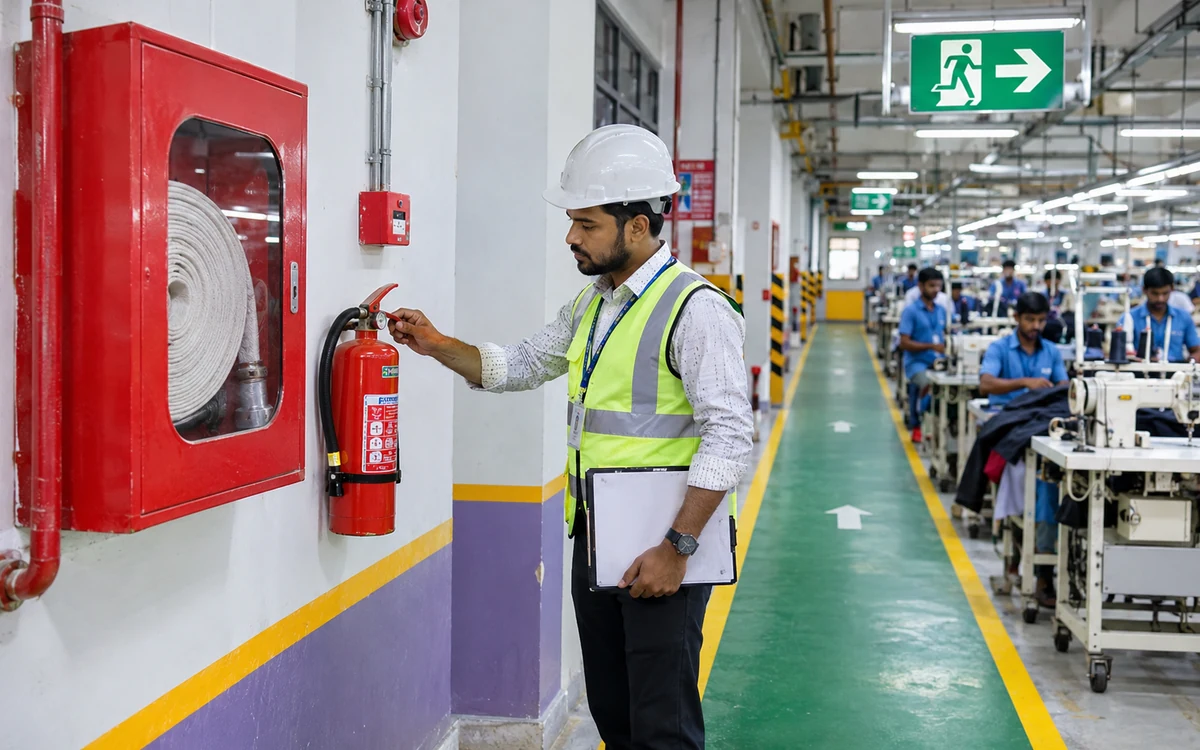
- Exits and stairs that are clear. No stored goods, machines, trolleys or garbage in them, at any time.
- Doors that are never locked or blocked while people are inside, and that open in the direction of escape.
- Clear exit signs that are lit or easy to see, with arrows that lead to the exit.
- Marked escape routes on each floor, with a plan on the wall that shows where you are.
- Fire resistant stairs and doors where the rule requires them.
- Passages inside the floor wide enough to walk out safely, with no machine or stack that narrows them.
- An assembly point outside, clear of traffic and away from the building.
- Safe access for fire vehicles to the building.
Exits that are locked, blocked or hidden behind stock are among the most serious faults any audit can find.
Detection, alarm and fire fighting equipment
- Fire alarm. A working alarm that can be heard on every floor, with manual call points. Test it on a schedule.
- Detectors. Smoke or heat detectors where the plan or rule requires them.
- Fire extinguishers. The right type for the hazard, placed where people can reach them, marked, and checked on a schedule. People should know how to use them.
- Hydrant, hose and water supply. Where required, working and tested, with a water source that can be relied on.
- Sprinklers. Where the rule or the building plan requires them, kept in working order.
- Emergency lights. Working lights for exits and stairs when the power goes off.
- Backup power. For alarm, lights and pumps as required.
- Firefighting gear for the fire team, such as protective items, kept ready.
Check the right extinguisher type for each area, for example for electrical equipment, chemicals and ordinary materials, and keep a record of every inspection and service.
Electrical safety
- Load check. Check that circuits can carry the load. See electrical load audit.
- Wiring and panels. Use proper cables, covers and breakers, with no open or damaged wire. Keep panels closed and clear.
- No temporary or loose connections. Remove them and replace with proper fixtures.
- Earthing and protection. Check earthing and protective devices as the electrician advises.
- Machine cables. Keep cables off the floor where they can be cut, and out of the walkway.
- Lighting and heat. Keep lights and hot parts away from fabric.
- Regular checks by a qualified electrician, with a written record. See lighting in a garment factory for the lighting side.
- Thermal check. Some factories use a thermal camera to find hot joints. Ask your electrician if this suits your building.
Housekeeping and storage
- Clean lint and waste from machines, floors, corners and ducts on a set schedule, and remove it from the floor.
- Keep fabric, cut parts and cartons away from heat and power points, and away from exits.
- Keep stock in marked places, with passages kept clear. See fabric warehouse and cutting section best practices and inventory control in apparel and textile warehouse.
- Store packing material such as cartons and poly bags in a controlled place, and not on the production floor or in the stairs. See garment packing methods.
- Store chemicals in a safe place, with labels and safety data sheets, away from heat and exits.
- Empty bins often, and keep waste in covered containers.
- Keep a clear space around electrical panels, extinguishers and exits.
- Ban smoking inside the building, and set a safe place for smokers if the rule allows.
Good housekeeping also improves work flow and safety in general. See ergonomics in sewing operations.
Hot work, pressing, fusing and boiler rooms
- Pressing and ironing. Switch off irons and presses when not in use, and keep fabric away from hot surfaces. See pressing and ironing in garment manufacturing.
- Fusing machines. Keep belts, rollers and surrounds clean, and check heat controls. See fusing machines in the garment industry.
- Boilers. Make sure operation, inspection and maintenance follow the rule and the maker’s advice, with a trained operator. See boilers and thermal oil heaters.
- Gas lines and cylinders. Keep them checked, stored and fixed as the rule requires.
- Hot work such as welding or cutting. Allow only with a permit, a fire watch and fire equipment ready, and with fabric moved away.
- Generators and fuel. Keep in a safe room, with fire equipment, and away from stock.
People: fire team, training and drills
- Fire team. Form a trained fire team with clear roles, such as alarm, fire fighting, evacuation and first aid. Include people for every shift.
- Safety committee. Keep a working committee that meets, reviews findings and follows up.
- Training. Train all workers on joining and again on a schedule, on what the alarm sounds like, where the exits are and what to do. Use clear language and pictures that every worker can understand.
- Drills. Hold fire drills as the rule and the buyer’s requirement say, on different shifts, and note the time to clear each floor. Check the current requirement for how often.
- Learn from drills. After each drill, write down what went wrong, fix it and tell the workers.
- Visitors and contractors. Tell them about exits and the alarm before they start.
- Workers’ voice. Let workers raise safety concerns without fear. A worker complaint channel can help find a problem early.
Emergency plan
Write a clear emergency plan and keep it up to date. It should cover:
- who raises the alarm and how,
- who calls the Fire Service and the ambulance, with the numbers on the wall,
- how each floor is cleared, and by which route,
- who helps people who need extra help to leave, such as those with a disability or an injury,
- the assembly point and how people are counted,
- who meets the fire vehicles and shows the way,
- what to do about power, boilers and gas,
- how to look after the injured,
- who talks to families, buyers and the press.
Display the plan, give copies to the safety committee, and practise it.
Records and checks
Keep written records for audits and for your own control:
- fire drill reports,
- training records and attendance,
- extinguisher, alarm, detector and hydrant checks and services,
- electrical inspection and repair reports,
- boiler inspection reports,
- licences, certificates and approvals as required,
- inspection findings, the action plan, the owner and the date closed,
- safety committee meeting notes.
Keep records for the period that the rule and your buyer require, and keep a copy in a place that is safe from fire.
A daily, weekly and monthly checklist
Daily
- Exits, stairs and passages are clear and doors open from inside.
- Exit signs and emergency lights look normal.
- No stock or machines in front of extinguishers and panels.
- Pressing, fusing and heating equipment switched off when not in use.
- Lint and waste removed from the floor and machines.
- Smoking only in the allowed place.
- No damaged wire or loose plug in sight.
Weekly
- Test the alarm, on a planned time that workers know.
- Check extinguishers for position, seal, pressure gauge and damage.
- Walk each floor with the safety committee or a supervisor.
- Check the boiler room, generator room and chemical store.
- Check the assembly point and access road.
Monthly
- Inspect electrical panels and cables by a qualified person.
- Check hydrant, hose and pumps as required.
- Review the findings and action plan.
- Hold a safety committee meeting.
- Review training and plan a drill if due.
- Check emergency lights and backup power.
The frequency of tests, services and drills should follow the current rule, the maker’s advice and your buyer’s requirement. This list is a starting point, not a legal standard.
Common failures found in audits
- Blocked, locked or hidden exits and stairs.
- Stock or waste in passages and stairs.
- Missing or poorly kept extinguishers.
- Alarms or lights that do not work.
- Poor electrical work, loose wires and overloaded sockets.
- Lint and waste left to build up.
- Missing or old training and drill records.
- No clear emergency plan, or a plan no one knows.
- Chemicals stored carelessly.
- Problems found earlier but not closed.
Fixing the same item twice is a sign that the root cause was not found. See root cause analysis in garments.
Final thoughts
Fire safety in garment factory work depends on a few things done well and every day: clear and unlocked exits, a working alarm and equipment, safe electrical work, good housekeeping, trained people and regular drills. Know who checks your factory, whether it is the authorities, your buyers or an inspection programme, and keep records that show what you did.
Use the checklist above as a starting point, and confirm every rule, number and schedule with the Fire Service, the building authority, your buyer and your inspection programme. Fire safety is never finished. Keep inspecting, fixing and learning.
Frequently asked questions
Lint and fabric near machines, electrical faults, hot pressing and fusing equipment, boilers and gas, chemicals, packing materials such as cartons and poly bags, and dense storage. Blocked exits make any fire more dangerous.
Government authorities such as the Fire Service, buyers and brands through their audits, and inspection programmes such as the RMG Sustainability Council. Check which ones apply to your factory.
The RMG Sustainability Council is a private national initiative of industry, global brands and trade unions. It says it carries out structural, electrical, fire and life safety and boiler inspections, supports remediation, runs training and a worker complaints mechanism, and governs more than 1,800 factories.
Follow the current rule, the buyer’s requirement and your safety committee plan, and check that the requirement has not changed. Also do drills on different shifts, and learn from each one.
Because in a fire, people have a short time to leave, and a locked or blocked exit can trap them. Exits must open from inside and stay clear at all times when people are in the building.
Typically an alarm, detectors where required, extinguishers of the right type, emergency lights, signs, and hydrants, hoses or sprinklers as the rule and building plan require. Check the exact list with the Fire Service and your buyer.
Who raises the alarm and calls the Fire Service, how each floor is cleared and by which route, help for people who need it, the assembly point and head count, who meets the fire vehicles, what to do with power, boilers and gas, first aid and communication.