A faux leather jacket looks sharp and costs much less than real leather. It also scares people at wash time. One wrong move and the surface can stiffen, crack or start to flake. So how to wash a faux leather jacket is a question worth answering before you reach for the washing machine.
The good news is that faux leather is much easier to clean than real leather, as long as you keep heat, harsh chemicals and rough rubbing away from it. This guide explains what faux leather is made of, how to read the care label, when to spot clean, when to hand wash and when a cold machine cycle is acceptable. It also covers drying, wrinkles, smells, storage and the mistakes that ruin jackets. A worked example near the end puts numbers on the cost of good care.
What is faux leather?
Faux leather, also called synthetic leather, leatherette, PU leather or vegan leather, is a fabric made to look like animal leather. Most of it has two parts. A base fabric, woven, knitted or non-woven, gives strength. A plastic coating on top gives the leather look. The two common coatings are polyurethane (PU) and polyvinyl chloride (PVC).
Many jackets are made of PU-coated cloth. The base is often polyester, though that depends on the maker. You can read about that fibre in our guide to polyester fibre, its properties and uses. The coating can feel soft and flexible when new. Over time, heat, rubbing, sun and strong chemicals can make it stiff, cracked or sticky, and in some jackets the coating peels from the base fabric. Care slows this down. It cannot stop it forever.
Step 1: Read the care label first
The label on your jacket outranks any general guide, including this one. It tells you what the maker has tested. Look for these things:
- A wash tub with a hand: hand wash only
- A wash tub with a cross: do not wash
- A tub with a number: the maximum water temperature
- A circle with a cross: no dry cleaning
- An iron with a cross: do not iron
Our care labels and wash symbols guide explains each symbol. If the label is missing or unreadable, treat the jacket as hand wash only, and test every method on a hidden area first.
How often should you clean it?
Less often than a cotton shirt. A faux leather jacket does not absorb sweat and dirt the way cloth does. A quick wipe after a dusty day is often enough. A full wash makes sense when:
- There is a visible stain you cannot wipe off.
- The lining smells of sweat.
- The jacket has been worn many times since the last clean, say 15 to 20 wears.
- It picked up smoke or food smells.
The wear count is a rough habit, not a rule. Use your nose and eyes.
What you need
- A soft microfibre cloth or two
- A mild liquid soap, such as washing-up liquid, or a gentle detergent
- A bowl or clean basin of warm water (not hot)
- A clean, dry towel
- A padded hanger
- A mesh bag or pillowcase, only if the label allows machine washing
Skip bleach, stain removers with strong solvents, scouring pads, stiff brushes and anything marked abrasive.
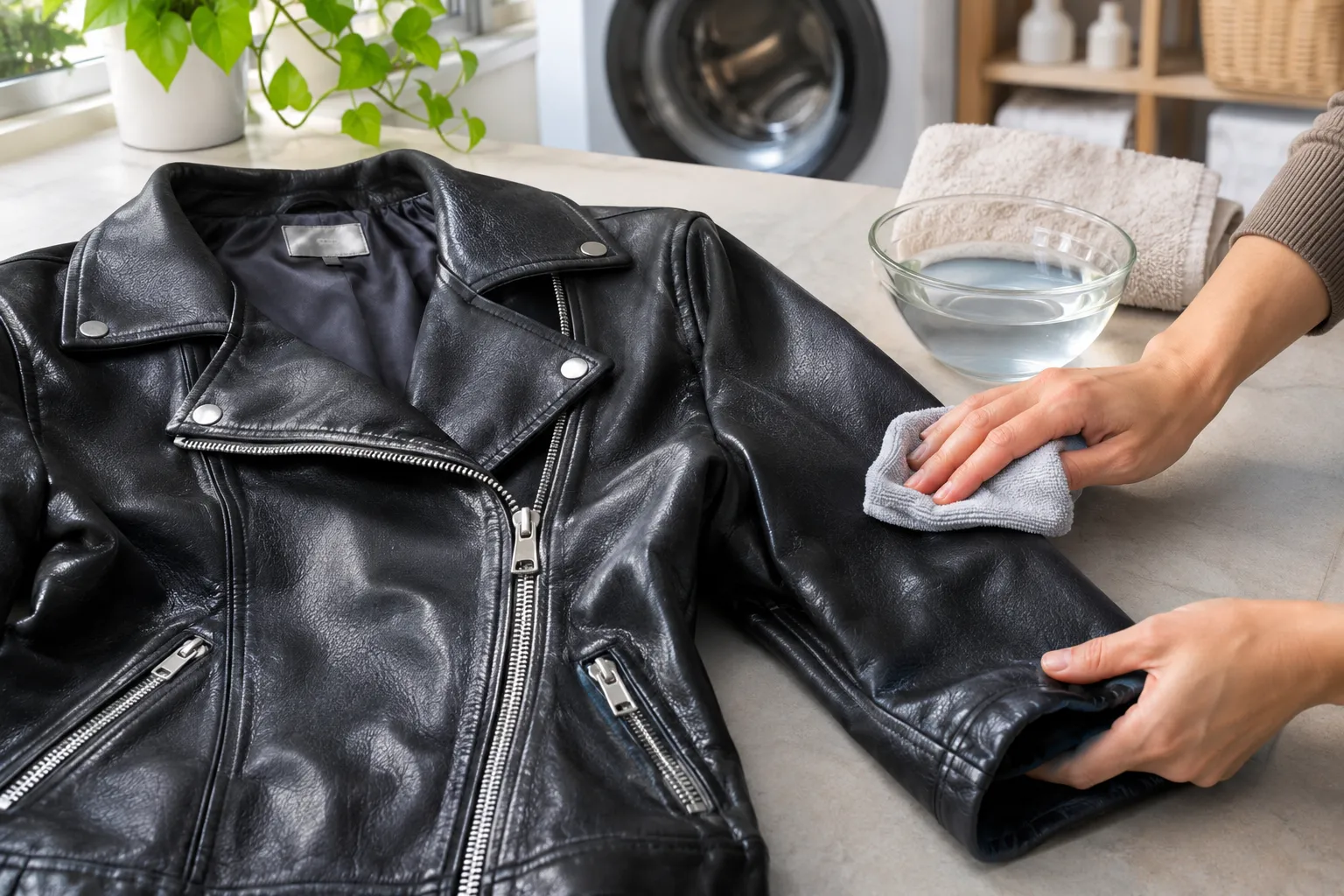
Method 1: Spot clean (the safest choice)
- Test first. Choose a hidden area such as the inside hem. Dab a small amount of soapy water on it, wait a few minutes and check for colour transfer or damage.
- Mix a mild solution. A small squirt of mild washing-up liquid in a bowl of warm water is enough.
- Dampen a soft cloth. Wring it out well. It should be damp, not dripping.
- Wipe gently. Work in small circles on the stain, then wipe the whole panel so no clean ring forms.
- Rinse the cloth in fresh water and wipe again to remove soap. Soap left on the surface can leave marks.
- Dry with a clean, dry cloth, then hang the jacket to air dry.
Do not scrub. A rough rub can scratch the coating and leave a shiny patch.
Method 2: Hand wash
Use this when the label allows washing and the jacket is dirty all over.
- Close zips and snaps. Empty the pockets.
- Turn the jacket inside out. This protects the coated face from rubbing.
- Fill a clean tub with cool or lukewarm water. Add a small amount of mild liquid detergent and mix.
- Press the jacket under the water and move it gently for a few minutes. Pay more attention to the collar, cuffs and underarms.
- Drain the water. Rinse in clean water until the soap is gone.
- Press out extra water by rolling the jacket in a dry towel. Do not wring or twist. Twisting can crack the coating.
- Hang it on a padded hanger to dry (see the drying section).
Method 3: Machine wash (only if the label allows)
Care guidance varies. One cleaning guide says that most faux leather clothing can be machine washed if the care label allows. Others tell readers to avoid the machine. You can see the difference. The label is the tiebreaker.
If you are allowed to use the machine:
- Turn the jacket inside out and fasten zips.
- Place it in a mesh bag or a pillowcase, alone or with a few soft items.
- Choose a cold water cycle and low spin.
- Use a small amount of gentle detergent. Harsh detergents can stiffen the material.
- Remove the jacket straight away when the cycle ends, and shape it by hand.
Never use hot water, a long spin or a heavy load. If the lining is a different fabric, such as fleece or quilting, it may react to water differently from the shell.
Drying a faux leather jacket
This step decides how the jacket looks next season.
- Hang it on a wide, padded hanger or lay it flat on a towel. Keep it in a well-ventilated place, away from direct sun and heaters.
- Never use a tumble dryer. Heat can melt, warp or crack the coating.
- Do not use a hair dryer on the surface.
- Leave it until fully dry, including the lining, before wearing or storing it. Damp storage can cause smells and mould.
- Wipe the surface with a dry cloth once dry to take off any watermarks.
Dealing with wrinkles
Do not iron faux leather directly. A hot iron can melt or mark the coating. Use steam instead. One approach is to hang the jacket in a bathroom after a hot shower. The moist warm air can relax light creases. You can also use a garment steamer, kept at a distance and moved constantly. If a heavy crease will not leave, test your method on a hidden area first, and do not force it.
Smells
Air is the first fix. Hang the jacket outside in the shade, or in a ventilated room, for a day. A smell in the lining often comes from sweat, and a spot clean or hand wash of the lining, if the label allows, helps. Avoid sprays that contain alcohol or strong solvents on the shell.
Stains: simple rules
| Stain | First action |
|---|---|
| Dust or light dirt | Wipe with a damp microfibre cloth |
| Food or drink | Blot at once, then wipe with mild soapy water |
| Oil or grease | Blot, do not rub, then wipe with mild soapy water. For heavy stains ask a professional cleaner |
| Ink or marker | Do not use strong solvents. Ask a professional cleaner, since ink can spread and damage the coating |
| Mud | Let it dry, brush off gently, then wipe |
| Makeup on the collar | Wipe with mild soapy water, working from the outside in |
When in doubt, stop. Professional cleaners have more tools, and it costs less to ask than to replace the jacket.
What to avoid
- Hot water, tumble dryers, radiators and hot cars. Heat is the main enemy.
- Bleach and strong chemicals. They can strip colour and weaken the coating.
- Abrasive pads and stiff brushes. They scratch.
- Wringing and twisting. They crack.
- Folding tightly for long storage. Hard creases can crack the coating.
- Plastic garment bags. They trap moisture. Use a breathable cover.
- Direct sun for long periods. It can dry and age the surface.
Storage tips
- Clean the jacket before long storage, since dirt and sweat can attack the coating.
- Hang it on a wide, padded hanger so the shoulders keep their shape.
- Give it space. Crowded wardrobes press the surface and leave creases.
- Keep it in a cool, dry, dark place.
- Use a breathable cotton cover instead of plastic.
- Check it every few months for sticky patches or peeling.
Common problems and fixes
| Problem | Likely cause | What to do |
|---|---|---|
| Surface feels stiff | Hot water, harsh soap or heat drying | Wipe with clean damp cloth. Prevent a repeat |
| Surface looks cloudy | Soap residue | Wipe with a cloth dampened in clean water, then dry |
| Cracks or peeling | Age, heat or rough cleaning | Hard to repair at home. See a repair shop if the damage is small |
| Sticky feel | Coating breaking down, often in warm, humid storage | Wipe clean. If the stickiness remains, the coating may be ageing |
| Water marks | Water dried unevenly | Wipe the whole panel evenly and dry flat |
| Colour on the cloth | Dye transfer | Test on hidden area. Avoid wearing against light fabric |
A sticky or flaking jacket is often at the end of its life, no matter how well you clean it.
A worked example: the cost of good care
Let us use simple numbers to see why careful cleaning pays. All figures are examples.
Part 1: Mixing the cleaning solution
For spot cleaning, mix 5 mL of mild washing-up liquid into 500 mL of warm water.
Concentration = 5 ÷ 500 × 100 = 1 percent
That is a weak solution. It cleans light marks and rinses off easily. If you hand wash in a basin with 5 litres of water, a small 5 mL squirt gives:
5 ÷ 5,000 × 100 = 0.1 percent
Gentle is the goal. A stronger mix does not clean much better, and it is harder to rinse.
Part 2: Cost per wear
You buy a jacket for 60 (in any currency) and wear it 40 times a year.
- With careful cleaning, it lasts 3 years: 40 × 3 = 120 wears. Cost per wear = 60 ÷ 120 = 0.50.
- With a hot wash and tumble dry, the coating cracks and it lasts 1 year: 40 wears. Cost per wear = 60 ÷ 40 = 1.50.
Careful care triples the use you get from the same money (1.50 ÷ 0.50 = 3). The lifespans here are guesses to show the effect, not tested figures.
Part 3: A simple cleaning schedule
If you wear the jacket 40 times a year and wipe it every 5 wears:
Wipes per year = 40 ÷ 5 = 8
If you hand wash it once or twice a year, the whole routine takes only a few minutes per wear. Small, regular care beats a big rescue wash.
For brands and buyers
The care label is part of the product. A faux leather jacket should be tested for the instructions printed on it, such as colour change after washing and coating adhesion after cleaning. If your label says “machine wash cold”, test that claim on real garments, not only on fabric swatches. Zips, linings, trims and thread can behave differently from the shell. Our guide to best practice in garments washing shows how factories approach wash testing, and the page on parts of a jacket lists the pieces to test.
A hand washing method is also described in our guide to how to wash bras by hand, and many of the same habits apply here: cool water, a mild soap and no wringing.
Final thoughts
To wash a faux leather jacket well, read the label, clean it only when it needs it and start with the gentlest method. Spot cleaning handles most marks. Hand washing in cool water suits a dirty jacket. A cold, low-spin machine cycle is for jackets whose labels allow it. Dry it on a padded hanger, away from heat and sun, and never iron it directly.
Our worked example showed a 1 percent soap mix for spot cleaning and a jacket whose cost per wear falls from 1.50 to 0.50 with careful care. Treat it kindly, store it well and it will look good for years.
Frequently asked questions
Only if the care label allows it. If it does, turn the jacket inside out, put it in a mesh bag, use a cold, low-spin, gentle cycle and a mild detergent.
Turn it inside out, wash gently in cool water with a little mild detergent, rinse well, roll in a towel to remove water and hang it on a padded hanger to dry. Do not wring it.
No. Heat can warp, melt or crack the coating. Air dry it on a hanger away from heat and sun.
Do not iron it directly. Use steam instead, and test on a hidden area first.
Blot the stain, then wipe gently with a cloth dampened in mild soapy water. For ink or heavy grease, ask a professional cleaner.
Heat, harsh chemicals, abrasive scrubbing, wringing and long exposure to strong sun. Ageing in warm, humid storage can also make the coating sticky or flaky.
Wipe it when it looks dusty and give it a fuller clean when it is stained or smells. It does not need washing after every wear.