An apron is one of the oldest garments in daily use. Cooks wear it to keep sauce off their shirts. Welders wear it to guard against sparks. Bakers, gardeners, barbers and artists all wear one. Despite the different jobs, most aprons share the same basic parts. If you know the parts of an apron, you can pick the right one, describe a custom order and spot weak points before they fail.
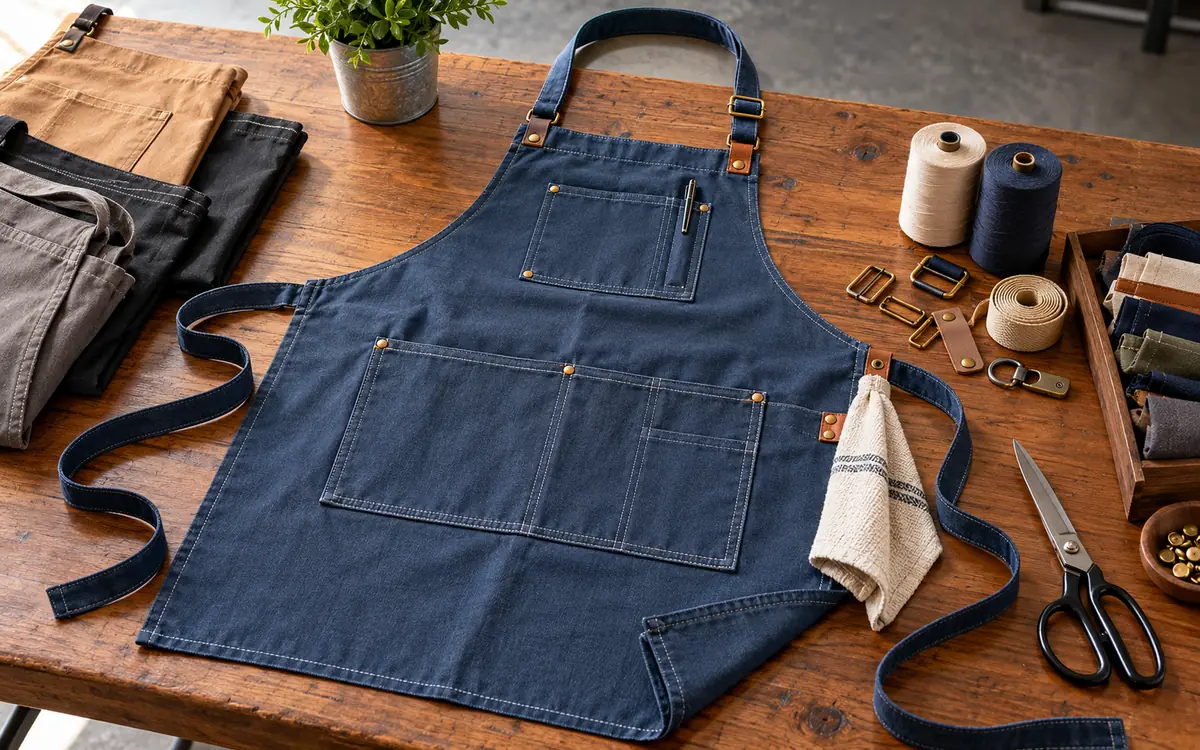
This guide goes through each part of an apron, from the neck strap to the hem. It also covers the main types, the common fabrics and the way aprons are cut and sewn. If you are interested in work clothing more widely, see our overview of types of workwear.
What an apron does
An apron is a protective garment worn over the front of the body. It guards clothes from spills, heat, dust, sharp tools or dirt. It often carries pockets for tools. In hospitality and retail, it also works as a uniform, with the logo printed or embroidered on the front.
Aprons usually tie or buckle behind the back and neck. They are open at the back, which makes them easy to put on and take off.
Parts of an apron at a glance
| Part | Location | Job |
|---|---|---|
| Bib | Upper front | Covers the chest |
| Neck strap | Around the neck | Holds the apron up |
| Waist ties | Sides | Tie around the waist |
| Skirt (body) | Lower front | Covers the lap and legs |
| Pockets | Front | Hold tools and towels |
| Hem | Edges | Finishes the edges |
| Straps and buckles | Neck and waist | Adjustable fastening |
| Rivets or reinforcement | Pocket corners | Strengthen stress points |
| Towel loop | Waist | Holds a cloth |
| D-rings or hooks | Waist | Hold tools |
| Label | Inside | Brand and care |
Bib
The bib is the upper part of the apron that covers the chest and stomach. Not all aprons have a bib. A bib apron covers the whole front of the body. A waist apron, common in restaurants, has no bib and covers only from the waist down.
The bib is usually a rectangle or a slightly shaped piece of fabric. It is sewn to the skirt, or it is cut in one piece with it. Its width ranges from about 25 to 40 cm at the top, widening toward the waist.
Some bibs have a built-in pocket for a pen or thermometer. Others have a cross-back design, with straps that cross behind the back, to spread weight across the shoulders.
Neck strap
The neck strap goes around the back of the neck and holds the bib up. It is attached to the top corners of the bib. There are three common styles.
- Fixed loop: A permanent loop that goes over the head. The size is fixed. Simple and cheap.
- Adjustable strap: A strap with a slide buckle, a D-ring or a ladder lock that lets the wearer set the length.
- Cross-back straps: Two straps that cross over the back and attach at the waist. They remove the load from the neck and spread it over the shoulders.
Straps are made from the same fabric as the apron, or from cotton webbing. Webbing is strong and does not stretch. A strap that digs into the neck is uncomfortable, so a wide strap or a padded one is better for long shifts.
Waist ties
Waist ties are the long fabric strips sewn at both sides of the apron. They wrap around the back and tie in a bow in front, or knot behind. A waist tie is typically 60 to 100 cm long, though styles differ, and about 2.5 to 5 cm wide.
Ties are usually sewn into the side seams. Heavy aprons use extra stitching or a bar tack, because the ties take strain every time the wearer ties them. A weak waist tie is one of the most common reasons aprons are returned.
Some aprons use a buckle or snap instead of a tie. This makes the apron quick to put on, which is useful in hospitals and laboratories.
Skirt or body
The skirt is the main lower part. It covers the lap, thighs and sometimes the knees. Skirt length varies. A café apron is short, ending at the thigh. A bistro apron is long and ends near the ankle. A butcher’s apron ends at the knee.
The skirt is the part that takes the most stains and wear. It is usually made from a thicker fabric than the bib. In kitchens, the skirt often has a double layer at the front, called a bib lining or double panel, to give extra protection.
Pockets
Pockets are a defining feature of working aprons.
- Patch pocket: A square pocket sewn onto the front. Most common.
- Divided pocket: A patch pocket stitched into several slots, for pens or small tools.
- Kangaroo pocket: A large pocket across the lower front, open at both sides.
- Bib pocket: A small pocket on the chest.
- Towel loop: A strip of fabric or a metal ring at the waist for hanging a towel.
- Thermometer pocket: A narrow pocket for a probe.
- Concealed pocket: A hidden pocket for money or phone.
Pocket stitching is reinforced at the corners, usually with a bar tack, because pockets are loaded with heavy tools. See our guide on the parts of a pocket for how corners are strengthened.
Hem and edges
The edges of an apron are finished to stop fraying. Common finishes include:
- Double-fold hem: The edge is folded twice and stitched. Simple and strong.
- Bound edge: A narrow strip of fabric wraps over the raw edge.
- Overlocked edge: The raw edge is trimmed and wrapped in thread.
- Piped edge: A cord covered in fabric is sewn into the edge for a decorative finish.
Neat edges are a sign of quality. A rough or uneven hem frays quickly after repeated washing.
Fabrics
The fabric depends on the job.
| Fabric | Features | Typical use |
|---|---|---|
| Cotton twill | Strong, absorbent, easy to wash | Kitchen, retail |
| Cotton canvas | Heavy duty | Workshop, barista |
| Denim | Hard wearing, stylish | Barista, craft |
| Polyester cotton | Wrinkle resistant, dries fast | Restaurants |
| Waxed canvas | Water resistant | Outdoor, workshop |
| Leather | Durable, heat resistant | Welding, blacksmith |
| Vinyl or PVC | Waterproof | Food processing, cleaning |
| Nylon | Light, easy to clean | Lab, hospitality |
| Flame resistant fabric | Resists sparks | Welding, industrial |
For more on fabric weight and uses, see our guide on canvas fabric and what is denim.
Apron types
| Type | Coverage | Features |
|---|---|---|
| Bib apron | Chest to knees | Neck strap, waist ties |
| Waist apron | Waist to thigh | No bib, short |
| Bistro apron | Waist to ankle | Long, no bib |
| Cross-back apron | Chest to knees | Straps cross at back |
| Butcher apron | Chest to knees | Heavy, often vinyl |
| Barista apron | Chest to thigh | Denim or canvas, pockets |
| Welding apron | Chest to knees | Leather, heat resistant |
| Lab apron | Chest to knees | Chemical resistant |
| Hairdresser apron | Chest to thigh | Pockets for tools |
| Artist apron | Chest to knees | Stain resistant |
Safety aprons
In industry, aprons can be personal protective equipment. Examples include:
- Welding aprons made from leather or flame-resistant cotton.
- Lead aprons used in X-ray rooms to block radiation.
- Chemical aprons made from rubber or PVC.
- Cut-resistant aprons for butchers, made with mesh or special fibers.
For these, the apron has to meet defined standards. Seams, straps and fastenings are tested for strength. The material is chosen for the specific hazard.
How an apron is made
A basic cotton apron follows a short process.
- Cutting. The body, bib, ties, strap and pockets are cut.
- Hemming. The edges of the body and bib are hemmed.
- Pocket making. The pocket top is hemmed and the sides are folded.
- Pocket attach. The pocket is sewn on the front, with bar tacks at the corners.
- Ties and strap. The strips are folded, stitched and attached.
- Final stitching. Straps are fixed with a box stitch or bar tack.
- Labeling. Labels are sewn on.
- Finishing. Threads are trimmed and the apron is pressed.
- Packing. Aprons are folded and packed.
Because aprons are simple, they are among the quickest garments to sew, which makes them popular for promotional orders. For common sewing problems, see our guide on sewing defects and root causes.
Customizing an apron
Businesses often order aprons with their logo. Common methods include:
- Screen printing: Good for large quantities.
- Embroidery: Durable and professional looking.
- Heat transfer: Good for small runs and detailed designs.
- Woven labels: Sewn on at a pocket or strap.
The logo is usually placed on the chest or on the pocket. Our guide on heat transfer operation guidelines explains how heat-applied logos are made to last.
Care and cleaning
Wash cotton and poly cotton aprons in warm water with a normal detergent and dry them on a medium setting. Pre-treat grease and food stains before washing, because heat can set them into the fabric. Leather aprons should be wiped clean with a damp cloth and conditioned from time to time. Vinyl aprons can be wiped down or rinsed. Never put welding or flame-resistant aprons through strong bleach, as it can damage the protective finish. Check the care label, and replace any apron with burned patches or torn seams.
Apron size and fit
Most aprons are sold in one size with adjustable straps, but length and width still matter. A bib apron should cover from the collarbone to the knee for most adults. A wide apron wraps around the waist with room for the ties to cross behind. For small or tall staff, check the dimensions before ordering, as many suppliers list width and length in centimeters or inches. Children’s aprons are shorter, with narrower straps and fewer pockets.
Common faults
- Neck strap too tight or too long: Poor adjustment.
- Torn waist ties: Weak stitching at the join.
- Pocket tearing: Missing bar tacks.
- Shrinkage: Cotton that was not pre-shrunk.
- Fading: Poor dye fastness.
- Staining: No stain finish on the fabric.
- Frayed hem: Poor edge finish.
- Uneven hem: Poor cutting.
- Rust on metal rings: Cheap hardware.
- Print cracking: Wrong print type or curing.
How to choose an apron
- Match the job. Heat, water and chemicals need different fabrics.
- Check the length. It should cover what you need to protect.
- Test the neck strap. It should be comfortable and adjustable.
- Look at the pockets. They should be deep enough and well stitched.
- Check the ties. They should be long enough to wrap around the waist.
- Look at the seams. Stitching should be strong at stress points.
- Wash it. A good apron holds its color and shape.
Final thoughts
An apron looks like a plain piece of cloth, but each part has a purpose. The bib covers the chest, the strap carries the load, the ties hold the apron in place, the skirt guards the lap and the pockets keep tools close. Before you buy or order aprons, check the strap, the ties and the pocket corners. Those three places tell you how long the apron will last.
Frequently asked questions
The main parts are the bib, neck strap, waist ties, skirt, pockets and hem. Some aprons add a towel loop and hardware.
It is called the bib. It covers the chest and stomach.
A waist apron has no bib. It covers only from the waist down, and it is common in restaurants and cafés.
Cotton twill and polyester cotton are common. They are washable and absorb spills. Waterproof vinyl suits wet work.
They should be long enough to wrap around the waist and tie in a bow. Most are between 60 and 100 cm long.
A cross-back apron has straps that cross at the back and attach at the waist. This spreads weight across the shoulders instead of the neck.
Choose a strong fabric, wash it in cool water, avoid bleach and check bar tacks on the pockets.