A glove has to fit a hand that bends, grips and stretches in all directions. That is why a glove is one of the most complex small garments to make. It has dozens of tiny pieces, each cut to a precise shape. If one is off by a few millimeters, the glove feels wrong. Knowing the parts of a glove helps you understand why a good glove costs more than a bad one, and how to choose well.
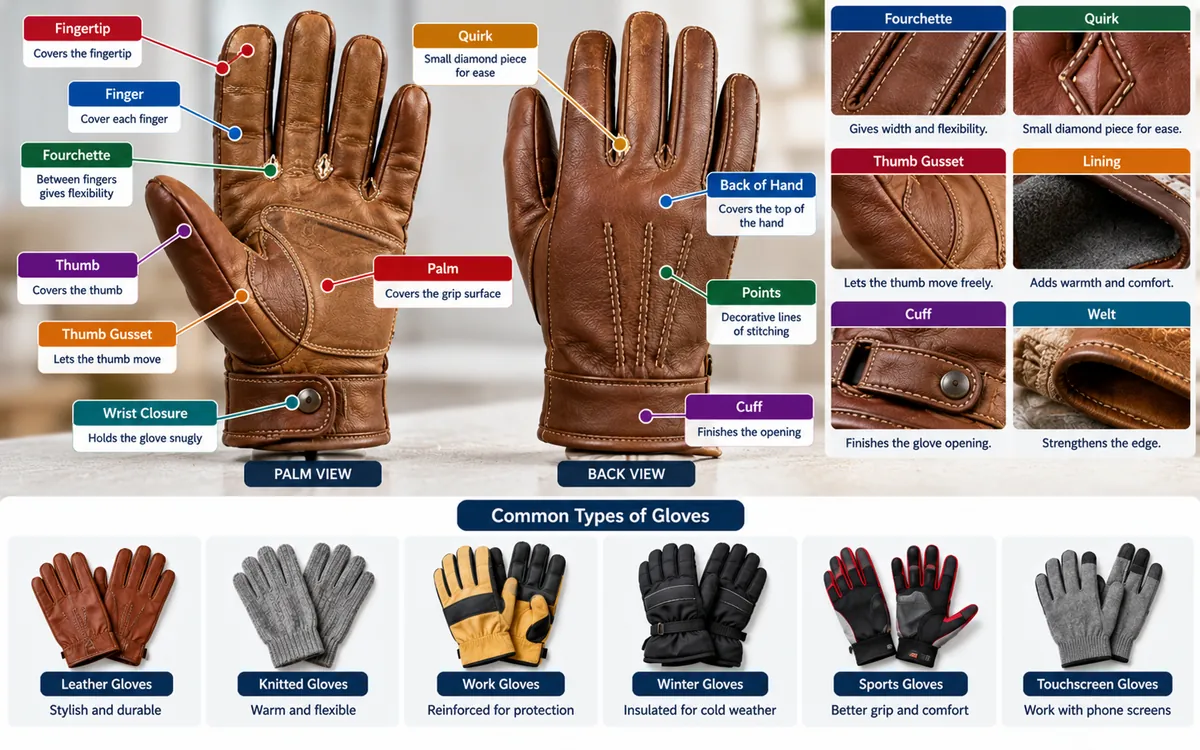
This guide names each part, explains what it does and shows how the pieces fit together. It also covers materials, sizing and the faults that matter. If you like learning how a garment is broken down, our guides on the parts of a jacket and the parts of a sleeve use the same approach.
Why gloves are hard to make
Hands have fingers of different lengths, a thumb that moves in its own direction and skin that stretches over knuckles. A glove has to cover all of these and still let the fingers close. A flat piece of fabric cannot do that, so glove makers use shaped pieces that curve around each finger.
Most traditional leather gloves are cut from many parts. A simple knit glove can be made in one piece on a knitting machine. The parts below apply mainly to cut and sewn gloves, but knit gloves share the same names.
Parts of a glove at a glance
| Part | Location | Job |
|---|---|---|
| Palm | Inside of hand | Covers the grip surface |
| Back of hand | Outside of hand | Covers the top of the hand |
| Fingers | Four tubes | Cover each finger |
| Thumb | Side | Covers the thumb |
| Fourchettes | Between fingers | Give width and flexibility |
| Quirks | Finger bases | Small diamond pieces for ease |
| Thumb gusset | Base of thumb | Lets the thumb move |
| Cuff | Wrist | Finishes the opening |
| Lining | Inside | Warmth and comfort |
| Welt | Edge of cuff | Strengthens the edge |
| Wrist closure | Wrist | Holds the glove snugly |
| Points | Back of glove | Decorative lines of stitching |
Palm and back of hand
The palm and the back of the hand are the two main panels. In many gloves, these are cut from different materials. A work glove, for example, often has a leather palm for grip and a breathable fabric back for comfort. A ski glove may have a padded leather palm and a waterproof back.
The palm takes the most wear. It needs reinforcement in high-wear areas like the base of the fingers and the thumb saddle. Reinforcement patches are added to the palm in work gloves. Skiers and cyclists sometimes use gel padding at the heel of the hand.
The back of the hand often carries the brand logo, decorative stitching or padding for protection.
Fingers
Each finger is a small tube with a closed end. In a cut glove, a finger is made from three pieces: a front piece, a back piece and the side pieces called fourchettes. The ends of the finger are curved to match the shape of a fingertip.
Finger length is measured from the base to the tip. Most gloves come in set lengths, so a long-fingered person may need a larger size or a special cut.
Fingertip
The fingertip needs reinforcement because it takes the most pressure in gripping. Some gloves double the fabric or add a patch of leather.
Touchscreen gloves have a special conductive thread or coated fingertip, which allows the glove to work on a phone screen.
Fourchettes
Fourchettes are narrow strips of material that sit between the fingers. The word comes from the French for small fork. They are sewn between the front and back pieces of each finger. A fourchette gives the finger its width and lets it bend.
Without fourchettes, a glove would be tight and stiff across the fingers. The fourchette is one of the hallmarks of a well-made leather glove. Cheaper gloves skip the fourchettes and use a flat-seam design. These feel stiffer.
Quirks
Quirks are tiny diamond-shaped pieces inserted at the base of the fingers. They provide extra room where the fingers join the palm. Without quirks, the glove would pull when the fingers spread. Quirks appear only on high-quality gloves.
Thumb
The thumb is cut and shaped differently from the fingers. It sticks out at an angle, and it needs room to move across the palm. In a cut glove, the thumb is one of the hardest parts to get right.
Thumb gusset
The thumb gusset is a small piece that sits at the base of the thumb. It gives extra width where the thumb joins the hand, so the thumb can move without pulling the whole glove. Different glove styles use different thumb constructions.
- Keystone thumb: The thumb piece is shaped like a key-stone and set into the glove. It gives a natural fit and allows a wide range of movement.
- Inseam thumb: The thumb is sewn into the side seam. It is simple and common in cheap gloves.
- Pique thumb: A detailed method where the thumb is sewn with a tiny overlapping seam. It gives a smooth feel.
- Set-in thumb: The thumb is made as a separate piece and sewn into the glove.
Cuff
The cuff is the end of the glove at the wrist. Its length depends on the style.
- Short cuff: Ends at the wrist bone. Common in dress gloves.
- Gauntlet cuff: A long, flared cuff that covers part of the forearm. Common in work gloves, motorcycle gloves and ski gloves.
- Knit cuff: A stretchy rib knit cuff that holds the glove in place. Common on work and winter gloves.
- Elastic cuff: Elastic is sewn into the wrist to give a snug fit.
- Strap cuff: A band with hook and loop tape or a snap.
The cuff keeps cold air and dirt from entering. In sports gloves, it also provides support for the wrist.
Welt
A welt is a strip of leather or fabric sewn to the edge of the cuff. It makes the edge strong and gives a clean finish.
Wrist closure
A glove has to stay on. Methods include:
- Elastic: The simplest closure.
- Hook and loop strap: Adjustable and secure.
- Snap: A small metal fastener. Common on dress gloves and leather driving gloves.
- Buckle: Used on some heavy work or riding gloves.
- Zipper: Found on some fashion gloves.
- Drawcord: Used on winter and ski gloves to seal out snow.
Lining
Many gloves have a lining. It provides warmth and makes the glove feel smooth. Common linings include:
- Fleece: Soft and warm. Popular in winter gloves.
- Silk: Light and smooth. Used in fine leather gloves.
- Cashmere or wool: Very warm and soft.
- Cotton: Cool and absorbent.
- Thinsulate and other insulation: Synthetic insulation for sports gloves.
- Waterproof membranes: Separate layers that block water.
The lining must be cut precisely, because a lining that is too small bunches up in the fingers.
Points
Points are the three lines of decorative stitching on the back of a glove. They run from the wrist to the knuckles. They are a traditional feature of dress gloves. Points are partly decorative and partly functional, because they guide the leather into the right shape.
Materials
| Material | Features | Typical use |
|---|---|---|
| Leather | Durable, flexible, ages well | Dress, work, driving |
| Sheepskin or lambskin | Soft and warm | Winter, fashion |
| Cowhide | Tough | Work gloves |
| Goatskin | Strong and light | Work and sport |
| Wool knit | Warm, stretchy | Winter |
| Cotton knit | Cool, cheap | Light work |
| Nylon or polyester | Light, quick drying | Sport |
| Nitrile or latex coating | Water resistance and grip | Work |
| Neoprene | Waterproof | Water sports |
| Kevlar fibers | Cut resistance | Safety |
Kevlar and similar fibers are used in safety gloves to resist cuts. They are so strong that standard scissors struggle to cut them.
Sizing
Glove size is based on the width of the hand around the knuckles, without the thumb. Measure the circumference with a flexible tape.
| Hand width (inches) | Typical size |
|---|---|
| 6.5 | XS |
| 7 | S |
| 8 | M |
| 9 | L |
| 10 | XL |
Treat this table as a general guide only. Brands use different sizing systems, so always check the maker’s chart. Finger length matters as well. A glove can fit around the palm but still be too short in the fingers.
How a leather glove is made
A traditional glove goes through many stages.
- Selecting and grading leather. Skins are checked for flaws.
- Cutting. Each piece is cut with a steel die.
- Skiving. Edges are thinned to reduce bulk at seams.
- Stitching the fourchettes. The side strips are attached to the finger pieces.
- Sewing the thumb. The thumb is attached.
- Joining the fingers and palm. The parts are sewn together.
- Turning. The glove is turned right side out using a wooden finger tool.
- Lining. The lining is made as a separate glove and fitted inside.
- Cuff and closure. The cuff, welt and closure are added.
- Finishing. The glove is shaped on a hot hand form and pressed.
Because of the number of pieces and the detailed stitching, hand-sewn leather gloves are costly.
Care and storage
Leather gloves last longer with simple care. Let wet gloves dry slowly at room temperature, away from heaters, because heat makes leather stiff and brittle. Reshape the fingers by hand while the glove is still damp. Store gloves flat or loosely rolled, not folded sharply at the knuckles. For washable knit and fabric gloves, follow the care label and use a gentle cycle. A small amount of leather conditioner a few times a year keeps the surface soft and slows cracking at the folds.
Common faults
- Seam failure at the fourchette. Weak stitching or low-quality leather.
- Tight fingers. Fourchettes or quirks were cut too small.
- Twisted fingers. Pieces were cut off the grain.
- Lining bunching. Lining is too short or too big.
- Thumb pulling. Poor thumb gusset.
- Loose closures. Snap or hook not fixed properly.
- Color bleeding. Dye runs on wet leather.
- Uneven stitching. Poor skill or machine tension.
- Stiff leather. Poor tanning.
- Size mismatch. One glove is bigger than the other.
For related problems and how teams solve them, read our guide on sewing defects and root causes.
How to choose a glove
- Check the fit. The glove should be snug, but fingers must reach the end.
- Close your fist. The glove should not pull across the knuckles.
- Flex your thumb. It should move without strain.
- Look at the seams. They should be neat and flat.
- Check the lining. It should lie smooth.
- Pick the material for the use. Leather for dress, coated for work, insulated for cold.
Final thoughts
A glove is a small garment with a very complex shape. The palm and back make the main body, the fingers and fourchettes allow movement, the thumb and gusset give freedom and the cuff keeps everything in place. Before you buy a glove, check the thumb, the fingertips and the seams between the fingers. If those areas are neat and flexible, you have a glove worth keeping.
Frequently asked questions
The main parts are the palm, back of hand, fingers, thumb, fourchettes, cuff and lining. Good gloves also have quirks and a thumb gusset.
Fourchettes are narrow strips sewn between the fingers of a glove. They give the fingers width and flexibility.
A thumb gusset is a small piece at the base of the thumb. It gives extra room so the thumb can move freely.
They are called points. They are decorative stitching that runs from the wrist to the knuckles on dress gloves.
Wrap a flexible tape around your hand at the knuckles, not including the thumb. The measurement in inches is your size.
A gauntlet cuff is a long, flared cuff that covers part of the forearm. It is used on work, riding and ski gloves.
Leather gloves need many small pieces cut and sewn by skilled workers. The fourchettes, quirks and thumb need careful work.