A belt holds up your trousers, but it also finishes your outfit. A good belt can last ten years. A poor one cracks, stretches or loses its buckle within months. The difference often comes down to the small parts, and the way they are put together. Once you know the parts of a belt, you can judge quality, choose the right size and describe a repair clearly.
This guide covers each part from the buckle to the tip, plus belt types, materials and sizing. It also explains what a factory checks on a belt order. If you wear belts with trousers, our guide on the parts of a pant shows where belt loops sit and how they work.
What a belt does
A belt is a flexible band worn around the waist. It has three jobs. It holds up trousers or a skirt. It can cinch a loose garment to define the waist. And it adds a style detail. Some belts also carry tools or equipment, like a tool belt or a holster belt.
Every belt works the same way. A strap wraps around the waist. One end has a fastener, usually a buckle. The other end has holes or a track that the fastener grips. The strap is held in place by loops.
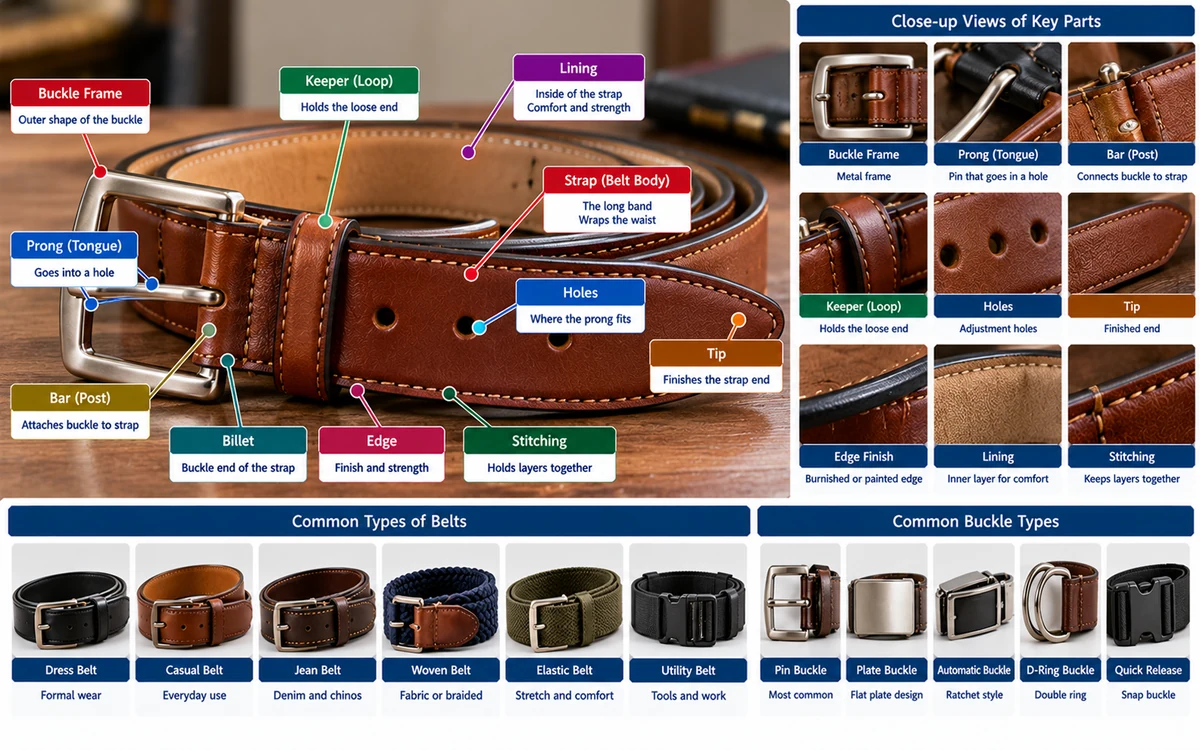
Parts of a belt at a glance
| Part | Location | Job |
|---|---|---|
| Strap (belt body) | The long band | Wraps the waist |
| Buckle | One end | Fastens the belt |
| Frame | Part of buckle | Outer shape of the buckle |
| Prong (tongue) | Part of buckle | Pin that goes in a hole |
| Bar (post) | Part of buckle | Attaches buckle to the strap |
| Keeper (loop) | Near the buckle | Holds the loose end flat |
| Holes | Along the strap | Where the prong fits |
| Tip | Free end | Finishes the strap end |
| Edge | Sides of the strap | Finish and strength |
| Lining | Back of the strap | Comfort and strength |
| Stitching | Along the strap | Holds layers together |
| Billet | Buckle end of the strap | The section that goes through the buckle |
The strap
The strap, also called the belt body or belt blade, is the long band. Its width depends on use.
- Narrow belts (about 2 to 2.5 cm): For dresses and light trousers.
- Dress belts (about 3 to 3.5 cm): The standard width for trousers and suits.
- Casual belts (about 3.5 to 4 cm): For jeans and chinos.
- Wide belts (4 cm and above): For work belts and fashion belts.
These numbers are typical, not strict. Each brand sets its own sizes.
Strap construction
A strap can be made from a single layer or several layers. Common builds include:
- Full grain leather strap: A single thick piece of top-quality leather. Strong and ages well.
- Bonded leather strap: Leather scraps pressed together with glue. It looks like leather but can crack and peel.
- Layered leather strap: A top leather layer, a middle filler and a backing leather. Common in dress belts.
- Woven or braided strap: Strands of fabric or leather woven into a flexible band.
- Webbing strap: A flat woven band of cotton, nylon or polyester. Common in casual and military belts.
- Elastic strap: A stretch band used in comfort belts and for children.
- Synthetic strap: A polyurethane layer on a fabric backing, used for low-cost belts.
Edge finish
The edge of a leather belt can be finished in several ways. It can be burnished, which means rubbed with heat and wax until smooth and shiny. It can be painted with edge paint, giving a neat colored line. It can be folded under, with a stitched edge. Poor edge finish peels and frays, and is a first sign of low quality.
Backing and lining
The back of a belt is often lined with a softer leather or fabric. This protects the belt from sweat and makes it more comfortable against the waist. The lining is glued and stitched to the strap.
The buckle
The buckle is the fastener. It has several small parts of its own.
Frame
The frame is the outer shape of the buckle. It can be rectangular, square, oval or ornamental. A heavy frame gives a bold look. A slim frame looks dressy. For a belt with a decorative plate, such as a Western belt, the frame can be large and engraved.
Prong or tongue
The prong is the metal pin that sits across the frame and goes into a hole in the strap. It must be strong enough to carry the pull of the waist. A thin prong can bend. A rough prong can wear the holes.
Bar or post
The bar is a rod inside the frame, around which the strap is folded. It holds the buckle to the strap. The prong is attached to this bar so it can pivot.
Buckle types
- Single prong buckle: The most common type for dress and casual belts.
- Double prong buckle: Two prongs for extra hold, sometimes found on wide belts.
- Roller buckle: A small roller on the bar lets the strap slide easily.
- Plate (box) buckle: A decorative plate with a hook, common on Western belts.
- Pin and clasp: A frame with a pin, often seen on fashion belts.
- Slide or ratchet buckle: Uses a track with small teeth instead of holes. It allows micro-adjustment.
- Military or web buckle: A metal plate with a slot, used on webbing belts.
- Magnetic or snap buckle: Used on light belts for ease of use.
Buckle materials
Buckles are usually made of zinc alloy, brass, stainless steel or nickel-plated metal. Zinc alloy is cheap and easy to cast, but can crack. Brass is strong and takes plating well. Stainless steel is hard and resists rust. Plating quality matters. Poor plating peels in months and exposes the base metal.
The keeper
The keeper, also called a belt loop, is a small band that sits near the buckle. It holds the free end of the belt flat after the belt is fastened. Most belts have one fixed keeper and one floating keeper. The fixed keeper is stitched to the strap. The floating keeper slides along the strap.
Keepers can be made of the same material as the strap or from metal. A weak keeper tears or snaps, letting the tail flap.
Holes
Holes are punched along the strap. The prong passes through one of them. Hole spacing is usually 2.5 cm (1 inch) apart for dress belts. A belt typically has five holes, though some have more.
The holes should be clean, round and reinforced. Poor holes tear and stretch over time. A leather belt can have a small eyelet in each hole, but this is less common on dress belts.
The central hole is where most people wear the belt. If you wear the belt on the first or last hole, the size is probably wrong.
The tip
The tip is the free end of the strap. The shape of the tip is part of the style. It can be square, round, pointed or beveled. Some belts add a metal tip for strength and decoration.
For a sharp, tidy look, the tip is cut with a die and the edges are finished. A rough tip with loose fibers shows poor workmanship.
Stitching
Stitching holds the layers of the belt together and attaches the keeper and the buckle. Strong belts have tight, even stitching close to the edge. The thread is usually nylon or polyester, because it resists wear and sweat.
Weak points include the buckle end and the keeper. These areas take the most strain. A good belt has several rows of stitching or rivets here.
Rivets and screws
Some belts, especially Western and work belts, use metal rivets or screws. A rivet is a small metal pin that is flattened on one side to hold two layers together. A screw allows the buckle to be changed. This is common on belts with interchangeable buckles.
Belt sizing
Belt size is measured from the buckle’s attachment point to the hole you use most. A standard rule is to buy a belt 2 inches (5 cm) larger than your trouser waist size. For example, a size 34 trouser needs a 36 belt. This is because the belt measures the length of the strap, not the waist.
To measure correctly:
- Take a belt you already wear and like.
- Lay it flat.
- Measure from the part of the buckle where the strap folds to the hole you use.
- That is the belt size.
Sizes differ by brand and region. Some sell belts in small, medium and large. Always check the size chart.
Belt types
| Type | Features |
|---|---|
| Dress belt | Slim, plain leather, small buckle |
| Casual belt | Wider, may be stitched, more textured |
| Jeans belt | Thick, with a bold buckle |
| Western belt | Wide, with an ornate plate buckle |
| Webbing belt | Flat woven band, adjustable |
| Reversible belt | Two colors on one strap, with a rotating buckle |
| Ratchet belt | No holes, adjusts with a track |
| Stretch belt | Elastic strap for comfort |
| Tool belt | Heavy duty with pouches |
| Obi or sash | Wide cloth belt tied around the waist |
How a leather belt is made
- Leather selection: Hides are chosen and checked for marks.
- Cutting: The leather is cut into strips, using a die or a strap cutter.
- Skiving: The edges and ends are thinned so they fold neatly.
- Edge finishing: Edges are burnished or painted.
- Hole punching: Holes are punched at set spaces.
- Buckle attachment: The strap is folded around the buckle bar and stitched or riveted.
- Keeper attachment: The keeper is stitched on.
- Finishing: The belt is cleaned, polished and labeled.
- Inspection and packing: Each belt is checked for flaws.
A similar process applies to fabric belts, with sewing instead of burnishing.
Common faults
- Cracking leather: Poor tanning or bonded leather.
- Peeling edges: Weak edge paint or bad gluing.
- Bent prong: Soft metal.
- Loose keeper: Weak stitching or glue.
- Buckle plating peeling: Poor plating.
- Stretched holes: Weak leather or holes punched too close to the end.
- Wrong size: Holes not placed correctly.
- Colour transfer: Dye rubbing off on clothes.
- Uneven strap width: Cutting errors.
- Rust: Low grade metal or damp storage.
For wider guidance on checking trims and fittings, our guide on trims and accessories inspection covers similar methods.
How to choose a good belt
- Check the material. Full grain leather is the best choice for durability.
- Flex the strap. It should bend without cracks.
- Look at the edge. It should be smooth and sealed.
- Check the stitching. It should be even and tight.
- Test the buckle. The prong should move smoothly.
- Count the holes. You should be able to fasten the belt on the middle hole.
- Look at the keeper. It should hold the tail neatly.
Belt loops on the garment
A belt only works with the loops on the garment. Trouser makers sew belt loops onto the waistband, usually five to seven of them, with extra loops at the back. Each loop is held at both ends by a bar tack, which is a short, dense block of stitches. Loops are cut slightly wider than a standard belt, so that belts up to about 4 cm can pass through them. If you often wear wide belts, check that the loops are wide enough. For a closer look at waistbands and loops, read our guide on the parts of shorts, where the same parts appear in smaller form.
Care tips
- Hang the belt or roll it loosely. Do not fold it sharply.
- Keep leather away from water and heat.
- Condition leather belts a few times a year.
- Wipe buckle metal with a soft cloth.
- Rotate belts so each gets rest.
Final thoughts
A belt is a simple object, but good ones depend on small details. The strap has to be strong, the edges sealed, the buckle solid and the stitching tight at stress points. Next time you pick up a belt, check four things: the strap material, the edge, the buckle attachment and the holes. If those are good, the belt will serve you for years.
Frequently asked questions
The main parts are the strap, buckle, prong, keeper, holes and tip. Most also have stitching and a lining.
It is called a keeper. It holds the loose end of the belt flat once the belt is fastened.
It is called the prong or tongue. It goes into the holes in the strap.
Measure a belt you already wear, from where the strap folds around the buckle to the hole you use. Or choose a belt about 2 inches larger than your trouser waist size.
Full grain leather usually lasts longest. It is strong and gets better with age. Bonded leather and synthetic straps wear out faster.
A ratchet belt has small teeth along the strap and a track in the buckle. It allows fine adjustment without holes.
Cracking is common in cheap or bonded leather, and in belts that are dry or folded sharply. Conditioning helps.