Every garment you own has a small tag sewn into a seam. It has a few drawings on it, like a tub of water, a triangle and a square with a circle inside. Most people look at it only after a wash has gone wrong. For a factory and a brand, though, care labels are a serious matter. A wrong symbol can cause a damaged garment, an angry customer and a legal problem.
This guide explains what care labels are, how the five main wash symbols work, how to read the extra marks, where to place the label and how to avoid common mistakes. It also shows how the label links to testing. If you want to see how trims fit into a garment, read our article on trims and accessories inspection.
What is a care label
A care label is a permanent label attached to a garment that tells the user how to clean and care for it. It gives instructions for washing, bleaching, drying, ironing and professional cleaning. It can use symbols, words or both.
The aim is simple. The label must tell the customer what treatment is safe so the garment keeps its shape, color and feel. The brand must be able to prove that the care instruction works, which means the garment should be tested using the same conditions.
Why care labels matter
- They protect the customer from damaging the garment.
- They reduce returns and complaints.
- Many countries require care labels by law or by trade rules.
- Buyers audit labels as part of quality and compliance checks.
- They show the brand cares about the product.
Care label rules differ between markets, so check the rules for each country you sell to. Some markets require words in the local language as well as symbols. Others accept symbols only.
The five basic care symbols
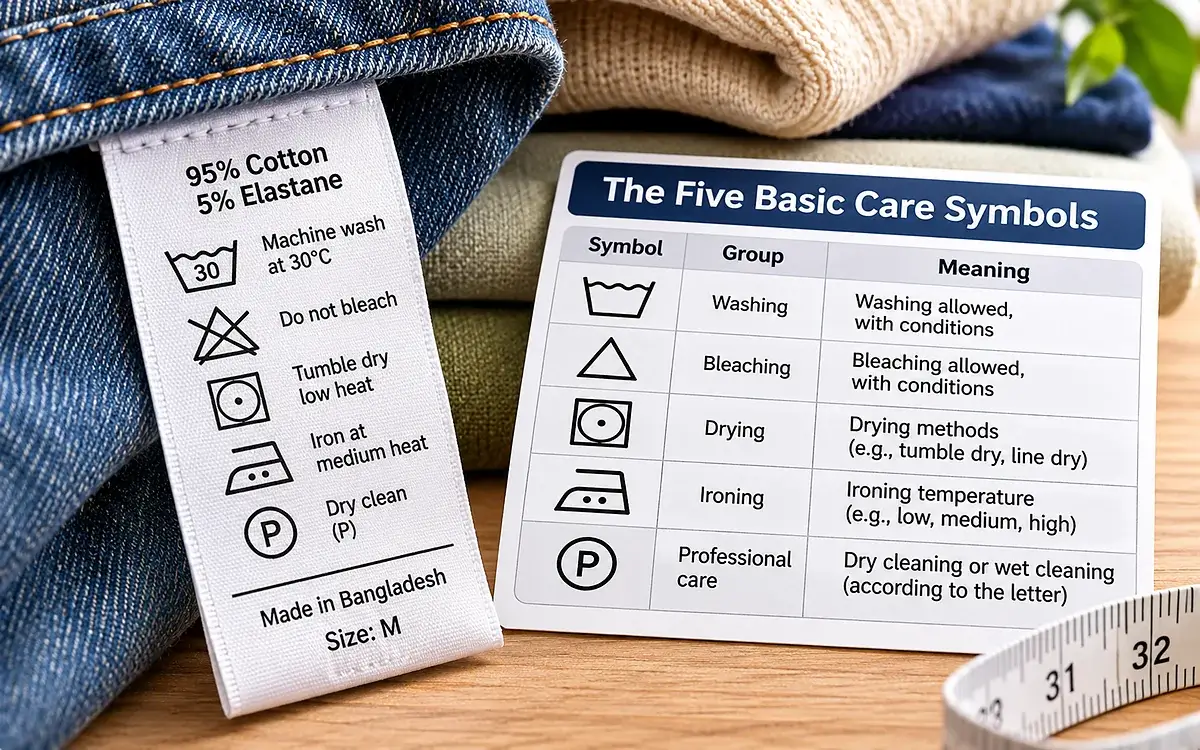
Most care label systems use five symbols in a fixed order: washing, bleaching, drying, ironing and professional care. Each has a basic shape.
| Group | Basic symbol | Meaning |
|---|---|---|
| Washing | Wash tub | Washing allowed, with conditions |
| Bleaching | Triangle | Bleaching allowed, with conditions |
| Drying | Square | Drying methods |
| Ironing | Iron | Ironing temperature |
| Professional care | Circle | Dry cleaning or wet cleaning |
A cross over any symbol means “do not”. For example, a crossed tub means do not wash and a crossed triangle means do not bleach.
1. Washing symbol (the tub)
A tub of water means the garment can be washed. Details are added inside or under the tub.
- A number inside the tub shows the highest water temperature in degrees Celsius, such as 30, 40 or 60.
- Dots inside the tub are used in some systems. One dot means a low temperature and more dots mean a higher one.
- A bar under the tub shows a gentler cycle. One bar means a mild cycle and two bars mean a very gentle one.
- A hand in the tub means hand wash only.
- A crossed tub means do not wash.
2. Bleaching symbol (the triangle)
- An empty triangle means any bleach is allowed.
- A triangle with two diagonal lines means only oxygen or non-chlorine bleach is allowed.
- A crossed triangle means do not bleach.
3. Drying symbol (the square)
The square covers tumble drying and natural drying.
- A square with a circle inside means tumble drying is allowed.
- Dots in the circle show the heat. One dot is low heat and two dots are a normal heat.
- A crossed square with a circle means do not tumble dry.
- A square with a curved line at the top is line drying.
- A square with vertical lines is drip dry.
- A square with a horizontal line is dry flat.
- A square with diagonal corner lines is drying in the shade.
4. Ironing symbol (the iron)
Dots on the iron show the maximum sole plate temperature.
| Dots | Meaning |
|---|---|
| One dot | Low heat |
| Two dots | Medium heat |
| Three dots | High heat |
| Crossed iron | Do not iron |
| Iron with crossed steam lines | Do not use steam |
5. Professional care symbol (the circle)
- A plain circle means professional dry cleaning is allowed.
- A letter inside tells the cleaner which solvent group to use.
- A bar under the circle means a gentler process.
- A circle with a W means professional wet cleaning.
- A crossed circle means do not dry clean.
The exact letters and the meaning of each depend on the standard in use. Brands should follow the system required in their market.
Systems and standards
Several systems are in use. Many countries use a system based on an international standard for care labeling (ISO 3758), which is close to the symbols from the GINETEX association. North America uses a system defined by ASTM D5489 and, in the United States, a federal rule on care labeling, which allows both words and symbols. Check the version that applies to your market, because rules and symbols have changed over time.
A simple rule: use one system per product line, follow the market’s required one and do not mix symbols from different systems on the same label.
Words on the label
Even with symbols, a label often carries text. Common lines include:
- Machine wash cold with like colors
- Wash inside out
- Do not bleach
- Tumble dry low
- Warm iron if needed
- Dry clean only
- Wash separately
Keep the wording short and clear. Use the same words every time, so staff and customers learn the pattern.
Other information on the label
A care label often sits beside, or is combined with, other required information.
- Fiber content: For example, 95 percent cotton and 5 percent elastane.
- Country of origin: Where the garment was made.
- Size: The size and, in some markets, a second size system.
- Brand and registration numbers: Used in some markets.
- Supplier code or lot number: Useful for traceability.
Check the labeling rules of each market, since the content and the order are often controlled.
Where to place the care label
Placement rules matter because the label must stay with the garment and be easy to find.
- Sew the label in a seam that is hard to remove, such as the side seam or the center back neck.
- Make sure it is permanent. It should last as long as the garment does.
- Keep the label readable after washing.
- For comfort, use a soft label or a printed one for items worn close to the skin, such as underwear and baby wear. A heat transfer label can avoid scratching. See our article on heat transfer labels.
- For jackets, coats and other layers, place the label in an inner seam or pocket bag.
- For a multi-part set, such as a suit, each part needs its own label.
Choosing the right care instruction
The care instruction is not a guess. It must match what the fabric, trim and finish can take.
- Check the fiber. Wool needs gentle care. Polyester tolerates more. Viscose may shrink.
- Check the dye. Poor color fastness means a lower wash temperature. Read our guide on color fastness tests.
- Check the trims. Buttons, zippers, prints and linings must handle the same care.
- Check the finish. Coated, waxed or flocked fabric needs special care.
- Test the garment. Wash it using the label’s own instruction and measure shrinkage, color change and appearance.
- Use the mildest necessary instruction. If a garment passes at 40 degrees, do not print 60.
For the shrinkage side, our guide on shrinkage control explains how to check dimension change after washing.
A worked example
A brand makes a cotton and elastane t-shirt, dyed in a dark shade. The fabric test shows:
- Shrinkage after a 40 degree wash is 3 percent in length, which is inside the buyer’s limit.
- At 60 degrees, shrinkage is 6 percent, which fails.
- Color change after a 40 degree wash is grade 4.
- Staining after wash is grade 3-4 on nylon, a little low.
The label should say 40 degrees at most. Because staining is low, adding “wash with similar colors” is wise. A tumble dry on low heat also protects the elastane. The final label would show a tub with 40, a crossed triangle for bleach, a square and circle with one dot and an iron with one or two dots. The numbers here are examples, so use your own test results.
Care advice by garment type
Different products need different advice, so do not copy one label to every style.
| Garment | Common care advice |
|---|---|
| Cotton t-shirt | Machine wash cool or warm, tumble dry low |
| Denim | Wash inside out in cold water, avoid bleach |
| Wool sweater | Hand wash or wool cycle, dry flat |
| Silk blouse | Dry clean or gentle hand wash, low iron |
| Sportswear | Wash cool, no softener, low heat or line dry |
| Underwear and socks | Wash warm or cool, avoid high heat on elastic |
| Jacket with lining | Dry clean or follow the lining’s limit |
When a garment has two or more fabrics, the most delicate part sets the limit.
A quick label approval checklist
Before approving a care label for production, check:
- The symbols follow the standard of the target market.
- The wording matches the symbols.
- The fiber content matches the test report.
- The temperature matches the garment wash test.
- The label is soft enough for the body area.
- The text stays readable after five washes.
- The label is sewn in the right place.
- The language is correct for the destination.
- The buyer has signed off the artwork.
Keep a copy of the approved artwork and the test report in the style file. If a complaint comes up months later, you can show what was tested and what was printed.
Common care label mistakes
| Mistake | Problem | Fix |
|---|---|---|
| Label says 60 but the garment is only tested at 40 | Damaged garments, claims | Test at the stated temperature |
| Wrong symbol order | Confusion, compliance issues | Follow the standard |
| Label falls off | Missing information | Sew in a strong seam |
| Label scratches skin | Complaints | Use a soft or printed label |
| Text is too small to read | Not useful | Use a readable size |
| Wrong fiber percent | Legal risk | Confirm composition with test |
| Different instructions on trims | Mixed advice | Match all components |
| Symbols and words disagree | Confusion | Check both |
| Label fades after washing | Unreadable | Use durable ink or woven labels |
| Missing language | Market non-compliance | Check market rules |
Label materials
Care labels come in several forms.
- Woven labels: Durable and neat, but costly for long text.
- Printed satin or polyester labels: Common and cheap. The print must resist washing and rubbing.
- Heat transfer labels: No tag in the neck, good for comfort.
- Paper or cardboard hang tags: Not permanent. They do not replace a sewn label.
- Leather or patch labels: Used on special products, with care text kept in a separate label.
Test the label too. Wash it with the garment and check that text and symbols stay clear.
Final thoughts
A care label is small, but it carries a promise. It tells the customer how to look after the garment, and it tells the buyer that the brand has tested the product. Learn the five symbols, follow the right standard for your market, place the label well and test every instruction. When the label is honest and clear, the garment lasts longer and the customer stays happy.
Frequently asked questions
Care labels are permanent labels in a garment that tell the user how to wash, bleach, dry, iron and professionally clean it.
They are the wash tub, the bleach triangle, the dry square, the iron and the professional care circle. A cross over a symbol means do not do it.
It shows the highest water temperature, in degrees Celsius.
It means do not dry clean.
It depends on the market. Some markets accept symbols only and some require words in the local language.
In a strong seam, such as the side seam or center back neck, where it stays with the garment.
Wash and test the garment under the same conditions as the label and check shrinkage, color and appearance.