Acid wash jeans have a look you can spot across a street: a sharp, marbled pattern of white and blue, as if the denim had been dipped in frost. The style started in the 1980s, faded for a time and now comes back every few years in fashion cycles. If you want to know how to acid wash jeans, you will find two very different answers. One is the factory process, which uses special stones and chemicals in big machines. The other is a home method that can be done safely with household bleach, if you take the right precautions.
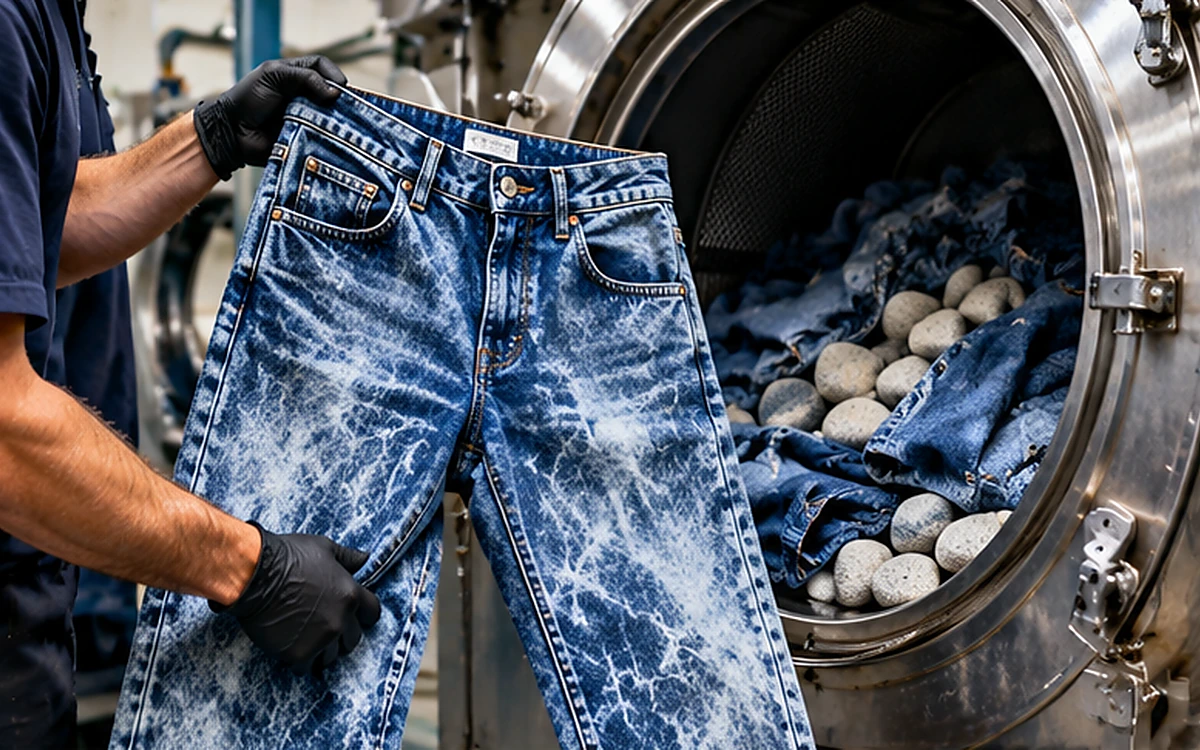
This guide explains both. You will learn what acid wash really is (the name is misleading), how a denim washing plant produces the effect step by step, how to get a similar look at home, what mistakes to avoid and how to stay safe. There is a worked recipe for a 60 kg batch of jeans, with every quantity calculated. If you want the basics of denim itself first, see our guides on what denim is and how denim fabric is made.
What is acid wash?
Acid wash is a finishing treatment that removes indigo dye from the surface of denim unevenly, leaving high-contrast white or light patches against deep blue. Despite the name, the factory process does not normally use a strong acid on the fabric. The “acid” in the name most likely comes from the harsh, chemical look of the result.
The two key ingredients in the classic factory method are:
- Pumice stones. Lightweight volcanic stones that rub the denim.
- An oxidising chemical, usually potassium permanganate or sodium hypochlorite. It is soaked into the stones and then transferred to the fabric by contact. It destroys indigo dye where the stones touch.
Because the chemical is carried by the stones and applied only at the contact points, the fabric bleaches in patches instead of evenly. That patchy contrast is the acid wash look.
This is different from an ordinary stone wash, where wet stones just rub the denim to soften and fade it evenly. For that process, read our guide to the stone wash denim process.
How acid wash differs from other washes
| Wash | Main action | Look |
|---|---|---|
| Rinse wash | Light wash and softening | Dark, almost raw |
| Stone wash | Pumice stones in water | Even fade, worn look |
| Enzyme wash | Cellulase enzymes | Soft, mild fade |
| Bleach wash | Sodium hypochlorite in the bath | Even light colour |
| Acid wash | Dry stones soaked with oxidiser | Marbled, high contrast |
| Ozone and laser | Gas or light | Clean, modern fade with less water |
Our comparison of stone wash, enzyme wash and ozone wash shows how these choices differ in look, cost and impact.
The factory process step by step
A denim washing plant follows a clear sequence. The times and amounts below are typical, but they change with the fabric weight, the machine and the target shade.
Step 1: Desizing
Denim warp yarns carry starch size from weaving. The garments are first washed with enzymes (amylase) or detergent to remove it. If size stays on, it blocks the next steps. This takes about 10 to 20 minutes at 50 to 60 °C. Our page on desizing process methods explains this stage.
Step 2: Spin or hydro-extract
The garments are spun in an extractor to remove most of the water. For acid wash, they must be nearly dry or only slightly damp, because the stones need to rub against the fabric surface and not float in a bath.
Step 3: Prepare the stones
Pumice stones are dried and loaded into a basket or a tank. A solution of potassium permanganate in water is sprayed over them or the stones are soaked in it. The stones absorb the solution. Operators then let the stones sit for a short time so the chemical spreads through them.
Step 4: Tumble garments with the stones
The damp garments and the soaked stones are put together in a dry tumble machine, which is like a large dryer with a drum. As the drum turns, the stones tumble against the jeans and transfer chemical at each contact point. The permanganate reacts with indigo and bleaches it.
The tumble time is short, often 10 to 30 minutes, and operators check the pattern frequently. They stop the machine as soon as the desired contrast is reached.
Step 5: Remove stones
The jeans are taken out and the stones are shaken off. Stones can be reused several times, though they wear down.
Step 6: Neutralise
Potassium permanganate leaves brown manganese dioxide deposits on the fabric. To remove this stain and stop the bleaching, the jeans are washed in a bath with sodium metabisulphite (a reducing agent) and sometimes a little acid, such as oxalic or acetic acid. The brown colour disappears, and the fabric turns pale.
Step 7: Rinse, soften and dry
The garments are rinsed well, treated with a softener, spun and dried. Many are then finished by hand with extra whiskers, tinting or a light overdye to adjust the final colour.
A worked recipe: acid wash for 60 kg of jeans
Let us calculate quantities for one batch. These numbers are illustrative. A washing technician would adjust them by trial on the actual fabric and machine. All chemicals should be handled with local safety rules.
Given
- Batch of dry jeans: 100 pairs, average 0.6 kg each
- Stone to garment ratio: 1.5 : 1 by weight
- Potassium permanganate solution: 15 g/L, using 0.5 litre of solution per kilogram of stones
- Neutralising bath liquor ratio: 1 : 10
- Sodium metabisulphite: 2 g/L
Step 1: Weight of garments.
100 × 0.6 = 60 kg
Step 2: Weight of stones.
60 × 1.5 = 90 kg
Step 3: Volume of permanganate solution.
90 kg of stones × 0.5 L/kg = 45 litres
Step 4: Weight of potassium permanganate.
15 g/L × 45 L = 675 g = 0.675 kg
Step 5: Neutralising bath volume.
60 kg × 10 = 600 litres
Step 6: Weight of sodium metabisulphite.
2 g/L × 600 L = 1,200 g = 1.2 kg
Summary of the batch
| Item | Quantity |
|---|---|
| Garments | 60 kg (100 pairs) |
| Pumice stones | 90 kg |
| Potassium permanganate | 0.675 kg in 45 L water |
| Neutralising liquor | 600 L |
| Sodium metabisulphite | 1.2 kg |
Notice that the oxidising chemical is under 1 kg for the whole batch. The water used for neutralising and rinsing is the largest volume, which is why washing plants focus on water saving. Our page on chemical consumption per kg of fabric explains how to track this kind of use.
What can go wrong in the factory
| Problem | Likely cause | Fix |
|---|---|---|
| Patches too strong or burnt look | Too much chemical or too long a tumble | Reduce dose, check every few minutes |
| Weak pattern | Stones too dry or too few | Check the solution uptake and ratio |
| Brown stains | Poor neutralising | Increase metabisulphite or add mild acid |
| Fabric damage and holes | Over-bleaching, harsh stones | Shorter time, test strength before bulk |
| Uneven batches | Different dry weights or loading | Standard loading and drying before treatment |
| Yellowing after storage | Chemical residue | Rinse well and neutralise fully |
Aggressive treatments weaken cotton. Factories test tear strength, tensile strength and seam strength before and after washing to make sure the jeans still meet the buyer’s standard. Our guide to garments washing defects covers more issues.
How to acid wash jeans at home
You cannot copy the factory process at home safely. Potassium permanganate is a strong oxidiser and can cause burns and stains. But you can get a good marbled look with plain household bleach, if you follow safety steps. This is the bleach marble method.
What you need
- A pair of 100 percent cotton denim jeans. Dark blue works best. Stretch denim with polyester or spandex will fade less evenly.
- Household bleach (sodium hypochlorite), with a label that says it is suitable for whites and colours as appropriate
- A plastic bucket or tub, and a spray bottle
- Rubber gloves, safety glasses and old clothes
- A well-ventilated space, such as outdoors
- Water
- Optional: small stones, golf balls, rubber bands or sponges
- Plenty of cold running water for rinsing
Method 1: Marble with crumpled fabric
- Wash the jeans first. Use no softener. Leave them damp.
- Crumple the jeans. Scrunch each leg into a tight ball, and tie with rubber bands, or twist the whole pair into a spiral and tie. The folds shield part of the fabric and create the marbled pattern.
- Mix the bleach. Pour 1 part bleach and 1 part water into a bucket or spray bottle. Never mix bleach with any other cleaner, especially ammonia or acids, which can create toxic gas.
- Apply. Spray or pour the diluted bleach on the exposed folds. Do not soak the whole pair.
- Watch the colour. Wait 5 to 15 minutes. The blue will turn lighter, then go greyish or orange-yellow at the edges. Check every few minutes.
- Stop the reaction. Rinse in plenty of cold running water until the bleach smell is gone, and keep rinsing for several minutes. Do not add vinegar or any other cleaner to the rinse while bleach is still in the fabric.
- Wash and dry. Wash on a normal cycle with detergent, then dry in the shade or on a low tumble setting.
Method 2: Stones in a tub
This copies the factory idea with safer materials.
- Place the damp jeans in a bucket and add several smooth stones or golf balls.
- Wrap the stones in the fabric to create contact points.
- Soak the stones with diluted bleach first and let them sit for a minute, then pack them in. The bleach transfers only where stones touch.
- Then follow steps 5 to 7 above.
Method 3: Spray and sponge
For a lighter effect, dab diluted bleach on the jeans with a sponge. Press and twist the sponge for a mottled pattern. Rinse and wash.
Home safety checklist
- Work outdoors or near an open window.
- Wear gloves and eye protection.
- Never mix bleach with ammonia, vinegar, toilet cleaner or any other chemical.
- Keep children and pets away.
- Test on a hidden spot or an old pair of jeans first.
- Do not leave bleach on the fabric for long. It weakens cotton fibres.
- Rinse fully. Bleach left in the fabric can cause yellowing and rot.
- Do not pour large amounts of bleach into drains that lead to septic systems.
Tips for better results
- Start with dark denim. The higher the starting colour, the stronger the contrast.
- Choose 100 percent cotton. Polyester and spandex do not bleach, so the look is weaker.
- Use less bleach than you think. You can always add more, but you cannot put the colour back.
- Work in daylight. You can judge the pattern better.
- Try the pattern first on a scrap. Old jeans make good test pieces.
- Finish with a gentle wash. Wash the jeans alone for the first few times.
Caring for acid wash jeans
Bleached cotton is weaker than untouched cotton. To keep your jeans longer:
- Wash inside out in cold water.
- Use a mild detergent.
- Skip chlorine bleach.
- Air dry when possible.
- Mend small holes before they grow.
Our guide to care labels and wash symbols helps you read the symbols on other garments.
Environmental and worker safety points
Potassium permanganate and hypochlorite washes create wastewater with oxidisers and manganese salts, and the dust from pumice stones is harmful to breathe. Responsible plants use closed systems, dust control, neutralising treatment and effluent treatment. Many brands now replace acid washing with laser fading and ozone treatment, which use much less water and fewer chemicals, and reproduce a similar look. The classic method still has a place, but it needs careful control.
Final thoughts
To sum up how to acid wash jeans: in the factory, pumice stones soaked with potassium permanganate tumble against nearly dry denim, bleach the indigo at the contact points, and the garments are then neutralised, rinsed and softened. At home, you can copy the marbled look with diluted household bleach, crumpled fabric and careful rinsing, as long as you follow safety rules.
The key to both is control. Use only as much chemical as the look needs, stop the reaction on time and neutralise well. That is how you get a bold marble pattern without wrecking the jeans.
Frequently asked questions
It is denim treated to remove indigo unevenly, leaving a marbled pattern of light and dark blue. In factories, dry pumice stones soaked in an oxidiser such as potassium permanganate create the pattern.
Not usually. The factory process uses an oxidising chemical, not a strong acid on the fabric. A mild acid may be used in the neutralising bath.
You can make a similar marbled look with diluted household bleach, crumpled fabric and stones or sponges. Do not try the factory chemicals at home.
Dark, 100 percent cotton denim gives the strongest effect. Stretch denim with polyester or spandex fades less evenly.
Usually 5 to 15 minutes, checking often. Stop when the colour is a little lighter than you want, because it can keep lightening. Rinse well.
It can weaken the cotton, especially if left too long or if too much chemical is used. Factories test strength before and after washing.
Dilute the bleach, test on a scrap, watch the time and rinse in plenty of cold running water, then wash with detergent. Never add vinegar or other cleaners while bleach is still in the fabric.