
Students, new merchandisers and curious shoppers often ask about the difference between fibre and fabric, and many also mix in a third word, yarn. They sound close. People use them in the same sentence. But each one names a different stage of textile making, and getting them straight makes everything else easier to follow, from reading a fabric label to talking with a mill.
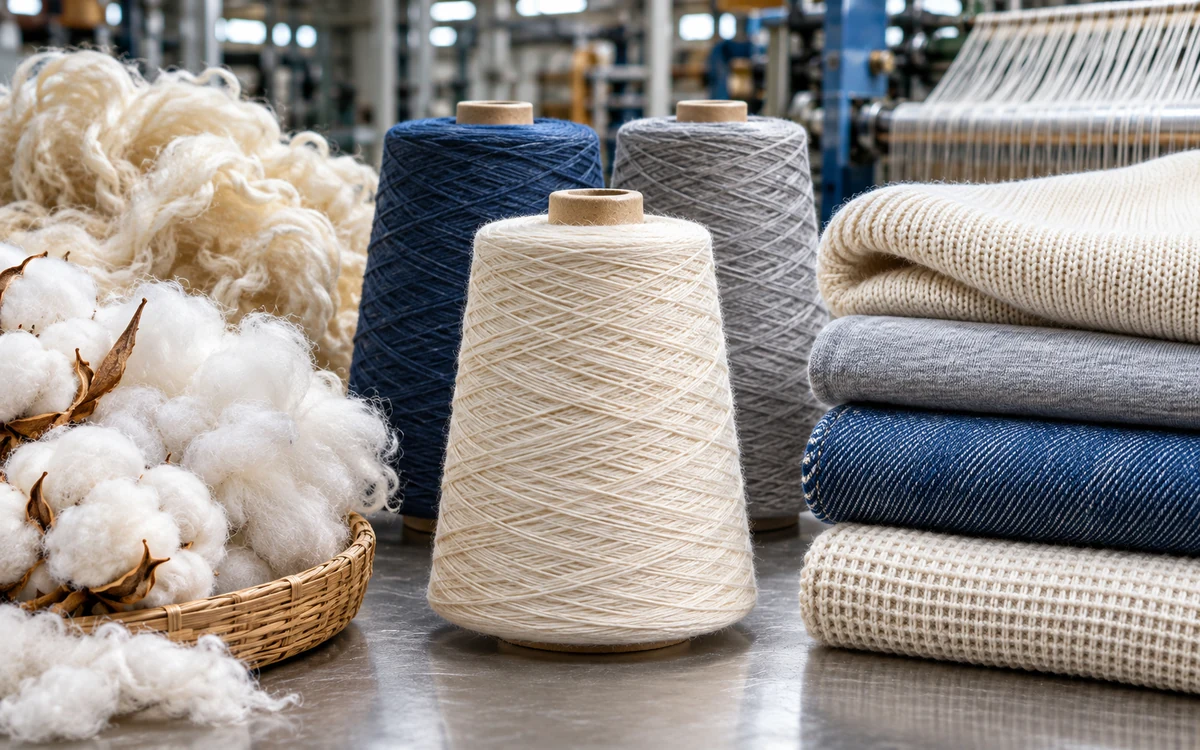
The short version is this. A fibre is a tiny hair-like strand. A fabric is a flat sheet made from many of those strands after they have been spun and then woven, knitted or bonded. Yarn is the link between the two. This guide explains each one, shows how they connect, compares them in a table and ends with a worked example that counts how many fibres are inside a single yard of cloth. The answer is far larger than most people guess.
The chain at a glance
Fibre → yarn → fabric → garment
Think of it like building a rope bridge. A single strand of grass is weak. Twist many strands into a cord and you get something strong. Weave cords together and you get a mat you can walk on. The grass is the fibre, the cord is the yarn and the mat is the fabric.
What is a fibre?
A fibre is the smallest basic unit of a textile. It is thin, flexible and much longer than it is wide. Cotton fibres, for example, are only a few centimetres long and thinner than a human hair, while a silk fibre can be hundreds of metres long.
Fibres come in two main kinds by length.
- Staple fibres are short. Cotton, wool and flax are natural staple fibres. Man-made fibres can be cut into short lengths as well.
- Filament fibres are very long, nearly continuous. Silk is the natural filament. Polyester and nylon filaments are produced by machines.
By origin, fibres fall into natural groups (plant, animal, mineral) and man-made groups (from natural polymers or synthetic). Our guides on the classification of textile fibres and the different types of textile fibres list them all, and the page on natural and synthetic fibre differences compares the two big families.
On its own, a fibre is not much use for clothing. It is too short, too weak and too hard to handle.
What is yarn?
Yarn is a continuous strand made by twisting or joining fibres together. Twist holds the short fibres in place by friction and gives strength. Filament yarn is made by gathering long filaments, sometimes with a little twist.
Yarn is the material that weavers and knitters actually use. It is measured by its count, which tells you how thick or fine it is. Our guide on yarn count explains the systems. If you want to see how fibres become yarn, our page on the yarn making process goes step by step.
What is fabric?
Fabric is a flat, flexible sheet made from fibres or yarns. The main methods are:
- Weaving. Two sets of yarn cross at right angles.
- Knitting. Yarn forms interlocking loops.
- Nonwoven methods. Fibres are bonded together by heat, chemicals or needles, with no yarn at all. Felt and many wipes are examples.
Fabric is what cutters and sewers handle in a garment factory. It is measured by its weight (GSM), width, construction and so on. See our comparison of woven and knit fabric and the guide to GSM.
Fibre vs yarn vs fabric: comparison
| Feature | Fibre | Yarn | Fabric |
|---|---|---|---|
| What it is | Smallest textile unit, hair-like | Continuous strand made of fibres | Flat sheet made from yarns or fibres |
| Typical form | Loose tuft, bale or filament | Cone, bobbin or hank | Roll or bolt |
| Made by | Nature or chemical spinning | Spinning or twisting | Weaving, knitting or bonding |
| Measured by | Length, fineness, strength | Count, twist, strength | GSM, width, construction |
| Example | Cotton lint, polyester filament | 30s Ne cotton yarn | Single jersey, poplin, denim |
| Can you wear it? | No | No (except as thread or trim) | Yes, once cut and sewn |
| Main skill area | Fibre science, agriculture | Spinning | Weaving, knitting, finishing |
How the three connect
- Fibre becomes yarn. In a spinning mill, cotton or other staple fibre is opened, cleaned, straightened and twisted. Filament fibres may be twisted, textured or combined.
- Yarn becomes fabric. Weavers set yarn on a loom as warp and weft. Knitters feed yarn to a knitting machine.
- Fabric becomes garment. The finished fabric is cut and sewn.
Properties are passed down the chain. A cotton fibre that is soft and absorbent gives a yarn and fabric with similar traits. But each stage adds its own effect. Yarn twist changes the feel. Weave pattern changes the strength and drape. Finishing changes the hand and look. That is why two fabrics made from the same fibre can feel very different.
How properties change at each level
A fibre has traits of its own. These include length, fineness, strength, stretch, moisture uptake and how it reacts to heat. Yarn adds traits that come from how the fibres are put together. Fabric adds a third set.
| Trait | Set by the fibre | Set by the yarn | Set by the fabric |
|---|---|---|---|
| Softness | Fibre fineness and surface | Twist level and hairiness | Structure and finish |
| Strength | Fibre strength | Twist and evenness | Weave or knit type and density |
| Absorbency | Fibre chemistry | Open or tight yarn | Thickness and finish |
| Stretch | Fibre elasticity | Elastic yarn such as spandex | Knit loops give stretch, plain weave gives little |
| Warmth | Fibre type, such as wool | Bulky, airy yarn | Thickness and trapped air |
| Colour | Dye affinity of the fibre | Dyeing yarn or fabric | Printing, finishing, dyeing the cloth |
A simple case shows the point. Cotton fibre and cotton yarn are both absorbent. But a cotton towel loops the yarn into pile, which holds far more water than a flat cotton sheet of the same weight. The fibre did not change. The structure did.
Why fibre length matters
Long fibres can be twisted into a smooth, strong yarn with fewer fibre ends sticking out. Short fibres give a hairier, weaker yarn. This is one reason fine cotton such as Supima costs more. You can see the effect in our comparison of Supima and Egyptian cotton.
Filament fibres need no spinning to form a yarn. They are already long, so they make smooth, shiny fabrics. Staple fibres need spinning, and the process gives a softer, more matte look.
A worked example: counting fibres in a fabric
Let us put numbers on the chain. We will look at a cotton single jersey T-shirt fabric.
Given
- Fibre: cotton, with a fineness of about 4.2 micrograms per inch (a common micronaire value)
- Fibre length: about 28 mm
- Yarn: 30s Ne
- Fabric: 160 GSM
Step 1: Fineness of one cotton fibre
4.2 micrograms per inch = 4.2 × 10⁻⁶ g ÷ 0.0254 m = 0.0001654 g per metre.
Textile people prefer dtex, which is the weight in grams of 10,000 m. So the fibre is 0.0001654 × 10,000 = about 1.65 dtex.
Step 2: Fineness of the yarn
tex = 590.5 ÷ Ne = 590.5 ÷ 30 = 19.68 tex, which equals 196.8 dtex.
Step 3: Fibres in the yarn cross-section
Fibres per cross-section = yarn dtex ÷ fibre dtex = 196.8 ÷ 1.65 = about 119 fibres
So a 30s Ne cotton yarn has roughly 120 fibres side by side at any point along its length. This is why yarn quality depends so much on the evenness of the fibres. Lose a few and the yarn gets thin.
Step 4: Weight of a single fibre
One fibre of 28 mm weighs 0.0001654 g/m × 0.028 m = about 4.63 × 10⁻⁶ g. That is less than five millionths of a gram.
Step 5: Yarn length in one square metre of fabric
At 160 GSM, one square metre weighs 160 g. Because 1,000 m of yarn weighs 19.68 g, 160 g holds 160 ÷ 19.68 × 1,000 = about 8,130 m of yarn. That is over 8 km of yarn in a piece of cloth that is only a metre by a metre.
Step 6: Number of fibres in one square metre
Fibres = 160 g ÷ 4.63 × 10⁻⁶ g = about 34.6 million fibres
So one square metre of ordinary cotton T-shirt fabric holds roughly 35 million fibres. A T-shirt that uses about a square metre of fabric holds that many. These are estimates, because real fibres vary in length and fineness, but the scale is correct.
Summary
| Level | Measure |
|---|---|
| One fibre | About 1.65 dtex, 28 mm, 4.6 millionths of a gram |
| One metre of 30s Ne yarn | About 119 fibres across, 19.68 mg |
| One square metre of 160 GSM fabric | About 8.1 km of yarn and 35 million fibres |
Everyday examples
| Item | Is it fibre, yarn or fabric? |
|---|---|
| Cotton wool pad | Mostly loose fibre |
| Knitting wool ball | Yarn |
| Sewing thread spool | Yarn (thread) |
| Bedsheet | Fabric |
| Jeans | Garment made of fabric |
| Raw cotton in a bale | Fibre |
| A roll of denim | Fabric |
Why the difference matters at work
- Merchandisers. The buyer may ask about fibre content (such as 100 percent cotton), yarn count (30s Ne) and fabric GSM (160). Each answer sits at a different level.
- Quality teams. A problem can start at any level. Neps start in the fibre stage, thick and thin places come from the yarn stage, and holes or streaks come from the fabric stage.
- Designers. Fibre choice sets the base feel, yarn sets the look, and fabric construction sets the drape and stretch.
- Costing. Each step has its own cost and waste. Our page on the bill of materials in garments shows how fabric and trim are listed.
- Buyers. Fibre content on a label applies to the finished fabric, not to the yarn count or fabric weight.
A quick self-test
Try these before you move on. The answers are in brackets.
- A bale of raw cotton in a warehouse. Fibre, yarn or fabric? (Fibre.)
- A cone of 40s Ne yarn at a knitting mill. (Yarn.)
- A roll of poplin leaving the loom. (Fabric.)
- A strand of silk straight from the cocoon. (A natural filament fibre.)
- A sheet of felt made by needle punching wool. (Fabric, made directly from fibre with no yarn.)
- A spool of polyester sewing thread. (Yarn, in the form of thread.)
All six right? Good. You have the idea. If not, return to the comparison table near the top and read the “What it is” row again, because every mix-up in this topic comes from forgetting where a material sits in the chain from raw strand to finished sheet.
Common mix-ups
- “Fabric” and “cloth”. Often used for the same thing. “Cloth” is a casual word and “fabric” is the technical one.
- “Thread” and “yarn”. Thread is a type of yarn made for sewing. See our guide to sewing thread size, tex and ticket number.
- “Fibre” and “filament”. All filaments are fibres, but not all fibres are filaments, since many are short staple.
- “Material” and “fabric”. Material is a broad word that can cover leather, plastic and metal. Fabric is only textile.
Final thoughts
A fibre is the tiny strand. Yarn is many fibres twisted into a continuous line. Fabric is yarn (or sometimes fibre alone) formed into a sheet. Keep that order in mind, and fibre, yarn and fabric stop being confusing. Our counting example showed about 119 fibres across one 30s Ne yarn and about 35 million fibres in a single square metre of 160 GSM cotton jersey.
When you talk with mills, buyers or teachers, name the level you mean. Say fibre when you mean the raw material, yarn when you mean the strand and fabric when you mean the sheet. It saves mistakes and makes your questions sharper.
Frequently asked questions
A fibre is a tiny hair-like strand. A fabric is a flat sheet made from yarns or fibres by weaving, knitting or bonding.
Yarn is a continuous strand made from fibres. Fabric is a sheet made from many yarns.
No. Fibres are the small units. Yarn is made by twisting or joining fibres into a long continuous strand.
Fibre comes first, then yarn, then fabric, then the garment.
Yes. Nonwoven fabrics such as felt are made by bonding fibres directly.
Millions. Our example estimated about 35 million fibres in one square metre of 160 GSM cotton jersey.
Yes. Sewing thread is a type of yarn designed for stitching.


