
Kevlar is the fibre behind bulletproof vests, racing tyres, cut-resistant gloves and the ropes that hold up some of the biggest structures on earth. People often assume it is a kind of metal or a hard plastic sheet. It is neither. Kevlar is a textile fibre, spun into yarn and woven or laid into fabric like any other. So what is Kevlar made of, and why does a fibre this thin behave like armour?
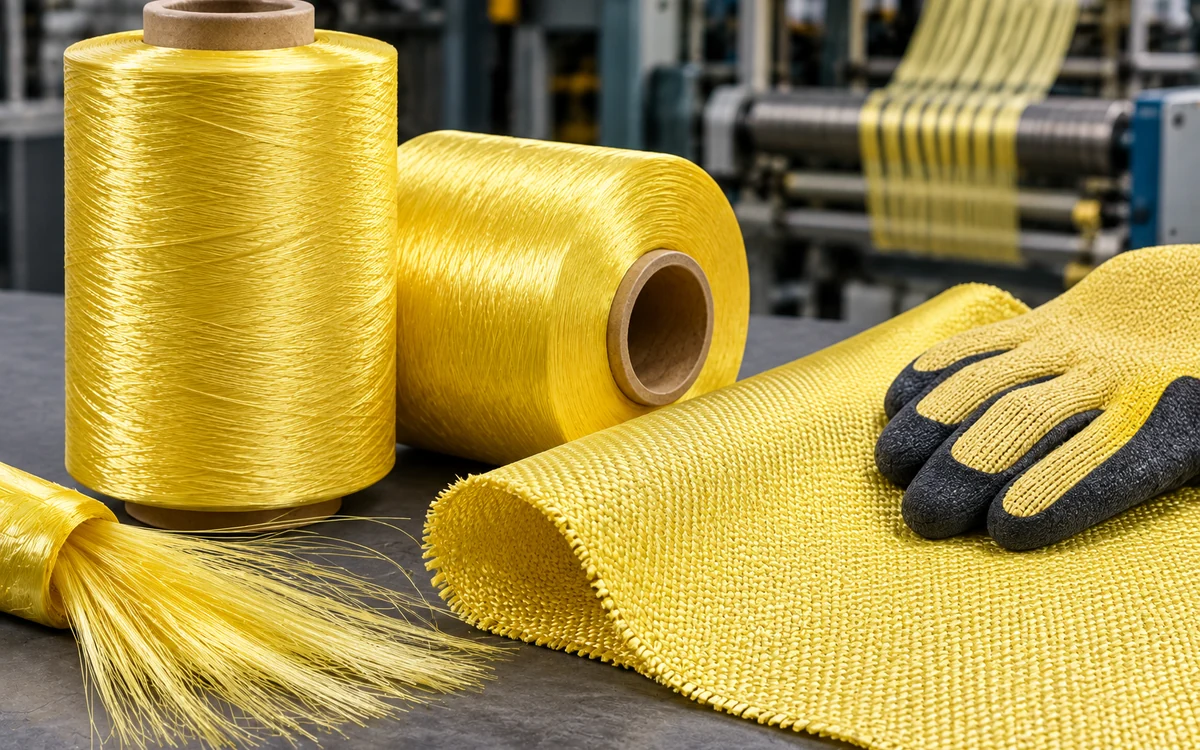
This guide answers that in plain language. You will learn the two chemicals that make up Kevlar, how they are joined into a polymer, how the polymer is spun into fibre, why the molecules give such high strength and what Kevlar is used for. We also work through a simple example that compares a Kevlar rope with a steel wire rope of the same strength. If you want a wider view of high-performance fibres, our page on glass, carbon and aramid technical fibres puts Kevlar next to its cousins.
The short answer
Kevlar is made from two chemicals, para-phenylenediamine and terephthaloyl chloride. When they react, they form a long chain polymer called poly(para-phenylene terephthalamide), often shortened to PPTA. This polymer belongs to a family called aramids, which is short for aromatic polyamides. The polymer is dissolved in strong sulfuric acid and pushed through tiny holes to make fibre. Kevlar is the brand name that DuPont gave to its para-aramid fibre. A very similar fibre is sold by another company under the name Twaron.
Let us unpack that, one piece at a time.
What aramid means
The word aramid joins “aromatic” and “polyamide.”
- Polyamide means a polymer made of units joined by amide links. Nylon is the best known polyamide. An amide link is a small group of atoms, a carbon double bonded to oxygen and single bonded to nitrogen, written as -CO-NH-.
- Aromatic means that the chain has benzene rings in it. A benzene ring is a flat ring of six carbon atoms. Rings are stiff and stable.
In nylon, the amide links are joined by flexible chains of carbon atoms, like a loose string of beads. In an aramid, the amide links are joined by stiff benzene rings. That one change turns a soft, stretchy polymer into a rigid, strong one. In the United States, a fibre is legally called aramid when at least 85 percent of its amide links are attached directly to two aromatic rings.
If you want to compare Kevlar with nylon, our guide to nylon 6 and nylon 66 shows how the aliphatic chain differs.
The two chemicals in Kevlar
Para-phenylenediamine (PPD)
This is a benzene ring with an amine group (-NH2) attached at each of two opposite ends. The word “para” means the two groups sit directly across the ring from each other, in the 1 and 4 positions. Its formula is C6H8N2.
Terephthaloyl chloride (TPC)
This is also a benzene ring, but with an acid chloride group (-COCl) at each of two opposite ends. Its formula is C8H4Cl2O2. It is made from terephthalic acid, the same acid that is used in making polyester.
When the amine end of one PPD molecule meets the acid chloride end of a TPC molecule, they join with an amide link. A molecule of hydrogen chloride (HCl) is given off. The product still has reactive ends, so it keeps joining with more PPD and TPC molecules, one after another. This type of reaction is called condensation polymerisation. After many repeats, the result is a long chain.
The repeating unit looks like this in words: a benzene ring, an -NH-CO- link, a benzene ring, then an -NH-CO- link in the opposite direction, and the pattern continues. Because both links on every ring are placed in the para position, the chain is straight and stiff, like a rod.
How Kevlar is made, step by step
The manufacturing process has four main steps.
- Polymerisation. PPD and TPC are mixed in a solvent. The solvent is usually a mixture of a polar organic liquid, such as N-methylpyrrolidone, with a salt such as calcium chloride, which keeps the growing polymer in solution. The reaction is fast and gives off heat and hydrogen chloride. The product is a yellow powder or crumb of PPTA polymer.
- Neutralising and washing. The acid that formed is removed with a base and the polymer is washed and dried.
- Making the spinning dope. The dry polymer is dissolved in concentrated sulfuric acid. Few solvents can dissolve PPTA, so this is a harsh step that needs special equipment. At the right concentration, the rigid rod molecules line up in groups all by themselves, and the solution becomes what is known as a liquid crystal. That lining-up is one of the main secrets of Kevlar.
- Spinning. The warm dope is pushed through a spinneret, a plate with many tiny holes. The jets of liquid first pass through a short gap of air, then fall into a cold water bath where the acid is washed out and the polymer solidifies into filaments. This method is called dry-jet wet spinning. The filaments are washed, dried and wound on bobbins. Some grades are then heat treated under tension to raise their stiffness.
After spinning, the filaments can be used as continuous yarn, or they can be cut into staple fibre and spun into spun yarn, or turned into a pulp for friction products such as brake pads.
For a general look at how fibre becomes yarn and fabric, you can read our overview of yarn making from fibre to yarn and our guide to synthetic fibres.
Why Kevlar is so strong
Two features of the molecules explain most of the strength.
Straight, stiff chains. In ordinary polymers, such as polyethylene or nylon, the chains are curled and tangled. When you pull on the fibre, the tangles first straighten out and only then do the chemical bonds take the load. In Kevlar, the chains are already straight, so the bonds carry the load almost at once.
Strong sideways bonds. Each amide link has a hydrogen atom on its nitrogen and an oxygen atom on its carbon. Hydrogen bonds form between the chains, a bit like very small hooks between neighbouring rods. The chains lie side by side in sheets that are held together by these bonds. The strong bonds along the chain and the many bonds between chains make the fibre hard to break or pull apart.
Add the liquid crystal step in spinning, which lines the chains up along the fibre axis, and you get a fibre in which nearly every chain is pulling in the same direction.
Key properties of Kevlar
| Property | Typical value or description |
|---|---|
| Type | Para-aramid, PPTA |
| Density | About 1.44 g/cm³ |
| Tensile strength of fibre | Roughly 3 to 3.6 GPa, depending on grade |
| Stretch at break | Low, about 2 to 4 percent |
| Heat behaviour | Does not melt. Starts to break down at around 450 °C |
| Moisture regain | About 3.5 to 4.5 percent at standard conditions |
| Sunlight | Loses strength in long UV exposure |
| Colour | Natural yellow, takes colour poorly |
| Cut resistance | Very good |
| Compression strength | Weak. The fibre buckles when squeezed |
The last row matters. Kevlar is excellent when it is pulled, but not when it is squeezed or bent sharply. The rod-like molecules slide and the fibre kinks. That is why Kevlar is paired with other materials in some uses and is not used as a stiff structural rod.
Values vary between sources and grades, so treat the table as a guide. Always check the data sheet from the maker for the grade you plan to use.
Kevlar grades
Kevlar is sold in several grades. A few examples:
- Kevlar 29. A general-purpose grade used for ropes, cables, body armour, gloves and tyres.
- Kevlar 49. A stiffer grade used to reinforce composites in aircraft parts, boats and sports gear.
- Other grades. Makers also sell grades for special jobs, such as higher stiffness, fine yarn counts or pulp for brake pads.
Related but different is Nomex, a meta-aramid made by the same company. Its molecules are joined at the meta position, which bends the chain. Nomex is not as strong as Kevlar but resists heat and flame very well, so it is used in firefighters’ suits and race-driver overalls.
A worked example: Kevlar rope against steel wire rope
How much lighter is a Kevlar rope than a steel one that carries the same load? Let us find out with a simple model. The numbers are typical values for the fibre and wire, not the rated breaking strength of a finished rope. Real ropes have twists, coatings and safety factors, which change the result. We ignore them here to keep the idea clear.
Assumptions:
- Load to carry at breaking point: 10 kN (about 1,020 kg-force)
- Kevlar fibre tensile strength: 3.0 GPa = 3.0 × 10⁹ N/m²
- Kevlar density: 1,440 kg/m³
- High-tensile steel wire strength: 2.0 GPa = 2.0 × 10⁹ N/m²
- Steel density: 7,850 kg/m³
Step 1: Find the cross-section area needed.
Area = force ÷ strength
- Kevlar: 10,000 ÷ (3.0 × 10⁹) = 3.33 × 10⁻⁶ m², which is 3.33 mm²
- Steel: 10,000 ÷ (2.0 × 10⁹) = 5.0 × 10⁻⁶ m², which is 5.0 mm²
Step 2: Find the mass per metre.
Mass per metre = area × density
- Kevlar: 3.33 × 10⁻⁶ × 1,440 = 4.8 × 10⁻³ kg, which is 4.8 g per metre
- Steel: 5.0 × 10⁻⁶ × 7,850 = 39.25 × 10⁻³ kg, which is 39.25 g per metre
Step 3: Compare.
39.25 ÷ 4.8 is about 8.2. In this model, the steel wire is around eight times heavier for the same breaking load.
Now think about a 1,000 metre length. The Kevlar would weigh about 4.8 kg and the steel about 39.25 kg. For a long mooring line, a helicopter sling or a rope that must be carried by hand, that difference is large. Kevlar also does not rust, though it does lose strength in sunlight if it is not covered.
A note on the often-repeated claim that Kevlar is “five times stronger than steel.” That statement compares strength for equal weight, and the exact figure depends on which steel and which Kevlar grade is used. Our model gives about eight times against high-tensile wire. Against ordinary structural steel, the gap would be much larger. So treat any single ratio as approximate.
Where Kevlar is used
Body armour and helmets
Soft body armour is made of many layers of woven Kevlar or similar fabric. When a bullet hits, the fibres catch it like a net and spread the force across many layers. Helmets use Kevlar in resin composites.
Cut and slash protection
Gloves, sleeves and aprons for glass handling, metal work and food processing use Kevlar yarn because it resists cutting. Often it is blended with steel, glass or other fibres to improve cut level. Our guide to protective textiles for fire, cut and impact resistance explains how these garments are rated.
Ropes and cables
Mooring lines, optical cable reinforcement, sailing lines and many lifting slings use aramid fibre because of the high strength for low weight and low stretch.
Tyres and rubber goods
Kevlar cord reinforces some racing and high-performance tyres, belts and hoses.
Composites
Kevlar 49 is woven into fabrics that are soaked in resin and shaped into boat hulls, aircraft panels, canoes and sports gear. Aramid composites are tough and absorb impact well, though they are weaker in compression than carbon fibre.
Friction products
Kevlar pulp is added to brake pads and clutch plates to improve wear and heat stability. It replaced asbestos in many of these uses.
Apparel
You may find Kevlar in motorcycle jeans and jackets, heavy work trousers and sewing thread for tough products. In normal fashion garments it is rare, because it is costly, hard to dye and not very comfortable.
Strengths and limits of Kevlar
Strengths
- Very high strength for its weight
- Low stretch
- Does not melt and resists heat
- Good cut and impact resistance
- Good resistance to many chemicals and solvents
Limits
- Weak under compression and sharp bending
- Loses strength in strong sunlight, so it must be covered or stabilised
- Takes up moisture, and long exposure to heat and damp can reduce its strength
- Difficult to dye, so colours are limited
- Costly compared with nylon or polyester
- Hard to cut, which makes cutting and sewing slower and wears tools quickly
How to sew and cut Kevlar fabric
If you work with aramid fabric in a factory, keep these basics in mind:
- Use sharp, hard-wearing blades and replace them often. Laser or water jet cutting may be used for some products.
- Choose a strong thread with similar heat resistance, such as aramid thread, for protective garments.
- Use a needle made for heavy or abrasive fabric and change it often.
- Test the seam strength, because the fabric is stronger than the seam in many cases.
For more on how needles and machines suit different fabrics, see our guide to sewing needle parts, size and point.
Safety and environment
PPTA fibre as a finished product is stable and is widely used in clothing and equipment. The chemicals used in making it, especially strong acids and solvents, need careful handling in the plant, and manufacturers control these under safety rules. At the end of life, aramid fabrics are hard to recycle because they are tough and often mixed with other materials, so most go to landfill or energy recovery. Some makers are exploring recycled aramid, but it is still a small share.
Final thoughts
So, what is Kevlar made of? It is a man-made polymer built from two chemicals, para-phenylenediamine and terephthaloyl chloride, joined into straight, stiff chains that are spun from a liquid crystal solution in sulfuric acid. The shape of those chains and the bonds between them give a fibre that is far lighter than steel for the same pulling strength. Our worked example showed a Kevlar rope weighing roughly an eighth of a steel wire for the same load, under simple assumptions.
Kevlar is not perfect. It dislikes sunlight, squeezing and sharp bends, and it costs a lot. Used in the right place, it protects people and carries heavy loads with very little weight.
Frequently asked questions
Kevlar is made from two chemicals, para-phenylenediamine and terephthaloyl chloride. They react to form a polymer called poly(para-phenylene terephthalamide), which is spun into fibre.
Kevlar is a synthetic polymer, so it is related to plastics, but it is sold and used as a fibre. It is spun into yarn and made into woven fabric, ropes and composites.
Weight for weight, yes. A Kevlar rope can be several times lighter than a steel rope of the same breaking load. Steel is stiffer and stronger when squeezed, so each has its place.
Thin Kevlar fabric can be cut, but ordinary scissors blunt quickly. Special sharp shears, rotary blades or laser and water jet cutting work better.
Kevlar does not melt. It begins to break down at around 450 °C. It chars rather than dripping, which helps in heat-protective clothing, though Nomex is the usual choice for flame resistance.
Both are aramids from the same company. Kevlar is a para-aramid with straight chains and very high strength. Nomex is a meta-aramid with bent chains, lower strength and excellent heat and flame resistance.
Layers of Kevlar fabric can stop many bullets, and tightly woven or treated Kevlar can resist slashes. Protection levels depend on the design, number of layers and the test standard met, so always check the rating on the product.


