
Raw cotton does not look dirty, but it will not take water. Drop a piece of grey cotton fabric into a bowl and it floats for a while before it sinks. That is because the fibre is wrapped in natural waxes and oils. Dyes and finishes cannot enter such a fibre evenly. The scouring process is the step that removes this barrier, so the cloth becomes absorbent and clean.
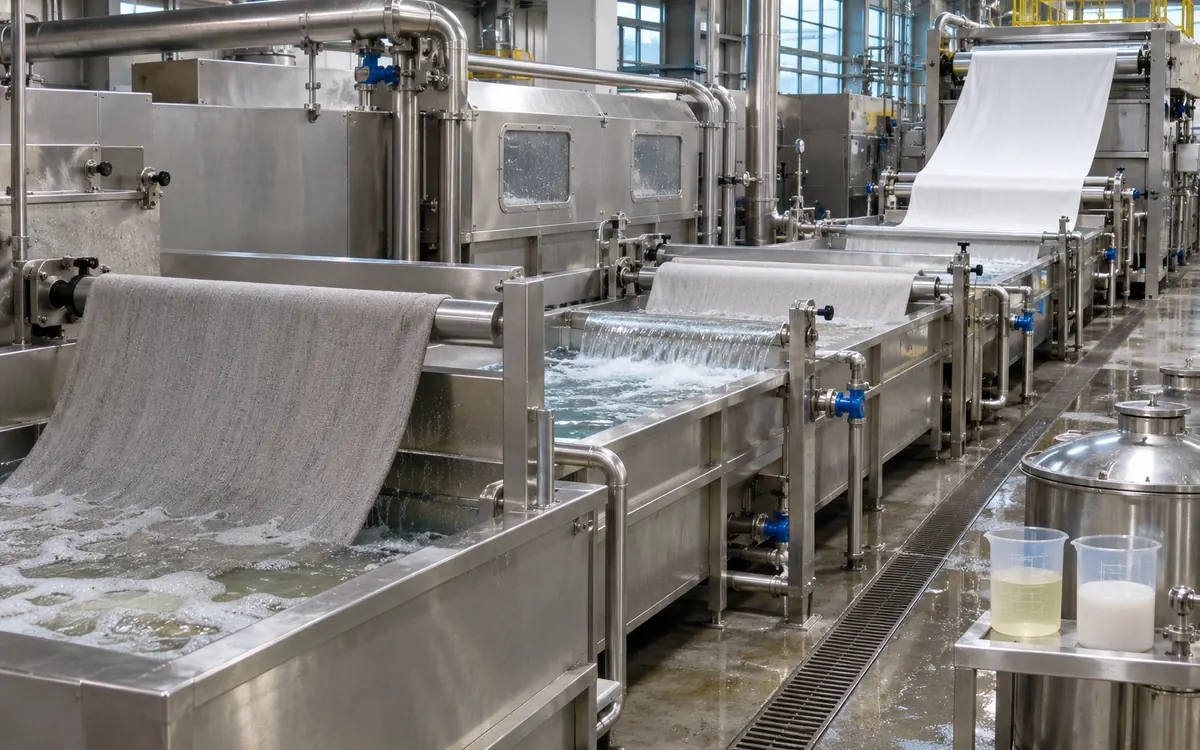
This guide explains the scouring process in simple steps. It covers why scouring is needed, what it removes, the main methods, a worked recipe with real numbers, quality tests and the problems you may meet. For a shorter note on the objectives and classes, see our page on the classification and objects of scouring.
What is scouring
Scouring is a wet process that removes natural impurities and added dirt from fibre, yarn or fabric. For cotton, the main target is the waxes, pectins, fats, proteins and mineral matter. It is done mostly with hot alkali, together with a wetting agent and other helpers.
Where does it sit in the line? For woven cotton, the usual order is singeing, desizing, scouring, bleaching, then dyeing or printing. Knits skip desizing since they carry no starch size, so they go from preparation straight to scouring and bleaching. Our guide on textile pretreatment chemicals shows how the chemicals work together, and the flow chart of weaving shows where the grey fabric comes from.
Why is scouring needed
- To make the fabric absorbent, so water, dye and chemicals enter fast and evenly.
- To remove waxes and oils that block dye and finishes.
- To remove pectins and proteins that cause yellowing and uneven dyeing.
- To remove cotton seed husks partly, along with some dirt.
- To prepare the fabric for bleaching, so bleach works evenly and with less damage.
- To remove oils from machines, such as knitting oil, which could stain.
- To improve whiteness and handle.
What does raw cotton contain
Cotton fibre is mostly cellulose, about 88 to 96 percent by weight. The remaining part is the natural material that scouring must deal with. Typical ranges, which vary with variety and growing conditions, are:
| Component | Approximate share in raw cotton | Effect if left in |
|---|---|---|
| Cellulose | 88 to 96 percent | The part we want |
| Wax | 0.4 to 1.2 percent | Repels water, causes patchy dyeing |
| Pectin | 0.4 to 1.2 percent | Binds fibres, reduces absorbency |
| Protein | 1 to 1.5 percent | Causes yellowing |
| Mineral matter | 0.7 to 1.6 percent | Lowers cloth quality |
| Others (sugars, pigments, organic acids) | 0.5 to 1 percent | Affects colour and handle |
Scouring and bleaching together usually bring the weight loss of cotton fabric to a total of 5 to 8 percent, depending on the quality of the raw material.
How scouring works
Hot alkali does several jobs at once.
- Saponifies some of the fats and oils into soap, which then helps to emulsify the rest.
- Swells the fibre so impurities come loose.
- Hydrolyses pectins and breaks down proteins, making them soluble.
- Emulsifies waxes with the help of a detergent or wetting agent, so they float away in the bath.
- Sequesters metal ions with a chelating agent, so hard water and iron do not cause spots. Our guide on sequestering agents in textile processing explains this step.
Sodium hydroxide (caustic soda) is the main chemical for cotton. Sodium carbonate (soda ash) is a milder choice, often used with wool or blends.
Chemicals used in scouring
| Chemical | Role | Typical amount for cotton |
|---|---|---|
| Caustic soda (NaOH) | Main alkali, saponifies and swells | 2 to 5 g/L for batch, 20 to 40 g/L for kier |
| Soda ash (Na₂CO₃) | Mild alkali, helps buffer | 1 to 3 g/L |
| Wetting agent or detergent | Lowers surface tension, emulsifies wax | 1 to 2 g/L |
| Sequestering agent | Binds metal ions | 0.5 to 1 g/L |
| Anti-creasing agent | Reduces rope marks in rope machines | 0.5 to 1 g/L |
| Enzymes (pectinase, cellulase) | Bio-scouring, mild and low temperature | As per supplier |
| Solvents | Used in special cases for oily fabrics | Rare today |
Always check amounts with the chemical supplier’s data sheet and run a lab trial first.
Main methods of scouring
1. Kier boiling
The oldest method for woven cotton. Fabric is packed into a large closed vessel called a kier. A hot caustic solution is circulated through it, often at a slightly raised pressure and about 120 degrees Celsius for several hours. It cleans well and is gentle on bulk lots, but it uses a lot of time, water and energy and is mostly replaced today.
2. Jigger scouring
The fabric in open width is passed back and forth through the bath between two rolls. It is common for small lots and delicate fabrics. Liquor is small and tension is controlled. See our guide on jet, jigger and winch dyeing machines for how these machines compare.
3. Winch scouring
Fabric in rope form is circulated through the bath by a winch reel. It suits knits and light wovens, but it can cause creases, so an anti-creasing agent is common.
4. Jet or overflow scouring
Fabric circulates in a closed tube, driven by the liquor jet. It is widely used for knit fabric and for synthetic blends. It is fast and the liquor ratio is low.
5. Continuous scouring (J-box, open-width ranges)
Fabric passes in open width through a saturator, then into a J-box or a steamer, where it is held hot for the required time. This is the choice for large mills with long runs. It is fast and uses chemicals and water more efficiently, but the equipment is costly.
6. Pad-batch scouring
Fabric is padded with the scouring liquor, wound on a roll, covered and left to turn slowly for several hours, at or near room temperature. It saves energy and water. Results depend on even padding.
7. Enzymatic (bio) scouring
Pectinase and other enzymes break down the pectin that holds the wax to the fibre, at a mild pH (often around 7 to 9) and moderate temperature (about 55 to 60 degrees Celsius). It lowers the alkali load in effluent and protects the fabric, but the wax removal can be less complete, so it needs careful trials.
| Method | Fabric type | Liquor use | Energy use | Best for |
|---|---|---|---|---|
| Kier | Woven cotton, heavy | High | High | Old plants, bulk lots |
| Jigger | Woven, delicate | Low | Medium | Small lots |
| Winch | Light knits and wovens | Medium | Medium | Light fabrics |
| Jet / overflow | Knits, blends | Low | Medium | Modern batch lines |
| Continuous | Woven, large volume | Low | Efficient at scale | Large mills |
| Pad-batch | Woven, knit | Very low | Low | Eco-minded plants |
| Enzymatic | Cotton | Low to medium | Lower | Soft handle, low alkali |
Scouring other fibres
- Wool: Scoured to remove wool grease (lanolin), dirt and sweat, using mild alkali such as soda ash and detergent at about 40 to 55 degrees Celsius. Strong caustic harms wool.
- Silk: Degumming removes sericin, the gum on raw silk, using soap and a mild alkali near 90 to 95 degrees Celsius. See our page on what silk is made of.
- Synthetics (polyester, nylon): Need light scouring with detergent and mild alkali to remove spinning oils, knitting oils and size, at about 60 to 80 degrees Celsius.
- Blends: The recipe is set by the most delicate fibre.
- Jute and linen: Need stronger treatment because of lignin and pectin, usually with bleaching.
Worked example: scouring a lot of knit cotton on a jet
A dye house scours 400 kg of single jersey cotton in a jet machine at a liquor ratio of 1:8.
Recipe
- Caustic soda: 3 g/L
- Wetting agent: 1 g/L
- Sequestering agent: 0.8 g/L
- Soda ash: 1 g/L
- Temperature: 98 degrees Celsius for 30 minutes
Quantities
- Water = 400 × 8 = 3,200 litres
- Caustic soda = 3,200 × 3 = 9,600 g = 9.6 kg
- Wetting agent = 3,200 × 1 = 3.2 kg
- Sequestering agent = 3,200 × 0.8 = 2.56 kg
- Soda ash = 3,200 × 1 = 3.2 kg
Heat needed to warm the bath from 30 to 98 degrees Celsius
- Energy = mass × 4.18 × temperature rise
- 3,200 kg of water × 4.18 × (98 − 30) = 3,200 × 4.18 × 68 = 909,568 kJ, or about 910 MJ
That figure ignores the heat in the fabric and the losses from the machine. In real life the demand is higher, because the cloth also has to be heated and heat escapes. It shows why lowering the liquor ratio is a strong way to save energy. At 1:6 the water is 2,400 litres, and the same calculation gives 2,400 × 4.18 × 68 = 682,176 kJ, a saving of about 227 MJ per batch, or 25 percent.
Weight loss check
A sample of the fabric weighs 100.0 g dry before scouring and 96.2 g dry after.
- Weight loss = (100.0 − 96.2) ÷ 100 × 100 = 3.8 percent
That is a healthy figure for a scour alone, since bleaching adds more loss later.
How to check scouring quality
Do not trust the look of the cloth. Test it.
| Test | How it works | Good result |
|---|---|---|
| Drop test (absorbency) | Place a drop of water on the fabric and time how long it takes to soak in | Under 3 seconds is the common target for good scouring |
| Wicking test | Hang a strip in coloured water and measure how far it rises in a set time | Higher rise means better absorbency |
| Sinking time test | Drop a small fabric piece on water, time how long before it sinks | Short sinking time |
| Weight loss | Compare dry weights before and after | About 3 to 5 percent for the scour alone, varying by fabric |
| Residual wax (extraction) | Extract the fabric with solvent and weigh the wax | Low residue, as set by the mill’s standard |
| pH of fabric after rinse | Test a wet piece with indicator or meter | Near neutral, 6.5 to 7.5 |
| Whiteness | Check by spectrophotometer | As per standard |
Some targets are in-house, so follow the buyer’s standard where one exists.
Common problems and how to fix them
| Problem | Likely cause | Fix |
|---|---|---|
| Poor absorbency | Too little alkali, low temperature, short time, poor wetting agent | Check recipe, raise temperature or time, test the wetting agent |
| Uneven dyeing later | Wax left in some areas, uneven scouring | Improve circulation, re-scour with detergent |
| Yellow cloth | Residual pectin, iron, or alkali too strong | Add sequestering agent, control alkali, rinse well |
| Creases in rope form | High temperature with poor lubrication | Use anti-creasing agent, adjust load |
| Fabric damage | Too much alkali, or air present at high heat | Reduce alkali, remove air |
| Oil stains | Machine oil, knitting oil not removed | Pre-treat with detergent, spot-clean the machine |
| High alkali in fabric | Poor rinsing or neutralising | Rinse hot then cold, neutralise with acetic acid |
| Spots on fabric | Hard water or metal ions | Use soft water, add sequestering agent |
| High effluent load | Strong alkali and high water use | Reduce liquor, use enzymes, recycle rinse water |
Combined processes
To save time and cost, mills often combine steps. Desizing and scouring can be done together for woven fabric with a one-bath recipe, and scouring and bleaching can be combined in one bath with hydrogen peroxide for knits. These save water, steam and time but need careful control of recipe and temperature. Check the fabric after each trial lot before moving to production. See our guide on desizing for the step that comes before scouring in woven lines.
Environment and safety
- Caustic soda burns skin and eyes. Use gloves, goggles and aprons, and know where the eyewash is.
- Handle hot liquor with care. Close the machine and drain with caution.
- Effluent from scouring is alkaline with high organic load. Neutralise and treat it before discharge.
- Save water with counter-current rinsing and lower liquor ratios.
- Consider enzymes and low-alkali recipes to reduce load. See our guide on the water treatment plant process.
Final thoughts
The scouring process is the foundation for good colour and finish. Control the alkali, the temperature and the time, test absorbency before you move to the next step and rinse well. When the cloth is clean and ready to take water, bleaching, dyeing and printing become easier, cheaper and more even.
Frequently asked questions
It is a wet process that removes waxes, oils, pectins, proteins and dirt from fibre, yarn or fabric so the material becomes clean and absorbent.
Without it, the fabric repels water and takes dye unevenly. Scouring makes it absorbent so colour penetrates well.
Mainly caustic soda, with a wetting agent, a sequestering agent and sometimes soda ash. Enzymes are used in bio-scouring.
Scouring removes natural and added impurities. Bleaching removes the natural colour to give whiteness. Both are preparation steps and often follow each other.
Often near the boil, about 95 to 100 degrees Celsius for batch machines, and higher in pressurised kiers. Enzymatic scouring runs at a milder 55 to 60.
Do the drop test. Good scoured cotton absorbs a drop of water in a few seconds. Also check weight loss and pH.
No. Washing removes surface dirt with detergent. Scouring uses alkali at high heat to remove natural waxes and impurities inside and around the fibre.

