Some of the world’s oldest cloths were made from a plant that looks like a tall nettle. Wrappings found in ancient tombs, fine summer shirts and strong fishing nets have all been made from it. That plant is ramie, and the fibre taken from its stem is among the strongest of all natural plant fibres. It is white, silky and cool to wear, yet it is also stiff and hard to process, which is why it has never become as common as cotton.
This guide explains what ramie is, where it grows, how the fibre is taken out and cleaned, and what it is like to wear and work with. It includes a worked example on yield and gum loss, a blend calculation and a clear list of strengths and limits. To see where ramie sits among the plant fibres, read our guides on the classification of textile fiber and the different types of textile fibers.
What is ramie
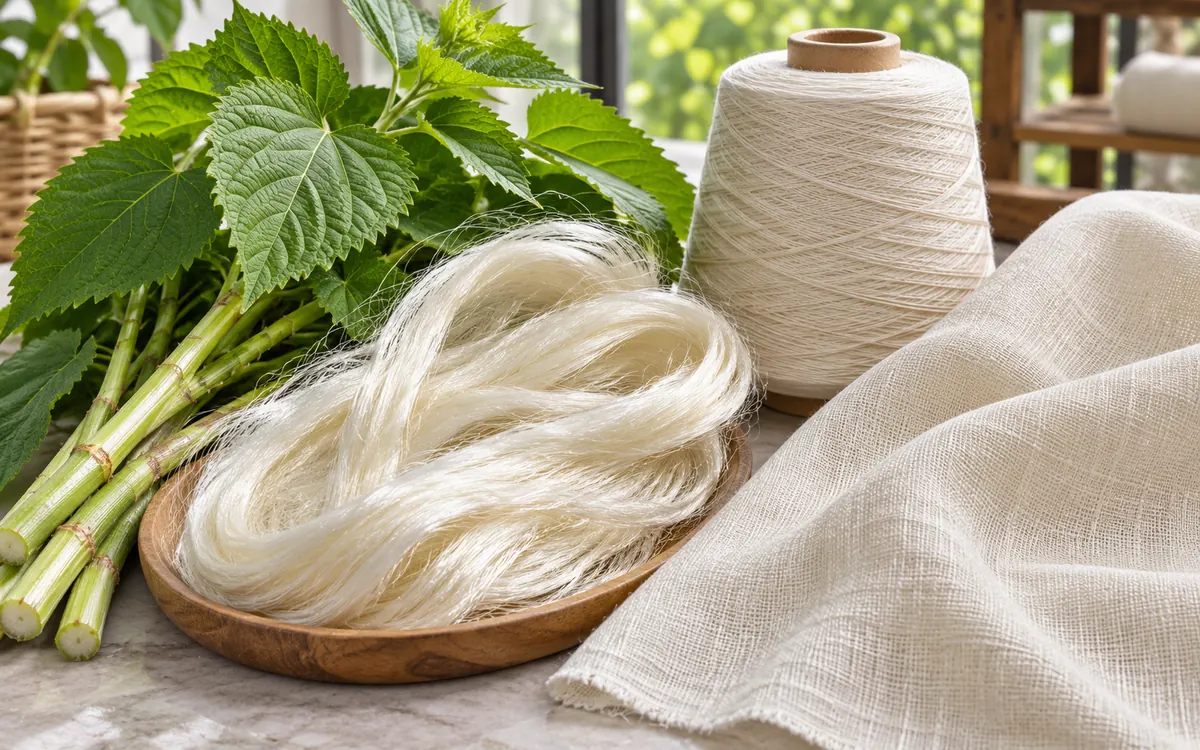
Ramie is a natural fibre from the stem of the plant Boehmeria nivea, a tall perennial in the nettle family. It is a bast fibre, which means the fibre lies in the inner bark of the stem, like flax, hemp and jute. Ramie is also called China grass, because China has grown and used it for thousands of years. Unlike stinging nettle, it does not sting.
A ramie plant grows from 1 to 2.5 metres tall in warm, wet climates. The roots live for many years, and the stems are cut several times a year. The stems are thin and green. Under the bark lie long, white bundles of fibre held together by natural gums.
Where ramie is grown
China is by far the largest producer, followed by smaller amounts from Brazil, the Philippines, India, Vietnam, Laos and Indonesia. Ramie needs a warm, humid climate with plenty of rain, which is why it grows well in southern China and in tropical countries. Exact production numbers change from year to year, so check a current source if you need them.
How ramie fibre is made
Ramie is harder to process than most fibres because of its gum. The steps are:
1. Harvesting
The stalks are cut when they reach about 1.2 to 1.8 metres, before they turn woody. In warm climates, there can be three to six harvests a year. Leaves are stripped off right away, because they dry out and make the stalk hard to work.
2. Decortication
The stalk is crushed and scraped to separate the outer bark from the woody core. This leaves ribbons, which are strips of bark with fibre and gum. Decortication is done by hand with knives or by machines with rollers and blades. The ribbons are dried in sun or in a dryer.
3. Degumming
The raw ribbon contains a lot of gum, mostly pectin and hemicellulose, which can make up about 20 to 35 percent of its weight. The gum makes the fibre stiff and prevents spinning. To remove it, the ribbons are boiled in an alkaline solution, usually caustic soda with other chemicals, often followed by bleaching and washing. Some processes use enzymes or bacteria to cut down on chemicals. After degumming, the fibre is soft, white and ready to be turned into yarn.
4. Softening and opening
The fibre is treated with oils and softeners, and opened by machines to separate bundles into fine strands.
5. Cutting and spinning
Ramie fibres are very long, up to several hundred millimetres. They are cut to a staple length that suits the spinning system, usually by cutting or breaking, then spun on machines similar to those used for flax or wool-type long-staple spinning. Ramie is often blended with cotton, wool or silk to make the spinning easier. For more on yarn making, see our guide on the yarn making process.
6. Weaving or knitting
The yarn is woven or knitted into fabrics. Ramie is more suited to woven fabrics than to knits, because it is stiff and has little stretch.
Properties of ramie fibre
| Property | What it means |
|---|---|
| Main chemistry | Cellulose, about 65 to 75 percent in raw ribbon, rising after degumming |
| Length | Very long, often 120 to 250 mm or more |
| Colour | Pure white, with a natural shine |
| Strength | Among the strongest natural fibres |
| Wet strength | Stronger when wet than when dry |
| Elongation | Low, about 2 to 4 percent, so it stretches little |
| Moisture absorption | High, with a moisture regain of about 12 to 17 percent |
| Drying | Dries quickly after absorbing water |
| Feel | Cool, smooth and silk-like when well processed, but stiff |
| Wrinkles | Wrinkles easily |
| Shrinkage | Low when finished well |
| Mildew and rot | Resists mildew, bacteria and insects |
| Dyeing | Takes dyes well, especially reactive and direct dyes |
| Biodegradable | Yes |
Strength and length values change with the variety, harvest and process. Ask your supplier for test results.
Why ramie is so strong
The fibre cells of ramie are among the longest in the plant world, and they have a very high degree of crystalline cellulose. Long cells give a long fibre, and well-aligned chains mean strength. That is why ramie is used for fishing nets, ropes and sewing threads for heavy goods.
Why ramie wrinkles
Ramie has a low ability to stretch and spring back. When folded, the fibre does not recover quickly. Blending with cotton or silk, or applying a finish, can lessen the problem.
Uses of ramie
Clothing
- Shirts, blouses and summer wear. Ramie breathes, absorbs sweat and dries quickly. It feels cool in hot weather.
- Trousers, suits and dresses. Usually in blends with cotton, linen, wool or silk.
- Sweaters. Blended with cotton or wool in knits for texture.
Home textiles
- Tablecloths, napkins and curtains
- Upholstery and bed linen in blends
- Wall coverings
Industrial and technical uses
- Fishing nets and lines. Strong and resistant to rot.
- Ropes and cords.
- Sewing thread for heavy goods such as canvas and leather.
- Filter cloths and canvas.
- Paper and specialty pulp.
- Composite reinforcement in plastics, as a natural-fibre option.
- Car parts and packaging in research and some products.
Craft and traditional goods
- Traditional summer cloth in China, Japan and Korea, often called grass cloth.
- Hand-woven shawls, mats and wall hangings.
Worked example 1: fibre yield and gum loss
These numbers are working assumptions for planning. Real values change with the variety, climate and process.
- Green stalk yield: 30 tonnes per hectare per year (over several harvests)
- Raw ribbon yield from green stalk: about 4 percent
- Gum content in raw ribbon: 25 percent
Raw ribbon = 30,000 × 0.04 = 1,200 kg
Gum removed = 1,200 × 0.25 = 300 kg
Degummed fibre = 1,200 − 300 = 900 kg per hectare per year
So only about 3 percent of the green stalk weight ends up as clean, spinnable fibre (900 ÷ 30,000 = 0.03). The rest is leaves, core, bark waste, water and gum. This low yield and the cost of degumming are among the reasons ramie fabric costs more than cotton.
If the degummed fibre sells for 3.5 currency units per kg, the hectare earns 900 × 3.5 = 3,150 units before costs. Costs include labour, decortication, chemicals, water treatment and transport.
Worked example 2: how much raw ribbon to buy
A spinning mill wants 5,000 kg of degummed ramie fibre. The supplier’s raw ribbon has 28 percent gum loss in the mill’s process.
- Fibre yield from ribbon = 100 − 28 = 72 percent
- Raw ribbon needed = 5,000 ÷ 0.72 = 6,944 kg
So the mill must buy about 6,950 kg of raw ribbon, and plan for the effluent from boiling 6,944 kg of ribbon. The gum removed is 6,944 − 5,000 = 1,944 kg, which ends up in the wastewater and must be treated. See our guide on the water treatment plant process in industry.
Worked example 3: a ramie and cotton blend
A common blend is 55 percent ramie and 45 percent cotton. Suppose degummed ramie costs 3.5 units per kg and cotton costs 2.1 units per kg.
- Blend cost = 0.55 × 3.5 + 0.45 × 2.1 = 1.925 + 0.945 = 2.87 units per kg
Pure ramie costs 3.5, and pure cotton 2.1. The blend sits in between, but gives a yarn that spins more easily than pure ramie and feels softer, with some of ramie’s strength and sheen. The share of ramie can be changed to suit the price and the feel you want.
Ramie vs flax vs cotton vs jute
| Point | Ramie | Flax (linen) | Cotton | Jute |
|---|---|---|---|---|
| Source | Stem bast | Stem bast | Seed hair | Stem bast |
| Strength | Very high | High | Moderate | Good dry |
| Feel | Smooth, stiff | Crisp, cool | Soft | Coarse |
| Shine | High | Medium | Low | Low |
| Wrinkling | High | High | Moderate | Moderate |
| Moisture absorption | High | High | High | High |
| Wet strength | Increases | Increases | Increases | Falls |
| Cost | High | High | Medium | Low |
See also our guides on jute fibre and sisal fibre.
Advantages of ramie
- It is very strong and durable, even when wet.
- It has a natural silky shine and white colour.
- It absorbs sweat and dries quickly, so it feels cool in the heat.
- It resists mildew, rot and insects.
- It keeps its shape and does not stretch out.
- It dyes well.
- It comes from a perennial plant that grows back without replanting.
- It is biodegradable.
Limitations of ramie
- It is stiff and low in elasticity.
- It wrinkles easily.
- Degumming needs a lot of chemicals and water, and creates effluent.
- Fibre yield from the stalk is low.
- Decortication is hard work or needs special machines.
- It can feel rough or itchy in coarse grades.
- Yarn can be hairy and hard to spin on cotton machines.
- Pure ramie can be brittle at folds and edges and may break when flexed again and again.
- Supply is concentrated in a few countries.
Environmental points
Ramie is a plant that needs little pesticide, grows back after cutting and protects soil on slopes. The weak point is processing. Boiling in caustic soda and washing use water and chemicals, and the effluent is high in organic matter and alkali. Mills that treat effluent, reuse water and move to enzyme degumming have a much smaller footprint. Ask suppliers about effluent treatment before you accept a claim of eco-friendly fabric.
Care of ramie garments
- Wash in cool or lukewarm water on a gentle cycle. Ramie is strong, but the surface can fuzz with hard rubbing.
- Do not wring hard, and avoid chlorine bleach.
- Dry in the shade or on a low setting.
- Iron while slightly damp at a medium-high heat, since the fibre wrinkles easily. Use steam if you have it.
- Ramie blended with silk or wool may need dry cleaning. Follow the label.
- Store folded loosely, changing the fold lines from time to time to avoid creases that turn into breaks.
Final thoughts
Ramie is a fibre of contrasts. It is strong, white, cool and long-lasting, yet stiff, wrinkle-prone and costly to process. It works best when a maker picks the right blend, a good finish and a clean degumming process. If you buy ramie fabric, ask about the blend, the gum removal and the test results. If you make it, keep the yield, the water use and the effluent in view. Used with care, ramie is a fine fibre for summer clothing, home textiles and strong industrial cloth.
Frequently asked questions
Ramie is a natural bast fibre from the stem of the plant Boehmeria nivea, a relative of the nettle. It is also called China grass.
Yes. Ramie is one of the strongest natural fibres and gains strength when wet. Cotton is softer and more flexible.
The fibre yield per stalk is low, decortication and degumming are labour and chemical heavy, and the spinning is harder than for cotton.
It is the step that removes the natural gum from raw ramie ribbon, usually by boiling in alkali, so that the fibre becomes soft and spinnable.
Yes. It absorbs moisture, dries fast and feels cool, though it can be stiff and wrinkle.
Yes. It is often blended with cotton, linen, wool or silk to improve softness, drape and spinning.
Yes. It breaks down naturally. The processing, however, needs good effluent control.