Walk through any market in summer and you will see long, flowing dresses swaying with every step. Some are printed with flowers. Some are plain and sleek. Some are tiered, with ruffles that dance in the breeze. Most of them are called maxi dresses, and they have been a favourite of many wardrobes for more than fifty years.
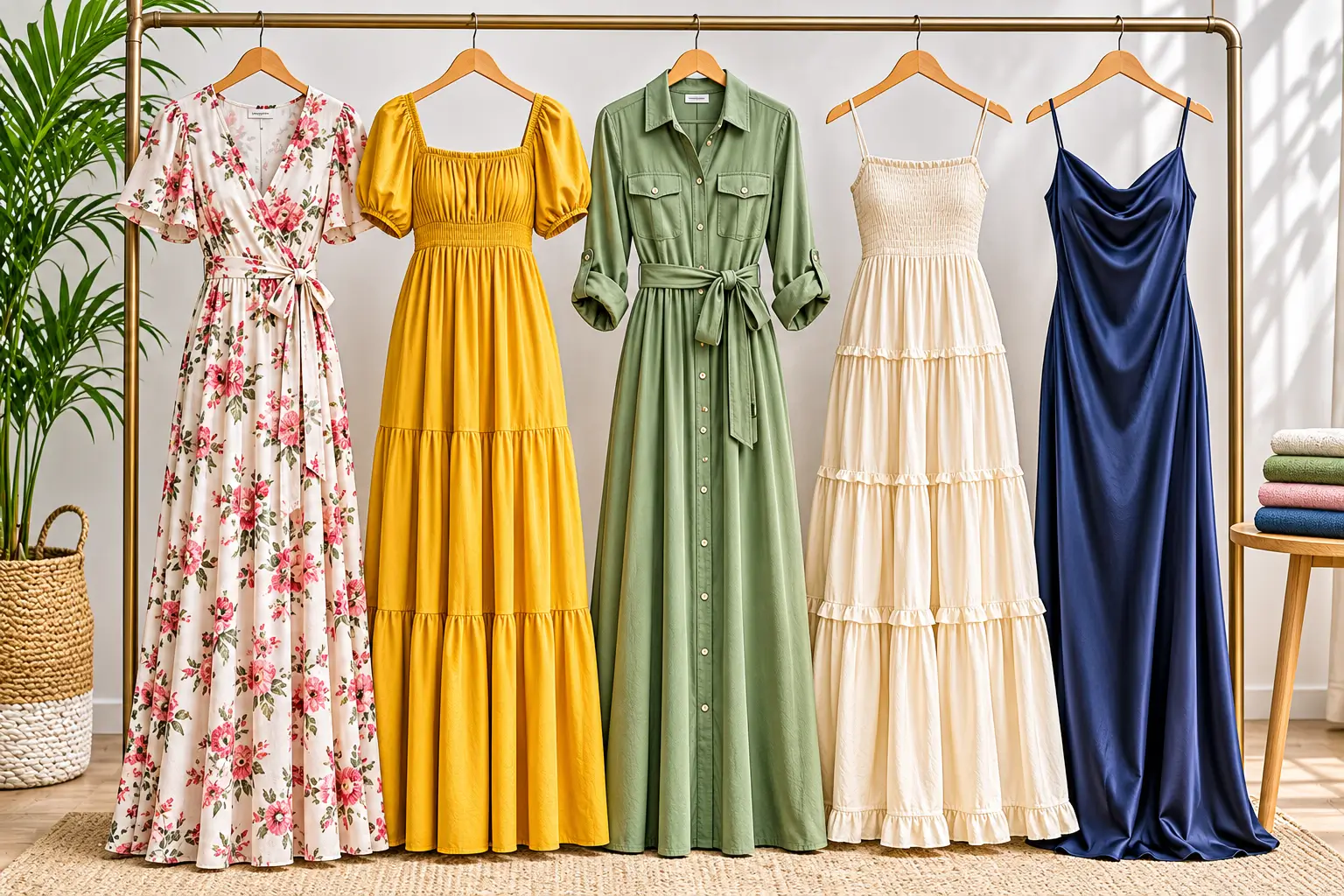
So, what is a maxi dress? In simple words, it is a long dress that reaches the ankle or the floor. This guide explains the meaning, the history, the main styles, the fabrics that suit it and how to pick the right length for your height. It also shows how a maker plans the fabric for one, with a worked example. If you are interested in a closer look at garment parts, read our guide on the parts of a sleeve.
What is a maxi dress
A maxi dress is a dress with a hem that falls to the ankle, to the floor, or somewhere between the calf and the floor. The word maxi comes from “maximum” and was used in the 1960s to describe long skirts and dresses, as a pair to the mini. It is not tied to one shape. A maxi can be fitted or loose, with sleeves or without, plain or printed. What defines it is length.
The usual length ranges are:
| Dress type | Hem falls at | Notes |
|---|---|---|
| Mini | Above the knee | Short |
| Knee-length | At the knee | Neat and work-friendly |
| Midi | Between knee and ankle, mid-calf | Seen as a smart in-between length |
| Maxi | At the ankle or the floor | Long, flowing |
| Floor-length or gown | Touches the floor | Often for formal events |
Some people say a maxi must touch the floor. Others include dresses that stop just above the ankle. In shops you will find both. When you shop, check the measured length and not only the name.
A short history
Long dresses are very old, since many cultures wore ankle-length robes and gowns. The modern maxi appeared in the 1960s. After the mini skirt became popular, designers and young people began wearing floor-length coats and skirts as a contrast. In the early 1970s, long dresses with floral prints, patchwork and bohemian styles became part of everyday fashion, linked to the hippie and folk look. Maxi dresses fell in and out of fashion over the next decades, and returned strongly in the 2000s and 2010s as light summer wear and as comfortable day-to-night dresses. Today they come in everything from simple cotton to formal satin.
Main styles of maxi dress
| Style | Features | Best for |
|---|---|---|
| Empire waist | Seam sits just under the bust, skirt falls loose | Comfort, long torso balance, maternity |
| Wrap | Crosses over the front and ties at the waist | Many body shapes, adjustable fit |
| A-line | Fitted at the shoulders, widens gently to the hem | Everyday wear, easy movement |
| Bodycon or fitted | Close to the body from top to hem | Evening events, stretch fabrics |
| Tiered or ruffle | Gathered layers stacked from waist to hem | Summer, holidays, a boho look |
| Slip or satin | Thin straps, smooth, bias-cut fabric | Evenings, layering with jackets |
| Shirt-dress maxi | Collar, buttons down the front, belt at the waist | Office casual and travel |
| Halter | Straps tie around the neck, bare shoulders | Beach, summer parties |
| Off-shoulder | Elastic or ruffle across the shoulders | Warm weather, holidays |
| Smocked | Elastic stitched bodice that stretches | Easy fit, comfort |
| Kaftan or caftan | Loose, flowing tunic-style | Beachwear, home wear |
| Sweater maxi | Knitted, long-sleeved | Cool weather |
Best fabrics for maxi dresses
The fabric decides how the dress hangs, how it feels and how well it handles the weather.
| Fabric | Feel and hang | Good for |
|---|---|---|
| Cotton and cotton voile | Breathable, soft, easy care | Everyday summer wear |
| Linen and linen blends | Crisp, cool, wrinkles easily | Hot weather and holidays |
| Viscose and rayon | Smooth and fluid, drapes well | Flowy styles. Check shrinkage |
| Chiffon and georgette | Light, sheer, floaty | Layered and party dresses. See chiffon fabric |
| Satin | Shiny and heavy drape | Evening and slip styles |
| Jersey knit | Stretchy, clings softly | Casual, comfortable styles |
| Crepe | Textured, drapes without clinging | Formal and work wear |
| Polyester blends | Strong, easy care, dries fast | Travel, easy care dresses |
| Denim and chambray | Structured and casual | Shirt-dress and pinafore maxis |
For warm and humid climates, cotton, linen and viscose are good choices. For travel, wrinkle-resistant polyester blends and jersey knits pack well. If you sew your own, wash and dry the fabric before cutting, as explained in our guide on how to prevent clothes from shrinking.
How to choose the right length
A maxi dress that is too long trips you up. One that is too short loses its flow. To check the length:
- Stand straight in the shoes you plan to wear.
- Measure from the high point of the shoulder, next to the neck, to the floor.
- Subtract about 1 to 2 cm if you want the hem to skim the floor, or 3 to 5 cm to clear the floor for walking.
- Compare the number with the dress length given by the seller. Dress length is usually measured from the high point of the shoulder, or from the back neck, to the hem.
Example: if shoulder to floor is 145 cm and you want the hem 3 cm above the floor in flat shoes, you need a dress of about 142 cm. With a 5 cm heel, add the heel height, so you can choose about 147 cm and allow it to just skim the floor.
Petite shoppers (under about 160 cm tall) often find that standard maxi dresses are too long. Look for petite ranges, or have the hem shortened. Tall shoppers can look for “tall” lengths or dresses with a longer shoulder-to-hem measurement.
Fit tips for different body shapes
- Hourglass: Wrap and fitted styles that follow the waistline.
- Pear: A-line or empire styles that skim over the hips.
- Apple: Empire waist and V-neck styles with a flowing skirt.
- Rectangle: Tiered, ruffled or belted styles to create shape.
- Petite: Vertical lines, one colour, V-necks and a hem that just touches the floor in the shoes you will wear.
- Tall: Bold prints, horizontal details and fuller skirts balance height.
- Plus size: Look for strong support at the bust, a defined waist and fabrics with some stretch and good drape. See our guide to wearing plus-size dresses.
These are guidelines, not rules. Wear what feels good and fits you well.
How to style a maxi dress
- Casual day: Flat sandals, a denim jacket and a tote bag.
- Office: A shirt-dress maxi with a belt and closed shoes, or a blazer in a neutral colour.
- Evening: A satin or slip maxi with heels or dressy flats and statement earrings.
- Cool weather: A knitted maxi with boots and a long cardigan.
- Holiday: A tiered cotton maxi with sandals and a sun hat.
- Wedding guest: A chiffon or crepe maxi in a rich colour with a clutch.
Add a belt to shape a loose dress. Use a short jacket to stop a long dress from overwhelming a short frame. Make sure shoes do not hide under the hem if you plan to walk fast.
Worked example: fabric needed for a tiered maxi dress
A designer plans a gathered, three-tier maxi dress for a size medium. The fabric is a 140 cm wide cotton voile. The target dress length is 145 cm from the high point of the shoulder to the hem. The design is:
- Bodice: 40 cm from shoulder to waist
- Tier heights: 30 cm, 35 cm and 40 cm, which add up to 105 cm
- Check the length: 40 + 105 = 145 cm, which matches the target (seam allowances are added later)
- Top tier circumference: 100 cm at the waist seam
- Gather ratio: 1.5, so each tier is 1.5 times as wide as the one above it
Width of each tier:
- Tier 1 = 100 × 1.5 = 150 cm
- Tier 2 = 150 × 1.5 = 225 cm
- Tier 3 = 225 × 1.5 = 337.5 cm
Fabric widths (140 cm each) needed for each tier:
- Tier 1: 150 ÷ 140 = 1.07, so 2 strips, 30 cm tall each = 60 cm of fabric length
- Tier 2: 225 ÷ 140 = 1.6, so 2 strips, 35 cm tall each = 70 cm
- Tier 3: 337.5 ÷ 140 = 2.4, so 3 strips, 40 cm tall each = 120 cm
- Bodice: front and back fit across one width, cut 40 cm tall plus 10 cm for the neckline, darts and ease = 50 cm
Total length of fabric:
- 50 + 60 + 70 + 120 = 300 cm
Add allowances. Add 10 percent for seam allowances, hems, print matching and shrinkage: 300 × 1.10 = 330 cm, so about 3.3 metres.
In real pattern work, seam allowances of 1 to 1.5 cm are added to every edge and the hem is usually 1 to 2 cm. A test sample is sewn before the final cut. Factories calculate fabric consumption in the same way, then add a wastage percentage. For how this links to price, see our guide on how to calculate cost of production.
How to measure a maxi dress for a spec sheet
Garment makers record measurements flat on a table. For a maxi dress, the key points are:
| Point | How it is measured |
|---|---|
| Length | High point of shoulder to hem, along the front |
| Bust | Flat across, 2.5 cm below the armhole, doubled |
| Waist | Flat across the natural waist, doubled |
| Hip | Flat across 20 cm below the waist, doubled |
| Sweep (hem width) | Flat across the bottom, doubled. Wider for flared and tiered styles |
| Strap length or sleeve length | Along the strap or sleeve seam |
| Neck drop | From the shoulder line to the neckline’s lowest point |
| Slit height | From the hem up to the top of the slit |
See our guide on the garment spec sheet for how these tables are used, and the measurement of top and bottom garments for the method.
Care of maxi dresses
- Check the label first. Silk, satin and some viscose may need gentle hand wash or dry cleaning.
- Wash cotton and polyester in cool water on a gentle cycle.
- Hang long dresses to dry, with a padded hanger or from the waist. Heavy wet fabric can stretch at the shoulders.
- Steam instead of ironing delicate fabrics.
- Store on hangers or folded in a breathable bag. Do not let the hem drag on the floor of the wardrobe.
- Fix the hem if it gets dirty. A hem facing or a hem tape can protect the edge.
Final thoughts
A maxi dress is a long dress, but it is also a lot more than that. It can be a quick, comfortable choice for a hot day, or a graceful dress for a special evening. If you shop, check the length, the fabric and the cut for your height and shape. If you sew, plan the fabric with care and test the hem length before the final cut. A well-chosen maxi dress feels easy to wear and looks good in most settings.
Frequently asked questions
A maxi dress is a long dress with a hem that reaches the ankle or the floor. It can have many shapes, necklines and sleeves.
A midi dress ends between the knee and the ankle, around mid-calf. A maxi ends at the ankle or the floor.
Yes. Choose petite lengths or hem the dress, wear a one-colour look, use a V-neck and wear shoes with a small heel.
Cotton, linen and viscose are breathable and light. Chiffon and georgette are also popular for a floaty look.
It should reach the ankle, or just above the floor in the shoes you will wear. Measure from the shoulder to the floor to get the right length.
A simple dress needs about 2.5 to 3.5 metres of 140 cm fabric for an adult size. A tiered or gathered dress can need 3.5 to 5 metres or more. Always check the pattern.
Yes, if you pick the right fabric. Light cotton and linen suit summer, and knitted or lined versions suit winter.