You buy a soft cotton T-shirt that fits perfectly. After two washes, the sleeves feel short and the hem sits above your belt. Almost everyone has had this happen. The good news is that most shrinking is easy to avoid once you know why it happens. This guide shows you how to prevent clothes from shrinking, step by step, and also what to do if a favourite item has already shrunk.
You will learn why fabrics shrink, how each fibre behaves, the best way to wash and dry, how to test a new garment and how to fix mild shrinking. We also include a worked example with real numbers so you can see how much a garment can change. The advice comes from how textile mills and garment factories control shrinkage, which you can read about in our guide on shrinkage control in fabric and garment factories.
Why do clothes shrink
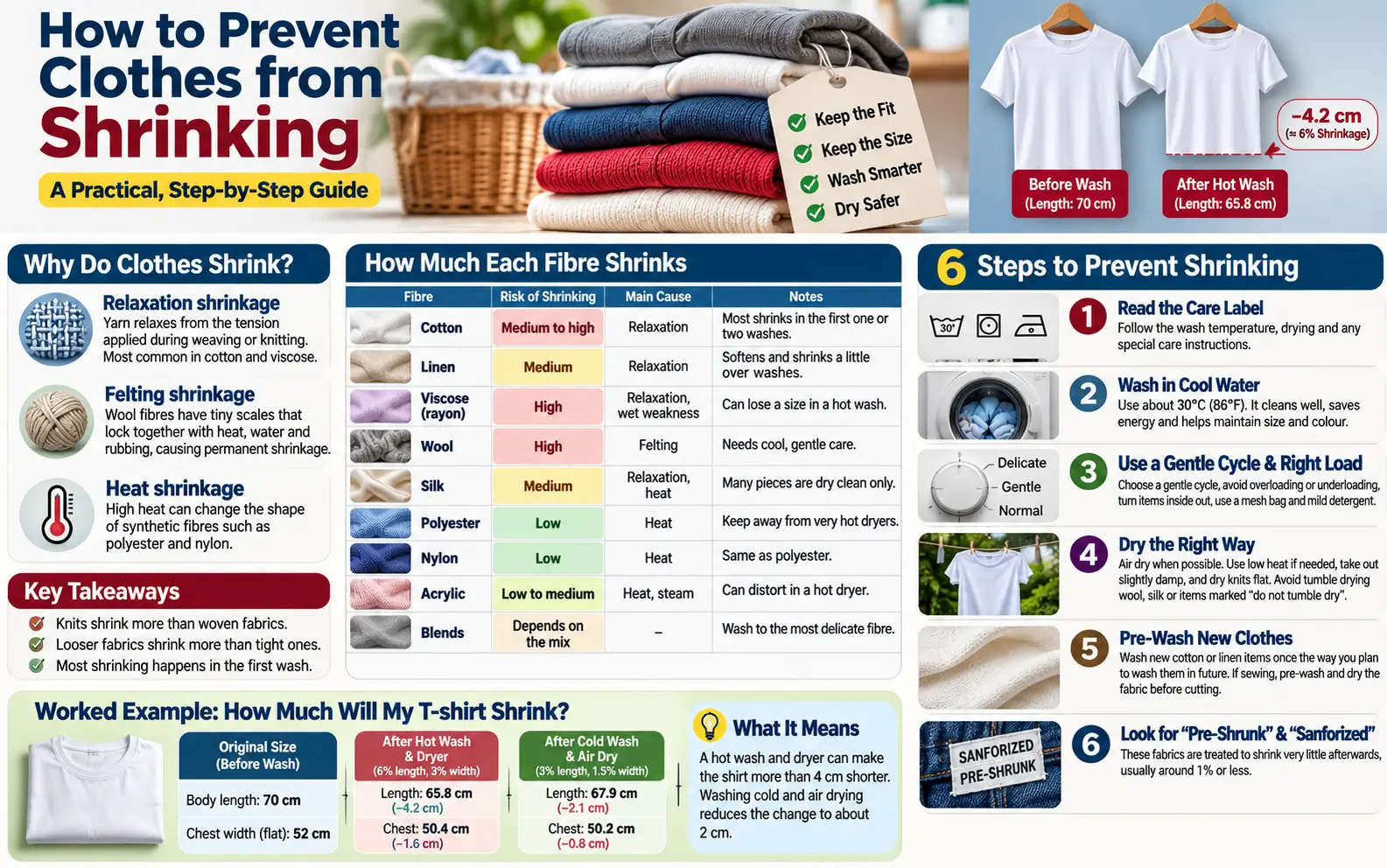
Shrinking is the loss of size in a fabric after washing, heat or moisture. There are three main causes.
- Relaxation shrinkage. During weaving or knitting, yarn is pulled under tension. The fabric is also stretched when it is dried and rolled in the mill. Water and movement in the wash let the yarn relax and spring back to its natural length. This is the most common cause in cotton and viscose. It mostly happens in the first wash.
- Felting shrinkage. Wool fibres have tiny scales on the surface. Heat, water and rubbing make the scales lock together. The fabric thickens and shrinks, and it cannot be undone. This is why a wool jumper turns small in a hot wash.
- Heat shrinkage. Synthetic fibres such as polyester and nylon are set with heat in the factory. A very hot dryer or iron can change that shape, though they usually shrink far less than natural fibres.
Knits shrink more than woven fabrics because loops can close up easily. Loosely made fabrics shrink more than tight ones. To see how mills measure it, read our guide on checking fabric shrinkage.
How much each fibre shrinks
| Fibre | Risk of shrinking | Main cause | Notes |
|---|---|---|---|
| Cotton | Medium to high | Relaxation | Most shrinks in the first one or two washes. See the properties of cotton |
| Linen | Medium | Relaxation | Softens and shrinks a little over washes |
| Viscose (rayon) | High | Relaxation, wet weakness | Can lose a size in a hot wash |
| Wool | High | Felting | Needs cool, gentle care |
| Silk | Medium | Relaxation, heat | Many pieces are dry clean only |
| Polyester | Low | Heat | Keep away from very hot dryers |
| Nylon | Low | Heat | Same as polyester |
| Acrylic | Low to medium | Heat, steam | Can distort in a hot dryer |
| Blends | Depends on the mix | The most shrink-prone fibre | Wash to the most delicate fibre |
Step 1: Read the care label
The label is the maker’s own advice for that garment. Look for the wash symbol with a temperature number, the tumble dryer symbol, and any words like “dry flat” or “dry clean only”. If the label says “cold wash, line dry”, follow it. If you have cut it out, wash at a low temperature and air dry, which is the safest choice.
Step 2: Wash in cool water
Heat is the biggest enemy. A good habit is to wash most clothes at 30 degrees Celsius (about 86 degrees Fahrenheit). Cold water cleans well with modern detergents, saves energy and helps the colours last. Use hot water only for items that need it, and only if the label allows.
Step 3: Use a gentle cycle and a good load size
- Choose a short, gentle or delicate cycle for knits, wool and viscose.
- Do not overload the drum. Clothes need room to move.
- Do not underload either. A tiny load tumbles hard against the drum.
- Turn items inside out to protect the surface.
- Use a mesh bag for delicate things.
- Use a mild detergent. Skip strong bleach.
Step 4: Dry the right way
The dryer is where most shrinking happens.
- Best: Air dry. Hang woven shirts and trousers on a hanger or line. Lay jumpers and knits flat on a clean towel, and reshape them with your hands.
- If you use a dryer: Choose low heat or air-only, and take clothes out while they are still slightly damp. Lay them flat or hang them to finish.
- Never tumble dry wool, silk, or items marked “do not tumble dry”.
- Keep out of strong sun for dark colours, since sun fades them.
Hanging a heavy wet knit on a hanger stretches the shoulders. Dry knits flat.
Step 5: Pre-wash new clothes
A new cotton or linen item will usually shrink the most in its first wash. If you want to control it, wash it once in the way you plan to wash it in future and dry it as you plan to dry it. If you are sewing, wash and dry your fabric before cutting. Our guide on pattern making based on fabric shrinkage shows how factories add extra allowance for this.
Step 6: Look for “pre-shrunk” and “sanforized”
Some fabrics are treated in the mill so that they shrink very little afterwards. A common process is compressive shrinkage, known by the trade name Sanforizing. It squeezes the fabric lengthwise so it has already been “shrunk” before you buy it. Denim and woven cotton shirts labelled sanforized or pre-shrunk usually have a residual shrinkage of about 1 percent or less. Raw, unwashed denim often is not treated, so it can shrink noticeably.
Worked example: how much will my T-shirt shrink
A mill tests a cotton jersey fabric and reports the shrinkage after one wash as 6 percent in length and 3 percent in width. You buy a T-shirt with these measurements:
- Body length: 70 cm
- Chest width (flat): 52 cm
After the first hot wash and dryer:
- New length = 70 × (1 − 0.06) = 70 × 0.94 = 65.8 cm, a loss of 4.2 cm
- New chest = 52 × (1 − 0.03) = 52 × 0.97 = 50.4 cm, a loss of 1.6 cm
The shirt becomes shorter by more than four centimetres. That is a visible change, and it can turn a hip-length tee into a crop. Now see the effect of washing cold and air drying. Suppose the loss falls to 3 percent in length and 1.5 percent in width.
- New length = 70 × 0.97 = 67.9 cm, a loss of 2.1 cm
- New chest = 52 × 0.985 = 51.2 cm, a loss of 0.8 cm
Careful care halves the shrinkage. If you are buying a cotton tee online and you are between two sizes, remember that the shirt may lose about 2 to 4 cm in length. Brands also account for this, so a new tee may be cut a little long on purpose.
How to test a garment for shrinkage
If you want proof before you commit, do a quick test.
- Measure the length and width of the garment with a tape, flat on a table. Write down the numbers.
- Wash and dry it the way you plan to.
- Measure again at the same points.
- Work out the change: (before − after) ÷ before × 100.
For example, a shirt that goes from 70.0 cm to 67.2 cm lost 2.8 cm, which is 2.8 ÷ 70 × 100 = 4 percent. If the change is more than you can accept, adjust the care next time or return the item. Mills use the same method, with set procedures, on a fabric swatch before cutting.
What to do if clothes have already shrunk
If the fabric is cotton, wool or a blend and has shrunk a little, you can often recover some of the size.
- Fill a basin with lukewarm water.
- Add a spoon or two of mild hair conditioner or baby shampoo. These soften the fibres.
- Soak the garment for 10 to 30 minutes.
- Gently squeeze out the water. Do not wring.
- Roll it in a clean towel to remove more water.
- Lay it flat on a dry towel. Gently stretch it back to its shape in small pulls, from the hem and the sleeves. Measure it against a similar item that fits.
- Let it dry flat, and repeat if it needs more.
This can recover a little size, not a lot. Wool that has felted heavily cannot be brought back fully. Pulling too hard can distort the fabric, so go slowly. Steam from an iron held above the fabric (not pressed) can also help relax cotton.
Care tips by garment
| Garment | Shrink-safe care |
|---|---|
| Cotton T-shirt | Wash at 30 degrees, low heat or air dry |
| Jeans | Cold wash, inside out, hang dry. Wash less often |
| Cotton shirt | Cold or warm wash, hang dry, iron slightly damp |
| Wool jumper | Hand wash cool or use the wool cycle, dry flat, never wring |
| Viscose dress | Cold gentle wash or dry clean, hang dry |
| Linen | Cool wash, air dry, iron damp |
| Athletic polyester | Warm wash, low heat or air dry |
| Silk blouse | Hand wash cool or dry clean |
| Socks and merino | Gentle cool wash, air dry. See merino wool socks |
Ironing and storing without shrinking
Heat from an iron can shrink wool and some synthetics, and a cotton shirt can tighten if it is pressed bone dry at a very high setting. Use the right dial: low for silk, wool and nylon, medium for polyester and viscose, high for cotton and linen. Iron cotton and linen slightly damp, and use a pressing cloth on wool. Fold knits instead of hanging them, because hanging stretches them, and then a wash pulls them back unevenly. Store clothes in a dry place, since damp air can also cause slight changes in size and shape.
Washing different loads together
Sort your laundry by fibre and weight, not only by colour. A heavy denim jacket in the same load as a thin viscose top will drag the lighter cloth around, and the viscose can twist and shrink unevenly. Keep delicate items in a mesh bag and wash them with similar pieces. Wash new, dark cotton clothes alone the first time, since they may release dye. Children’s clothes grow fast, so shrinking is more noticeable. Buy a size up in 100 percent cotton if you plan to wash and tumble dry often.
Common mistakes
- Washing everything on the hottest setting out of habit
- Using the dryer on high for knits and wool
- Overloading the washer so garments twist and drag
- Wringing out wet wool or cotton knits
- Ignoring the label because the shirt looks sturdy
- Washing new items together with older ones in the same hot cycle
Shrinking and clothes you buy or sew
If you shop, check the label for “pre-shrunk”, look for a fabric blend with some polyester if low shrinkage matters, and buy a size that fits you after one wash if the fabric is 100 percent cotton. If you sew, wash and dry your fabric exactly as you plan to treat the finished garment. Then cut and sew. Factories do the same thing on a bigger scale by testing every lot and adding allowance to the pattern for the expected shrinkage.
Final thoughts
To prevent clothes from shrinking, keep three things in mind: less heat, less rubbing and a flat or hanging dry. Read the label, wash cool, use a gentle cycle and skip the high-heat dryer for cotton, wool and viscose. Test new items when it matters, and add a little room to your size when you buy raw cotton. A few small habits keep clothes the same size, and they last longer too.
Frequently asked questions
Fibres relax from the tension they had in the mill, and heat, water and rubbing make them tighten. Wool also felts, which is a permanent shrink.
Wash in cool water on a gentle cycle, then air dry or use a low-heat dryer for a short time. Follow the care label.
Heat in the dryer often causes the biggest change, but a very hot wash also shrinks fabrics. Both matter.
Mild shrinking can sometimes be reversed by soaking in lukewarm water with a little conditioner and gently stretching the garment flat. Heavily felted wool cannot be restored fully.
Cold water greatly reduces shrinking and fading, because heat is the main trigger for fibre movement.
Only a little. Very high heat can still distort them, so use low heat.
The label or the product page will usually say “pre-shrunk” or “sanforized”. If it does not, assume the fabric may shrink and wash it with care.