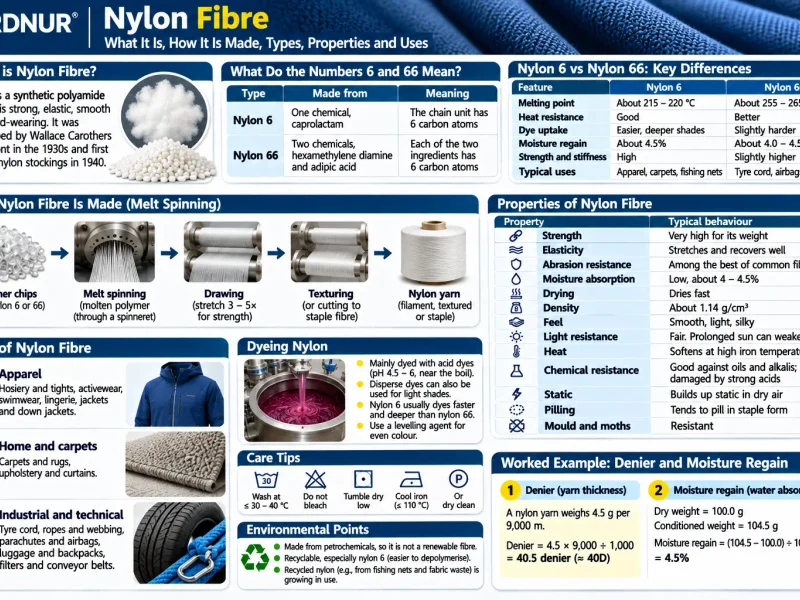
A boat hull, a wind turbine blade, a circuit board and the insulation in your attic have something in common. Inside each of them are fine strands of glass. Glass fibre is made by pulling molten glass into threads thinner than a human hair. It is strong, does not burn and does not rot, and it is one of the most used industrial fibres in the world.
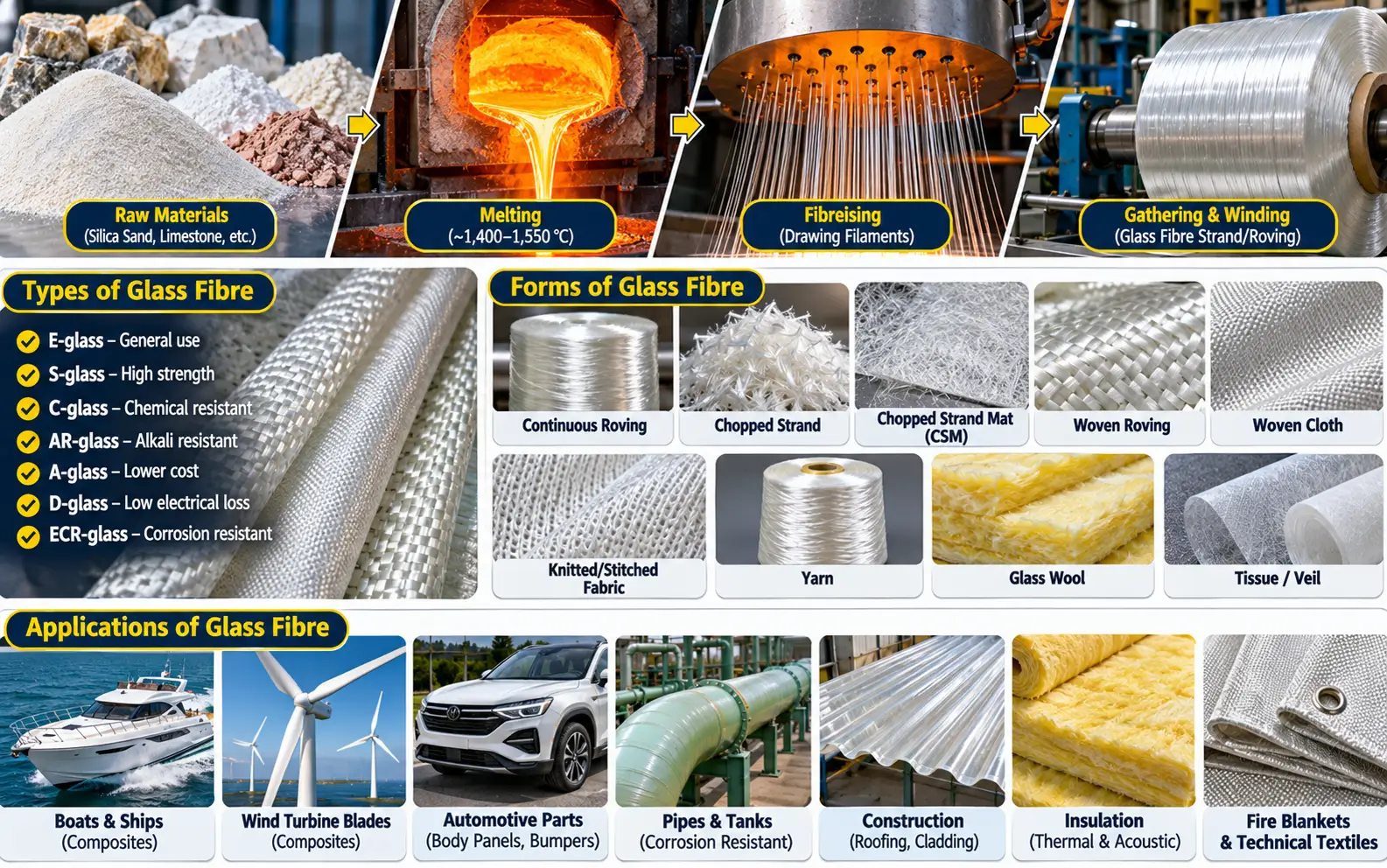
This guide explains what glass fibre is, how it is made, its main types and properties and where it is used. It then places glass among the high-performance fibres: aramid, carbon, polyethylene and basalt. You will find tables for comparison and two worked examples with real numbers. For where these fibres fit in the larger family, see our guides on the types of synthetic fibres and the properties of textile fibres.
What is glass fibre
Glass fibre, also spelled fiberglass in the US, is a fibre made of very thin glass filaments. It is a man-made fibre, but it is mineral and not polymer. Glass is made mostly from silica sand, with other minerals that help it melt and give it special traits.
Glass was spun into threads in ancient times, but modern glass fibre began in the 1930s in the United States, when large-scale production of fine, continuous filaments was developed. The fibre soon found use in insulation and, in the 1940s, as reinforcement for plastics. Today it is the main reinforcement in composite materials worldwide.
How glass fibre is made
- Batching. Raw materials are weighed and mixed. They include silica sand, limestone, soda ash, alumina, boron compounds and other minerals, in a recipe that gives the glass type wanted.
- Melting. The batch is melted in a furnace at about 1,400 to 1,550 degrees Celsius. The molten glass is refined to remove bubbles.
- Fiberising. Molten glass flows through a bushing, a plate with hundreds or thousands of tiny holes, usually made of a platinum alloy. The streams are pulled quickly by a winder, which stretches them into continuous filaments about 5 to 25 micrometres in diameter. Common textile filaments are 9 to 17 micrometres.
- Sizing. A thin coating called size is sprayed on the filaments as they form. It protects them from scratching one another and helps them bond with the resin later.
- Gathering and winding. Hundreds of filaments are gathered into a strand and wound on a package. Strands become rovings, yarns, chopped fibre or mat.
- Drying and packing. The packages are dried and packed.
For wool-type glass fibre used in insulation, the molten glass is spun in a rotating cup that throws it out through holes, and the fibres are blown into a wool-like mass.
Types of glass fibre
Glass fibre types are named by letters. The recipe changes the properties.
| Type | Letter means | Key feature | Typical use |
|---|---|---|---|
| E-glass | Electrical | Good strength, low cost, good electrical insulation | Most composites, circuit boards, general use. About 90 percent of the market |
| S-glass | Strength | Higher strength and temperature resistance | Aerospace, defence, pressure vessels |
| C-glass | Chemical | Good resistance to acids and chemicals | Chemical tanks, filters, battery separators |
| AR-glass | Alkali resistant | Contains zirconia, resists cement’s alkali | Fibre-reinforced concrete and cement boards |
| A-glass | Alkali | Soda-lime glass, lower cost | Some glazing and insulation |
| D-glass | Dielectric | Low electrical loss | Radomes, electronics |
| ECR-glass | E-glass, corrosion resistant | Boron-free, acid resistant | Pipes and tanks |
Forms of glass fibre
| Form | What it is | Use |
|---|---|---|
| Continuous roving | Many strands wound together without twist | Filament winding, pultrusion, weaving |
| Chopped strand | Short pieces, 3 to 50 mm | Moulding compounds, mats |
| Chopped strand mat (CSM) | Random chopped fibres bonded in a sheet | Hand layup in boats and tanks |
| Woven roving | Heavy roving woven into a fabric | Boat hulls, panels |
| Woven cloth | Fine glass yarn woven into fabric | Circuit boards, aerospace, fire cloth |
| Knitted or stitched fabrics | Layers of fibres stitched together | Wind blades, car parts |
| Yarn | Twisted strands | Weaving, braiding, sleeving |
| Glass wool | Fluffy mass of fine fibres | Thermal and acoustic insulation |
| Tissue and veil | Very thin mat | Surface layers, filters |
Properties of glass fibre
The numbers below are typical values for E-glass. They vary with the grade and the test method.
| Property | Typical value or behaviour |
|---|---|
| Density | About 2.5 to 2.6 g/cm³, heavier than polymer fibres |
| Tensile strength (single filament) | About 2,000 to 3,500 MPa |
| Tensile modulus (stiffness) | About 70 to 73 GPa |
| Elongation at break | About 3 to 5 percent |
| Softening point | Around 840 degrees Celsius |
| Burning | Does not burn and does not support flame |
| Moisture absorption | Very low, near zero |
| Chemical resistance | Good against many chemicals, attacked by strong alkali and hydrofluoric acid |
| Electrical | Good insulator |
| Thermal conductivity | Low, good for insulation |
| Abrasion | Poor, filaments can scratch and break |
| Flexibility | Brittle, low resistance to repeated bending |
| Rot and pests | Not affected |
| Dimensional stability | Very good, does not stretch or shrink with humidity |
The strength of glass is very high in a fresh filament, but surface scratches reduce it quickly. That is why size is applied right away, and why handling matters.
Uses of glass fibre
Composites (glass-reinforced plastic)
- Boats and ships: Hulls, decks and tanks.
- Wind energy: Turbine blades, which are largely glass fibre in resin.
- Cars and trucks: Body panels, bumpers, interior parts and leaf springs.
- Pipes and tanks: Corrosion-resistant pipes for water, chemicals and sewage.
- Construction: Roofing sheets, cladding, rebars and reinforcement in cement.
- Sports equipment: Surfboards, skis, hockey sticks and vaulting poles.
- Electrical: Circuit boards (FR-4), insulators and cable trays.
Insulation
- Glass wool batts and rolls for thermal and sound insulation in buildings.
- Pipe insulation and industrial furnace lagging.
Textile and technical uses
- Fire blankets and welding curtains.
- Filter fabrics for hot gases and dust collection.
- Coated fabrics for architecture, such as PTFE-coated glass roofs.
- Window screens and mesh.
- Reinforcement scrims in plasterboard, roofing felt and wallpaper.
- Specialist sleeving to protect wires and hoses from heat.
Glass fibre is rarely worn as clothing, since it is brittle and can irritate the skin. It is mostly a technical textile.
Health and safety
- Fine glass particles and short fibres can irritate the skin, eyes and nose. Wear gloves, long sleeves, goggles and a dust mask when cutting or sanding.
- Wash hands and clothes after work. Wash glass-contaminated clothes separately.
- Good ventilation and dust extraction are important in cutting areas.
- Resin systems used with glass have their own hazards, so read the safety data sheets.
What are high-performance fibres
High-performance fibres are fibres with much higher strength, stiffness, heat resistance or chemical resistance than everyday fibres like cotton, polyester and nylon. They are used where failure is costly: aircraft, protection, medical, energy and sport.
Aramid fibres
Aramids are aromatic polyamides, which are chemical cousins of nylon with rigid rings in the chain. Para-aramid, sold under names such as Kevlar and Twaron, has very high strength and stiffness at low weight. It is used in body armour, helmets, tyre reinforcement, ropes and cut-resistant gloves. Meta-aramid, such as Nomex, offers heat and flame resistance and is used in firefighter suits and racing overalls. Aramid weakens in strong sunlight and needs protection.
Carbon fibre
Carbon fibre is made by heating polyacrylonitrile (PAN) fibre in stages, up to about 1,000 to 3,000 degrees Celsius, in an oxygen-free atmosphere. This leaves nearly pure carbon filaments. It has very high stiffness and strength and very low weight. It is used in aircraft, racing cars, bicycles, sporting goods, wind blades and medical devices. It is costly and brittle compared with glass.
Ultra-high-molecular-weight polyethylene (UHMWPE)
Made of extremely long polyethylene chains, fibres such as Dyneema and Spectra are very strong for their weight and float on water. They are used in ropes, fishing lines, protective gloves and armour. They soften at fairly low temperatures, so they are not used in hot places.
Basalt fibre
Basalt fibre is made by melting crushed volcanic basalt rock and drawing it into filaments. It is similar to glass fibre in process and cost level, with better heat and chemical resistance. It is used in composites, insulation, friction materials and reinforcement for concrete. It is also called a mineral fibre.
Other high-performance fibres
- PBO and PBI: Very high strength or heat resistance, used in specialty protection.
- Ceramic fibres: Alumina and silicon carbide, used in extreme heat.
- PTFE fibre: Extremely chemical resistant, used in filters.
- Polyimide (P84): Heat-resistant filter fibre.
Comparison of glass with other high-performance fibres
Approximate typical values for common grades. Real products vary.
| Fibre | Density (g/cm³) | Tensile strength (GPa) | Modulus (GPa) | Notes |
|---|---|---|---|---|
| E-glass | 2.55 | 2.0 to 3.4 | 72 | Low cost, non-flammable |
| S-glass | 2.49 | 4.5 | 87 | Higher strength, costlier |
| Basalt | 2.7 | 3.0 to 4.8 | 85 to 95 | Good heat and chemical resistance |
| Para-aramid | 1.44 | 3.0 to 3.6 | 70 to 130 | Tough, light, sensitive to UV |
| Carbon (standard) | 1.78 | 3.5 to 4.9 | 230 to 240 | Very stiff, costly |
| UHMWPE | 0.97 | 2.5 to 3.5 | 90 to 130 | Floats, low melting point |
| Steel wire (reference) | 7.8 | 1.5 to 2.0 | 200 | Heavy, can rust |
Worked example 1: specific strength
Specific strength is strength divided by density. It shows how strong a material is for its weight. Using the mid-range values above, with strength in MPa and density in g/cm³:
- E-glass: 2,700 ÷ 2.55 = 1,059
- Basalt: 3,900 ÷ 2.7 = 1,444
- Para-aramid: 3,300 ÷ 1.44 = 2,292
- Carbon: 4,200 ÷ 1.78 = 2,360
- UHMWPE: 3,000 ÷ 0.97 = 3,093
- Steel wire: 1,750 ÷ 7.8 = 224
Per unit of weight, UHMWPE, carbon and aramid fibres are strongest, with glass in the middle and steel far behind. But glass is much cheaper, so it wins in large structures where cost matters, such as boat hulls and pipes. In wind blades, makers use a mix of glass and carbon to balance cost and stiffness.
Worked example 2: glass and resin in a laminate
A boat builder lays up a panel using four layers of 450 g/m² chopped strand mat. The target glass content is 30 percent by weight, which is typical for hand layup.
- Glass per square metre = 4 × 450 = 1,800 g
- Total weight of laminate = 1,800 ÷ 0.30 = 6,000 g
- Resin per square metre = 6,000 − 1,800 = 4,200 g, or 4.2 kg
For a hull surface of 40 m²:
- Glass = 1,800 × 40 = 72,000 g = 72 kg
- Resin = 4,200 × 40 = 168,000 g = 168 kg
- Total laminate weight = 240 kg
If glass costs 2 currency units per kg and resin costs 3 per kg, the material cost is 72 × 2 + 168 × 3 = 144 + 504 = 648 units. Resin is the bigger cost. Methods such as vacuum infusion get glass content up to 50 percent or more, which makes the panel stronger and lighter with less resin. With 50 percent glass, the same 1,800 g of glass needs only 1,800 g of resin, so the laminate weighs 3,600 g per square metre, 40 percent lighter than the hand layup panel. Prices change by market, so use your own quotes.
Worked example 3: roving yardage
A glass roving is labelled 2,400 tex. Tex is the weight in grams of 1,000 metres.
- Weight per metre = 2,400 ÷ 1,000 = 2.4 g
- Length per kilogram = 1,000 ÷ 2.4 = 417 m
A 20 kg bobbin therefore holds about 8,340 metres of roving. This helps in planning filament winding or weaving runs.
Advantages of glass fibre
- High strength and stiffness at low cost
- Does not burn, rot or rust
- Very low moisture uptake
- Good electrical and thermal insulation
- Stable dimensions
- Wide range of forms
- Easy to mould with resin into complex shapes
Limitations of glass fibre
- Heavier than polymer fibres and carbon
- Brittle and poor in abrasion and flex fatigue
- Can irritate the skin and lungs during handling
- Hard to recycle, since the fibres are bonded in thermoset resin
- Lower stiffness than carbon
Final thoughts
Glass fibre is an everyday workhorse of modern industry. It is strong, cheap, stable and fire-proof, and it sits behind many products we use without noticing. High-performance fibres like aramid, carbon, UHMWPE and basalt push strength and stiffness much further, at a higher price. The right choice depends on the job: weight, cost, heat, handling and life. Use data sheets, compare specific strength and cost, and take safety seriously when you cut or sand. With that approach, you can match the fibre to the task with confidence.
Frequently asked questions
Glass fibre is a material made from very fine strands of glass. It is used to reinforce plastics and to make insulation, fabrics and filters.
E-glass is the standard, low-cost grade with good electrical properties. S-glass has higher strength and temperature resistance but costs more.
Yes. Fiberglass is the same material, often meaning the composite of glass fibre and resin.
The fibres can irritate the skin and eyes. Wear gloves, long sleeves and a mask when cutting or sanding it.
They are fibres with much higher strength, stiffness, heat or chemical resistance than ordinary fibres. Examples are aramid, carbon, UHMWPE and basalt.
By weight, yes. Aramid is lighter and has a higher specific strength than glass, but it costs more.
It is difficult when mixed with thermoset resin. Methods such as grinding, pyrolysis and cement kiln use exist, but they are still developing.