
Knit fabric that measures perfectly on the finishing line can still shrink noticeably once a customer washes the finished garment, and that gap between finishing-line measurement and real-world wash performance is exactly what compactor machines exist to close. Skipping or under-running this step is one of the more common reasons a garment passes initial quality inspection and still generates shrinkage complaints once it’s actually in wear.
Why Knit Fabric Needs Compaction
Knit fabric structure carries built-in tension from the knitting process itself, tension that partially releases the first time the fabric is washed, showing up as shrinkage that wasn’t apparent in the fabric’s dimensions right off the knitting machine or even after dyeing. Compaction mechanically pre-shrinks the fabric before it reaches the customer, physically compressing the loop structure to release much of that built-in tension under controlled conditions, so the fabric arrives closer to its stable, washed dimension rather than shrinking unpredictably after the garment is already sewn and sold.
Tubular Compactors
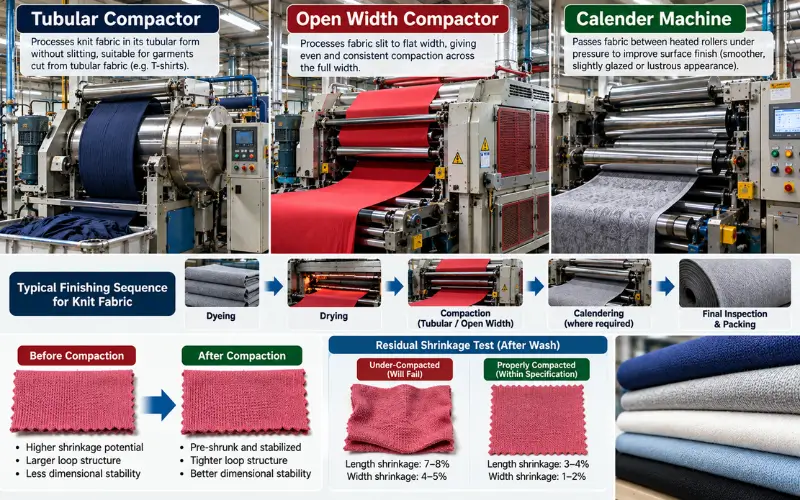
Tubular compactors process knit fabric in its tubular, circular-knit form, without slitting it open into flat width first. This suits garments cut directly from tubular fabric, common in basic t-shirt and similar knitwear construction, where maintaining the fabric’s tubular form through finishing avoids introducing a cut edge and the handling complexity that comes with it.
Open Width Compactors
Open width compactors process fabric that’s been slit and opened to flat width before compaction, which is necessary for garment styles cut from flat-laid fabric rather than tubular form, and also gives more even, consistent compaction across the full fabric width compared to some tubular configurations, since the fabric lies flat and under more uniform, controllable tension during the compaction process itself.
Which configuration a mill needs depends on downstream cutting requirements. A factory cutting exclusively from tubular fabric doesn’t need open width compaction capability, while a factory running a mix of tubular and flat-cut styles needs both, or needs to route tubular-form orders and flat-cut orders to compatible compaction equipment accordingly.
Calender Machines
Calender machines pass fabric between heated rollers under pressure, primarily to affect surface finish rather than dimensional shrinkage control, though some calendering also has a secondary compaction effect depending on the specific machine configuration and settings used. Calendering can produce a smoother, sometimes slightly glazed or lustrous surface effect, useful for certain fabric finishes where that particular hand and appearance is the desired outcome, though it’s a more targeted finishing tool than a universal step every knit fabric needs.
Where Compaction Sits in the Finishing Sequence
Compaction typically happens after dyeing and after the fabric has gone through drying, since compacting wet fabric wouldn’t achieve the same controlled, stable result as compacting dry, dimensionally settled fabric. It generally comes before final inspection and before the fabric ships to the cut-and-sew factory, since compaction is meant to be the last dimensional-stability step in wet processing before the fabric leaves the mill’s control. Calendering, where used, typically sits close to the end of the finishing sequence as well, since it’s affecting surface appearance on fabric that’s already through its primary wet processing and dimensional finishing steps.
Verifying Compaction Actually Worked
The practical test for whether compaction has achieved its intended effect is residual shrinkage testing, washing a fabric sample under standard conditions and measuring actual shrinkage against the target specification, typically expressed as a maximum acceptable shrinkage percentage in both length and width directions. Relying on fabric measurement immediately after compaction, without an actual wash test, misses the point of compaction entirely, since the whole purpose is predicting and controlling what happens after a real wash, not just achieving a target dimension on the finishing line where no washing has actually occurred yet.
A Worked Shrinkage Target Example
Say a buyer specification requires a finished garment to shrink no more than 5 percent in length and 3 percent in width after a standard home wash cycle. A knit fabric coming off the dyeing and drying stages, before compaction, might measure with an inherent shrinkage potential of 12 percent in length if left uncompacted, since that’s roughly how much built-in tension the knitting and dyeing process has left in the fabric structure. Running that fabric through a properly set compactor, targeting a compaction level that pre-shrinks the fabric by approximately 8 to 9 percentage points of that potential before it ever reaches the customer, leaves a residual shrinkage of roughly 3 to 4 percent when the customer eventually washes the finished garment, comfortably within the 5 percent specification.
Under-compacting, say only achieving 4 to 5 percentage points of pre-shrinkage due to settings that are too conservative, leaves 7 to 8 percent residual shrinkage still built into the fabric, which would fail the buyer’s 5 percent specification once the garment is actually washed, even though the fabric measured correctly on the finishing line immediately after compaction. This gap between finishing-line measurement and actual post-wash performance is exactly why the residual shrinkage testing covered above, not just an in-line width and length check, is the real verification step that matters.
Getting Compactor Settings Right for a New Fabric
Compactor settings, feed tension, compression pressure, temperature where the machine applies heat as part of the process, need adjustment for different fabric constructions and weights, similar in principle to the stenter settings trial process covered elsewhere. A new fabric quality entering production deserves a compaction trial with residual shrinkage testing on the washed result before full production commits to a specific setting, rather than assuming settings from a similar-weight fabric will transfer cleanly, since knit structure and fiber content both affect how a fabric responds to compaction in ways that aren’t always predictable from weight alone.
Frequently Asked Questions
Why does knit fabric shrink after a garment’s first wash even if it measured correctly at the mill?
Knit fabric carries built-in tension from knitting and dyeing that partially releases on first wash. Compaction pre-shrinks the fabric under controlled conditions before it reaches the customer, closing most of that gap.
What’s the difference between tubular and open-width compactors?
Tubular compactors process fabric in its circular-knit form, suited to garments cut directly from tubular fabric, while open-width compactors process fabric slit to flat width, needed for garments cut from flat-laid fabric.
Does calendering control shrinkage the same way compaction does?
Not primarily. Calendering mainly affects surface finish, a smoother or slightly glazed appearance, though some configurations have a secondary compaction effect depending on settings.
How is compaction effectiveness actually confirmed?
Residual shrinkage testing on a washed sample, not just measuring fabric dimensions immediately after compaction, since the whole point is predicting real post-wash behavior, not the finishing-line measurement alone.

