
An operation bulletin in garments is the working document that lists every sewing operation needed to make one style, in order, with the time, the machine and the skill each operation needs. It is the plan behind the line. Without it, the line planner has no firm way to say how many operators are needed, which machines to set up or where the bottleneck will be. With it, the planner can set up the line on paper before a single bundle reaches the floor.
This guide explains what an operation bulletin is, what it is used for, what it contains and how to make one, step by step. It also covers how to get the time for each operation, how to use the bulletin for line balancing and manpower, how to keep it up to date and what mistakes to avoid. It is written for industrial engineers, line planners and production managers.
What an operation bulletin is
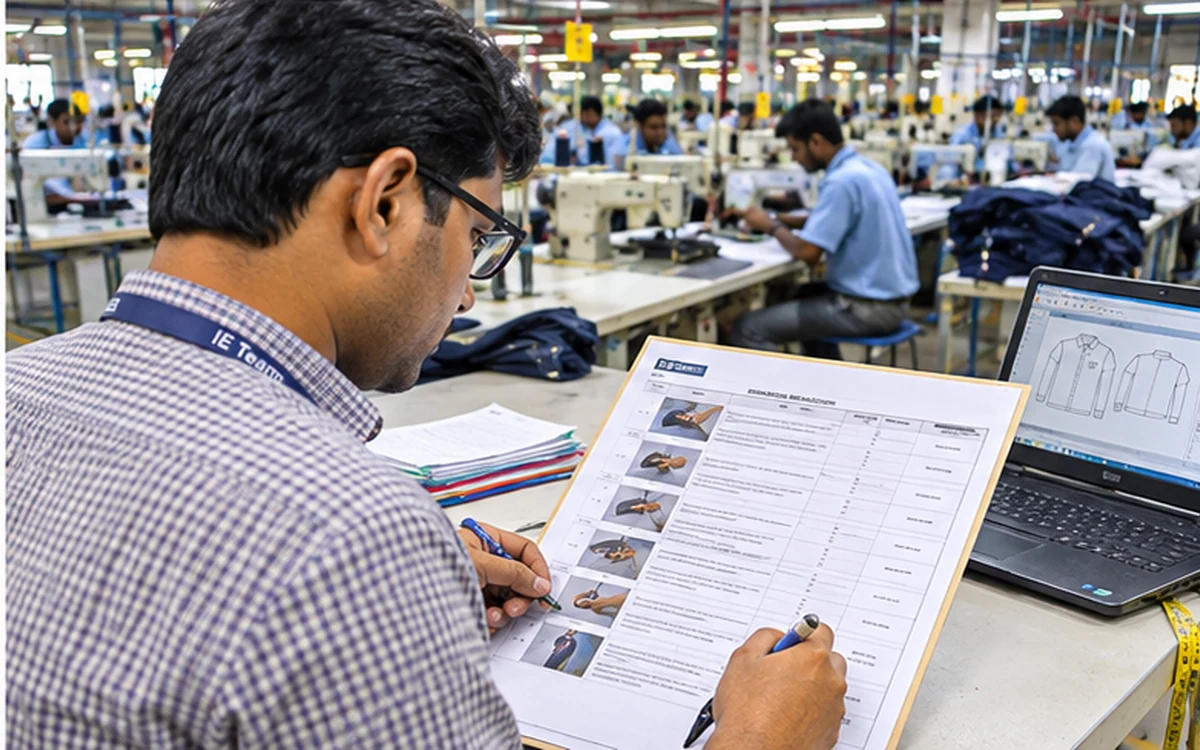
An operation bulletin, often called an OB, is a list of all the operations needed to sew a garment, in the order they are done. For each operation it shows what the work is, which machine or tool is used, how long the work takes (the standard minute value) and how many operators the operation needs. At the bottom, the times are added up to give the total SMV of the garment.
Think of it as a recipe for the sewing line. A recipe lists each step, the tools and the time. The operation bulletin does the same for a garment.
Operation bulletin, operation breakdown and OB sheet: the names
Different factories use different names for the same kind of document. In many factories, “operation bulletin”, “operation breakdown” and “OB” mean about the same thing. Some use “operation breakdown” for the list of operations and “operation bulletin” for the full sheet that also has machines, manpower and times. Check how your factory or your buyer uses the words, and keep it consistent inside the factory.
You will find ready examples of operation breakdowns for many styles on this site, such as the T-shirt, the polo shirt and the trouser.
What it is used for
- Setting the target. The total SMV and the number of operators decide how many pieces a line can make in a day. See hourly production target for a sewing line.
- Planning manpower. The number of operators for each operation comes from the SMV and the target. See how to calculate manpower for a sewing line.
- Planning machines. It shows which machines, how many of each, and which attachments are needed. See machine requirement calculation for a garment line.
- Balancing the line. It shows which operations are too long and which are too short. See line balancing in the garment industry.
- Costing. The total SMV is used to work out the cost of making the garment. See standard minute value in garments.
- Training and skill matching. It tells you what skill each operation needs, so you can place the right people.
- Quality planning. It shows where quality checks and critical operations sit.
- Quoting. Merchandisers use the total SMV when they discuss price and capacity with a buyer.
What an operation bulletin contains
A good operation bulletin has two parts: the header and the table.
Header
- Style name or number, buyer and order number.
- Garment description and fabric.
- Date made, version number and who made it.
- Machine and manpower summary.
- Total SMV, target and efficiency level used.
- Approval signatures, if the factory uses them.
Table of operations
For each operation, the table usually shows:
- Operation number or sequence.
- Operation name and a short description (for example, attach collar).
- Machine or tool type, such as single needle lockstitch, overlock, bartack or manual work.
- Attachment, folder or work aid, if used.
- SMV (standard minute value) or SAM for the operation.
- Number of operators or machines needed.
- Skill grade needed.
- Stitch details, such as stitch type, stitches per inch and thread.
- Notes, such as quality points, critical dimensions or special handling.
A simple format
Here is a blank format. Copy it into a spreadsheet and fill in your own values.
| No. | Operation | Machine or tool | Attachment or folder | SMV (min) | Operators needed | Skill grade | Stitch and notes |
|---|---|---|---|---|---|---|---|
| 1 | |||||||
| 2 | |||||||
| 3 | |||||||
| 4 | |||||||
| Total | Total SMV | Total operators |
Many factories also add columns for the part of the garment (collar, sleeve, body), the section (preparation, assembly, finishing), the target per hour and the actual per hour.
Steps to make an operation bulletin
- Get the inputs. Collect the approved sample, the tech pack, the spec and the pattern. See tech pack for clothing.
- Study the garment. Look at the sample, and take it apart if you can, to see how each seam and part is made. Note the stitch types and seam types.
- List every operation. Write down each separate piece of sewing work, such as hem sleeve, join shoulder, attach label. Do not skip small jobs like trimming, marking and turning.
- Put them in order. Arrange the operations in the sequence in which the garment is made. Show which operations feed into others (for example, sleeve parts made before joining to the body).
- Split into sections. Group operations into preparation (small parts), assembly (joining) and finishing sewing.
- Decide the method. For each operation, choose the machine, the stitch, the folder or attachment, and the way the work is held and moved.
- Get the time for each operation. See the next section.
- Work out the operators needed. Divide each operation time by the time per piece the line must achieve. See takt time in garment manufacturing.
- Add up the SMV. The total gives the garment SMV.
- Check the flow. Make sure the work flows from one operation to the next without back tracking.
- Review with the line. Ask the supervisor and a few skilled operators to check the sequence and the method.
- Approve and issue. Record the version, get approval and give copies to the line, the planner and quality.
How to get the time for each operation
Operation times come from three main sources.
- Time study. An industrial engineer times the operation with a stopwatch on skilled operators, rates their pace and works out the standard time with allowances. See work measurement techniques in the garment factory.
- Standard data. Many factories keep a database of times for common movements and operations, such as sewing a straight seam of a given length. Times for a new style are built from these.
- Previous styles. For a similar style, the time from a past operation bulletin can be used as a first estimate and then checked.
Whichever source you use, the time should be a standard time, which means a fair time for a trained operator at a normal pace, with allowances for rest and small delays. See how to calculate standard allowed minutes. Check new operations on the floor, because the real times may differ from the first estimate.
Machines, attachments and work aids
The method and the equipment change the time. A folder that shapes a hem, a guide that holds a seam allowance, or a machine with the right feed can cut the time and improve quality at once. For each operation, write down:
- the machine type and any special features, such as the feed type. See types of feed in sewing machines,
- the attachment, folder or template. See folders in the apparel industry,
- the needle and thread,
- the stitch and stitches per inch,
- any special tool, such as a marking tool or a jig.
This helps the mechanics set up the line, and it helps the planner count the machines.
Using the bulletin for line balancing and manpower
Once the bulletin is made, you can balance the line.
- Decide the target for the line per day or per hour.
- Work out the takt time from the target and the available time.
- Divide each operation’s SMV by the takt time to see how many operators it needs.
- Find operations that need more than one operator, and those that need less.
- Combine short operations next to each other for one operator, and split long operations or add a second operator.
- Adjust for efficiency. Divide by the expected line efficiency to get the real number of operators.
- Lay out the line, with machines in the order of the operations, so bundles move forward with little handling.
The same bulletin supports changes in target. If the buyer asks for more pieces per day, the bulletin tells you where to add people and machines. When a line is slow, the bulletin helps you find the long operation. See bottleneck identification in the sewing line.
Keeping it up to date
An operation bulletin is not a one time document. Update it when:
- the style changes, even slightly,
- the method changes, for example a new folder or machine,
- the fabric changes in a way that affects speed,
- a better sequence is found,
- actual times show that the standard is wrong,
- the buyer changes the spec or the quality requirement.
Use a version number and date on each copy. Remove old copies from the floor. Keep a record of each version, so you can see how the style changed over time. When a style repeats, review the old bulletin and improve it before the new order starts. This shortens setup time. See style changeover time reduction.
Common mistakes
- Missing small operations. Marking, trimming, turning and checking take time too.
- Copying a bulletin from another style without checking it. Small differences in the garment change the work.
- Using times that are not tested. Estimates that are never checked on the floor can mislead the plan.
- Ignoring the method. Two operators doing the same operation with different methods give different times. Fix the method first.
- Confusing SMV with actual time. SMV is a standard. Actual times are what the floor does.
- No sequence logic. An order that makes the work go back and forth adds handling.
- No version control. Old and new bulletins on the floor cause errors.
- Not sharing it. If operators and supervisors never see the bulletin, it does not help the line.
- Setting it once and forgetting it. A bulletin that never changes will drift away from the real work.
Final thoughts
An operation bulletin in garments lists every operation for a style in order, with machine, attachment, SMV, operators and skill. It is made by studying the garment, listing and ordering the operations, choosing methods, timing each operation and adding up the times. With it, you can set the target, plan manpower and machines, balance the line and cost the style.
Keep the sequence logical, the times tested and the versions controlled. Share the bulletin with the line, review it when a style repeats and update it when the method or spec changes. A good bulletin saves time before a style starts and helps solve problems while it runs.
Frequently asked questions
It is a document that lists every sewing operation for a garment, in order, with the machine, the standard time, the number of operators and the skill needed. It is the plan for setting up a sewing line.
Many factories use the two terms for the same thing. Some use operation breakdown for the list of operations and operation bulletin for the full sheet with machines, times and manpower. Follow the use in your factory.
Usually an industrial engineer, sometimes with a pattern or sample room specialist and a line supervisor. The people who know the garment and the machines should check it.
From a time study with a stopwatch, from standard data, or from a similar past style, then checked on the floor. The result should be a standard time with allowances.
The style details, the list of operations in order, the machine or tool for each, the attachment, the SMV, the number of operators, the skill grade, the stitch details and the total SMV.
Whenever the style, method, fabric, spec or standard times change, and when a style repeats and you find a better way. Keep version numbers and dates.
You can use it as a starting point, but check it against the new order. Fabric, trims, buyer spec or method changes may need updates to the operations and the times.

