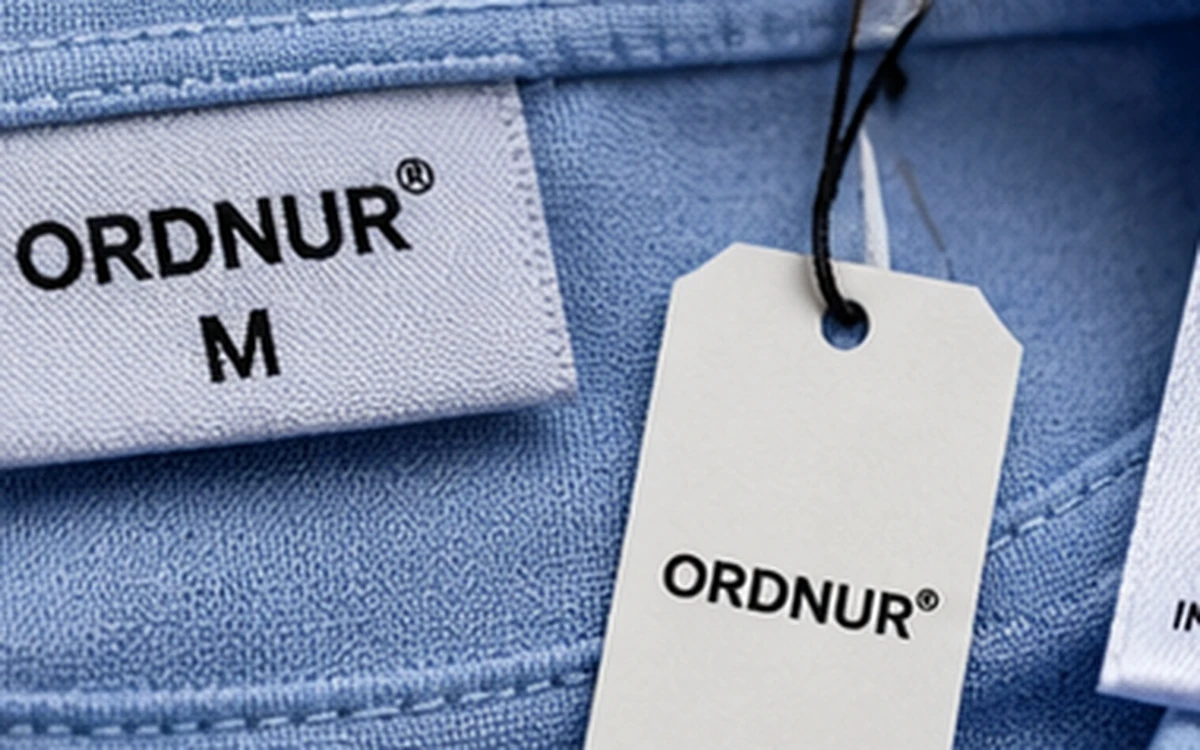
The types of garment labels on a single shirt can be five or six: a brand label at the neck, a size label, a care and content label, a flag label on the side seam, a hang tag, a price sticker and a barcode. Each one has its own job, its own supplier, its own place on the garment and its own risk. A wrong size label on a whole bundle, a care label that fades in the first wash or a missing country of origin can hold up a shipment as surely as a sewing defect.
This guide explains each label type, what it should carry, how labels are made and attached, and how a factory keeps them under control. For the machine side and the other trims on the card, see our guide to the trim card in garments.
Labels that sew into the garment
1. Main label (brand label)
The main label carries the brand name or logo. It is usually sewn at the centre back neck, or at the waistband of trousers, so that the wearer and the retailer can see whose product it is. It is the most visible label, and brands are strict about its quality, size, colour and position.
2. Size label
The size label shows the size, for example S, M, L or a number, and sometimes the fit name. It may be a separate label, or combined with the main label or the care label. Size labels are sorted by size and controlled with the cut parts, because a size label in the wrong size is among the costliest mistakes to find late. Our guide on bundle tickets in a garment factory shows how size is tracked through the line.
3. Care and content label
This label carries the care instructions, symbols and the fibre content, and often the country of origin and size. It is sewn in a side seam or at the neck, depending on the style. Rules on what it must show differ by market, so check the requirements of the country where the garment will be sold. Our guide to care labels and wash symbols explains the symbols and what each one means.
Typical content includes:
- Fibre content, in percentages, in order of weight
- Care symbols, and sometimes text in several languages
- Country of origin
- Size
- Identification of the maker, importer or brand, as the market requires
- A batch, style or production code for tracing
4. Flag label
A flag label is a small label sewn into a seam so that part of it sticks out, usually on the side seam or on a pocket edge. It often shows a logo, a brand tag line or a size. Common on jeans, polo shirts and casual wear.
5. Size flag or size tab
A small tab with only the size on it, sewn into the seam, often under the main label or at the side. Used where the main label has no size.
6. Patch labels
Patches are larger pieces made of fabric, leather, PU leather, suede or rubber, sewn or bonded onto the garment, often on the waistband, the pocket or the sleeve. Brand logos on jeans and caps are often patches.
7. Special labels
- Fibre or fabric technology labels: to show features of the fabric such as recycled content or a certified material. Certification marks must only be used by those who hold the right to use them.
- Organic or sustainability labels: linked to schemes such as GOTS or the recycled standards. Our guide on garment factory certifications explains which certificates relate to which label.
- Loop labels for hanging: a small loop sewn at the neck or the waist, used for hangers or storage.
- Anti counterfeit labels: with security features, used by brands.
Labels by how they are made
| Method | Description | Typical use |
|---|---|---|
| Woven (damask) | Dense weave with fine detail, firm hand | Main labels, brand labels |
| Woven (taffeta) | Flat, light weave, softer and cheaper | Size and care labels, flag labels |
| Woven (satin) | Smooth, shiny and soft face | Soft labels on lingerie, baby wear |
| Printed satin or polyester | Print on a ribbon, soft and cheap, but the print may wear | Care labels, size labels |
| Printed cotton or twill tape | Printed on a tape, natural look | Casual and workwear |
| Heat transfer | Printed on a transfer, applied with heat directly on the fabric | Tagless labels in T shirts and underwear |
| Embossed or debossed leather and PU | Pressed logo on leather | Jeans patches, bags, caps |
| Rubber, silicone and PVC | Moulded logo, can be 3D | Sportswear, outerwear |
| Embroidered | Stitched design on a base | Badges, patches |
| Metal | Plates or tags with engraving | Jeans, bags, luxury items |
Woven labels in more detail
- Damask woven labels have a high thread count and show small text and fine lines well. They feel firm and may scratch the neck on a soft garment.
- Taffeta labels are lighter and cheaper, with less fine detail. They are a good choice for care and size labels.
- Satin labels are soft and smooth, and suit places that touch the skin.
Heat transfer labels
A heat transfer label is printed onto the garment with heat and pressure, rather than sewn. It removes the stitched label, so there is nothing to scratch at the neck. It is often called a tagless label. It must be applied at the right temperature, pressure and time, and tested for wash durability. Our guide on heat transfer labels and the guide to heat transfer operation in garment manufacturing cover the process and the settings.
Label cutting and folding
How the label is cut and folded decides how it looks and feels, and how it is sewn.
- Straight cut: the label is cut straight, sometimes with heat or ultrasound to seal the edges. Sewn flat on all edges, or on two sides.
- End fold: the ends are folded back and sewn on three or four sides, which makes a neat, flat label with soft edges.
- Centre fold (loop fold): the label is folded in half, with the ends together, to make a loop. The raw ends are sewn into a seam. Often used for the main label at a neck seam.
- Mitre fold: the ends are folded at an angle, so the label has pointed ends, and the sewn edges are tidy.
- Laser cut or die cut: used for special shapes and finer edges.
Choose a fold based on where it is sewn, the thickness of the garment and the feel against the skin.
Labels that do not sew into the garment
A hang tag is a card or paper tag, attached to the garment with a string, plastic fastener or pin. It shows the brand, the style name, the price, the fibre and features. It is a marketing item as well as an information item. The attachment point, the string length and the fastener are given in the buyer’s instructions.
9. Price tag and barcode sticker
A sticker or tag carries the price, the barcode, the style number, the colour and the size. The barcode is read by the retailer’s system, so accuracy is vital. The data must match the order. Many retailers have a standard for the printing and the position. Keep a record of the barcode data used, so that errors can be traced.
10. Packaging labels
These go on polybags, inner boxes and cartons. They show the style, size, colour, quantity, order number and barcode. Their format is set in the buyer’s packing instructions. See our guide on garment packing methods and the export carton packing specs.
11. Warning and safety labels
Polybag suffocation warnings, flammability notices and similar warnings are required by law or by the buyer in some markets. They are printed on the polybag or attached to the garment. Check the rules for the destination market.
Some retailers add an RFID tag, sewn in or attached to the hang tag, for stock control. These carry electronic data and must be applied and tested as per the buyer’s instructions.
What must appear on a label
The required information varies by country and by product. Rules on fibre content, country of origin, care and traceability differ between regions, and they change. As a factory, do not rely on memory. Ask the buyer for the label content in writing, with the exact text and symbols, and have the buyer approve the label before bulk production. The merchandiser is responsible for the approval trail. See also the tech pack for clothing, which should list the labels and their positions.
Label placement
Placement is set in the tech pack, with a measurement from a fixed point, such as the centre back neck seam. Typical positions:
| Label | Typical position |
|---|---|
| Main label | Centre back neck, inside, or at the waistband for bottoms |
| Size label | Below or beside the main label, or part of it |
| Care label | Left side seam, near the hem or the waist |
| Flag label | Side seam or pocket edge |
| Patch | Waistband, back pocket, sleeve |
| Hang tag | Attached at the neck loop, the side seam or a buttonhole |
Check for position, straightness and the correct side. A label upside down, off centre or sewn on the wrong side is a defect.
How labels are specified in the order
Put the following on the trim card and in the bill of materials.
- Label type and purpose
- Construction (woven damask, printed satin, heat transfer and so on)
- Size, in millimetres
- Colour, with a reference
- Content and artwork, with the approved file
- Fold or cut
- Placement and sewing method
- Quantity per garment, with wastage allowance
- Supplier, lead time and minimum order
- Wash and test requirements
Labels often have a long lead time, because artwork must be approved, and a minimum order may apply. Put the label approval date in the time and action calendar. Late labels are a common reason for late shipments.
Quality tests for labels
- Wash durability: the print or weave should stay clear and readable after the specified washes.
- Colour fastness: the label should not bleed or stain the garment.
- Softness and comfort: an itchy label at the neck brings returns.
- Heat resistance: labels should survive ironing and pressing as the care label permits.
- Adhesion of heat transfer labels.
- Dimension against the approved sample.
- Accuracy of text: check spelling, symbols, percentages, size and country of origin against the approved artwork.
See the buyer’s garments test requirements and the guide on trims and accessories inspection for how labels are inspected when they arrive.
Controlling labels in the factory
Labels cause expensive mistakes because they are small and look alike. Good control includes these steps.
- Check incoming labels against the approved artwork and the order. Count them.
- Store labels by style, colour and size, in marked boxes, locked up if they carry a brand.
- Issue labels to the line by bundle or by count, with a record. Size labels go with the matching size bundles.
- Keep a sample of each label at the line, and at the checking point.
- Check the first garment for label type, content, position and attachment.
- Collect unused and rejected labels at the end of the order and count them against the issue. Destroy or return branded labels as the buyer requires.
- Keep the artwork approval and the test reports with the order file.
- Match barcodes against the data before the polybag stage. A scan and pack system helps, see scan pack system in the apparel industry.
Common label faults
- Wrong size label on a garment
- Wrong content or country of origin
- Spelling mistakes in the text
- Label missing
- Label crooked, off centre or upside down
- Label sewn into the wrong seam
- Care label fades or cracks after wash
- Label too stiff and scratches the skin
- Colour from the label stains the garment
- Heat transfer label peels
- Hang tag attached to the wrong place
- Barcode that does not scan or does not match the style
Many of these are found at final inspection, when the whole lot may have to be opened and reworked. Use the checks above to find them earlier. Include label checks in your AQL sampling plan and decide which label faults are major.
Final thoughts
The main types of garment labels are the main label, the size label, the care and content label, flag labels and patches that sew in, together with the hang tags, price stickers, barcode and packaging labels that do not. They can be woven, printed or heat transferred, cut and folded in different ways, and each must be approved, placed and checked.
Treat labels as controlled items. Get the content and artwork approved in writing, put the approval and delivery dates into the calendar, and keep count of every label from the store to the carton. A label costs very little, but a wrong one can cost a shipment.
Frequently asked questions
Main or brand labels, size labels, care and content labels, flag labels and patches are sewn in. Hang tags, price and barcode stickers, packaging labels and RFID tags are attached to the outside.
A care label shows how to wash and care for the garment, usually with symbols. It is often combined with fibre content, country of origin and size.
Woven labels are made by weaving threads into a design, and feel firm with good detail. Printed labels have the design printed on a tape or ribbon, which is cheaper and softer, but the print may fade with wash.
It is a label printed directly onto the garment with heat and pressure, with no sewn label. It is also called a tagless label and is used to avoid itching at the neck.
Usually at the centre back neck on tops, and at the waistband on bottoms. The tech pack gives the exact position.
The buyer approves the artwork and text, and the merchandiser holds the record. Content rules depend on the destination market, so check them before production.
Store labels by size, issue them with the matching bundles, keep a sample at the line, check the first piece, and count labels at the end of the order.