Leggings are everywhere. People wear them to the gym, to work from home, to travel and to run errands. They look simple, just a tube of stretchy fabric for each leg. But anyone who has owned a cheap pair knows how quickly things go wrong. The waistband rolls down, the fabric turns see-through when you bend and the seams dig in. These faults trace back to specific parts. Learning the parts of leggings helps you buy better and helps factories build them better.
This guide covers each part from the waistband to the ankle hem, the fabrics used, how leggings are sewn and the faults to watch for. If you also want to see the structure of trousers, our guide on the parts of a pant shows many of the same ideas in woven form.
What makes leggings different
Leggings are a skin-tight garment made from knit fabric with a high stretch. Because the fabric stretches, there is no fly, no zipper and no belt loops. The garment relies on elasticity to stay on. That puts a lot of work on the waistband, the seams and the fabric.
Most leggings use knit fabric with spandex, also called elastane. Spandex gives the garment its stretch and recovery. Without it, the fabric would bag out at the knees and seat.
Parts of leggings at a glance
| Part | Location | Job |
|---|---|---|
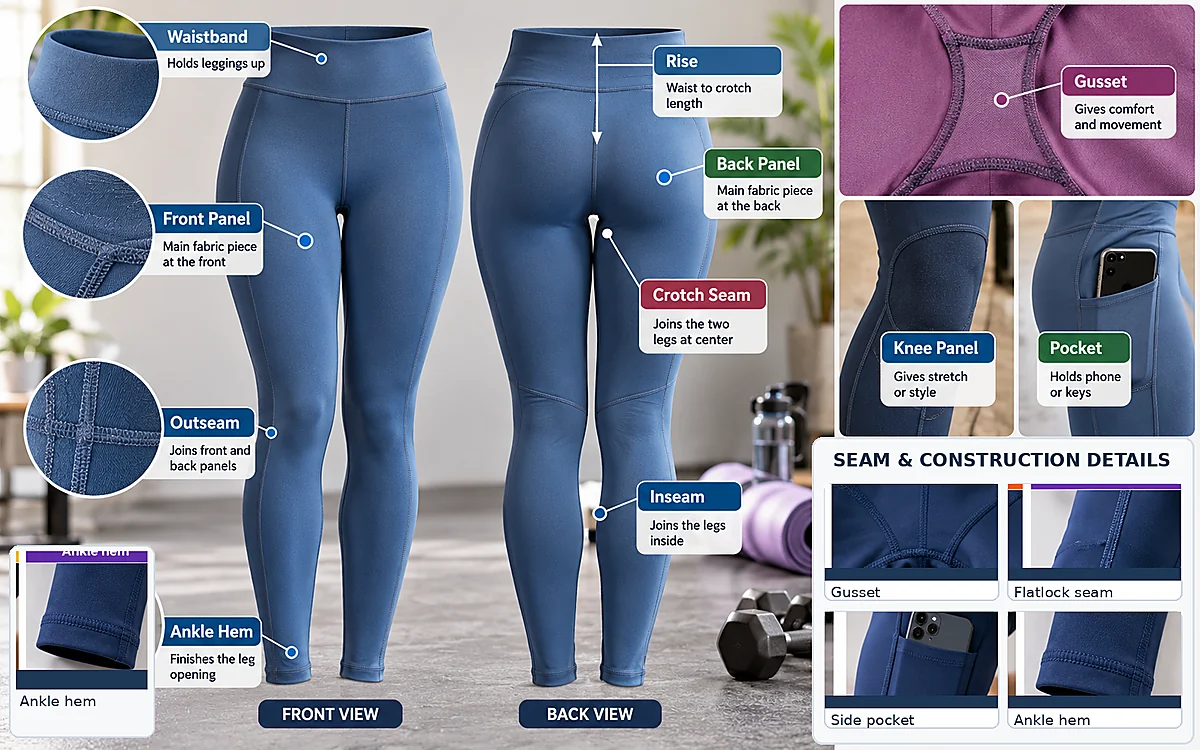
| Waistband | Top | Holds leggings up |
| Rise | Waist to crotch | Sets the fit at the waist |
| Front and back panels | Body | Main fabric |
| Gusset | Crotch | Gives comfort and movement |
| Inseam | Inside leg | Joins the legs |
| Outseam | Outside leg | Joins front and back |
| Crotch seam | Center | Joins the two legs |
| Knee panels | Knees | Give stretch or style |
| Ankle hem or cuff | Bottom | Finishes the leg |
| Pockets | Waist or side | Hold phone or keys |
| Drawcord | Waist | Adjusts fit |
| Label | Inside | Size and care |
Waistband
The waistband is the most important part of leggings. It must hold the garment up without digging in or rolling down. There are several designs.
- Wide yoga waistband: A broad band, often folded over, that sits high on the waist. It is soft and smooths the stomach.
- Elastic waistband: A thin elastic sewn inside a casing. It is simple and low cost, but can dig into the skin.
- Drawcord waistband: A cord through the band allows adjustment. Often paired with elastic.
- Foldover waistband: A band that folds over to adjust height.
- Crossover waistband: Two panels cross at the front and create a V shape.
- Flat or bonded waistband: A smooth finish with no thick seam.
Waistband width
Waistbands vary widely. A narrow band might be 2.5 cm wide. A wide yoga band can reach 15 cm or more. A wider band spreads pressure and is more comfortable, but it needs more fabric.
Waistband construction
A good waistband is cut from a double layer of fabric. This makes it opaque, strong and soft. It is sewn to the body with a stretch stitch, such as a cover stitch or a flatlock. A single layer waistband is thin and may roll over.
Poor sewing causes ripples in the waistband. The cause is often the band being stretched too much when it is attached.
Rise
Rise is the length from the crotch seam to the top of the waistband. It decides where the leggings sit on the body.
| Rise type | Sits at |
|---|---|
| Low rise | On the hips |
| Mid rise | Below the belly button |
| High rise | At or above the belly button |
| Ultra high rise | Close to the ribs |
High rise is popular because it holds in the stomach and stays up during exercise. But it needs enough stretch to fit well at the waist.
Front and back panels
The body of the leggings is made from front and back panels. In basic leggings, these are two simple pieces for each leg. Sporty leggings may be cut from several panels, shaped to follow the leg and seat. Panel seams can improve fit and add style. A seam at the back of the thigh can lift the seat. A contrast panel on the side gives a design line.
Fabric
Leggings fabrics are knitted with high stretch.
- Cotton and spandex: Soft and breathable, but can bag out.
- Nylon and spandex: Smooth, strong and common in sportswear.
- Polyester and spandex: Quick drying and durable.
- Brushed fabric: Soft inside, for winter.
- Compression fabric: Dense and firm for support.
- Faux leather or coated fabric: For fashion leggings.
- Ribbed knit: Textured and stretchy.
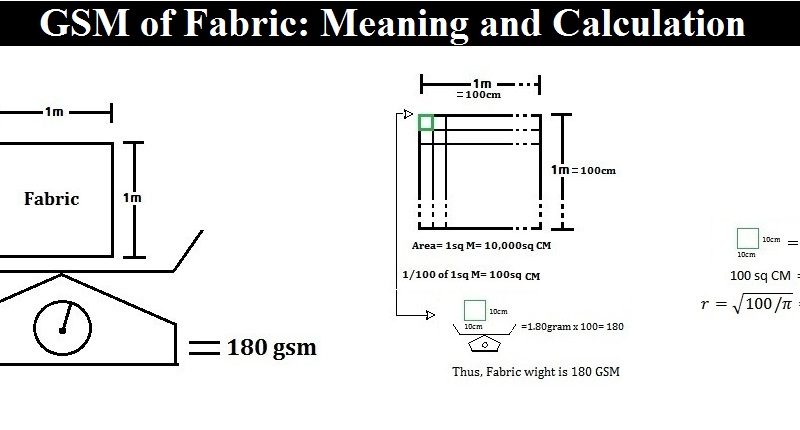
Fabric weight is described in GSM. Lightweight leggings may be around 180 GSM. Medium weight might be 220 to 280 GSM. Heavy compression fabrics can pass 300 GSM. Heavier fabric is more opaque and gives more support. For a deeper look at fabric weight and gauge, see our guide on knitting machine gauge and fabric GSM.
Squat test and opacity
A common check is the squat test. A person wearing the leggings bends down and the fabric stretches. If the fabric turns see-through, it fails. Good leggings stay opaque when stretched. Opacity depends on fabric weight, yarn density and dye. Light colors reveal more than dark ones.
Gusset
The gusset is a diamond-shaped or triangular piece of fabric in the crotch. It joins the front, back and inner legs with fewer seams in the center. Without a gusset, four seams meet at one point, which is bulky and can rub. With a gusset, the stress is spread. This improves comfort during movement.
Many sports leggings have a gusset. Cheaper leggings skip it and use a simple crotch seam.
Seams
Seams in leggings need to stretch with the fabric. Sewing teams use special stitches.
- Flatlock: A flat, wide seam that lies against the skin. Common in sportswear.
- Cover stitch: A seam with two or three rows of stitching on the top and a looper thread underneath. Good for hems and waistbands.
- Overlock: A stitch that trims and wraps the edge. Used for inner seams in cheaper leggings.
A regular lockstitch would break when the fabric stretches. See our guide on lockstitch, overlock and flatlock for more on the difference.
Inseam and outseam
The inseam runs along the inner leg, and the outseam runs along the outer leg. Some leggings have no outseam, because the panels are cut to wrap around the leg in one piece. Seams on the outer leg can create side lines that are visually slimming. Seams on the inner leg should sit flat so they do not rub.
Crotch seam
The crotch seam joins the two legs at the center. It takes the most stress. A weak crotch seam is a common reason leggings tear. A double row of stitching or a flatlock helps.
Pockets
Leggings pockets have become a selling feature.
- Waistband pocket: A small flat pocket in the band for a key or card.
- Side pocket: A pocket on the side seam or thigh, big enough for a phone.
- Hidden pocket: Sewn inside the band.
- Back pocket: A small zipped pocket on the back of the waistband.
Pockets in stretch fabric must not sag. Designers use a firm lining fabric for the pocket bag. For more on how pockets are built, see our guide on the parts of a pocket.
Ankle hem and cuff
The ankle hem finishes the bottom of the leg. Common finishes include:
- Cover stitch hem: A flat, stretchy double row of stitching.
- Raw edge: Left unfinished, used on some knits that do not fray.
- Elastic cuff: For a snug ankle.
- Ribbed cuff: A stretch band.
- Zip ankle: A small zipper at the ankle, used on some fashion styles.
- Stirrup: A strap under the foot, found in some retro styles.
Length varies. Full-length leggings reach the ankle. Capri leggings end mid-calf. Shorts leggings end at the thigh.
Labels and care
Many leggings use heat-transfer labels. They are soft against skin. A sewn-in care label may be placed in the side seam. Care instructions usually say to wash in cold water and avoid high heat. High heat can break down the spandex, which makes leggings lose shape.
How leggings are made
- Fabric relaxing and inspection. The knit fabric is allowed to rest, and any flaws are marked.
- Cutting. Panels are cut from a spread.
- Panel assembly. Seams are joined with flatlock or overlock.
- Gusset. The gusset is sewn into the crotch.
- Waistband. The waistband is sewn and attached.
- Hem. Ankles are hemmed with a cover stitch.
- Labels. Heat-transfer or sewn labels are added.
- Finishing. Threads are trimmed.
- Inspection and packing. Leggings are folded.
For the timing of these steps, see our guide on the operation breakdown, SMV and layout of leggings.
Leggings, tights and jeggings
These three are often confused. Leggings are made of thicker, opaque knit and are worn as trousers. Tights are thin, often sheer, and are worn under skirts and dresses, with a built-in foot. Jeggings are leggings printed or finished to look like denim, with fake pockets and rivets. They are often made from a heavy knit with spandex and sometimes include a real zip or button. Because the parts differ, they are sewn differently, and jeggings need extra detail on the waistband and pocket areas.
Washing and care
Wash leggings inside out in cold water with mild soap. Skip fabric softener, because it can coat the fibers and reduce stretch and moisture control. Dry flat or tumble on a low setting. Heat is the main enemy of spandex, since it makes the fiber brittle and the leggings lose their shape. Washing dark colors separately stops dye from rubbing onto lighter pieces. With simple care, a good pair can last through hundreds of wears.
Sizing and fit notes
Leggings are sized by waist and hip, but the stretch is wide, so one size often covers several body shapes. Compare your hip and inseam measurements to the brand chart, because inseam length varies from capri to full length. If you are between sizes, choose the one with the better waistband fit, since the waistband is the part that cannot stretch much further without losing grip. Compression leggings run tighter on purpose, so many people size up for comfort.
Common faults
- Waistband rolling: Waistband too thin or loose.
- Transparency: Fabric too light.
- Seam puckering: Wrong stitch or tension.
- Seams breaking: Wrong stitch type for stretch.
- Bagging at the knees: Weak spandex or poor recovery.
- Pilling: Short fibers rubbing.
- Dye transfer: Dark color rubs off.
- Twisted legs: Fabric cut off grain.
- Uneven hem: Poor sewing.
- Odor: Poor fiber or finishing.
How to choose leggings
- Do the squat test. Check opacity under good light.
- Stretch the waistband. It should return to shape.
- Check the seams. They should be flat.
- Feel the fabric. It should be soft and thick.
- Look at the gusset. A diamond gusset adds comfort.
- Check the pocket depth. It should hold your phone.
- Choose the right rise. Pick one you can wear all day.
Final thoughts
Leggings are simple in shape, but every part works hard. The waistband holds them up, the panels shape the fit, the gusset makes movement comfortable and the seams must stretch. Before you buy a pair, test the waistband, check the opacity and look at the seams. If they are soft, strong and flat, you will probably enjoy wearing them for years.
Frequently asked questions
The main parts are the waistband, front and back panels, gusset, inseam, outseam, crotch seam and ankle hem. Some leggings add pockets and drawcords.
The gusset is a diamond-shaped piece sewn into the crotch. It reduces bulk and adds comfort.
Nylon and spandex blends are smooth and durable. Cotton blends are soft. Polyester blends dry quickly.
The fabric may be too thin, too light in color or over-stretched. A heavier fabric and darker color help.
Rise is the distance from the crotch to the waistband. High rise sits at or above the belly button.
Stretch stitches such as flatlock, overlock and cover stitch are used, because they stretch with the fabric.
Wash in cold water and avoid high heat. Hot water and dryers can damage spandex.