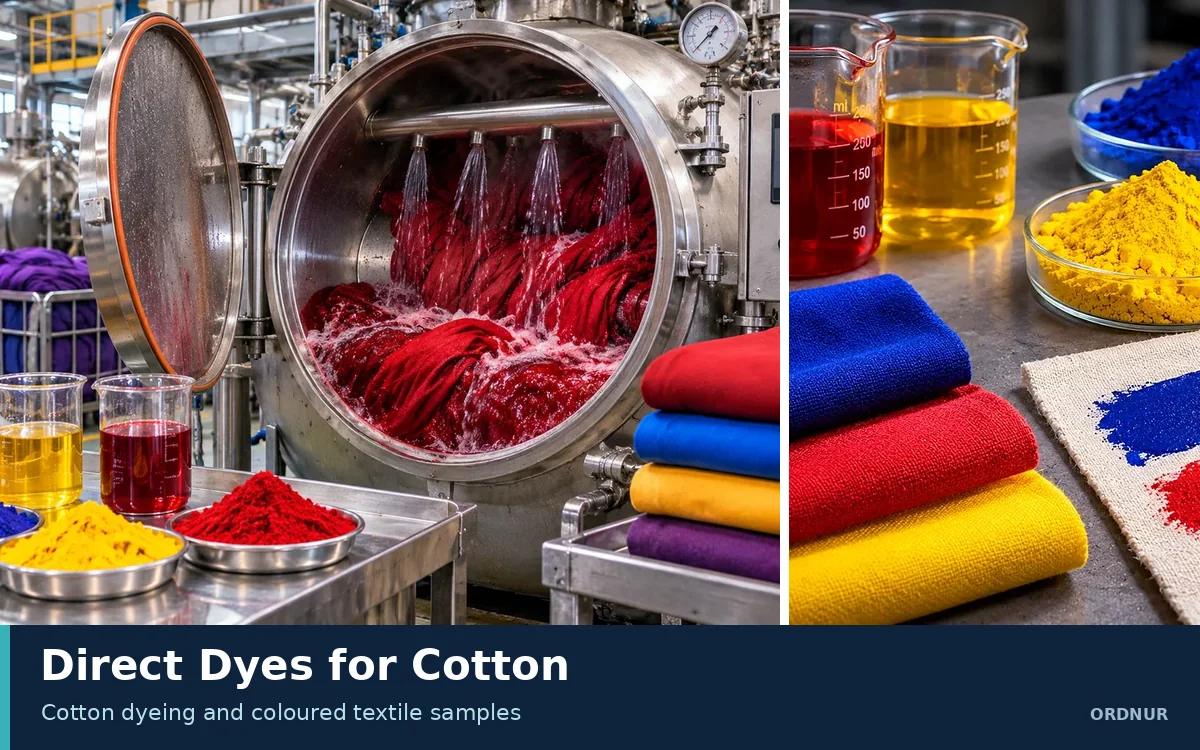
Direct dyes are among the oldest and simplest dyes for cotton. As the name says, you apply them straight to the fibre from a water bath, with no chemical reaction needed to hold the colour in place. Add the dye, add some salt, heat the bath, and the cotton pulls the colour out of the water.
That simplicity has a price. Direct dyes are cheap and easy to use, but they do not hold up well in washing. So they sit in a particular corner of the dye house: low-cost goods, pale and medium shades, and fabrics that will not be washed often. This guide explains how direct dyes work, how to dye with them step by step, how to improve their fastness and when to pick something else. There is also a worked recipe for a 500 kg lot, with every number checked.
What are direct dyes?
Direct dyes are water-soluble dyes that attach to cellulose fibres such as cotton, linen, viscose and paper without a mordant (a metal salt that helps fix colour). They are anionic, which means the dye molecule carries a negative charge in water, because of sulphonic acid groups on the molecule.
Most direct dyes share a similar shape. The molecule is long, thin and flat, and it often contains azo groups (a nitrogen to nitrogen double bond that gives colour). That shape matters, because a long, flat molecule can lie alongside a cellulose chain, like two logs side by side, and stay there.
They are named in the Colour Index as “C.I. Direct” followed by a colour and a number, for example C.I. Direct Blue 1. Our page on the classification of dyes shows where direct dyes sit among the other groups.
How direct dyes work
Cotton in water picks up a slight negative charge on its surface. A direct dye is also negative. So the two repel each other, and the dye struggles to get close to the fibre.
This is where salt comes in. Common salt (sodium chloride) or Glauber’s salt (sodium sulphate) in the bath reduces that repulsion. The positive sodium ions gather around the fibre surface and the dye anions, which lets the dye move onto the cotton.
Once the dye is on the fibre, it is held mostly by hydrogen bonds and weak van der Waals forces. These bonds are far weaker than the covalent bond formed by a reactive dye. That is the reason for the lower wash fastness. Under hot, soapy washing, the dye can move off the fibre again.
Properties at a glance
| Property | Direct dyes |
|---|---|
| Fibres | Cotton, linen, viscose, paper, some leather |
| Bond to fibre | Hydrogen bonds and van der Waals forces |
| Dyeing medium | Neutral to slightly alkaline bath with salt |
| Temperature | Near the boil, often about 90 to 95 °C |
| Shade range | Wide, but often duller than reactive dyes |
| Brightness | Moderate |
| Wash fastness | Poor to moderate before after-treatment |
| Light fastness | Varies. Some are good, many are only moderate |
| Cost | Low |
| Ease of use | Simple, with a forgiving process |
Ranges depend on the exact dye and shade depth, so treat these as general guidance and check the supplier’s data sheet.
Advantages and limits
Advantages
- Low price per kilogram of fabric dyed
- Simple application with plain equipment
- Wide range of shades, including good blacks and navy at low cost
- Good levelling (even colour) when salt is added carefully
- Works on cotton, viscose, linen and paper
- Low energy compared with a high-temperature process
Limits
- Poor wash fastness without an after-treatment
- Colour can bleed in water and stain other items
- Less bright than reactive dyes
- Heavy shades use a lot of salt, which ends up in the effluent
- Not the best choice for sportswear, towels or school uniforms that get washed hard
The dyeing process, step by step
Direct dyeing is usually an exhaust process, which means the dye moves from the bath to the fibre over time. It can be done on a winch, jet, jigger or package machine. Our comparison of jet, jigger and winch dyeing machines explains the choices.
- Prepare the fabric. The cotton must be clean, absorbent and evenly bleached or at least well scoured. Wax and size left on the fabric will cause patchy dyeing. See our guide to the scouring process.
- Set the bath. Fill the machine with water at a set liquor ratio. A common liquor ratio runs from 1:10 to 1:20, and lower is cheaper to heat. The liquor ratio affects water, steam and chemical cost.
- Add auxiliaries. Add a wetting agent, a sequestering agent if the water is hard and sometimes a small amount of soda ash (sodium carbonate) to keep the bath neutral to slightly alkaline.
- Add the dye. Dissolve the dye in hot water first, then add it to the bath through a filter. Undissolved dye leaves spots.
- Heat. Raise the temperature slowly, around 1 to 2 °C per minute, to the dyeing temperature. Too fast and the dye rushes onto the fibre unevenly.
- Add salt in portions. Salt goes in at intervals, often two or three portions at set temperatures, so the dye is pulled onto the fibre gradually. Adding it all at once can cause unlevel dyeing.
- Hold. Keep the temperature for about 30 to 60 minutes while the dye exhausts onto the cotton.
- Cool slowly. Many recipes cool to about 60 to 70 °C before draining, so dye does not wash off again while the bath is still hot. Some dyes need the bath cooled with dye in it to improve the final yield.
- Rinse. Cold rinse, then warm rinse.
- After-treat (see below), rinse again, soften and dry.
After-treatments that improve fastness
Because the bond is weak, nearly every direct dyeing for washable goods gets an after-treatment.
| Treatment | How it helps | Notes |
|---|---|---|
| Cationic fixing agent | A positively charged compound that bonds with the negative dye and makes it bigger and less soluble | Most common today. May slightly dull or change the shade. |
| Copper sulphate (for certain dyes) | Forms a metal complex that raises light and wash fastness | Used only with copper-compatible dyes. The shade can shift, and metal in effluent is a concern. |
| Diazotising and coupling (developed direct dyes) | The dye on the fibre is chemically changed to a larger molecule | Gives better wash fastness. Used less often now. |
| Resin finishing | A cross-linking resin traps the dye | Also changes fabric hand feel. |
Always test a small sample first. Our guide to colour fastness tests shows how washing, rubbing and light grades are assessed, and a second page covers wash, rubbing, perspiration and light tests.
A worked recipe: 500 kg of cotton in a medium shade
Let us write a full recipe. The numbers below are an example, and a real lot would be adjusted after a lab dip.
Given
- Fabric: 500 kg of bleached cotton
- Shade depth: 2.0 percent on weight of fabric (owf)
- Liquor ratio: 1:10
- Salt: 10 g per litre
- Fixing agent: 1.5 percent owf
Step 1: Dye weight
Dye = 500 × 2.0 ÷ 100 = 10 kg
Step 2: Bath volume
Liquor = 500 kg × 10 = 5,000 litres
Step 3: Salt
Salt = 5,000 L × 10 g/L = 50,000 g = 50 kg
If the salt is added in two portions, that could be 25 kg first and 25 kg after the temperature is reached.
Step 4: After-treatment
Fixing agent = 500 × 1.5 ÷ 100 = 7.5 kg. This is added in a fresh bath after rinsing, usually at a lower temperature and a different liquor ratio. Follow the supplier’s data sheet for time and temperature.
Step 5: What is left in the bath?
Suppose 70 percent of the dye goes onto the fabric. This is called the exhaustion.
Dye left = 10 × (1 − 0.70) = 3.0 kg
In the 5,000 L bath, the concentration is 3,000 g ÷ 5,000 L = 0.6 g/L. That coloured water goes to the effluent plant, and it shows why exhaustion and liquor ratio matter for cost and for the environment.
Step 6: Cost check
If the dye costs 6 dollars per kg, the dye cost for the lot = 10 × 6 = 60 dollars. That is 0.12 dollars per kg of fabric. If a reactive dye at the same depth costs more per kilogram of dye and needs salt and soda ash at higher levels, the cost gap can still be small, so compare the whole recipe and not only the dye price. (The price here is an example only.)
Direct dyes versus reactive dyes
Many mills choose between these two for cotton. Here is a plain comparison.
| Feature | Direct dyes | Reactive dyes |
|---|---|---|
| Bond to cotton | Weak physical bonds | Strong covalent bond |
| Wash fastness | Poor to moderate | Good to very good |
| Brightness | Moderate | High |
| Process | Simple, one bath | Needs salt, alkali and careful control |
| Cost per lot | Often lower | Often higher |
| Typical use | Low-cost goods, paper, linings, bags | T-shirts, towels, bed linen, uniforms |
For the details on reactive dyes, see our guide to cotton dyeing with reactive dyes and our page on how to choose between reactive, disperse and vat dyes.
Common problems and fixes
| Problem | Likely cause | Fix |
|---|---|---|
| Patchy, uneven colour | Salt added too fast or the heat-up was too quick | Add salt in portions and slow the heat rise |
| Dye spots | Dye not fully dissolved | Dissolve in hot water and filter before adding |
| Colour bleeds in wash | No after-treatment | Use a cationic fixing agent |
| Shade changes after fixing | The fixing agent shifts some dyes | Run a lab test and match to the final shade |
| Poor depth | Too little salt or too short a hold | Check recipe and hold time |
| Batch-to-batch variation | Different water, liquor ratio or fabric prep | Standardise and check. See shade variation |
Where direct dyes are used today
- Paper and board
- Low-cost cotton and viscose goods
- Linings and interlinings
- Shopping bags and craft items
- Leather finishing
- Base shades before a second dye or finish
Reactive dyes took over most apparel cotton because of their better wash fastness. Direct dyes remain useful where cost matters more than fastness.
Safety and environment
Some older direct dyes were based on benzidine, an amine that is linked to cancer, and they are banned or restricted in many markets. Modern commercial direct dyes should be free of banned amines, but you should ask the supplier for test reports. Salt load and coloured effluent are the main environmental points, so use the lowest salt level that gives an even result and treat the effluent properly. Wear gloves and a mask when handling dye powder, because fine dust is easy to breathe in.
Final thoughts
Direct dyes colour cotton in a simple way. A long, flat dye molecule, some salt and a hot bath are the main ingredients. The result is a low-cost shade that needs a fixing step if the garment will be washed. Our 500 kg recipe showed 10 kg of dye, 5,000 L of liquor and 50 kg of salt, with about 0.6 g/L of dye still in the bath after dyeing.
Pick direct dyes for linings, paper, bags and light-duty goods. Pick reactive dyes when the garment must last through many washes. And whichever you choose, test a lab dip, test fastness and record the recipe, because a good dye house wins on repeatability.
Frequently asked questions
Direct dyes are water-soluble anionic dyes that colour cotton, viscose, linen and paper directly from a salt bath, without a mordant or a chemical bond.
Cotton and the dye both carry a negative charge in water, so they repel each other. Salt reduces that repulsion and helps the dye move onto the fibre.
They are held by hydrogen bonds and weak physical forces, not by a covalent bond. Hot, soapy washing can pull the dye back out.
Use an after-treatment such as a cationic fixing agent. Some dyes can also be treated with copper salts or developed on the fibre, but test the shade first.
Typically near the boil, often about 90 to 95 °C, but follow the data sheet for the specific dye.
No. They suit cellulose fibres. Polyester is dyed with disperse dyes at high temperature.
Modern direct dyes sold for textiles should not release banned amines, but ask for test reports. Handle powders with gloves and a mask, and treat the effluent.