A necktie looks like a plain strip of silk. But a good tie hangs straight, ties into a neat knot and keeps its shape after years of use. That quality comes from a hidden structure of cut angles, linings and hand stitching. If you know the parts of a necktie, you can tell a well-made tie from a poor one in a few seconds.
This guide names each part, from the wide blade to the narrow neck, explains what each one does and shows how ties are cut and sewn. You will also learn common fabrics, widths and faults. Neckties are one of the most traditional items in menswear. For more on the types and the fabrics used, see our guide on neckties types, names, uses and fabric.
The basic shape
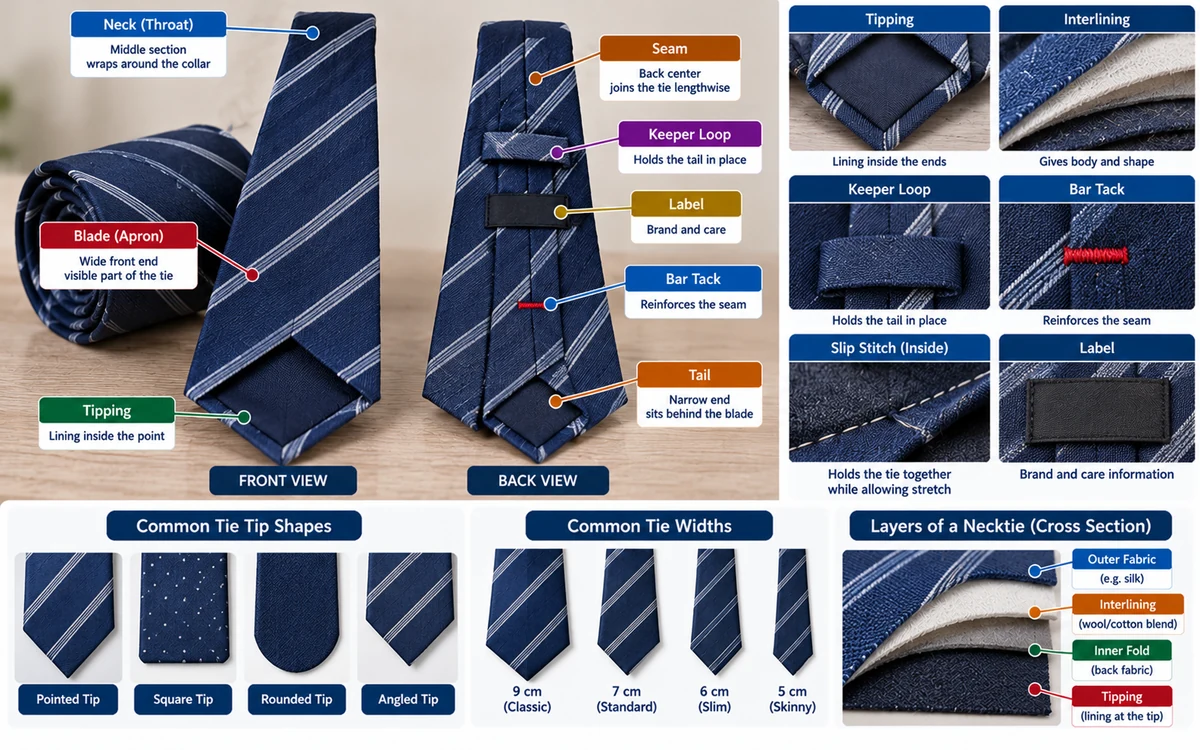
A tie is a long, narrow piece of cloth, wider at one end and narrower at the other. It wraps around the neck, goes through a knot and hangs down the front of the shirt.
A tie has three broad zones.
- The wide end (blade), which hangs at the front.
- The narrow end (tail), which sits behind the blade.
- The neck (middle), which goes around the collar.
Parts of a necktie at a glance
| Part | Location | Job |
|---|---|---|
| Blade (apron) | Wide front end | The visible part of the tie |
| Tail | Narrow end | Sits behind the blade |
| Neck (throat) | Middle | Passes around the collar |
| Seam | Back center | Joins the tie lengthwise |
| Tipping | Inside the ends | Lines the points |
| Interlining | Inside the whole tie | Gives body and shape |
| Slip stitch | Inside the back | Holds the tie together while letting it stretch |
| Bar tack | Back of the blade | Reinforces the seam |
| Keeper loop | Back of the blade | Holds the tail in place |
| Label | Back | Brand and care |
| Fold | Back seam | Hidden fold lines |
Blade
The blade, also known as the apron, is the wide end of the tie. It is the part that hangs at the front of the chest. It carries the pattern and any print or weave. A blade is usually 7 to 9 cm wide for a classic tie, and 5 to 6.5 cm for a slim tie. Width trends change over the years, so there is no fixed standard.
The point of the blade can be shaped differently. Most blades have a pointed tip. Some have a square or rounded end.
Tail
The tail is the narrower end of the tie. It sits behind the blade when the tie is knotted. The tail is shorter than the blade, and it is usually partly hidden. It carries a small loop on the back to keep it in place.
Neck or throat
The neck, or throat, is the narrow section in the middle of the tie. It wraps around the shirt collar. The width of the neck is only about 2.5 to 3 cm, which helps the tie form a neat knot. A neck that is too thick makes a bulky knot.
Cutting a tie on the bias
A good tie is cut on the bias, which means at a 45 degree angle to the threads of the fabric. Bias cut gives a tie its stretch and drape. A tie cut along the straight grain would be stiff and would twist or hang crooked. Because of the bias, the tie can stretch slightly when tied, and recover when untied.
Tie fabric is usually cut in three pieces: the blade, the tail and the neck section. These are sewn together at a slight angle. The seam lines are hidden inside the tie.
This cutting method wastes more fabric than a straight cut, which is one reason ties made from good silk cost so much. The exact usage depends on the tie width and the pattern repeat.
Seam
A tie has a back seam that runs along its length. It is a slip-stitched seam, which means it is sewn by hand with a loose thread that gives the tie some room to flex. If the seam was sewn tightly by machine, the tie would be stiff and would pucker.
In a hand-finished tie, the seam is closed with a long, loose stitch that runs through the interlining. The stitch is called a slip stitch. A loose stitch also helps the tie recover its shape after tying. Many tie makers include a small tying loop in the stitch so it can stretch.
Interlining
The interlining is a layer of soft fabric inside the tie, between the outer silk and the back. It gives the tie body, shape and weight. It is usually made from wool, cotton or a blend. Good interlining makes the tie feel full and hang well. A poor tie has thin interlining and feels flat.
Interlining is cut on the bias too, so it matches the silk. It is wrapped inside the tie, and the silk is folded over it before stitching.
Weight matters as well. A heavy interlining makes a thick tie. A light one suits summer. Some ties use two layers for extra body.
Tipping
Tipping is a piece of lining fabric inside the front edge of the blade and tail. It covers the points, keeps them neat and protects the main fabric from wear. Tipping is often made from the same fabric as the tie, or from a contrasting color. In cheap ties, the tipping may be a separate piece of polyester.
Some ties, particularly those from Italian makers, have a visible tipping with the brand name on the back.
Bar tack
The bar tack is a small reinforcing stitch at the base of the tie’s seam, near the wide end. It stops the seam from opening when you pull the tie. You will often find a second one at the tail end. They are visible on the back as short, dense stitches.
A good tie has a firm bar tack that lies flat. A poor tie has a loose or crooked one.
Keeper loop
The keeper loop, also called the tie keeper or label loop, is a small fabric loop on the back of the blade. The tail slips through it so it does not swing around. Many keeper loops are made from the same fabric as the tie. The label may be sewn onto the loop.
Labels
Ties often carry several labels. The main label shows the brand and sometimes the fiber content. A care label shows cleaning advice. Many silk ties say dry clean only. In some quality ties, the label is hand-sewn.
Length, width and knots
Most adult ties are about 145 to 150 cm long, with longer sizes for tall wearers, though makers differ. Length decides how the tie sits once knotted. The tip of the blade should end near the belt buckle. Thick ties suit simple knots, such as the four-in-hand. Thin silk ties can hold a larger knot, such as the half Windsor. The collar matters as well: a spread collar suits a bigger knot, and a narrow point collar suits a small one. You can read about collar styles in our guide on different styles of shirt collar, and about the collar’s own parts in our guide on the parts of a collar.
Fabrics
- Silk: The classic choice. It drapes beautifully and holds a knot. It can be woven or printed.
- Polyester: Cheaper and more durable, but it can look shiny.
- Wool: A warm, textured look. Used in winter ties.
- Cotton: Casual and light.
- Linen: Summer ties with a textured look.
- Knit: Made from knitted silk or cotton, with a square end.
- Microfiber: Cheap and soft, used in school and uniform ties.
Silk ties can be woven or printed. A woven silk tie, such as jacquard, has a pattern built into the weave. A printed silk tie has a design printed on a plain weave. Both can look great.
Tie types
| Type | Features |
|---|---|
| Classic tie | Wide at 8 to 9 cm, pointed end |
| Skinny tie | Narrow at 5 to 6 cm |
| Bow tie | A small pre-shaped or self-tie bow |
| Ascot | Wide, fold-over cravat |
| Bolo tie | A cord with a decorative clasp |
| Knit tie | Square-end tie from knitted fabric |
| Clip-on tie | Pre-tied with a clip |
| Zipper tie | A pre-tied tie with a zip |
How a tie is made
A hand-finished tie goes through these main steps.
- Cutting. The silk and the interlining are cut on the bias.
- Joining. The three pieces are sewn together.
- Pressing. The seams are pressed open.
- Folding. The silk is folded around the interlining.
- Slip stitching. A hand stitch closes the back seam.
- Bar tacking. The ends are reinforced.
- Loop attachment. The keeper loop and label are sewn.
- Pressing. The tie is pressed.
- Inspection. The tie is checked for flaws.
Mass-market ties are made on specialized machines, but they use the same ideas.
Seasonal and occasion choices
Fabric and color change the message a tie sends. Heavy silk and wool ties suit autumn and winter, while light linen and cotton suit summer. Solid navy, grey and burgundy are safe for interviews and offices. Bold prints and bright colors suit parties and weddings. Knit ties give a casual look that works with blazers and open collars. Matching the width of the tie to the width of your jacket lapel keeps the outfit balanced.
Care and storage
Never pull a tie tight when you undo the knot. Loosen it, slide the blade back through and lay the tie flat. Hang it on a tie rack or roll it loosely in a drawer, so the bias cut can relax. Do not wash silk ties in a machine. Spot clean with a damp cloth, and dry clean only when the label says so. Rotate your ties so each one gets a few days to recover its shape between wears.
Common faults
- Twisting: Wrong bias cut or poor interlining.
- Knot too bulky: Neck section too thick.
- Puckering seam: Seam sewn too tight.
- Shiny marks: Over-pressing or heavy friction.
- Fraying edges: Poor folding or lack of tipping.
- Loose keeper loop: Weak stitching.
- Shade mismatch: The blade and tail pieces differ in color.
- Pattern misalignment: The pattern does not line up at the seams.
- Stains: Water spots on silk.
- Thin feel: Weak interlining.
How to judge a tie
- Hold it up. It should hang straight.
- Check the weight. A good tie feels solid.
- Look at the back. The seam should be neat and the bar tack firm.
- Feel the silk. It should be smooth.
- Pinch the neck. It should be soft and narrow.
- Look at the pattern. It should be even.
- Tie a knot. It should hold and not twist.
Final thoughts
A necktie is a long strip of fabric with a careful structure inside. The bias cut gives it drape, the interlining gives it body, the tipping protects its points and the slip stitch gives it room to move. If you want a tie that lasts, check the bias cut, the back seam and the bar tack. Those are the places where good makers show their skill.
Frequently asked questions
The main parts are the blade, tail, neck, interlining, tipping, back seam, bar tack and keeper loop.
It is called the blade, or the apron. It is the part that hangs at the front.
Cutting on the bias gives the tie stretch and drape. It lets the tie recover after tying and hang without twisting.
It is called the keeper loop. The tail passes through it to stay in place.
Tipping is a lining inside the front edge of the blade and tail. It keeps the points neat and protects the fabric.
Most classic ties are 7 to 9 cm. Slim ties are 5 to 6.5 cm. Pick a width that matches your jacket lapels.
A slip stitch is a loose hand stitch along the back of a tie. It holds the seam closed while letting the tie flex.