
A sewing machine has about 25 to 30 working parts, and they fall into four groups: the thread path, the needle area, the bobbin area and the controls. The thread path (spool pin, thread guides, tension discs, take-up lever) feeds the upper thread. The needle area (needle, presser foot, throat plate, feed dog) holds and moves the fabric. The bobbin area (bobbin, bobbin case, hook) forms the lower stitch. The controls (handwheel, stitch dials, reverse lever, motor) run it. Below you will find every part with its location and job, how industrial garment machines differ from home machines, and what to check when a stitch goes wrong.
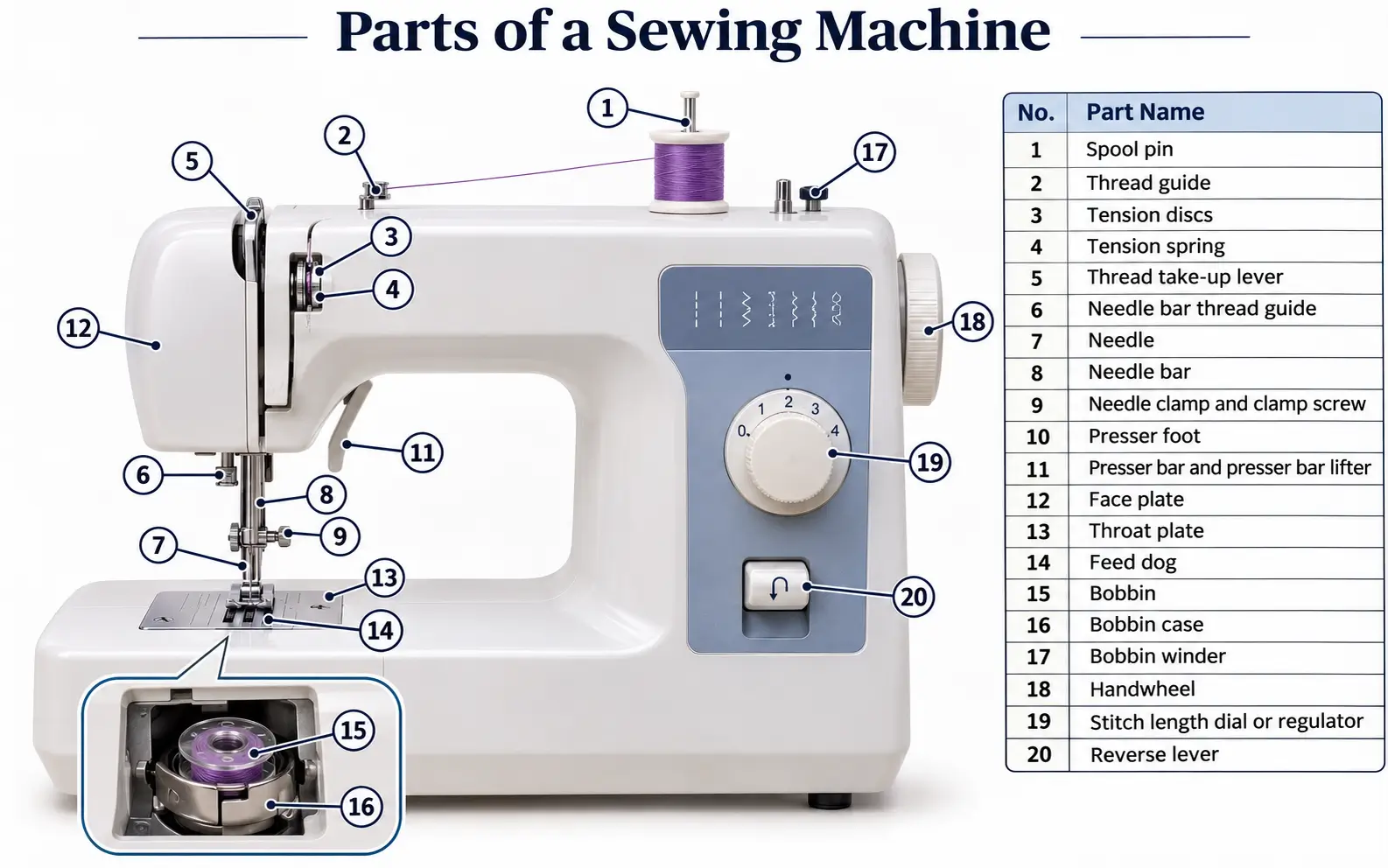
Parts of a Sewing Machine: Location and Function
| Part | Group | What it does | Also called |
|---|---|---|---|
| Spool pin | Thread path | Holds the thread spool, upright or lying flat | Spindle |
| Thread guide | Thread path | Routes the thread so it feeds smoothly into the tension discs | Thread guide bar |
| Tension discs | Thread path | Two discs that grip the upper thread; the tension dial sets how tightly | Tension assembly |
| Tension spring | Thread path | Keeps light tension on the thread while the take-up lever rises | Check spring |
| Thread take-up lever | Thread path | Moves up and down to feed thread and pull the stitch tight | Take-up arm |
| Needle bar thread guide | Thread path | Last guide before the needle; keeps the thread on line | Needle thread guide |
| Needle | Needle area | Carries the upper thread through the fabric to meet the bobbin thread | None |
| Needle bar | Needle area | The shaft that moves the needle up and down | None |
| Needle clamp and clamp screw | Needle area | Holds the needle in the bar; the screw locks it | Needle clamp thumb screw |
| Presser foot | Needle area | Presses fabric against the feed dog so it does not slip | Foot |
| Presser bar and presser bar lifter | Needle area | The lifter raises the foot to insert fabric and release the thread tension | Foot lifter |
| Pressure regulating screw | Needle area | Sets how hard the presser foot presses | Pressure adjuster |
| Face plate | Needle area | Cover on the machine head; removed to oil and clean | Head cover |
| Throat plate | Needle area | Metal plate under the needle with a needle hole and seam guide lines | Needle plate |
| Feed dog | Needle area | Toothed bars under the plate that move the fabric one stitch at a time | Feed |
| Bobbin | Bobbin area | Small spool holding the lower thread | None |
| Bobbin case | Bobbin area | Holds the bobbin and sets its thread tension | Bobbin holder |
| Hook | Bobbin area | Catches the upper thread loop and passes it around the bobbin to lock the stitch | Rotary hook, shuttle |
| Slide plate or bobbin cover | Bobbin area | Cover that gives access to the bobbin | Bobbin cover |
| Bobbin winder | Controls | Spindle and guide that wind thread from the spool onto the bobbin | Winder |
| Handwheel | Controls | Turn by hand to raise or lower the needle; sets needle position | Balance wheel, flywheel |
| Stitch length dial or regulator | Controls | Sets how far the feed dog moves per stitch | Stitch regulator |
| Stitch indicator plate | Controls | Scale showing the stitch length setting | Stitch selector plate |
| Reverse lever | Controls | Makes the machine stitch backward to lock seam ends | Back-tack lever |
| Motor and foot pedal (home) or table motor (industrial) | Controls | Drives the machine; speed follows the pedal | Servo motor (industrial) |
Common Sewing Machine Parts and Functions
Although basic sewing functions remain the same, the pattern of stitches is different. You can put different types of stitches with the modern machine. For well-finished garments, you need to buy a good quality machine, either you can buy manual or automated. For personal use, people used to buy handheld machines.
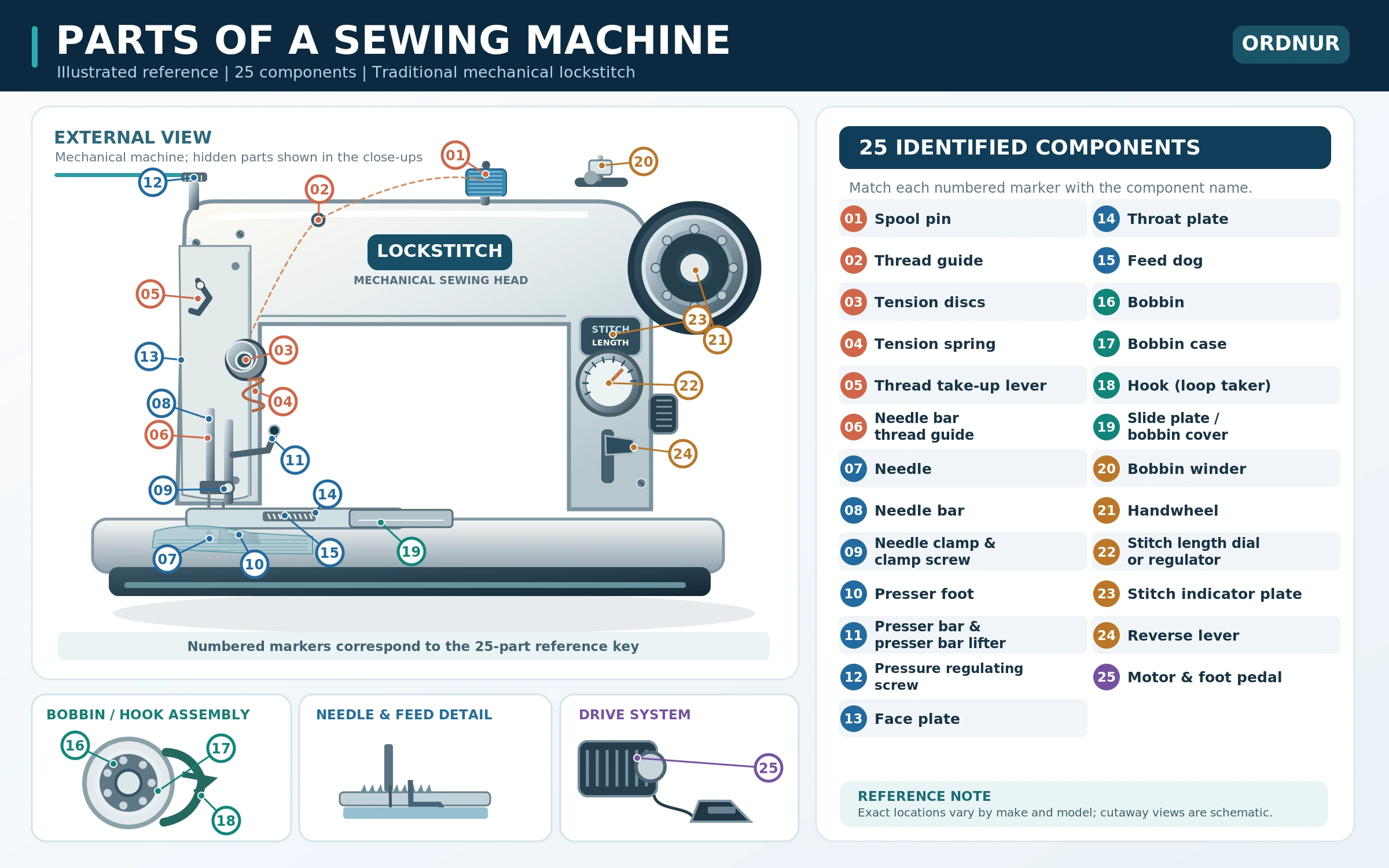
Now with a modern machine, you can not only sew your cloth but also can do embroidery. A good quality thread is required for getting better finishing and strength.
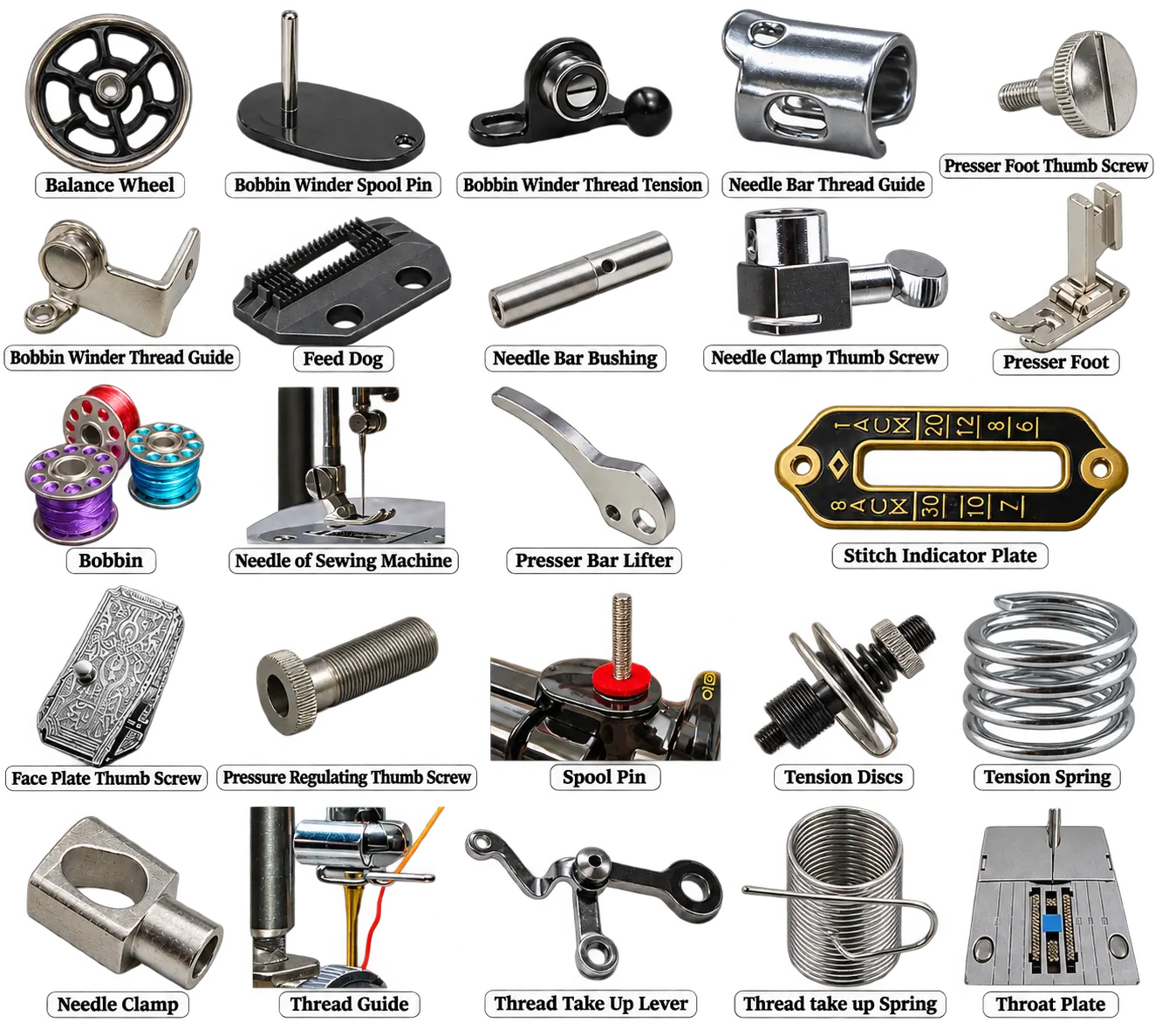
Balance Wheel
In a traditional handheld machine and in a semi-auto machine, you can see that there is a wheel on the top right corner of a sewing machine. Basically, it is used to run the machine manually.
Needle
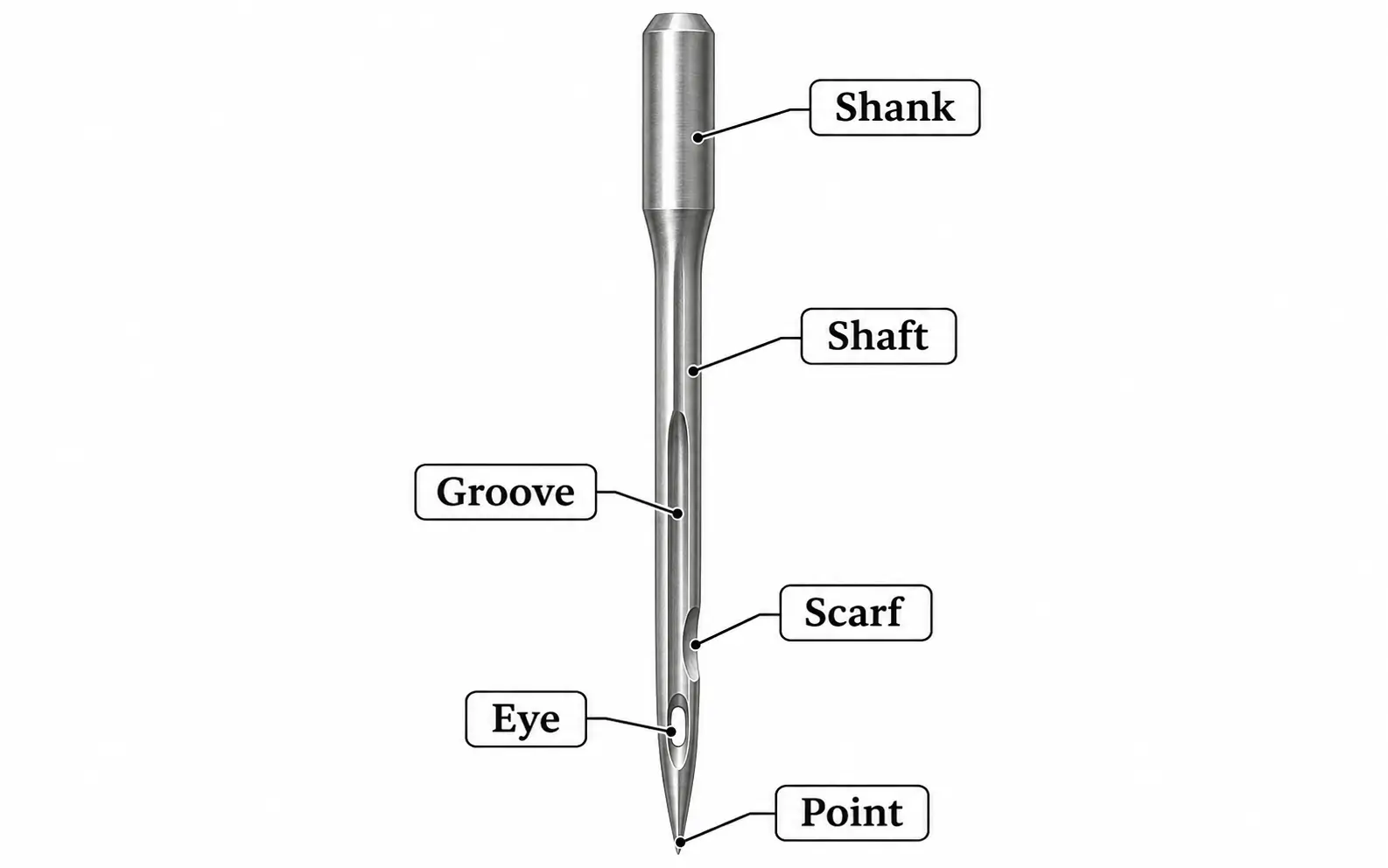
A needle is a sharp metal, very sharp in nature which has a small hole (eye) in which a thread goes through. Basically, a needle is used for sewing. A needle consists of 5 parts. They are a shank, Shaft, Front Groove, Point Scarf, and eye. However, for woven fabric and denim, lather, knit fabric, different types of Needle are used and Needle made of steel coated with chrome or titanium.

Parts of a needle
A needle has six parts: shank (the top end that goes into the clamp), shaft, front groove (guides the thread down), scarf (the cut-out above the eye that lets the hook catch the loop), eye and point. Needle size is printed on the shank. In metric sizes, 60 to 70 suits thin fabric, 80 to 90 medium fabric, and 100 to 110 heavy fabric such as denim. Domestic machines usually take 130/705H needles; industrial lockstitch machines usually take DB×1 needles. Always check the machine manual before buying.
How the parts work together
- The spool pin releases thread, which passes the thread guides and tension discs.
- The take-up lever lifts and drops, feeding thread to the needle.
- The needle goes down through the fabric and forms a loop on the way back up.
- The hook catches that loop and carries it around the bobbin thread.
- The take-up lever rises and pulls the loop tight, locking the stitch inside the fabric.
- The feed dog moves the fabric one stitch length, and the cycle repeats.
Different Size of Sewing Machine Needle
According to the purpose, Different sizes of a needle are used for different types of fabric.

Sourcing of Needles
The needle is mainly sourced from China because of a cheap price. So you can also source it locally if the order quantity is less.
Spool Pin
A spool pin is placed vertically or horizontally which actually used for holding the spool of threads and this is a fixed part of a sewing machine.
Bobbin
A bobbin is one of an integral part and it is non-electrical parts. Bobbins can be found in different electric devices. In a bobbin, threads are wired which is used for sewing. You need to set the required thread into a bobbin. After finishing you have to refill the bobbin.
Sourcing of Bobbin
There are many popular brands of bobbin manufacturer, you can collect bobbin from them. You can source either by importing or if locally available then purchase it locally because it will be cheaper. Different manufacturers of sewing machine bobbins are:
- Brother
- Juki
- Janome
- Singer
- Boby Lock
- Bernina
- Consew
- Elena
- Kenmore
- Riccar
- Handi Quilter
Bobbin Holder
Bobbin holder is used to holding the bobbin into the machine. Bobbin holder also is known as the bobbin case which is one of the key parts. Time to time you may need to conduct cleaning and maintenance of the bobbin case. It is one of the commonly used spare parts.
Presser Foot
A presser foot is used to hold the fabric in the right place on the throat plate so that fabric cannot slip around. Sometimes it may require to change the pressure foot if you use your machine for commercial garments production or small household business.
Tension Discs and Tension Spring
The tension discs used to control the thread tension to give proper stitch on the fabric. If there is a problem of tension then you may see that stitch is not placing properly, it may loose or tight. A tension spring is added to control the pressure so that two different fabrics can join together with proper stitch. Tension discs and spring may need to change if it is damaged. Sourcing options are local or source it from China or any other region if you need a large quantity.

Remember that you have to clean dust from time to time from the tension discs otherwise, you will get an improper stitch on the fabric.
Face Plate Thumb Screw
The faceplate thumb screw is used for attaching the faceplate of a sewing machine. You may find it a traditional machine but normally this part is not required to replace it.
Thread Guide
Thread guide is a small part of a machine that has a hole inside, is responsible for properly guide the threads from the spool pin to the hole of a needle. Thread guide is made of steel or metal.
Throat Plate
The throat plate is placed between the pressure foot and bobbin case. This plate also is known as a needle plate. It is made of metal and at the time of sewing, a pressure foot is placed on top of the throat plate.
Stitch Indicator Plate
Stitch Indicator plate indicates the stitching type where different stitching number is written. This plate is a fixed part of the machine that is not required to change but you should clean the surface of the plate so that the written number is visible.
Stitch Regulator
By using a stitch regulator, you can regulate the type of stitch on the fabric. In accordance with your requirements, you can switch into a different stitch or adjust your sewing stitch.
Bobbin Winder
Bobbin winder basically ensures the right direction of the threads from the spool to the bobbin. An automated mechanical process works inside the machine.
Feed Dog
Feed dog helps to feed the fabric to the required direction, either backward or forward using its teeth. It is a metal-based product. Normally it is not a visible part of a machine. But if you look closely into the needle plate then you can see. If the feed dog is damaged then you must need to change it.
Choice of Right Brand of Sewing Machine
You may think about what brand you should choose among available brands. My suggestion is, first determines the purpose and then decide the purchase decision. There are many popular brands available out there.

If it is for home use, then the singer machine you can purchase. For industrial garments production Juki, Janome, and Brother these two brands are highly used all over the world because of their good quality.
Therefore, to get long-term service from a sewing machine, you have to ensure regular cleaning and maintenance. Put lubricants or oil into the required parts which are functional. Sewing Machine Parts can be imported from China, Europe or bought from the local market. Needle, bobbin, bobbin-case, oil, and lubricants are commonly needed parts and require regular maintenance.
Common problems and the part to check
| Problem | Check this part first | Likely fix |
|---|---|---|
| Skipped stitches | Needle | Replace a bent or wrong-size needle; check the hook timing if it persists |
| Upper thread keeps breaking | Tension discs, needle, throat plate | Re-thread with the presser foot up; replace a damaged needle; polish a burr on the plate |
| Loops or a “bird’s nest” under the fabric | Tension discs, take-up lever | Re-thread fully, with the presser foot lifted |
| Seam puckers | Tension, presser foot pressure, needle size | Lower the tension, reduce pressure, use a finer needle |
| Fabric does not feed | Feed dog, presser foot | Clean lint from the feed dog; check it is raised and the foot pressure is not too low |
| Needle breaks | Needle clamp, presser foot | Tighten the clamp, use the right needle size, do not pull the fabric |
| Uneven stitches | Bobbin, bobbin case | Rewind the bobbin evenly; clean the case |
Basic Maintenance
- Clean lint from the feed dog, bobbin case and hook area after each bobbin change.
- Oil only the points named in the manual; wipe off excess.
- Replace the needle at the first sign of damage or about every 8 hours of sewing.
- Cover the machine when not in use.
- Buy spare parts from a seller you can check, and match the part number, not just the name.
FAQ
How many parts does a sewing machine have?
A typical machine has 25 to 30 main working parts, plus many small internal ones. This guide covers the main parts you will handle or name.
What is the most important part of a sewing machine?
The needle and the hook work together to form the stitch, so both matter equally. A bent needle or a badly timed hook stops stitching.
What is the difference between the throat plate and the feed dog?
The throat plate is the flat metal plate with the needle hole. The feed dog is the set of teeth that rise through slots in that plate to move the fabric.
What does the handwheel do?
It lets you move the needle up or down by hand. Turn it toward you.
What are the main parts of an industrial sewing machine?
Head, table, motor, needle bar, presser foot, feed dog, hook and bobbin case, tension assembly, take-up lever and the oil system. The functions match a home machine but are built for continuous use.
Written by
Md. Nahian Mahmud Shaikat


Is very best
Lovely lovely hair by introducing of I Mr Anzaku William am happy to meet with diz am sewing machine entry God bless ous
good
ਸੀਡਲ ਦੀ ਇਸ ਵਿੱਚ ਕੋਈ ਜਾਣਕਾਰੀ ਨਹੀ ਦਿੱਤੀ ਗਈ?
Thanks that’s good
Were can i get parts for singer computer sewing machine
So beautiful and loving industry of sewing machine, am in press of u guys keep it up and may god help us all in Jesus name? Amen
Love your ideas very well explain.
Am looking for company that can supplies domestic sewing machine parts.
Like bobbin, shuttle, bobbin case, needle plate, teeth, presser foot,.needle tight.
good morning,
do you sell spares for a Brother sewing machine.
i need the Pressor foot set and the bobbin cover plate for the bobbin.
Sorry right now we don’t have it
I really like the way it is identified
May GOD bless you . Am indeed bless with this.
I APPRICAITE YOUR EXPLANATION!!!
Thanks for the answers,
I really appreciate it.
Delver to other people about stitching matching which are used in industry
Such like
1- over lock
2-fiddo
3-double stitch
4-lock stich
Thanks for sharing your perspective on the Sewing machine. I think it’s crucial to keep in mind that sewing when approaching sewing, as it can significantly impact the outcome.
This is nice sewing machine part i really like it am in psser with what i sew keep it up n god will see us true?