Types of tapes in garments cover a wide family of narrow woven, knitted or bonded strips that are sewn, fused or glued into a garment to strengthen it, stabilise it, finish an edge, carry a label or add a design detail. Most wearers never notice them, but a garment without the right tape in the right place will stretch out at the shoulders, twist at the neck, rip at the seam or lose its shape after a few washes. Tapes are a trim, like zips, buttons and labels, and they need the same attention in the bill of materials, the spec and the quality plan.
This guide explains the main types of tape, what each is made of, where it goes in the garment, the usual widths and properties, the tests worth running, the common problems and how to write a clear tape spec. It is written for merchandisers, product developers, sourcing staff, quality teams and students.
What tapes do in a garment
Tapes are used for one or more of these jobs.
- Stabilise. Stop a seam or an edge from stretching, for example the shoulder seam on a knit T shirt.
- Reinforce. Add strength at stress points, such as pocket mouths, crotch seams and strap joints.
- Finish and cover. Hide raw edges, such as inside a neckline or along a hem.
- Carry. Hold items such as a hanger loop, a care label or a drawcord.
- Seal. Cover seam holes in waterproof garments.
- Decorate. Add colour, texture, branding or pattern.
- Grip or fasten. Provide grip on sportswear or form part of a hook and loop closure.
Main types of tapes
| Tape | What it is | Common use |
|---|---|---|
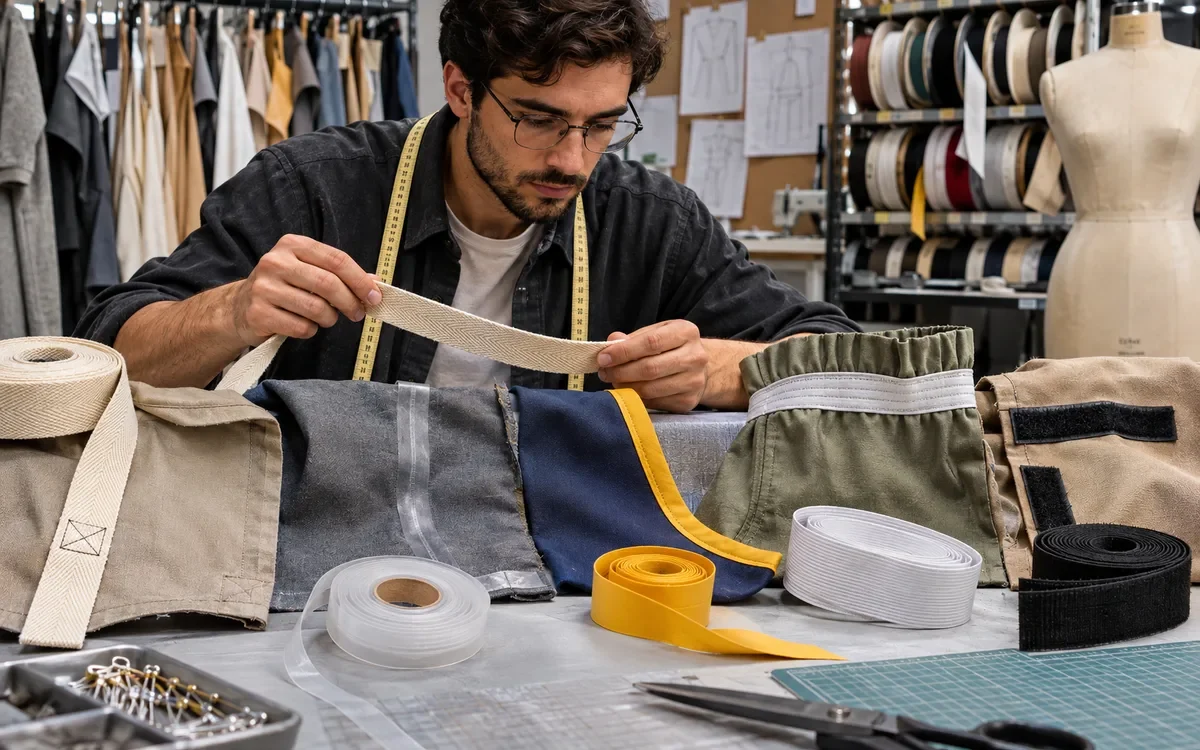
| Twill tape | A strong, flat woven tape with a diagonal twill pattern | Drawstring casings, hanger loops, edge binding, labels, bags |
| Herringbone tape | A woven tape with a zigzag herringbone pattern | Jackets, workwear, drawcords and decoration |
| Cotton tape and webbing | Plain woven natural fibre tape | Waistbands, ties, casings and heavy duty straps |
| Polyester tape and webbing | Woven synthetic tape, stronger and less prone to shrinking | Sportswear, outerwear and bags |
| Nylon webbing | Strong, smooth, often used for straps | Bags, harness, outerwear |
| Neck tape, or back neck tape | A strip sewn along the back neck seam inside the garment | Covers the seam, adds comfort and stops stretching |
| Shoulder tape, or stay tape | A strip sewn into the shoulder seam | Prevents stretch and keeps the line of the shoulder |
| Bias tape | A strip cut on the diagonal, folded or flat | Curved edges, bindings and piping. See binding and piping in garments |
| Seam tape, or seam binding | Narrow tape to cover or bind inside seams | Linings, jackets and tailored garments |
| Seam sealing tape | A waterproof tape bonded over stitched seams | Rainwear. See seam sealing in garments |
| Elastic tape | A woven, knitted or braided stretch tape | Waistbands, cuffs, underwear. See types of elastic in garments |
| Fusible tape or stay tape | A tape with a heat activated adhesive on one side | Stabilises seams and edges, such as shoulders, hems and zip openings |
| Hook and loop tape | A pair of tapes that grip each other | Cuffs, pockets, straps and children’s wear |
| Zipper tape | The woven strip that carries the zip teeth | See types of zippers in garments |
| Reflective tape | A tape with a reflective surface | Workwear, sports and children’s wear |
| Jacquard or printed tape | Tape woven or printed with patterns or logos | Branding, drawcords, shoulder straps and trims |
| Silicone gripper tape | A tape with a silicone print for grip | Sports tops, socks, cycling wear and hem grips |
| Ribbon | A decorative woven or satin strip | Lingerie, dresses, gift packs |
| Drawcord and cord tape | Round or flat cord for pulling | Hoods, waists and bags |
Twill and herringbone tape
Twill tape has a visible diagonal rib and is dense and strong. It is common as a drawstring, as a hanger loop, along the inside of a placket or yoke and as a binding. Herringbone tape has a reversing pattern like the bones of a fish and a slightly softer look. Both come in cotton, polyester and blends. Cotton shrinks more than polyester, so check shrinkage against the garment fabric.
Neck tape
Neck tape runs along the back neck seam, from shoulder to shoulder, on the inside of T shirts, shirts, jackets and sweatshirts. It covers the raw seam, adds strength and stops the neck from stretching out of shape. It may be plain or printed with a brand name, size or a care message, which is also used as a label. The tape is usually sewn in the same seam or with a separate stitching line, and the tape width is set by the design, often in the range of 10 to 25 millimetres, though widths vary.
Shoulder and stay tape
A strip of tape, often woven or fusible, is sewn or fused into the shoulder seam of knit garments. Knit fabric stretches, and without tape the shoulder seam grows with wear and washing, so the shoulder droops. Tape holds the seam length. Fusible stay tapes are quick to apply, but must be fused at the right heat and pressure. The page on fusing process and quality inspection covers fusing control.
Seam tape and seam binding
A narrow, soft tape, often made of cotton, polyester or rayon, used to bind and neaten inside seams, mainly in lined jackets, coats and tailored trousers. It prevents fraying, adds stability and gives a neat inner finish.
Elastic tape
Tapes that stretch, used in waists, cuffs and underwear. They may be woven, knitted or braided, with rubber or elastane. Choose by stretch, recovery, width and softness against the skin. The guide to types of elastic in garments covers the options in detail.
Reflective tape
A tape with glass beads or micro prisms that return light. Used for workwear, sportswear and children’s wear. Safety rated tapes are tested to standards, and fashion reflective tapes are not safety products. Check the rating, and check washing durability. Flame retardant workwear needs flame resistant reflective tape. The guide to flame retardant fabric explains the details.
Hook and loop tape
Two tapes, one with tiny hooks and one with soft loops, that stick together when pressed. It makes quick, adjustable closures, but the hook side can catch on other fabrics in the wash, so some garments need a cover flap. It is used in children’s wear, sportswear and medical wear. The sewing of hook and loop needs a suitable needle and a clean cut, since the hooks dull needles.
Silicone gripper tape
A narrow elastic or woven tape with a printed silicone pattern on one side. It keeps the hem of a garment in place on the skin, for example on cycling shorts or sports tops, without tight elastic.
Materials and construction
| Material | Properties | Points to watch |
|---|---|---|
| Cotton | Soft, absorbent, natural look | Shrinks more than synthetics, may fade or bleed colour |
| Polyester | Strong, low shrinkage, good colour fastness | Can feel harsher, melts under high heat |
| Nylon | Very strong, smooth | Absorbs more water than polyester, can yellow with some finishes |
| Viscose or rayon | Soft, lustrous | Weaker when wet, shrinks |
| Elastane blends | Stretch and recovery | Heat sensitive, check recovery after washing |
| Blends | Balance of properties | Check composition and shrinkage |
Woven, knitted and non woven tapes
- Woven tapes. Made on a narrow loom, with a firm structure and clean selvedge edges. Good for strength and shape.
- Knitted tapes. Made on narrow knitting machines, softer and with some stretch. Good for comfort and for knit garments.
- Braided tapes. Made with interlaced yarns, often used for cords and elastics.
- Non woven and bonded tapes. Made from fibres or films bonded together, such as fusible tapes and seam sealing tapes.
Widths and weights
Tape widths range from very narrow, a few millimetres, to wide, 50 millimetres or more. Weight and thickness vary. Choose the width from the job, such as the seam allowance or the size of the cord casing, and the thickness from the garment fabric, so the tape does not show through or add bulk. Always follow the design or tech pack, and test on the fabric.
Where tapes go in a garment
| Garment area | Tape used | Purpose |
|---|---|---|
| Back neck | Neck tape | Cover seam, stop stretching, add label space |
| Shoulder seam | Stay tape | Hold the length and shape |
| Waistband | Elastic tape, twill tape, drawcord | Hold the waist, make a casing, adjust fit. See types of waistbands in garments |
| Hems and edges | Bias tape, binding, hem tape | Finish edges, add structure |
| Pocket openings | Twill tape, stay tape | Stop stretch, reinforce |
| Zip area | Zipper tape, stay tape | Support the zip and the opening |
| Seams of rainwear | Seam sealing tape | Keep water out |
| Cuffs and ankles | Elastic or hook and loop tape | Adjust fit |
| Hanger loops | Twill or cotton tape | Hang the garment |
| Safety wear | Reflective tape | Visibility |
| Jackets and coats | Seam tape, webbing | Neaten, strengthen, carry hardware. See parts of a jacket |
Tests and quality checks
Tapes are small, but poor tape quality can ruin a garment. Check:
- Shrinkage. Wash the tape the way the garment will be washed. If the tape shrinks more than the fabric, the seam puckers. If it shrinks less, the tape can show as a ridge. The guide to shrinkage control in the garment factory is a good companion.
- Colour fastness. To washing, rubbing, perspiration and light, depending on the product. Contrast tapes can stain light fabrics. The page on colour fastness tests is a useful companion here.
- Width and thickness. Measure against the spec, with tolerance. A tape that varies in width makes uneven seams.
- Breaking strength and elongation. Important for straps, drawcords and load bearing tapes.
- Stretch and recovery. For elastic tapes. The page on stretch and recovery in fabric covers this in more detail.
- Tape tension. Whether the tape is wound loose or tight on the reel, since a tape that relaxes after sewing makes puckering.
- Adhesion. For fusible tapes, bond strength after washing.
- Edge quality. Frayed or rolled edges are a risk.
- Reflective performance. For reflective tapes, brightness after washing, if required.
- Chemical compliance. Restricted substances, especially for children’s wear and prints. The guide to restricted substances in garments goes deeper on this.
- Needle and metal control. Tapes with metal threads or hardware must be allowed for in metal detection.
Common problems and fixes
| Problem | Likely cause | Remedy |
|---|---|---|
| Seam puckering along the tape | Tape shrinks differently from fabric, tension too high | Pre shrink or test the tape, relax the tape on the reel, adjust tension |
| Neck stretches out of shape | No tape, weak tape or tape sewn too tight | Add neck or stay tape, use suitable tape, sew with even feed |
| Shoulder droops | No stay tape or tape too short | Use stay tape, check length |
| Tape twists or rolls | Tape not flat or sewn off line | Choose a flat tape, guide the feed |
| Colour bleeding from tape | Poor colour fastness | Test fastness before use, choose better dyed tape |
| Fusible tape peels | Wrong temperature, time or pressure, or poor fabric match | Adjust fusing, check the adhesive type |
| Tape shows through the fabric | Tape too thick or too dark | Use a thinner or lighter tape |
| Tape frays | Poor edge, wrong cutting | Use a better selvedge, hot cut synthetic tapes where suitable |
| Hook and loop sticks to other items | Hook side exposed in the wash | Cover the hooks, add a flap, close before washing |
| Uneven tape width in a lot | Poor supplier control | Set width tolerance and test incoming lots |
Writing a tape spec
A clear spec helps the supplier and avoids disputes. Include:
- Type and use. For example, back neck tape for knit T shirts.
- Material and composition. For example, 100 percent cotton or polyester.
- Construction. Woven, knitted or non woven.
- Width and tolerance.
- Thickness or weight.
- Colour and standard. With a swatch and lighting standard.
- Print or pattern. Artwork, position and repeat.
- Shrinkage limit. And the test method.
- Colour fastness requirements.
- Strength or stretch requirements.
- Length on reel or pack.
- Packing and labelling.
- Chemical requirements.
- Approval samples. Pre production and production samples.
Include tapes in the bill of materials with consumption per garment and wastage. The page on the bill of materials in garments shows how trims are listed. Neck tape per garment is a simple length, but it needs an allowance for seam turn and wastage.
Costing and sourcing
Tape is cheap per metre, but it is used in many places, and a wrong choice can cause expensive problems. Cost depends on the material, width, construction, printing and order size. Printed and jacquard tapes need minimum orders and set up time. Standard plain tapes are available in stock colours with shorter lead times. For labels and printed tapes, consider the same planning as for other branded trims, as covered in the guide to types of garment labels. Order enough for the order plus wastage and test needs, and confirm lead times early, since special widths and colours can take weeks.
Final thoughts
The types of tapes in garments range from simple twill and cotton tapes to fusible stay tapes, neck tapes, bias tapes, elastic tapes, reflective tapes and waterproof seam sealing tapes. Each does a particular job, such as holding a shoulder seam, covering a raw edge, carrying a cord or sealing a seam against water. The right choice depends on the garment, the fabric, the washing process and the buyer’s rules.
Match tape shrinkage and strength to the fabric, check colour fastness and width tolerance, and test fusible tapes for adhesion. Write a full spec with material, width, tolerance and tests, add tapes to the bill of materials with wastage and approve samples before bulk. When tapes are chosen with care, they keep garments in shape and looking good long after the first wash.
Frequently asked questions
Twill tape, herringbone tape, neck tape, shoulder stay tape, bias tape, seam tape, elastic tape, fusible tape, hook and loop tape, reflective tape, seam sealing tape and decorative jacquard or printed tapes.
Neck tape covers the back neck seam, adds strength, stops the neck from stretching and can carry a brand or size print.
Knit fabric stretches, so tape sewn or fused into the shoulder seam holds the seam length and keeps the shoulder line in shape.
Bias tape is cut on the diagonal so it stretches and bends round curves. Twill tape is a woven tape with a diagonal rib, firm and strong, used for loops, casings and binding.
Widths range from a few millimetres to 50 millimetres or more. Neck tapes are often around 10 to 25 millimetres, but the design and tech pack decide.
Usually because the tape shrinks differently from the fabric, was wound tight on the reel or was sewn with too much tension. Test shrinkage and relax the tape before sewing.
Shrinkage, colour fastness, width and thickness, strength and stretch where relevant, adhesion for fusible tapes and chemical compliance.