
A quality circle in garment industry settings is a small group of workers from the same area who meet regularly, by choice, to find and solve problems in their own work. It might be eight sewing operators and a line chief who decide to cut the rework at the collar operation, or six finishing staff who want to stop wrong labels. They collect the facts, find the causes, test a fix and write down the result.
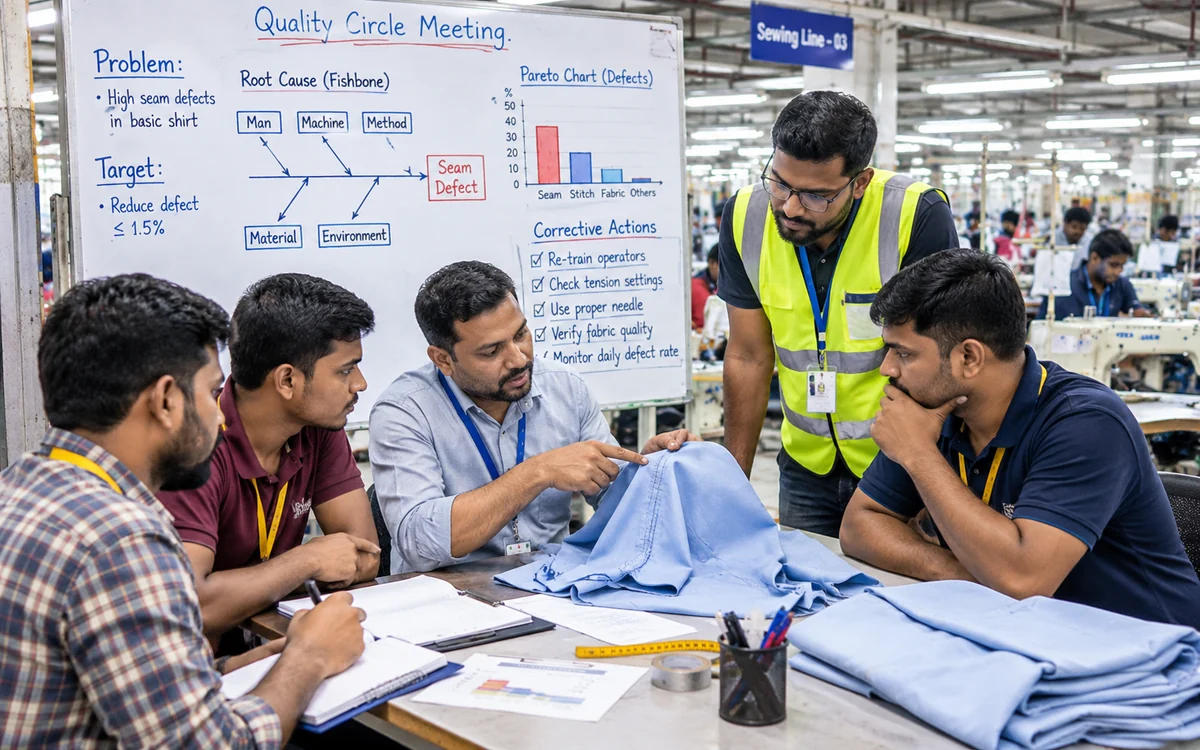
This guide explains what a quality circle is, how it is built, the steps a circle follows, the tools it uses and the kind of projects that suit a garment floor. It also covers how to start one, how management should support it and the reasons circles often die after a few months.
What a quality circle is
A quality circle is a voluntary group of about five to ten people who do similar work. They meet on a regular schedule, usually weekly, for a short time, to identify, analyse and solve problems related to their work. The idea grew in Japan in the 1960s, linked to the work of Kaoru Ishikawa and the Japanese Union of Scientists and Engineers, and spread worldwide.
The key features are these.
- Voluntary. People join because they want to, not because they are told.
- Same work area. Members share the same problems, so the topics are real to them.
- Small. Everyone can speak.
- Regular. Meetings happen on a schedule, so progress continues.
- Data driven. The group uses facts and simple tools, not opinions.
- Management supported. The group gets time, a place and attention, and ideas that need approval get a quick answer.
A circle is not a complaint session or a committee that reports to others. It solves problems within its own power and passes bigger ones to management with evidence.
Quality circle and kaizen
The two ideas are close relatives. Kaizen is the habit of continuous small improvement by everyone. A quality circle is a structured team that takes on one problem at a time with a fixed method. Circles are one way to organise kaizen. Our guide on kaizen in a garment factory covers daily improvement, and the circle gives a team form to the same idea.
Why a garment factory should have quality circles
- The people closest to the work know the problems. An operator who sews 800 collars a day knows what goes wrong better than anyone in the office.
- It reduces defects and rework. Many quality problems come from small, repeated causes that circles can find.
- It builds ownership. People who solve a problem protect the solution.
- It develops skills. Members learn data collection, problem solving and presentation.
- It improves communication between operators, supervisors and managers.
- It supports retention. People who feel heard are more likely to stay. See the cost of turnover and absenteeism.
Who is in a circle
Members
Operators, helpers, checkers or other staff from one area, such as a sewing line, the cutting room, the finishing section or the store.
Leader
Usually the line supervisor or a respected team member. The leader runs the meeting, keeps it on track, makes sure all voices are heard and records the work. Leaders need a short training in running meetings and using the tools.
Facilitator
A person from quality, industrial engineering or HR who trains the circles, helps with data and tools, and links to management. One facilitator can support several circles.
Steering committee
A group of senior managers who set the policy, give resources, review progress, remove obstacles and recognise results. Without the steering committee, circles run out of energy.
How a circle works: the QC story
Most circles follow a standard sequence of eight steps, often called the QC story. It keeps the work orderly.
Step 1: choose the theme
Pick a problem that the circle can influence and that matters. Use defect records, line reports and members’ own experience. A good theme is specific, measurable and in the circle’s area. “Reduce collar attach rework on Line 4” is a good theme. “Improve quality” is too vague.
Step 2: understand the present situation
Collect data about the problem as it is now. How often does it happen? Where? When? Which style, operator or machine? Use check sheets, defect counts, charts and photos. Our guide on the daily production report format shows where data lives, and the KPI factors of garments give the main numbers.
Step 3: set a target
State what you want to reach, by when. For example, cut the defect to half in six weeks. Targets should be challenging but possible. They should come from the circle itself.
Step 4: analyse the causes
Find out why the problem happens. Brainstorm causes, group them in a fishbone chart, and check the likely ones with data. Ask “why” several times to reach the root cause. Our article on sewing defects and root causes shows the method.
Step 5: plan and carry out the countermeasures
Decide what to change, who does it, and when. Prefer simple, low cost changes within the circle’s power. Try them on a small scale. Ideas such as a guide, a template or a checklist often work. For more ideas on stopping mistakes at the source, see poka yoke in garments.
Step 6: check the results
Collect data again, in the same way as before. Compare with the starting point and the target. If the result is short of the target, go back and check the causes or the countermeasures.
Step 7: standardise
If the change works, write it into the work instruction, the checklist or the training. Teach everyone who does the job. Without this step, the gain slips away.
Step 8: review and choose the next theme
Look back at what went well and what did not. Note what remains. Choose the next theme, which may be the next biggest cause of the same problem.
The tools a circle uses
Circles use basic quality tools, which anyone can learn. The classic set is the seven QC tools.
- Check sheet. A simple form to record how often something happens.
- Pareto chart. Bars in order of size, showing the few causes that make most of the problem.
- Fishbone, or cause and effect, diagram. A map of possible causes.
- Histogram. A picture of how values are spread.
- Scatter diagram. A plot to see whether two things are related.
- Control chart. A chart to see whether a process is stable.
- Stratification, or graphs. Splitting data by group, such as by operator, shift or machine.
Our guide to the 7 QC tools in the apparel industry explains each with garment examples. In practice, most circles do well with the check sheet, the Pareto chart and the fishbone.
Project ideas for a garment factory
| Area | Example themes |
|---|---|
| Sewing | Reduce skipped stitches, puckering, uneven seam allowance or open seams on one operation |
| Sewing | Cut waiting time for bundles at a bottleneck |
| Sewing | Reduce broken needles or thread breaks |
| Cutting | Reduce shade mixing, wrong ply count or cutting defects |
| Finishing | Reduce stains, missed trimming of threads or wrong folding |
| Packing | Reduce wrong carton ratio or wrong labels |
| Store | Reduce time to find trims or fabric rolls |
| Quality | Improve first-time pass in final inspection |
| General | Reduce changeover time. See style changeover in sewing |
| Safety and comfort | Improve lighting or seating. See ergonomics in sewing operations |
Pick themes for which you can get data, and which affect the circle’s own work.
How to start quality circles
1. Get management commitment
Senior managers must agree to give time, a meeting place and a quick response. Without this, do not start.
2. Explain the idea
Hold short sessions for supervisors and workers. Explain what a circle is, what it is not, and how it will help. Be clear that joining is voluntary and that there is no blame for problems raised.
3. Train the leaders and members
A short course on the circle method, the QC tools and meeting skills is enough to begin. Use real factory data in the training.
4. Form a few circles
Start with two or three, in areas where the supervisor is keen and the problems are clear. Success there will encourage others.
5. Fix a time and place
A regular slot, such as 30 to 45 minutes once a week, within paid time, in a quiet corner or meeting room. If circles have to meet after work with no pay, they will fade.
6. Register the circle
Record the circle’s name, members, leader, area and first theme. A short registration sheet keeps track.
7. Support and review
The facilitator visits each meeting early on, helps with tools and removes blocks. The steering committee reviews progress monthly.
8. Present and recognise
Hold a presentation day each quarter or half year where circles show their results to management and other circles. Give recognition. A certificate, a mention on the board or a small prize is enough, and the thanks of senior managers matters most.
A simple circle project sheet
Use one page per project.
| Field | Content |
|---|---|
| Circle name and area | Who and where |
| Members and leader | Names |
| Theme | The problem chosen |
| Why chosen | Impact on quality, cost, delivery or safety |
| Present situation | Data before the project |
| Target | What and by when |
| Causes found | From the fishbone or the Pareto |
| Countermeasures | What was done, by whom |
| Results | Data after, compared with the target |
| Standardisation | What was changed in the system |
| Next theme | What to tackle next |
The role of management
Management makes or breaks a circle.
- Give time. Meetings in paid hours.
- Respond fast. An idea that waits three months for approval kills interest. Set a rule, such as an answer in a week.
- Provide small resources. Materials for a template or a jig should not need a long approval.
- Attend sometimes. Visits show the work matters.
- Do not take over. The circle owns its theme and its solution.
- Do not punish. Problems found are a gain, not a failing.
- Recognise results, and share the best with other circles.
Why circles fail
- No time. Meetings are cancelled when production is busy.
- Not voluntary. People forced to join go through the motions.
- No management response. Suggestions disappear.
- Themes that are too big. The circle cannot solve a problem that belongs to another department.
- Opinion in place of data. Debates go on without facts.
- No standardisation. Gains are lost.
- Blame. If problems are used against people, they will be hidden.
- Reward fights. Large cash prizes lead to competition and disputes. Recognition works better than money.
- No leadership training. Meetings turn into chatter or one person’s show.
- A short burst of enthusiasm with no plan to keep it going.
Measuring the programme
Track a few measures across all circles.
- Number of active circles and meeting attendance.
- Number of projects started and completed.
- Results against target, in defect rate, rework, time or cost.
- Savings or benefits from completed projects.
- Participation as a share of the workforce.
- Staff feedback.
A programme that does not show its results to management will lose support. A programme that shows them will grow.
Final thoughts
A quality circle in garment industry work is a small team, a regular meeting and a simple method. The group picks a problem from its own area, collects facts, finds the cause, tries a fix, checks the result and writes down the new standard. The tools are basic, and the main ingredients are time, trust and quick answers from management.
Start with two circles, a short training and a clear first theme. Meet weekly, keep the projects small and recognise the work. Once people see that their ideas lead to change, the circles will multiply on their own.
Frequently asked questions
It is a small, voluntary group of workers from the same area who meet regularly to find, analyse and solve work problems using simple quality tools.
Usually five to ten. This is small enough for everyone to take part, and large enough to bring different views.
It is the standard eight step method that circles follow: choose a theme, understand the present situation, set a target, analyse causes, carry out countermeasures, check results, standardise, and review and plan the next theme.
Kaizen is the broad habit of continuous improvement by everyone. A quality circle is a structured team that works through one problem at a time with a fixed method. Circles are one way of doing kaizen.
The seven QC tools: check sheet, Pareto chart, fishbone diagram, histogram, scatter diagram, control chart and stratification. Most circles rely mainly on the check sheet, Pareto chart and fishbone diagram.
Usually once a week for 30 to 45 minutes, within paid working time.
Common reasons are no time, no management response, forced participation, themes that are too big, no data, no standardisation, blame and no recognition.
