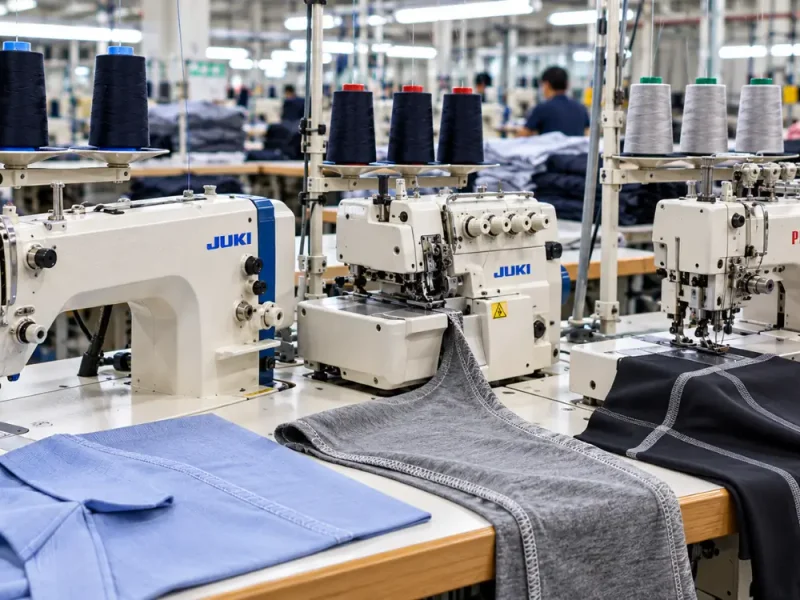
Pick up three cones of thread from a factory shelf and you will see three different sets of numbers: Tex 27, Tkt 120, 40/2, Nm 37, maybe 150 denier on the side. Every number tries to say the same thing, which is the sewing thread size, but each follows a different system. That confusion costs real money. The wrong thread size gives puckered seams, broken threads, skipped stitches and slow lines.
This guide explains sewing thread size in plain words. You will learn what the main systems mean (tex, ticket number, denier, English count and metric count), how to convert between them, how thread thickness relates to needle size, which sizes suit which fabrics and a worked example that shows how thread size changes cone length and cost. If you work with thread consumption in a factory, our guide to the bill of materials in garments shows where thread fits in the order plan.
Why thread size matters
Thread has three jobs. It must hold the seam together, it must pass through the machine without breaking and it must look right on the garment. Thread size affects all three.
- A thread that is too thin may break under stress, and the seam may split.
- A thread that is too thick may pucker the fabric, wear out the needle eye and slow the machine.
- The wrong size for the needle causes skipped stitches, fraying and thread breaks.
- Sizes must match across a line so that stitch quality is consistent.
The main sizing systems
Thread sizing systems fall into two groups. In direct systems, a higher number means a thicker thread. In indirect systems, a higher number means a thinner thread. Mixing them up is a common mistake.
1. Tex (direct system)
Tex is the weight in grams of 1,000 metres of thread. A thread of Tex 27 weighs 27 g per 1,000 m. A higher tex means a thicker thread. Tex is the international standard and is used on most industrial thread labels.
Thread tex is usually the total tex of the finished plied thread, not the tex of each ply.
2. Denier (direct system)
Denier is the weight in grams of 9,000 metres. It is used for filament threads such as nylon and polyester.
Tex = denier ÷ 9
So 243 denier is 27 tex.
3. English cotton count, Ne (indirect system)
Ne is the number of 840-yard hanks in one pound. A higher Ne means a finer thread. Cotton thread and spun polyester thread are sometimes labelled with Ne, along with the number of plies, for example 40/2.
Tex = 590.5 ÷ Ne (for a single yarn)
4. Metric count, Nm (indirect system)
Nm is the number of kilometres of thread in 1 kilogram.
Tex = 1,000 ÷ Nm
5. Ticket number (Tkt)
The ticket number is a trade label used on many industrial sewing threads. It is an indirect number, so a higher ticket is a finer thread. As a rough rule:
Ticket number is about 3,000 ÷ tex
So Tex 27 is close to Tkt 120 (3,000 ÷ 27 = 111, and makers label it Tkt 120), and Tex 40 is about Tkt 75. Makers round and assign tickets differently by thread type, so use this rule only as a guide and check the maker’s chart.
What ply notation means
Sewing thread is made by twisting several thin yarns together. The numbers on the label often show the single yarn count and the number of plies.
- 40/2 means two plies of count 40.
- 50/3 means three plies of count 50.
- 120/3 may mean three plies, with the number related to ticket sizes in some brands.
The finished thread is thicker than one ply, so you must take the ply number into account.
Conversion table
| Tex | Denier | Nm | Ne (single equivalent) | Approx. ticket | Typical use |
|---|---|---|---|---|---|
| 18 | 162 | 56 | 32.8 | 170 | Fine sewing, light fabrics |
| 21 | 189 | 48 | 28.1 | 150 | Shirts, blouses |
| 27 | 243 | 37 | 21.9 | 120 | General garment sewing |
| 35 | 315 | 29 | 16.9 | 90 | Trousers, work wear |
| 40 | 360 | 25 | 14.8 | 75 | Denim seams, heavy cotton |
| 50 | 450 | 20 | 11.8 | 60 | Jeans, upholstery |
| 70 | 630 | 14 | 8.4 | 40 | Topstitch on denim, canvas |
| 105 | 945 | 9.5 | 5.6 | 30 | Heavy leather, bags |
The columns are calculated from the tex. The ticket column is approximate. These numbers are general guides, and every maker has its own chart. Always check the label on your brand of thread.
Matching thread to needle
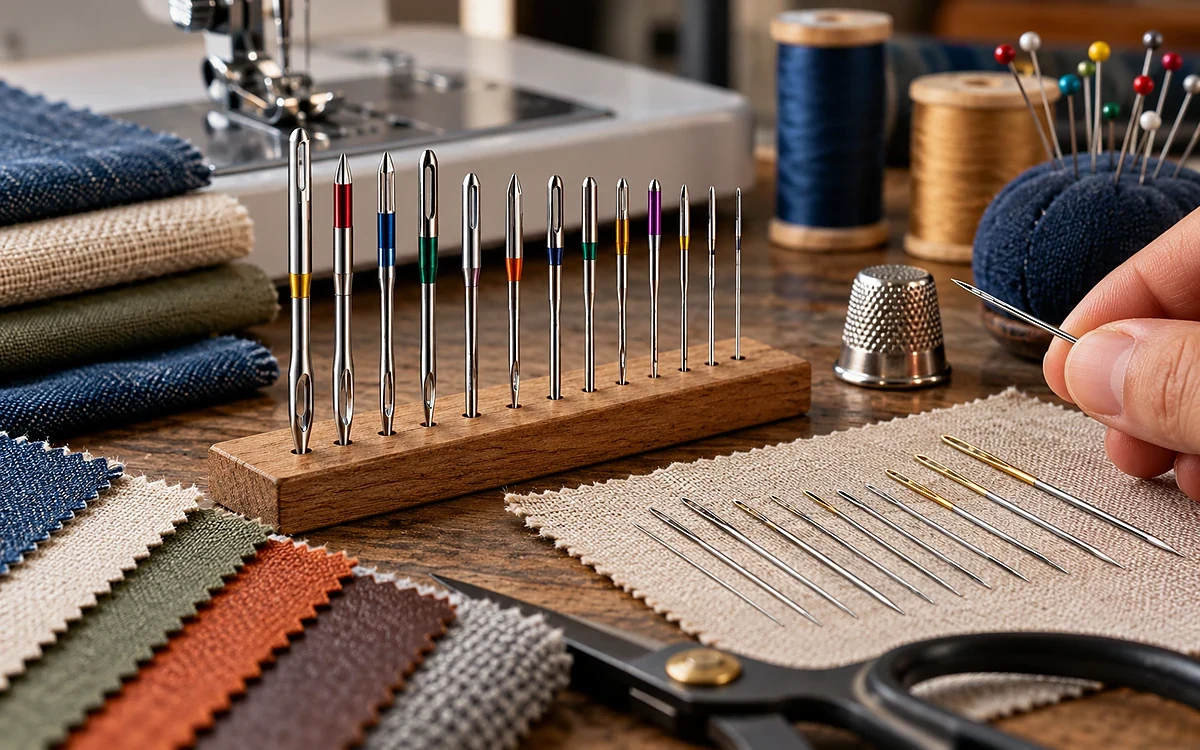
Thread should pass freely through the needle eye and the groove along the needle blade. If it is too thick, it shreds. If too thin, it may cause loose stitches. The needle size is the blade diameter in hundredths of a millimetre, so a size 90 (Nm 90) needle has a blade of about 0.9 mm.
| Thread tex | Typical needle size (Nm) | Fabric examples |
|---|---|---|
| 18 to 21 | 60 to 70 | Chiffon, lawn, fine lingerie |
| 24 to 27 | 70 to 80 | Poplin, shirting, jersey |
| 30 to 35 | 80 to 90 | Twill, trousers, light denim |
| 40 to 50 | 90 to 100 | Denim, canvas, work wear |
| 60 to 70 | 100 to 110 | Topstitch, heavy denim |
| 90 and above | 110 to 120 | Upholstery, bags, leather |
These pairings are common starting points, and exact matches differ by needle type, thread construction and fabric. For more on choosing a needle, see our guide to sewing needle parts, size and point selection.
Matching thread to fabric and seam
Think about four things.
- Fabric weight. Light fabrics need fine thread. Heavy fabrics need thicker thread.
- Seam strength. A stressed seam, such as a crotch seam or a bag strap, needs a stronger and thicker thread than a decorative seam.
- Stitch type. Lockstitch uses one size for the needle thread and bobbin. Overlock uses finer thread in the looper than the needle thread in some cases. Topstitching uses thicker thread for a visible line.
- Fibre. Polyester gives strength and low shrinkage. Cotton gives a soft look but weaker seams. Nylon suits stretch and heavy duty. Core-spun thread has a polyester core wrapped in cotton or polyester.
A simple rule: the thread should be a bit weaker than the fabric, so that if the seam is overstressed, the thread breaks before the fabric tears. Fine fabrics need thread of lower strength.
A worked example: cone length, weight and cost
Thread is sold on cones, usually by length. Let us see how thread size changes the numbers.
Given
- Cone length: 5,000 m
- Thread A: Tex 27
- Thread B: Tex 40
- Thread C: 50/3 cotton-type thread (single count Ne 50, three plies)
- Price: A is 2.50 per cone, B is 3.20 per cone
Part 1: weight of thread on a cone
Weight in grams = length in metres × tex ÷ 1,000
- Thread A: 5,000 × 27 ÷ 1,000 = 135 g
- Thread B: 5,000 × 40 ÷ 1,000 = 200 g
Part 2: price per kilogram and per metre
- Thread A: 2.50 per 0.135 kg = 2.50 ÷ 0.135 = 18.52 per kg. Per metre: 2.50 ÷ 5,000 = 0.0005.
- Thread B: 3.20 per 0.200 kg = 3.20 ÷ 0.200 = 16.00 per kg. Per metre: 3.20 ÷ 5,000 = 0.00064.
The thicker thread is cheaper per kilogram, but it costs more per metre. For sewing, cost per metre matters, because a seam needs a set length. B costs 0.00064 ÷ 0.0005 = 1.28 times more per metre than A.
Part 3: total tex of a plied thread
Take Thread C, 50/3.
Step 1: tex of one ply.
Tex = 590.5 ÷ Ne = 590.5 ÷ 50 = 11.81 tex
Step 2: total tex for 3 plies.
Total = 11.81 × 3 = 35.4 tex
So a 50/3 thread is about Tex 35, which is near the Tex 35 line of the table. This is the kind of size used for trousers or light denim. In practice, twist makes the thread a little shorter, and so the true tex is slightly higher.
Part 4: thread for a large order
Suppose a shirt uses about 130 m of thread, including allowances. For an order of 20,000 shirts of Tex 27:
- Total length = 130 × 20,000 = 2,600,000 m
- Cones = 2,600,000 ÷ 5,000 = 520 cones
- Weight = 2,600,000 × 27 ÷ 1,000 = 70,200 g = 70.2 kg
- Cost at 2.50 per cone = 520 × 2.50 = 1,300
If the factory switched to Tex 40 for the same shirt without need, the thread weight would rise to 2,600,000 × 40 ÷ 1,000 = 104,000 g = 104 kg, and the cost to 520 × 3.20 = 1,664. That is an extra 364 for no gain. Using the thinnest thread that meets the strength and look targets saves money.
Thread size and seam performance
Thread size affects seam strength, but the relationship is not simple.
- Thicker thread has higher breaking strength, but it also needs more space in the stitch hole.
- Very thick thread in fine fabric causes puckering and distorts the fabric.
- Stitches per inch (SPI) and thread tension also matter. A higher SPI uses more thread and can weaken the fabric by perforating it.
For this reason, buyers often define a seam strength requirement or a thread tex in the specification. Our guide to types of seams in garments shows how seam types change load and thread use.
Thread type quick guide
| Thread | Description | Typical size | Best for |
|---|---|---|---|
| Spun polyester | Staple fibre, twisted, cotton-like look | Tex 21 to 40 | General garment sewing |
| Core-spun | Polyester filament core, polyester or cotton wrap | Tex 27 to 40 | High-speed sewing, strong seams |
| Continuous filament polyester | Smooth, strong, shiny | Tex 18 to 70 | Heavy duty, bags, upholstery |
| Cotton | Soft, low strength, shrinks | Ne 30/2 to 50/3 | Natural look, light use |
| Nylon | Strong, stretchy | Tex 18 to 70 | Stretch seams, leather, outdoor wear |
| Textured polyester | Bulky, stretchy | Often 150 denier and up | Overlock loopers, swimwear |
| Embroidery thread | Rayon or polyester, shiny | 120/2 and others | Decoration. See our guide to embroidery thread types |
How to find the size of an unmarked thread
If a thread has no label, you can estimate its size.
- Cut a known length. Use 1 metre, measured without stretching.
- Weigh it on a precise scale. A jeweller’s scale that reads 0.001 g or finer is needed.
- Calculate tex. Tex = weight in grams × 1,000 ÷ length in metres.
Example: 5 metres of thread weigh 0.135 g. Tex = 0.135 × 1,000 ÷ 5 = 27 tex.
If you do not have a good scale, weigh a longer length, such as 100 m, which is easier to measure. Another method is to compare with a known thread of the same colour by eye and by feel, but it is less reliable.
Common problems linked to thread size
| Problem | Possible size cause | Fix |
|---|---|---|
| Thread breaks often | Thread too thick for needle eye, or too thin and weak | Match thread and needle, check tension |
| Skipped stitches | Needle too small for thread | Use a larger needle |
| Puckered seams | Thread too thick for the fabric | Use a finer thread |
| Seam splits | Thread too weak | Use a stronger or thicker thread |
| Visible stitch holes | Needle too large | Use a finer needle and thread |
| Uneven stitches | Different thread sizes in needle and bobbin | Use matching sizes unless the design says otherwise |
Our guide on sewing defects and root causes goes deeper into causes and solutions.
Tips for choosing thread size
- Start with Tex 27 for general woven and knit sewing, then adjust.
- Use Tex 40 to 70 for jeans and heavy work.
- Check your buyer’s specification for thread type, tex and colour.
- Use the same brand for needle and bobbin where possible.
- Test seam strength and appearance on the actual fabric.
- Keep a conversion chart at the line for quick checks.
- Record the thread size on the operation breakdown and the BOM.
Final thoughts
Sewing thread size looks like a puzzle of numbers, but it comes down to one idea: how much a given length of thread weighs. Tex states it directly, denier does so for a different length, and ticket number, Ne and Nm tell the same story in reverse. Once you know the conversions, you can compare any two threads, match thread to needle and calculate how much a cone holds.
The best thread size is the thinnest one that gives the strength and look the seam needs. Use the charts here as a starting point, test on real fabric and keep a record of what works.
Frequently asked questions
Tex is the weight in grams of 1,000 metres of thread. A higher tex means a thicker thread.
The ticket number is a trade size label. A higher ticket number means a finer thread. It is roughly 3,000 divided by the tex, but makers use their own charts.
Divide the denier by 9. For example, 243 denier equals 27 tex.
Tex 27 (about ticket 120) is a common general-purpose size for shirts, blouses and light trousers. Heavier fabrics need Tex 35 to 70.
It means two plies of count 40. The total thickness is about twice the tex of a single ply. For a cotton-type count of 40, a ply is 590.5 ÷ 40 = 14.8 tex, so the thread is about 29.5 tex.
Needles of size 70 to 80 are a common starting point. Check the fabric, and test for skipped stitches or breaks.
Thicker thread is stronger, but it can pucker the fabric and slow the machine. Use the thinnest thread that meets the strength and look you need.