Walk into any lingerie shop and the choice can feel endless. Bras with straps, bras without straps, briefs, thongs, slips, shapewear and more. Each piece is made for a reason. When you know the main types of inners for ladies, it becomes much easier to shop, to dress for different clothes and to feel comfortable all day.
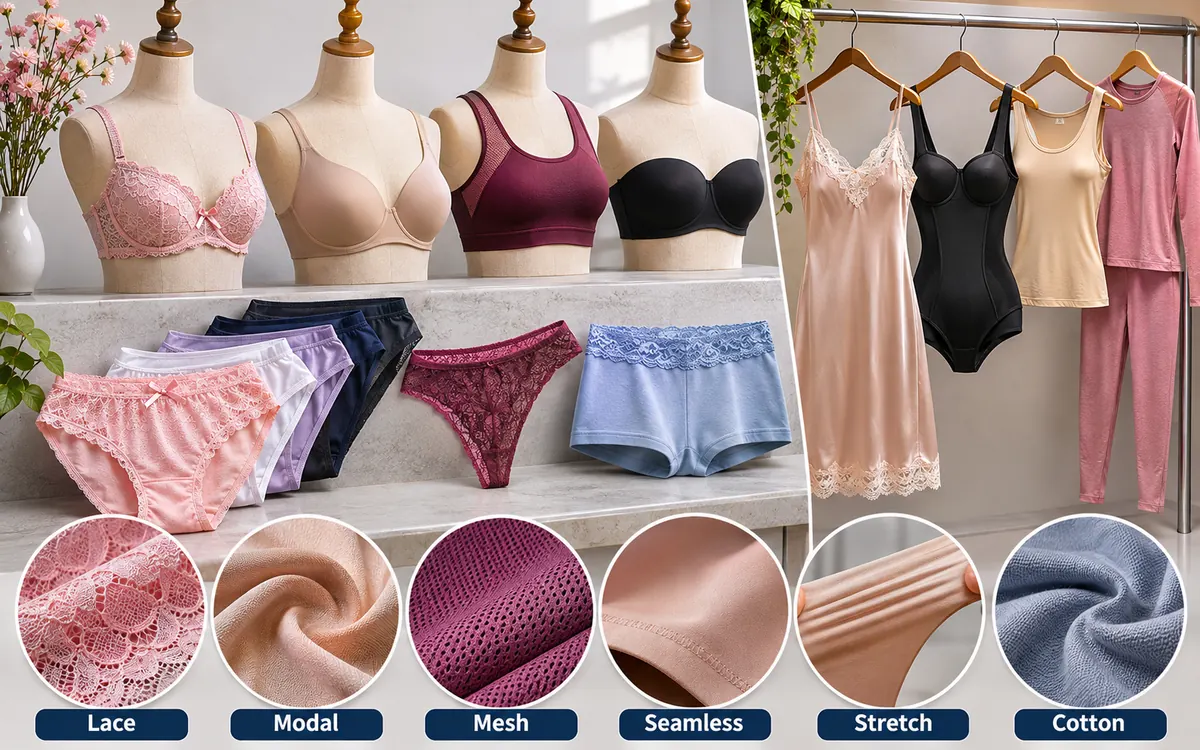
This guide covers the main groups of women’s innerwear in simple words. For each type you will see what it is, when to wear it, which fabric suits it and what to watch for. It also includes a worked example of how to find your bra size, plus care and buying tips. If you want to learn how the pieces are built, read our guides on the parts of underwear and the parts of a bra.
What are inners
Inners, also called innerwear, intimates or lingerie, are the garments worn next to the skin under outer clothes. They support the body, keep outer clothes clean, smooth the shape and add comfort. Some are made for daily wear, some for sport, some for sleep and some for special clothes like a saree or a party dress.
Main groups of women’s innerwear
| Group | Examples | Main purpose |
|---|---|---|
| Bras | T-shirt bra, sports bra, bralette, strapless bra | Support and shape |
| Panties | Brief, bikini, hipster, thong, boyshort | Cover and hygiene |
| Slips and petticoats | Full slip, half slip, saree petticoat | Under dresses and sarees |
| Camisoles and tops | Camisole, spaghetti top, tank | Layer and modesty |
| Shapewear | Control brief, body shaper, waist cincher | Smoothing |
| Thermal wear | Thermal top and leggings | Warmth |
| Sleepwear and loungewear | Nightdress, pyjama set | Rest at home |
| Maternity and nursing wear | Nursing bra, maternity brief | Support in pregnancy and feeding |
| Period wear | Period panties | Comfort during menstruation |
Types of bras
A bra is the most technical piece of innerwear. The main kinds are:
- T-shirt bra. Smooth, moulded cups that do not show under fitted tops. Usually lightly padded or moulded.
- Everyday or full-coverage bra. Cups cover the whole breast. Good for comfort and support, and for larger sizes.
- Push-up bra. Padding at the bottom or sides lifts the breast. Used for a fuller look under low necklines.
- Padded bra. Has foam or fibre padding in the cup. Gives shape and can hide nipple outline. Our guide on padded bras suitable for summer helps you choose breathable ones.
- Non-padded (wire-free) bra. Soft cups, often in cotton. Good for home and sleep.
- Underwired bra. A thin curved wire under each cup adds lift and shape. Needs a correct fit to avoid pain.
- Wire-free bra. Support comes from the band and fabric. Often more comfortable for daily wear.
- Sports bra. Made to reduce bounce. Types include compression (presses the chest flat), encapsulation (separate cups) and a mix of both. Pick the level of support by the activity.
- Strapless bra. Has a firm band, often with silicone grip. Used under off-shoulder tops and gowns.
- Convertible or multiway bra. Straps can be removed or crossed in different ways.
- Bralette. Light, soft and unwired, often lace or cotton. Good for relaxed days or as a layer.
- Plunge bra. Deep V cut in the centre. Fits low necklines.
- Balconette (balcony) bra. Cups cut straight across the top. Suits square necklines.
- Racerback bra. Straps meet at the back, so they do not slip off. Good under racerback tops.
- Nursing bra. Cups open to feed a baby. Made with soft fabric and easy clips.
- Minimiser bra. Spreads the breast tissue to reduce the look of projection.
- Backless or adhesive bra. For backless dresses. Adhesive types stick to skin and are for short use.
Types of panties
| Type | Coverage | Good for |
|---|---|---|
| Brief | Full rear, sits at or above the hip | Everyday comfort |
| High-waist brief | Covers to the navel | Under dresses and shapewear |
| Bikini | Lower rise, thinner side | Under jeans and fitted clothes |
| Hipster | Mid-rise, wider side | Daily wear |
| Boyshort | Short, covers upper thighs | Under skirts and dresses to stop chafing |
| Thong | Thin strip at the back | Under tight clothes to avoid lines |
| G-string | Narrower than a thong | Special clothing |
| No-seam panty | No stitched edges, bonded or knitted | Under slim fits |
| Cheeky | Partial rear coverage | Style choice |
| Period panty | Built-in absorbent layer | Menstruation |
| Maternity brief | Stretch panel that goes over or under the bump | Pregnancy |
Cotton gusset linings are a good choice for daily wear, because cotton lets skin breathe.
Slips, petticoats and under-layers
- Full slip. A one-piece dress-length slip worn under sheer dresses.
- Half slip. Waist to knee, worn under skirts to stop cling and see-through.
- Saree petticoat. A drawstring skirt worn under a saree. It is usually made in cotton or a cotton blend, and the fit at the waist matters for pleats.
- Saree shapewear. A fitted skirt with a flare near the hem. It gives a clean line under silk and satin.
- Blouse inner (camisole). Worn under a sheer blouse.
Camisoles, tank tops and vests
Camisoles have thin straps and a smooth, slim cut. They add a layer under sheer or low-cut tops, and give a bit of warmth. Cotton vests are common for daily wear in warm countries. Smooth no-seam styles in nylon and elastane blends suit fitted tops.
Shapewear
Shapewear uses strong elastic fabrics to smooth the body line. Common forms include:
- Control briefs and high-waist shapers for the tummy and hips
- Body shapers or bodysuits for the whole torso
- Thigh shapers to stop chafing and smooth under dresses
- Waist cinchers for a narrower waistline
A good piece should feel snug, not painful. If it leaves deep marks, restricts breathing or rolls down, it is too tight. Do not wear tight shapewear for long hours, and take it off for sleep and exercise.
Thermal and winter wear
Thermal inners keep body heat in cold weather. They are made from cotton, wool, merino, viscose blends or synthetic fibres with a brushed inside. Choose a light base layer you can wear under normal clothes. Merino and fine wool feel soft and stay warm even when damp, though they cost more. For fibre background, see our guide on the properties of cotton.
Sleepwear and loungewear
Soft, loose fabrics help you rest. Common options are:
- Nightdresses in cotton or modal
- Pyjama sets
- Lounge shorts and tees
- Silk or satin sleepwear for special days
Choose breathable cotton in hot climates and brushed or flannel fabrics in cold ones.
Maternity, nursing and period wear
Pregnancy changes body size fast. Maternity bras are stretchy and wire-free, with extra rows of hooks. Maternity panties have a wide waistband that fits over or under the bump. After birth, nursing bras have clip-down cups. Period panties have an absorbent layer sewn in, often with a leak barrier. Buy small quantities first and try them, because fit and comfort are personal.
Fabrics used for inners
| Fabric | Feel | Good for | Watch out for |
|---|---|---|---|
| Cotton | Soft, breathable | Daily panties, vests, sleepwear | Dries slowly, can lose shape |
| Cotton and elastane | Stretchy, comfortable | Briefs, bralettes | Heat can wear the elastane |
| Modal and viscose | Silky, smooth | Camisoles, sleepwear | Can pill, needs gentle wash |
| Nylon (polyamide) | Smooth, strong, dries fast | No-seam wear, sports bras | Less breathable |
| Polyester | Light, quick-drying | Sports bras, lace | Can hold odour |
| Microfibre | Very soft and fine | Smooth panties and bras | Warm in summer |
| Lace | Pretty, light | Trims and bralettes | Can itch or snag |
| Silk and satin | Luxurious | Sleepwear, slips | Needs gentle care |
| Wool and merino | Warm | Thermals | Needs careful washing |
Worked example: how to find your bra size
Bra sizing methods vary between brands and countries, so treat this as a starting guess and try before you buy. A common method in the US and UK uses two measurements.
- Underbust (band). Measure around the ribcage just under the breasts, with the tape level and snug. Round to the nearest whole inch.
- Bust. Measure around the fullest part of the chest, with the tape level and not tight.
Suppose the underbust is 32 inches and the bust is 36 inches.
- Band size = 32
- Difference = 36 − 32 = 4 inches
- Each inch of difference is one cup step: 1 inch = A, 2 = B, 3 = C, 4 = D
So the starting size is 32D.
Now try the “sister size” idea. If the band feels too tight but the cup fits, go up one band size and down one cup. Sister sizes hold about the same cup volume.
- 32D has the same cup volume as 34C and as 30DD
If you work in centimetres, 1 inch is 2.54 cm, so a 32-inch band is about 81 cm, and 4 inches of difference is about 10 cm. Different brands cut cups differently, and cup letters after D may follow different rules in different countries, so always try a few sizes.
How to check the fit
- The band should sit level around your back and stay at the same height at the front. If it rides up, it is too big.
- You should fit two fingers under the band. More than that means it is loose.
- Most of the support comes from the band, not the straps. Straps should not dig in.
- The centre piece should rest flat against your breastbone.
- Breast tissue should fill the cup without spilling over the top or sides.
- Wires should surround the breast and not sit on it.
- Check yourself again after weight changes, pregnancy and every year or so.
Which inner for which outfit
| Outfit | Suitable inner |
|---|---|
| T-shirt or fitted top | Smooth T-shirt bra, no-show brief |
| Saree | Petticoat or saree shapewear, comfortable bra, blouse inner |
| Off-shoulder top | Strapless bra |
| Low neck dress | Plunge bra or adhesive cups |
| Backless dress | Backless bra or adhesive bra |
| Sheer top | Skin-tone bralette or camisole |
| Jeans | Bikini or no-seam brief |
| Skirt or dress in summer | Boyshort or anti-chafe shorts |
| Gym | Sports bra and moisture-wicking brief |
| Sleep | Wire-free bralette or none, soft cotton |
| Winter | Thermal base layer |
Care tips
- Hand wash bras in cool water with mild soap, or use a mesh bag and a gentle machine cycle. Our guide on how to wash your bras by hand gives the steps.
- Do not wring, twist or tumble dry. Air dry flat or on a line.
- Rotate several bras so the elastic can rest between wears.
- Replace worn bras. A common sign is a stretched band that rides up, or wires poking out.
- Wash new panties before wearing them.
- Keep dark and light pieces apart to avoid colour transfer.
- Store bras with the cups kept in shape, not crushed in a drawer.
Buying tips
- Try before you buy when you can, and move around in the fitting room.
- Look for soft, flat seams and clean finishing, especially in the gusset and the band.
- Check the label for fabric. Cotton or a blend with cotton is good for panties.
- Buy a few comfortable basics in skin-tone shades and black before spending on fancy styles.
- Ask about the return policy for online orders, because fit is personal.
- Pick the right sports bra for your activity level.
- Check that elastic and hooks feel secure but soft.
Final thoughts
The types of inners for ladies are many, but the idea is simple: choose the right piece for the body, the clothes and the moment. Start with comfortable cotton basics, add a few special styles for outfits you wear often and check your fit now and then. Care for each piece well and it will support you for longer.
Frequently asked questions
Bras, panties, slips, camisoles, shapewear, thermal wear, sleepwear and special pieces like maternity and period wear.
A soft, well-fitting wire-free or lightly padded T-shirt bra in a breathable fabric is a common choice. The best bra is the one that fits you and feels comfortable all day.
A bralette is lighter, usually unwired and unpadded, with less support. A bra has more structure and support.
Cotton briefs, hipsters or boyshorts with a cotton lining breathe well. Avoid tight synthetic fabrics for long hours.
When the band stretches, the straps lose shape or the cups lose form. Depending on wear and care, this is commonly within one to two years for daily use.
A saree petticoat or saree shapewear, a well-fitting bra and a blouse. Pick a skin-tone or matching shade under light colours.
Light shapewear for a few hours is usually fine, but very tight pieces worn all day can be uncomfortable. If you feel pain or breathlessness, remove it and choose a looser style.