Hold a piece of bright acrylic knitwear next to one made of cotton. The acrylic colour often looks stronger and cleaner, almost glowing. A big part of the reason is the class of colour used on it. Basic dyes, also called cationic dyes, are famous for their very bright shades, and they are the main way acrylic fibre is coloured.
This guide explains what basic dyes are, how they work, which examples matter and how they are used in a dye house. It includes a worked recipe with real quantities, the common problems, and the safety points that every user should know. For the wider picture of dye families, see our guides on the classification of dyes and what is a dye.
What are basic dyes
Basic dyes are water-soluble dyes in which the coloured part of the molecule carries a positive charge. That is why they are also called cationic dyes. A cation is an ion with a positive charge.
The name “basic” does not mean the dye is a strong alkali. It comes from the fact that these dyes are the salts of coloured bases, usually made with hydrochloric acid, so they are sold as chlorides or similar salts. In water, the salt splits and the coloured cation is free to move to the fibre.
The first synthetic dye in history, mauveine, made by William Perkin in 1856, was a basic dye. Many of the early synthetic colours that followed were also basic dyes.
How basic dyes work
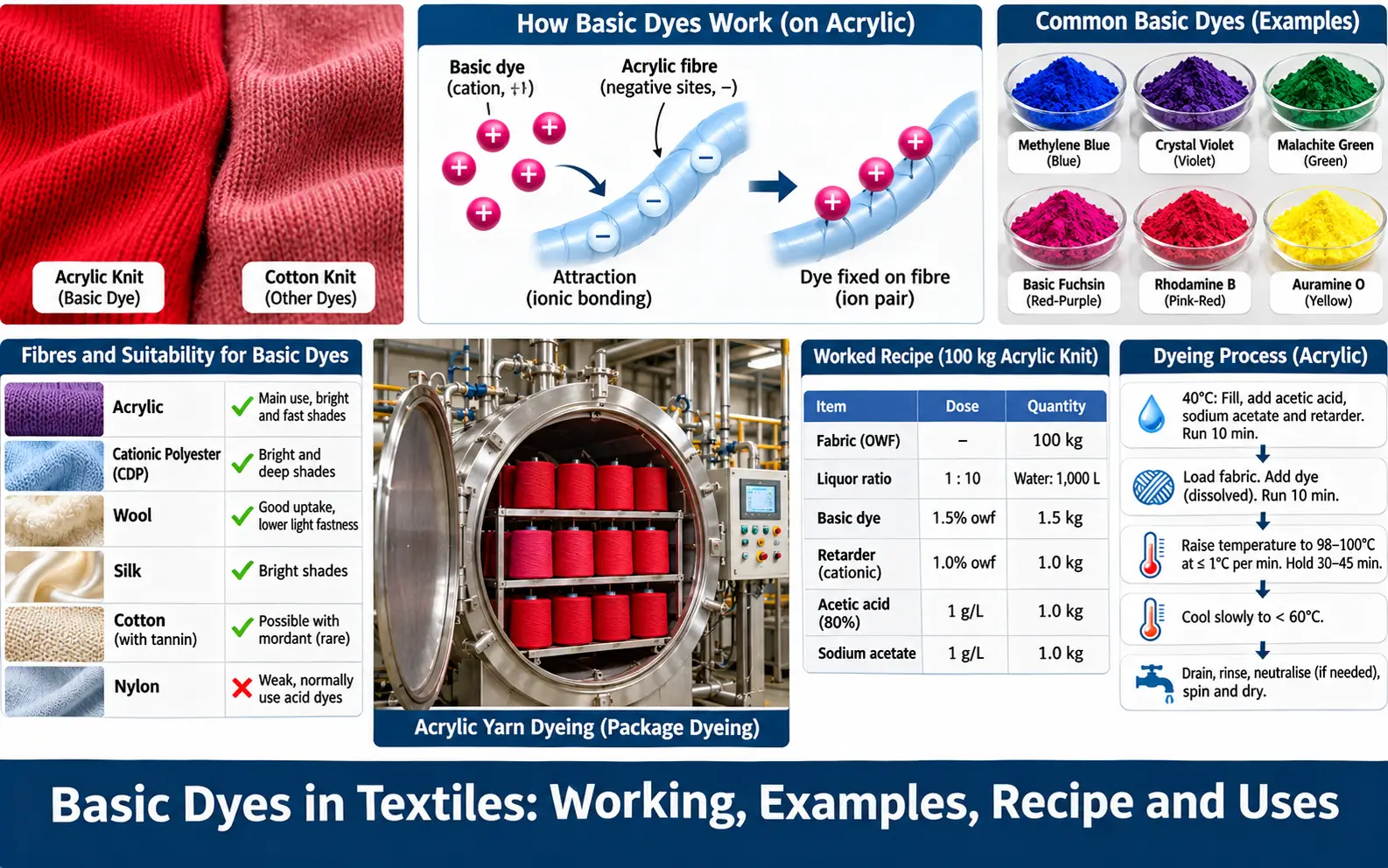
Fibres such as acrylic carry negative sites in the polymer, usually sulfonate or carboxyl groups that come from the chemicals used in making the fibre. The positive dye cation is attracted to these negative sites and forms a strong ionic bond. This is called ionic or electrostatic bonding.
Think of it as a lock and key. The fibre has a fixed number of negative sites, like small parking spaces. Once all spaces are full, no more dye can go in. This limit is called the saturation value of the fibre.
On wool and silk, the dye also bonds to the fibre, but less strongly. On cotton, the dye has no natural attraction, so a mordant, usually tannin, is first applied to give the cotton negative sites. For more on mordants, see our guide on natural dyes.
Common examples of basic dyes
| Dye | Colour | Typical use |
|---|---|---|
| Methylene blue | Blue | Lab stain, paper, medical stain, old cotton dyeing with tannin |
| Crystal violet (gentian violet) | Violet | Biological stain, inks, paper |
| Malachite green | Green | Paper, leather, some textiles (strict limits on use) |
| Basic fuchsin (magenta) | Red-purple | Stains, inks, early textile dyeing |
| Rhodamine B | Pink-red | Fluorescent tracer, paper, inks |
| Auramine O | Yellow | Paper, leather, lab stain |
| Safranin | Red | Cell stain, paper, silk |
| Bismarck brown | Brown | Leather, paper, stain |
| Modern cationic dyes | Many bright shades | Acrylic and modified polyester |
The modern dyes made for acrylic are not the same as the old basic dyes. They are designed to give better fastness and are often sold as “cationic dyes” or under trade names from dye makers. They are still part of the basic dye family because they are cations.
Properties of basic dyes
| Property | What it means |
|---|---|
| Charge | Positive (cationic) |
| Solubility | Dissolve in hot water, often with a little acetic acid |
| Shade | Very bright and strong |
| Tinting strength | High, so small amounts give deep colour |
| Affinity | Strong for acrylic, modified polyester, silk and wool, and for tannin-treated cotton |
| Light fastness | Poor on natural fibres, good to very good on acrylic |
| Wash fastness | Fair on natural fibres, good on acrylic |
| Migration | Poor, which makes level dyeing hard |
| Compatibility | Dyes must be matched when mixed |
The “high tinting strength” point is useful. A small error in weighing a basic dye makes a big change in shade, so measurements must be careful.
Fibres that take basic dyes
| Fibre | Result |
|---|---|
| Acrylic and modacrylic | Bright, fast shades. The main use. See our acrylic fibre guide |
| Cationic-dyeable polyester (CDP) | Bright, deep shades |
| Wool and silk | Bright but poor light fastness |
| Cotton | Needs tannin and antimony or other fixing, rarely used now |
| Paper and leather | Very common. Bright shades at low cost |
| Nylon | Weak. Normally dyed with acid dyes. See acid dyes |
How acrylic is dyed with basic dyes
Acrylic fibre is made from at least 85 percent acrylonitrile. It has a glass transition temperature (Tg) in water of around 75 to 90 degrees Celsius, depending on the type. Below Tg the polymer is tight and hard, and dye cannot enter. Above Tg, the polymer opens up and dye moves quickly. That quick movement is the main risk. Dye rushes onto the first part of the fabric it meets and leaves uneven patches.
To control this, dyers use these tools:
- Slow heating through the critical range. Between about 70 and 100 degrees Celsius, heat at 1 degree per minute or less.
- A retarder. This is a cationic chemical, usually a quaternary ammonium compound, that competes with the dye for the negative sites and slows the uptake. The dye replaces it slowly as the temperature climbs.
- Acid pH. A pH of 4 to 5.5, set with acetic acid and sodium acetate, keeps the dye stable and the fibre sites ready.
- Slow cooling. After the dyeing, the bath is cooled slowly below Tg before it is dropped, so the fibre does not crease or lose bulk.
Worked example: dyeing acrylic knit fabric
A mill dyes 100 kg of acrylic knit fabric to a red shade. The dye maker’s data sheet gives a recipe of 1.5 percent dye on the weight of fabric (owf), 1 percent retarder owf, 1 g/L acetic acid (80 percent) and 1 g/L sodium acetate. The liquor ratio is 1:10.
- Water = 100 × 10 = 1,000 litres
- Dye = 100 × 0.015 = 1.5 kg
- Retarder = 100 × 0.01 = 1.0 kg
- Acetic acid = 1 g/L × 1,000 L = 1,000 g = 1 kg
- Sodium acetate = 1,000 g = 1 kg
Process:
- Fill the machine and set the bath at 40 degrees Celsius. Add acetic acid, sodium acetate and retarder. Run 10 minutes.
- Load the fabric. Add the dye, dissolved in hot water with a few drops of acetic acid. Run 10 minutes.
- Heat to 70 degrees at about 2 degrees per minute.
- Heat from 70 to 100 degrees at 1 degree per minute. This takes 30 minutes.
- Hold at 100 degrees for 45 to 60 minutes.
- Cool at about 1 degree per minute to 70 degrees, then faster to 50.
- Rinse, then give a light soaping and softener.
Time check: Warm-up from 40 to 70 degrees at 2 degrees per minute takes 15 minutes. The critical range takes 30 minutes. Hold takes 45 to 60. Cooling from 100 to 70 takes 30 minutes. The total dyeing time is therefore about 130 to 145 minutes, not counting rinse and unload. That slow cycle is the price of level colour.
Dye cost example: If the dye costs 1,500 currency units per kg, 1.5 kg costs 2,250 units. Over 100 kg of fabric, that is 22.5 units per kg of fabric. A stronger or deeper shade, such as a black at 4 percent, would cost far more. Use your own dye price.
Compatibility and the K value
When two or more basic dyes are mixed to make a shade, they must dye at the same rate. If one goes on faster than the other, the shade will change as the bath heats up. Dye makers give each dye a compatibility value, often called a K value, from 1 to 5. Dyes with the same K value, or values close together, can be mixed. Always choose the mix from one maker’s compatible range.
Comparison with other dye classes
| Point | Basic (cationic) | Acid | Reactive | Disperse |
|---|---|---|---|---|
| Charge | Positive | Negative | Reacts with fibre | Non-ionic |
| Main fibre | Acrylic | Wool, silk, nylon | Cotton, viscose | Polyester |
| Shade brightness | Very high | Good | Good to high | Good |
| Level dyeing | Hard | Moderate | Moderate | Moderate |
| Fastness on main fibre | Good | Good | Very good | Very good |
Our guide to reactive, disperse and vat dye selection helps you choose among these.
Uses of basic dyes
- Acrylic knitwear and sweaters. The main textile use.
- Acrylic fur and blankets. Bright colours at low cost.
- Carpets and upholstery with acrylic. For brightness and light fastness.
- Paper. Tissue, napkins, wrapping paper and coloured pulp.
- Leather. Surface colouring.
- Inks and markers. Ballpoint inks and stamp pads.
- Biological stains. Methylene blue, crystal violet and safranin are used in labs.
- Fluorescent tracers. For water tracing.
Advantages of basic dyes
- They give very bright, strong colours.
- They need only small amounts of dye for deep shades.
- They have good fastness on acrylic.
- They are cheap for the colour they give.
- They dye paper and leather directly.
Limitations of basic dyes
- Level dyeing is hard on acrylic, and it needs careful control.
- Light fastness is poor on natural fibres.
- The range of fibres is narrow.
- Dyes must be chosen for compatibility.
- Some old basic dyes are toxic and restricted.
- Dye uptake stops at the saturation value of the fibre.
Common problems and fixes
| Problem | Cause | Fix |
|---|---|---|
| Patchy or unlevel dyeing | Heated too fast through critical range | Slow the heating to 1 degree per minute or less, add retarder |
| Shade changes during dyeing | Incompatible dyes | Use dyes from the same K group |
| Dull shade | Wrong pH or poor water | Check pH, soften water |
| Bath exhausts too fast | No retarder | Add retarder and keep pH in range |
| Creases in the fabric | Fast cooling above Tg | Cool slowly |
| Poor rub fastness in deep shades | Unfixed dye on surface | Soap and rinse, or use a light after-treatment |
| Residual colour in water | High dye load | Test effluent and treat. See water treatment plant process |
Safety and environmental points
Some basic dyes are hazardous. Malachite green has been banned in food-producing fish farming in many places, and crystal violet and some others are restricted in certain uses. Always read the safety data sheet for each dye. Wear gloves, a mask and eye protection when weighing powders, since fine dye dust can irritate the lungs and eyes. Keep dye powder away from food. Test dyed goods against the restricted substance list of your buyer, and test them for fastness. Our guide on colour fastness tests lists the common methods.
For the full dyeing path, from preparation to washing off, see our guide on the dyeing process.
Final thoughts
Basic dyes are the brightest colours in the dye house, and acrylic is where they shine. The trade-off is control. Heat slowly through the critical range, use a retarder, match dyes by compatibility and keep a close eye on pH. Handle the powders with care, check the safety data and test the finished goods. Done well, basic dyeing gives the clear, glowing shades that buyers notice.
Frequently asked questions
Basic dyes are water-soluble dyes with a positive charge on the coloured part of the molecule. They are also called cationic dyes.
They are salts of coloured bases. The name does not mean they are strongly alkaline.
Acrylic and modacrylic are the main fibres. They are also used on cationic-dyeable polyester, wool, silk, paper and leather.
Examples include methylene blue, crystal violet, malachite green, basic fuchsin, rhodamine B, auramine O and safranin.
Dye moves very fast once the fibre passes its glass transition temperature. Without slow heating and a retarder, the dye goes on unevenly.
A retarder is a cationic chemical that competes with the dye for the fibre’s negative sites and slows the dye uptake, giving level dyeing.
Safety depends on the dye. Some are toxic or restricted. Check the safety data sheet and your buyer’s restricted substances list.