
Why does cotton feel cool and soft, while polyester dries in minutes? Why does wool stay warm when it is damp, and why does linen wrinkle like paper? The answers lie in the properties of fibre. A fibre is a thin, flexible strand with a length at least a hundred times its width. Everything we wear, sit on or sleep under is built from these strands, and each one behaves in its own way.
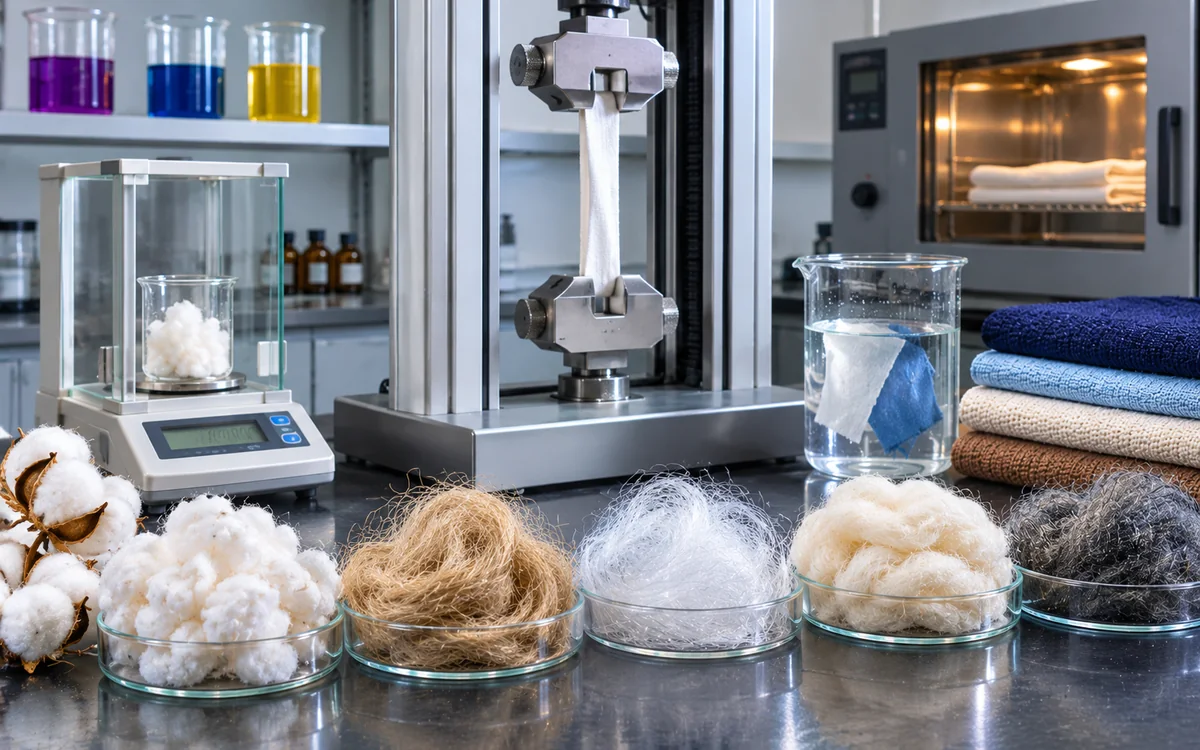
This guide explains the main properties of fibre in plain words. It covers the physical properties, the chemical ones, how each is measured and what it means for the final fabric. It also gives a comparison table and worked examples for tex, denier and tenacity. If you are new to fibre groups, start with our guide on the classification of textile fiber and the overview of different types of textile fibers.
What is a fibre
A fibre is the basic unit of a textile. Natural fibres come from plants (cotton, flax, jute), animals (wool, silk) or minerals (asbestos, now banned in many places). Man-made fibres are made in factories, either from natural material like wood pulp (viscose) or from chemicals (polyester, nylon). Fibres are short (staple) or very long (filament). They are twisted into yarn, and yarn is woven or knitted into fabric. So the traits of the fibre carry through the yarn and the fabric.
Primary properties
Some properties are essential. Without them, a fibre cannot be spun into a useful yarn.
1. Length
Fibre length affects how easily it spins and how strong, smooth and fine the yarn can be. Long fibres give strong, smooth yarn. Short fibres make hairy, weak yarn. Cotton fibre is typically around 1 to 3 cm long, with long-staple types at the upper end. Wool is about 3 to 30 cm. Flax is 2 to 3 cm per ultimate fibre but is used in long bundles. Filament fibres like silk and polyester can be hundreds or thousands of meters long.
2. Fineness
Fineness is how thin the fibre is. It is given as a diameter in microns for wool, as micronaire for cotton, and as denier or tex for man-made fibres. A finer fibre feels softer and makes finer yarn, but it is harder to process and may be weaker per fibre.
3. Strength (tenacity)
Strength is the force needed to break a fibre. To compare fibres of different thickness, we use tenacity, which is the breaking force divided by the linear density. A stronger fibre makes a stronger yarn and fabric. Polyester, nylon, flax and jute are strong. Wool and acetate are weaker. Most fibres are weaker when wet, but cotton and flax get stronger when wet.
4. Elongation
Elongation is how much the fibre stretches before it breaks, shown as a percentage of its original length. High elongation means the fibre is stretchy. Wool and nylon stretch a lot. Flax and cotton stretch little. Fibres with some stretch resist shock and tearing better.
5. Elasticity and resilience
Elasticity is the ability to return to the original length after being stretched. Resilience is the ability to spring back from crushing and bending. Wool and polyester resist wrinkles well. Cotton and linen crease easily.
6. Moisture regain
Moisture regain is how much water a fibre takes from the air. It is the water weight as a percentage of the dry weight. It affects comfort, static, dyeing, drying time and strength.
7. Crimp
Crimp is the natural waviness of a fibre. It helps the fibres cling to each other during spinning and traps air in the yarn for warmth. Wool has a lot of crimp. Synthetic fibres have crimp added during making.
8. Cohesiveness and surface
Scales on wool and twist in cotton help fibres grip each other. Smooth filaments need more twist to hold together.
Secondary properties
These properties shape the look, feel and performance of the finished fabric.
Luster
Luster is the shine of a fibre. Silk and filament viscose are shiny. Cotton and wool are dull. Man-made fibres can be made bright, semi-dull or dull by adding titanium dioxide.
Density (specific gravity)
Density is the weight of the fibre for a given volume. Light fibres like polypropylene make light fabrics that can float. Heavy fibres like cotton and viscose make heavier cloth for the same thickness.
Thermal properties
Some fibres burn, some melt and some char. Wool and silk char and can self-extinguish. Cotton and viscose burn quickly. Polyester and nylon melt and drip. Heat also affects ironing temperature and heat setting.
Electrical properties
Dry synthetic fibres hold static charge, so they cling and attract dust. Moist fibres like cotton and wool conduct charge away better.
Colour and dye affinity
Different fibres take different dyes. Cotton takes reactive and direct dyes. Wool and silk take acid dyes. Polyester takes disperse dyes. Acrylic takes basic dyes. See our guides on acid dyes and basic dyes.
Handle and drape
Handle is how the fibre feels in the hand. Drape is how the fabric hangs. Both come from stiffness, fineness and fibre shape.
Chemical properties
- Effect of acids and alkalis: Cotton resists alkali but is damaged by strong acid. Wool and silk resist acid but are damaged by alkali. Polyester resists both fairly well.
- Effect of bleach: Chlorine bleach damages wool, silk and elastane. Cotton tolerates it with care.
- Effect of sunlight: Silk and nylon weaken in strong sun. Acrylic and polyester resist sunlight well.
- Resistance to organisms: Cotton and wool can be attacked by mildew and moths. Synthetic fibres resist both.
- Solvents: Acetate dissolves in acetone. Dry cleaning solvents can damage some fibres.
Comparison table
| Fibre | Moisture regain (%) | Density (g/cm³) | Strength | Elongation | Main trait |
|---|---|---|---|---|---|
| Cotton | about 8.5 | about 1.54 | Medium | Low | Soft, absorbent, creases |
| Flax (linen) | about 12 | about 1.50 | High | Very low | Strong, stiff, creases |
| Wool | about 16 | about 1.31 | Low | High | Warm, elastic, felts |
| Silk | about 11 | about 1.34 | High | Medium | Smooth, lustrous |
| Viscose | about 13 | about 1.52 | Low (weak wet) | Medium | Soft, drapey |
| Polyester | about 0.4 | about 1.38 | High | Medium | Strong, quick drying |
| Nylon | about 4.5 | about 1.14 | Very high | High | Tough, elastic |
| Acrylic | about 1.5 to 2 | about 1.17 | Medium | Medium | Soft, warm |
| Polypropylene | near 0 | about 0.91 | High | Medium | Very light, no absorption |
These are widely quoted standard values. Exact figures vary with the source, test method and fibre grade, so use them as a guide.
Worked example 1: tex and denier
Tex and denier measure how thick a fibre or filament is by its weight per length.
- Tex = weight in grams of 1,000 meters
- Denier = weight in grams of 9,000 meters
- So denier = tex × 9
A polyester filament weighs 1.5 grams for 9,000 meters. Its denier is 1.5. Its tex is 1.5 ÷ 9 = 0.167. A yarn made of 100 such filaments is 150 denier, or 16.7 tex.
Worked example 2: tenacity
Tenacity is breaking force divided by linear density, normally in centinewtons per tex (cN/tex).
A polyester yarn of 20 tex breaks at a force of 1,000 cN.
- Tenacity = 1,000 ÷ 20 = 50 cN/tex
A cotton yarn of 20 tex breaks at 500 cN.
- Tenacity = 500 ÷ 20 = 25 cN/tex
So the polyester yarn is twice as strong as the cotton yarn at the same thickness. In another way, for the same breaking force, a polyester yarn can be half as thick. This is why strong synthetic fibres allow thinner, lighter fabrics.
Worked example 3: moisture regain and drying
Say a 200 g dry cotton T-shirt and a 200 g dry polyester T-shirt are left in humid air until they are in balance.
- Cotton holds 200 × 0.085 = 17 g of water in the air
- Polyester holds 200 × 0.004 = 0.8 g
When wet in the wash, cotton can hold much more, often more than half its own weight in water, while polyester holds only a little. So the polyester shirt dries faster. The cotton shirt feels more comfortable on a humid day because the fibre can take up moisture from the skin.
How fibre properties affect the final product
| If you want | Look for fibre with |
|---|---|
| Soft, comfortable clothing | Fine diameter, good moisture regain |
| Durable workwear | High tenacity and abrasion resistance |
| Quick-drying sportswear | Low moisture regain, wicking structure |
| Warm winter wear | Crimp, bulk and good insulation |
| Wrinkle-free shirts | High resilience |
| Stretch fit | High elongation and elasticity, or elastane blends |
| Flame resistance | Wool, aramid or treated fibres |
| Light fabric | Low density |
Blends combine properties. A cotton and polyester blend has comfort from cotton and strength from polyester. See why in our guide on why blended fibers are so popular. For one natural fibre in detail, see properties of cotton. For synthetic fibres, see our guide on the types of synthetic fibres.
Natural fibres vs man-made fibres in properties
Natural fibres come with built-in variation. Two cotton bales from different farms can differ in length, fineness and colour, so mills blend many bales to keep yarn steady. Man-made fibres are made to a recipe, so their length, fineness, shine and strength can be set and repeated. A maker can extrude a fibre that is very fine, very strong or hollow for extra warmth. This control is why synthetic fibres dominate sportswear and technical cloth. Natural fibres win on comfort, breathability and a pleasant feel, and many people choose them for skin contact. Neither group is better in every way. The right choice comes from the product, the price and the care people are willing to give.
Fibre shape and cross-section
The shape of a fibre, when seen end-on, changes how it looks and feels.
- Cotton has a flat, bean-like shape with a hollow centre that collapses as it dries. This gives its twisted ribbon look.
- Wool is round with an outer layer of scales.
- Silk has a rounded triangular shape that reflects light, which creates its shine.
- Polyester and nylon are round when made, but can be extruded in trilobal, hollow or flat shapes. A trilobal shape gives a silk-like glitter. A hollow shape traps air and adds warmth.
- Microfibres are finer than one denier per filament. They give soft handle and good drape, and they also hold dirt and oil closely.
When a supplier offers two polyester yarns at the same denier, ask about the cross-section and filament count. They explain much of the difference in handle and cost.
Why fibre properties matter to buyers
A buyer who reads a fibre specification can predict many problems before an order is placed. Low moisture regain hints at static and clammy comfort. High elongation warns of shape change in sewing. Weak wet strength warns of damage in washing. A light density keeps freight cost down for the same cloth area. A narrow tolerance on fineness predicts even dyeing. Simple questions at the quotation stage, such as the fibre type, staple length, denier and regain, avoid expensive surprises later.
How fibres are tested
- Length: Staple length is measured by sorter or by fibre length instruments.
- Fineness: By airflow (micronaire), optical methods or vibration methods.
- Strength: On a tensile tester for single fibres, bundles or yarns.
- Moisture regain: By drying a sample in an oven and weighing it before and after.
- Identification: By microscope, burn test, solubility or infrared methods.
Final thoughts
The properties of fibre decide what a garment feels like and how it behaves. Length and fineness shape the yarn. Strength and elongation shape durability. Moisture regain shapes comfort and drying. Luster, density and dye affinity shape the look and weight. Learn the key numbers, compare them in a table and choose the fibre for the job. When you read a label, you will know what each name means for the person who wears it.
Frequently asked questions
The main properties are length, fineness, strength, elongation, elasticity, moisture regain and crimp. Secondary ones include luster, density and dye affinity.
For spinning, length, fineness and strength matter most. For comfort, moisture regain and fineness matter. The most important one depends on the use.
It is the amount of water a fibre absorbs from the air, shown as a percentage of its dry weight.
Denier is the weight in grams of 9,000 meters. Tex is the weight in grams of 1,000 meters. Denier equals tex times nine.
Polyester is a man-made polymer with long, aligned molecular chains, which gives high tenacity. Cotton is a natural cellulose fibre with lower strength per unit thickness.
A fibre in clothing is the thin strand that is spun into yarn and made into fabric. It can be natural, such as cotton, or man-made, such as polyester.
Wool has the highest regain among common fibres, at around 16 percent. Polypropylene and polyester absorb the least.


