An undersized boiler doesn’t announce itself with a dramatic failure. It shows up as a dyeing floor that quietly can’t hit process temperature on schedule during peak demand periods, batches running slower than they should, or a plant that works fine in isolation testing but bottlenecks the moment several machines call for steam simultaneously. Getting boiler capacity right at the planning stage avoids a problem that’s expensive and disruptive to fix retroactively once the dyeing floor is already built around an undersized steam supply.
Steam Demand: Where Boiler Sizing Actually Starts
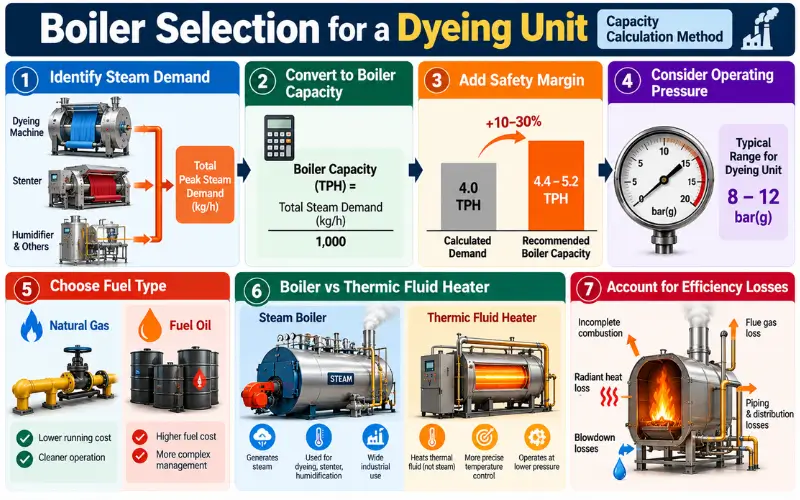
Boiler capacity should be calculated from actual process steam demand, not backed into from a boiler size that happened to fit the available budget or floor space. This means totaling the steam requirement of every process that draws steam simultaneously during the mill’s peak operating period, not average demand across a full day, since a boiler sized to average demand will underperform precisely when the mill needs full capacity most.
Each dyeing machine, each stenter, and any other steam-consuming equipment has a steam demand figure, either from the manufacturer’s specification or measurable directly if the equipment is already in operation, and peak simultaneous demand is the sum of what’s realistically running at once during the busiest point in a typical production schedule, not the sum of every machine’s demand as if everything ran at full steam draw simultaneously, which overstates true peak demand in most real operating patterns.
TPH: The Standard Boiler Capacity Unit
Boiler capacity is conventionally expressed in TPH, tons of steam per hour, and converting calculated peak steam demand into a required TPH figure is the core output of the sizing exercise. This calculation needs to account for the specific steam pressure and temperature the connected processes require, since TPH capacity at one operating pressure doesn’t translate directly to the same capacity at a different pressure, and a boiler’s rated TPH figure from a manufacturer is typically specified at a particular design pressure that needs to match what the mill’s actual processes require.
Building in a Realistic Safety Margin
Sizing a boiler to exactly calculated peak demand, with no margin, leaves no room for future capacity growth, no allowance for demand estimation error, and no buffer for reduced boiler output as the unit ages or requires maintenance. A reasonable safety margin above calculated peak demand is standard practice, though the specific margin a given mill should apply depends on how confident the demand calculation is and how much near-term capacity growth is realistically anticipated. Oversizing well beyond a reasonable margin carries its own cost, since a boiler running well below its rated capacity most of the time operates less efficiently than one running closer to its design point, so this is a genuine balance rather than a “bigger is always safer” decision.
Fuel Choice
Fuel choice affects both running cost and the specific efficiency losses a mill needs to plan for. Natural gas is the dominant boiler fuel in current Bangladeshi mill practice, given the country’s gas distribution infrastructure, generally offering cleaner combustion and easier efficiency management than liquid fuel alternatives, though gas supply reliability and pricing vary by region and connection type, worth confirming directly with the relevant gas distribution company for the specific mill location before finalizing fuel choice as part of the boiler decision. Fuel oil remains in use where gas connection isn’t available or reliable, generally carrying higher fuel cost and more involved combustion management than gas firing.
Thermic Fluid Heater Versus Boiler
For some processing applications, a thermic fluid heater, which heats a thermal transfer fluid rather than generating steam directly, presents an alternative to a conventional steam boiler. Thermic fluid systems can offer more precise temperature control for certain processes and operate at lower system pressure than an equivalent steam system, which carries some safety and maintenance advantages. The trade-off is that thermic fluid systems aren’t a universal substitute for steam wherever steam serves multiple functions across a mill, since steam’s direct heat transfer and its role in processes like fabric humidification aren’t always replicable through a thermal fluid system, and the choice between the two technologies should be evaluated against the mill’s actual full range of steam and heating demands, not decided on a single process’s requirements alone.
Efficiency Losses to Plan For
A boiler’s nameplate efficiency rating reflects performance under specific, controlled test conditions, and real operating efficiency typically runs somewhat below that figure due to a combination of factors: incomplete combustion under real fuel and air mixture variation, radiant and convective heat loss from the boiler shell and connected piping, blowdown losses (periodic draining of boiler water to control mineral concentration, which removes heated water and its associated energy from the system), and stack losses from combustion gases exiting at a temperature well above ambient. Planning boiler capacity and expected fuel consumption using realistic operating efficiency, rather than the nameplate figure alone, gives a more accurate picture of actual running cost and helps set reasonable expectations for what a boiler upgrade or efficiency improvement project can realistically achieve.
A Worked TPH Calculation Example
Say a dyeing unit runs 6 jet dyeing machines, each with a peak steam demand of 800 kg/hour at full heating draw, plus a stenter with a peak steam demand of 1,200 kg/hour. In a realistic operating pattern, not every machine hits peak demand simultaneously. Say the mill’s actual peak overlap, based on observed or reasonably estimated scheduling, has 4 of the 6 dyeing machines and the stenter drawing peak steam at the same time.
Peak simultaneous demand: (4 × 800) + 1,200 = 3,200 + 1,200 = 4,400 kg/hour, or 4.4 TPH.
Applying a 20 percent safety margin for growth capacity and estimation uncertainty: 4.4 × 1.20 = 5.28 TPH.
Rounding to a commercially available boiler size, this mill would reasonably look at a 6 TPH boiler rather than trying to source an exact
5.28 TPH unit, since boilers are typically manufactured in standard
capacity increments rather than custom-sized to the last decimal.
Compare this to a naive sizing approach that simply sums every machine’s peak demand as if all ran simultaneously: (6 × 800) + 1,200 = 4,800 + 1,200 = 6,000 kg/hour, or 6.0 TPH, before any safety margin is even applied. Adding the same 20 percent margin to that naive figure would suggest a 7.2 TPH boiler, a full capacity size larger than the realistic calculation supports, representing real unnecessary capital cost for capacity the mill’s actual operating pattern will rarely, if ever, demand simultaneously. This is exactly why establishing genuine peak simultaneous demand, not a simple sum of every connected machine’s individual maximum, matters as much as it does in this sizing exercise.
Connecting Boiler Sizing to the Rest of the Utility Picture
Boiler capacity doesn’t exist in isolation from the rest of a mill’s utility and process planning. It connects directly to the dyeing machine capacity planning covered in Processing Machinery guide, since a dyeing floor’s real production capacity is capped by whichever constraint, machine capacity or steam supply, is more limiting at any given point, and a mill that expands dyeing machine capacity without a corresponding boiler capacity review can find itself with dyeing machines that simply can’t run at their rated output because steam supply hasn’t kept pace. It also connects to the steam trap survey and insulation quality covered in a related article, since a boiler correctly sized on paper can still underperform in practice if a meaningful portion of the steam it generates is being lost to a poorly maintained distribution system before it ever reaches the process equipment it was intended for.
Ongoing Monitoring After Installation
Boiler sizing is a one-time calculation, but boiler efficiency isn’t a one-time achievement. Combustion efficiency drifts over time as burner components wear and as fuel-air mixture calibration shifts, which is why a properly run boiler operation includes regular combustion efficiency testing, checking flue gas composition against expected values for the fuel and burner setup in use, rather than assuming the efficiency figure achieved at commissioning holds indefinitely without active monitoring. Water treatment for boiler feedwater also deserves ongoing attention, since scale buildup from poorly treated feedwater reduces heat transfer efficiency inside the boiler itself, a slow, easy-to-miss efficiency loss that compounds over months if feedwater quality isn’t actively managed and tested on a defined schedule.
A Practical Sizing Checklist
Before finalizing boiler capacity for a new or expanding dyeing unit, confirm actual peak simultaneous steam demand across all connected processes rather than a simple sum of every machine’s rated maximum, convert that demand to TPH at the correct design pressure for your actual processes, apply a reasonable safety margin that balances growth capacity against oversizing inefficiency, confirm fuel availability and realistic supply reliability for the specific mill location, and plan expected fuel consumption using realistic operating efficiency rather than nameplate efficiency alone. Skipping any one of these steps is a common way a boiler that looked correctly sized on a simple capacity spreadsheet ends up underperforming once it’s actually running against real production demand.
Frequently Asked Questions
How is boiler capacity actually calculated for a dyeing unit?
From genuine peak simultaneous steam demand across all connected processes, converted to TPH at the correct operating pressure, plus a reasonable safety margin, not a simple sum of every machine’s individual maximum draw.
Why does a naive boiler sizing approach lead to oversized, expensive equipment?
Summing every machine’s rated maximum demand as if all ran simultaneously overstates true peak demand, since real operating patterns rarely have every machine drawing full steam at once. The worked example in this article shows this can suggest a full capacity size larger than actually needed.
Is natural gas always the right fuel choice for a Bangladeshi mill’s boiler?
It’s the dominant choice given the country’s gas infrastructure and generally cleaner combustion, but supply reliability varies by region and connection type, worth confirming directly with the local gas distribution company.
Does a boiler’s nameplate efficiency reflect real operating performance?
No. Real efficiency typically runs below nameplate figures due to combustion variation, radiant heat loss, blowdown losses, and stack losses, so fuel consumption planning should use realistic operating efficiency, not the nameplate number.