A buyer asking for a lighter GSM on an existing fabric sounds like a simple request, and sometimes it is. Other times, the honest answer is that hitting that GSM properly means a different machine, not just a different setting, and knowing which situation you’re in starts with understanding what gauge actually controls and what it doesn’t.
What Machine Gauge Actually Means
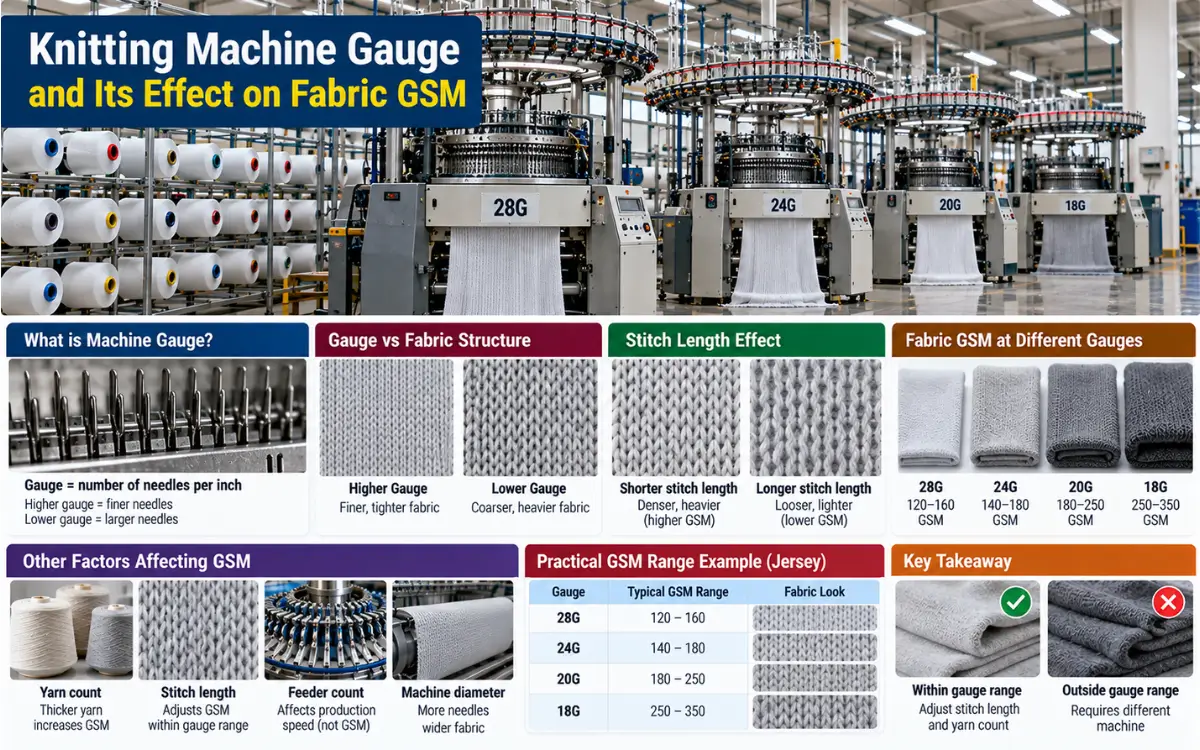
Gauge refers to the number of needles per unit of machine diameter (commonly per inch) on a circular knitting machine, and it’s a fixed physical property of the machine itself, not an adjustable setting. A higher gauge machine has more, finer needles packed into the same space, producing a finer, more tightly constructed fabric, while a lower gauge machine has fewer, larger needles, producing a coarser, typically heavier fabric structure.
Because gauge is fixed by the machine, it sets a boundary on what GSM range a given machine can realistically produce, regardless of other adjustable settings. This is the core practical limit buyers and production planners need to understand: a machine bought for a specific gauge range can’t be adjusted its way into a fundamentally different fabric weight category the way stitch length or yarn count adjustments can shift GSM within a narrower range.
How Needle Count Factors In
Total needle count on a given machine, a function of both gauge and machine diameter, determines how many loops form in each course (row) of knitting. For a fixed gauge, a larger diameter machine has more total needles and therefore more loops per course, which affects fabric width and, in combination with stitch length, contributes to the fabric’s overall density and weight.
How Stitch Length Drives GSM Within a Gauge
Stitch length, the amount of yarn fed into each loop, is the primary adjustable variable a mill uses to fine-tune GSM within the range a given gauge machine can produce. A shorter stitch length packs more yarn into a tighter loop structure, producing a denser, heavier fabric at a given gauge. A longer stitch length produces a looser, lighter fabric. This is genuinely adjustable on a running machine, within limits, since stitch length that’s too short creates excessive tension and needle stress, and too long produces a fabric structure that’s unstable and prone to laddering or poor recovery.
Yarn count (thickness) also affects final GSM independent of stitch length and gauge, and adjusting yarn count is another lever available for GSM fine-tuning without changing machine, though yarn count changes also affect fabric hand feel and cover, not just weight, so they’re not a free adjustment without other consequences.
Loop Length and Feeder Count
Loop length, closely related to stitch length, is sometimes the more precise technical term used in mill specifications, referring to the actual length of yarn in each individual loop, which directly determines fabric density for a given yarn count and gauge. Feeder count, the number of yarn feeding points around a circular machine’s circumference, affects production speed (more feeders knitting simultaneously means faster fabric production) but doesn’t directly change GSM, since it’s a throughput factor rather than a fabric structure factor.
The Practical Limits of Changing GSM Without Changing Machine
Within a given gauge, GSM can typically be adjusted within a meaningful but bounded range through stitch length and yarn count adjustment, enough to accommodate normal product development flexibility for similar fabric categories. What gauge adjustment can’t do is cross into a fundamentally different fabric category. A machine built for a fine, lightweight jersey gauge range can’t be adjusted into producing a heavy, coarse-gauge fleece fabric, because the needle spacing itself physically limits how much yarn and loop structure the machine can accommodate, regardless of stitch length or yarn count settings.
This matters directly for production planning and buyer conversations. A request to meaningfully change a fabric’s weight category, not just fine-tune it within a similar range, needs to be evaluated against actual machine gauge availability before being treated as a simple settings adjustment, since promising a GSM change that’s outside what the currently available machine gauge can achieve leads to a fabric that technically hits the requested number but with compromised hand feel, cover, or structural integrity as the machine gets pushed outside its intended operating range to force the result.
A Worked Example of Gauge Limits
Consider a 24-gauge circular knitting machine commonly used for lightweight jersey, typically producing fabric in a range of roughly 140 to 180 GSM depending on yarn count and stitch length adjustment within that gauge. A buyer requesting a lighter 120 GSM jersey is likely still within reach through a longer stitch length and possibly a finer yarn count, an adjustment the existing 24-gauge machine can accommodate. A buyer requesting a heavy 320 GSM fleece-weight fabric on the same machine is asking for something the 24-gauge needle spacing simply cannot produce well, regardless of stitch length adjustment, since fleece-weight fabric typically requires a coarser gauge machine (often in the 18 to 20 gauge range or lower) built with wider needle spacing to accommodate the heavier yarn and looser loop structure that weight category requires.
Pushing the 24-gauge machine to attempt the heavier fabric anyway, forcing an extremely short stitch length and heavier yarn than the gauge was designed for, typically produces a fabric that hits close to the target weight on paper but with poor hand feel, uneven stitch formation, and often needle damage from the stress of running yarn far heavier than the gauge was engineered to handle, illustrating exactly why the gauge boundary discussed throughout this article is a genuine physical limit, not simply a starting point that skilled adjustment can always work around.
A Practical Framework for GSM Requests
When a GSM change request comes in, the useful first question isn’t “can we adjust settings to hit this,” it’s “does this GSM sit within the range our current gauge machines can reasonably produce for this fabric type.” Small adjustments, a modest weight increase or decrease within the same general fabric category, usually can be handled through stitch length and yarn count adjustment on existing machines. Larger changes, moving into a genuinely different fabric weight category, more honestly require either sourcing the fabric from a mill with the appropriate gauge machine already in place, or a genuine capital decision about adding gauge capacity the current machine fleet doesn’t cover. Being upfront about which situation a specific request falls into avoids the more expensive problem of promising a result the existing machine fleet was never going to deliver cleanly.
Frequently Asked Questions
Can a knitting machine’s gauge be adjusted to change fabric weight?
No. Gauge is a fixed physical property of the machine’s needle spacing, not an adjustable setting. Stitch length and yarn count are the adjustable levers used to fine-tune GSM within the range a given gauge can produce.
How much can GSM change without needing a different machine?
Within a given gauge, GSM can typically be adjusted within a meaningful but bounded range through stitch length and yarn count. Crossing into a genuinely different fabric weight category usually requires a different gauge machine entirely.
What happens if a machine is pushed to produce a GSM outside its gauge range?
It can technically hit the target number, but usually with compromised hand feel, uneven stitch formation, or needle damage, since the machine is being operated outside the range it was engineered for.
Does higher gauge always mean better quality fabric?
No, it means finer, more tightly constructed fabric. Whether that’s “better” depends entirely on the product, since a coarser gauge is exactly right for fleece-weight fabric the way a fine gauge is right for lightweight jersey.