
Data. Every department touches it. Every decision leans on it. Customer records, financial documents, operational metrics — strip those away and most businesses can’t function for a day, let alone a quarter. Yet storage practices inside most organizations are a mess, and nobody notices until something actually breaks. Breaches. Regulatory fines. Files gone forever. Weeks of downtime nobody budgeted for. None of that is hypothetical — it’s the predictable result of letting storage habits go unexamined. So where do companies keep getting this wrong?
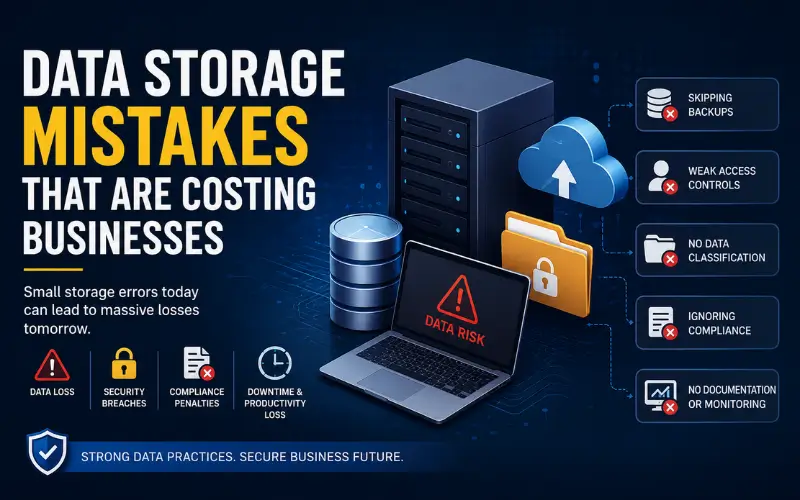
Skipping Backups and Redundancy
Treating backups as optional is genuinely dangerous. Hardware dies without warning. Ransomware doesn’t care how busy you are. Floods don’t call ahead. Too many organizations assume their primary servers are sufficient — right up until they aren’t. The 3-2-1 rule exists for a reason: three copies, two different media types, one stored offsite. Ignore that structure and a single bad day can mean permanent loss. But setting backups to run isn’t enough either. Test them. Corrupted or incomplete backups have a nasty habit of revealing themselves mid-emergency, when there’s no margin left to recover.
Weak or Absent Access Controls
Who can actually see your data right now? Be honest. If the answer is “more people than necessary,” that’s a real exposure problem — honest mistakes and deliberate misuse both thrive in that environment. Role-based access controls fix this. Restrict data to employees whose jobs genuinely require it. Never share admin credentials. Change default passwords immediately — not soon, not eventually, immediately. Then audit on a schedule. People change roles. People leave. Access that made sense six months ago might be a liability today.
No Classification System for Data
A press release and a customer’s payment details are not the same thing. Treating them identically wastes effort in some places and leaves dangerous gaps in others. Tiered classification — public, internal, confidential, highly confidential — lets you apply real safeguards where they actually matter. Marketing copy needs basic protection. Trade secrets and financial records need considerably more. Poor organization makes everything worse. Duplicate files pile up. Storage bloats. Critical documents disappear inside folder structures nobody thought through. Industrial environments feel this sharply — sensor feeds and machine data spiral into chaos fast without discipline. That’s why high-volume operational teams rely on IoT data historian software to organize, timestamp, and retrieve time-series data with actual precision. Classification isn’t bureaucracy. It’s how control holds at scale.
Ignoring Compliance Obligations
Regulations aren’t suggestions. Healthcare, finance, legal — strict rules govern how data gets stored, protected, and retained. Cross-border operations stack another layer on top. Many businesses genuinely don’t know how long they’re legally required to hold certain records, so they either delete too early or hoard data indefinitely, running up storage costs for no reason. Both create problems. Violations carry real consequences: heavy fines, reputational damage, sometimes worse. Compliance can’t be treated as an afterthought. Train your team. Make sure everyone understands their role in keeping storage practices within legal boundaries.
No Documentation. No Monitoring.
Where is your data stored? Who owns it? What protections apply? If those questions don’t have clear, documented answers, your team can’t respond effectively when something breaks — and something always eventually breaks. Documentation closes that gap. Active monitoring handles the rest. Watch capacity trends, backup completion rates, access logs. Catch performance problems and unauthorized access attempts before they escalate into something unmanageable. Without visibility, issues grow quietly. They compound. By the time they’re impossible to ignore, the damage is already done. Build documentation habits now. Keep monitoring systems live. Don’t wait for a crisis to learn what you should’ve known all along.
Conclusion
Good data storage isn’t a single decision. It’s a set of ongoing practices — backups, access controls, classification, compliance, monitoring. Drop any one of them and you’ve opened a gap that can turn expensive fast. Take an honest look at how your organization handles storage right now and measure it against the pitfalls above. The fixes aren’t glamorous. But businesses that make them hold up under pressure, keep customer trust intact, and avoid the brutal costs that follow a breach or a system failure.