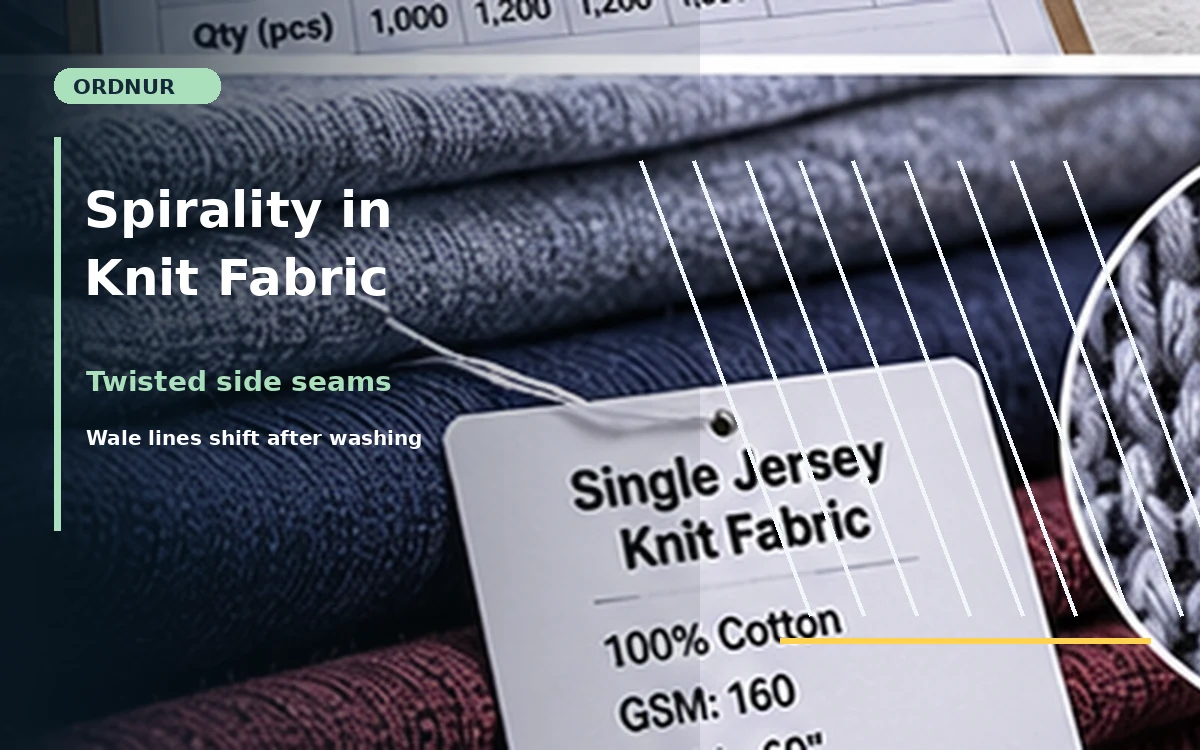
Spirality in knit fabric is the slanting of the wale lines, so that they no longer run at a right angle to the courses. It shows up in the finished garment as a side seam that twists around the body after washing, a hem that is higher on one side, or stripes that run at an angle. The garment may look fine on the cutting table and even on the final check, and then twist in the first wash at the customer’s home. It is one of the most common reasons for returns of knit T shirts, polos and leggings.
This guide explains what spirality is, why it happens, how to measure it with a simple formula, the typical buyer limits, and what the yarn, knitting, dyeing, finishing and garment sections can do to control it. It is written for merchandisers, quality managers and knit technologists.
What spirality is
A knitted fabric is made of loops arranged in rows and columns. The rows across the fabric are the courses, and the columns along the fabric are the wales. In a well balanced fabric, the wales are at a right angle to the courses.
In a fabric with spirality, the loops lean to one side, and the wales run at an angle. The fabric is also called skewed, and the effect is also named torque in some mills, though torque more exactly means the twisting force in the yarn that causes it. When the fabric is cut and sewn into a tube garment, the lean makes the side seams move across the body.
Spirality is mainly a problem of single jersey and similar single knit fabrics made on circular machines. Rib, interlock and many double knit fabrics are much more stable, because the two sets of loops hold each other in balance.
What it looks like in garments
- Side seams that twist toward the front or the back after washing
- A hem that is not level, with one side higher than the other
- The back panel and the front panel sit at different angles
- Printed or striped fabric where lines slope across the body
- Leg seams of leggings and trousers that spiral around the leg
- Sleeves twisting around the arm
- A garment that measures correctly flat when new, but changes shape in use
The amount of twist can be small, but it is easily seen at the side seam. A few degrees of angle make the seam shift several centimetres over the length of a long garment.
Why spirality happens
A knitted loop is held in shape by the yarn, and the yarn wants to untwist. Spirality is the result of two forces: the twist in the yarn, which tries to rotate the loops, and the fabric structure and finishing, which decide whether the loops can rotate.
1. Yarn twist and torque
Spun yarn has twist put in during spinning. A single ring spun yarn carries a built in torque, a tendency to untwist. In a loop, the torque turns the legs of the loop and tilts the loop. The higher the twist, the larger the torque, and the larger the spirality.
- Highly twisted single yarns, such as hard twisted cotton yarn, give more spirality.
- Yarn made with the same twist direction in all the knitting feeders adds up, since all loops lean the same way.
- Fine counts with a high twist multiplier may have more torque. See our guide on twist in yarn, TPI and twist multiplier.
- Poorly conditioned yarn, where the twist was not set by steaming or conditioning, keeps more residual torque.
2. Fabric structure and knitting
- Single jersey on a circular machine is made with all the loops in one direction, in a spiral path around the cylinder, so the course lines may not be truly horizontal.
- Number of feeders. Each feeder lays one course. With many feeders, the pattern of lean can add up or cancel.
- Stitch length and tightness. Loose fabrics with long stitches allow more distortion. Very tight fabrics can hold torque in the loops.
- Machine gauge and yarn count need to match. A yarn too coarse or too fine for the gauge gives uneven loops. See the guide on knitting machine gauge and fabric GSM.
- Machine setup, including uneven yarn tension, take down tension and needle condition, adds to the tilt.
- Knitting faults may add to the problem. See knitting defects, causes and remedies.
3. Wet processing and finishing
- Tension during dyeing and washing. Fabric pulled in a rope or an open width can be held out of shape and then spring back after the garment is washed.
- Not enough relaxation. If the fabric does not reach its relaxed state in the mill, it will relax in the customer’s wash, with spirality as one of the results.
- Tubular finishing, where a tube of fabric is cut open and the twist is not corrected, or where it is dried in a state with built in torque.
- Compacting and calendering that sets the fabric at a wrong width or length. See compactor and calender machines in knit finishing.
- Heat setting of synthetic blends that locks in the shape.
- Fabric that is skewed during stentering, where one side runs ahead of the other.
4. Garment manufacture
- Cutting off grain. Panels cut at a slight angle to the wales carry the angle into the garment.
- Front and back from different positions in the roll or from different rolls, giving different amounts of twist.
- Stretching the fabric during spreading, cutting and sewing.
- Unbalanced sewing where one seam is stretched more than the other.
- No relaxation before cutting. See knit fabric relaxation before cutting.
How to measure spirality
Spirality is measured as the displacement of a line from its true position, after washing, compared with its length.
Spirality (%) = (displacement ÷ original length) × 100
The angle of the wales from the vertical is given by:
Angle = arctangent of (displacement ÷ length)
A simple example
A line of 50 centimetres is marked along a wale on a piece of fabric or along the side seam of a garment, from the hem upward. After washing and drying, the bottom end of the line has moved sideways by 2.5 centimetres from the top end. The figures are assumed.
- Spirality = (2.5 ÷ 50) × 100 = 5 percent
- Angle = arctangent of 0.05, which is about 2.9 degrees
Test methods
Several standard methods exist. Two common ones are ISO 16322, which has parts for fabric and for garments, and AATCC 179 for skewness change after home laundering. Buyers often use their own wash procedures and rules for marking and measuring, so read the buyer’s test requirement and follow it. See garments test requirements of a buyer.
How a typical fabric test goes
- Take a sample from the roll, away from the ends, with the full width.
- Condition the sample in a standard atmosphere.
- Mark a square with the sides along the course and wale lines, using a template. Mark the corners with a stable ink or stitches.
- Measure the marks and record them.
- Wash and dry using the buyer’s wash and dry cycle, usually repeated a set number of times.
- Condition again, lay the sample flat with no stretching and measure the displacement of the marks.
- Calculate the percentage, and record the direction of the shift, for example left or right.
A garment test
Mark the side seam and a point on the hem on a finished garment, and measure the shift of the seam relative to the hem line after washing, as the buyer’s method describes. Test garments of each size and each roll or dye lot where possible, since twist varies between lots.
What limits do buyers set?
Limits differ by buyer and product. Many buyers set a limit of about 5 percent or less, and some are stricter for tops with side seams and printed stripes. Take the number from the buyer’s spec. Where none is given, agree one in writing before production. Record the limit in the order sheet, with the wash method.
How to control spirality
Spirality is easiest to control early, in the yarn and the knitting. By finishing, you can reduce it, but not always remove it.
In the yarn
- Choose yarn with lower torque. Plied yarn, which has two yarns twisted together in the opposite direction, is balanced and gives very little spirality. Many premium fabrics use it.
- Use compact, open end or air jet yarns where the product allows, since the structure of these yarns gives lower residual torque than a conventional ring spun single yarn. Check with the spinner for the yarn type.
- Control the twist level. Do not use more twist than the handle and strength need.
- Condition or steam the yarn to set the twist before knitting, where the mill can do it.
- Use special treated or torque free yarn where the buyer allows the cost.
In the knitting
- Knit with balanced twist. Some mills use yarns with S and Z twist on alternate feeders, so that the lean of the loops cancels out. This is a known method, but it needs two yarn types and careful control to avoid streaks.
- Use the right machine and number of feeders for the style. A machine with a larger number of feeders, set up well, helps.
- Keep stitch length and tension constant. Avoid variation across the cylinder.
- Match yarn count and gauge.
- Use stable structures where the design allows, such as rib or interlock, or a double knit.
In the dyeing and finishing
- Relax the fabric fully. Use a process with low tension and enough time for the fabric to relax in the wet state. A relaxed fabric before the final dry and set will show less change at the customer’s wash.
- Reduce tension in the machines, with the right machine speed, and proper overfeed.
- Correct skew in open width finishing. Stenters and finishing lines can straighten the course lines, and set them at a right angle, though a fabric that carries a strong torque may spring back.
- Use a good compactor setting and avoid pulling in length.
- Use the right heat setting for synthetics.
- Run a spirality test on each lot after finishing, and reject or reprocess lots over the limit.
- Use resin or chemical treatments only as a last measure and with the buyer’s approval, because they change hand feel and may add chemical limits.
In the garment factory
- Test the fabric lot before cutting, with the washing method of the buyer. Do not wait until after the garments are made.
- Allow the fabric to relax before spreading.
- Spread without tension. See fabric spreading methods in garment cutting.
- Cut on grain, with the marker lines parallel to the wales, and check the first lay.
- Cut the front, back and sleeves from the same roll and same lay, so that all parts have the same lean.
- Do not mix rolls or dye lots in one garment.
- Write the roll data in the cut order plan so you can trace a problem to a roll.
- Sew with balanced stretch on both side seams.
- Check a garment from each lot after washing, before shipping the lot.
- Plan the allowance in the pattern for the shrinkage that remains. See garment pattern making based on fabric shrinkage.
Spirality, shrinkage and measurement
Spirality is a change of shape, not of size, but it often comes with shrinkage and appears at the same time. Both depend on how well the fabric was relaxed. Shrinkage shows as a change in length and width. Spirality shows as a twist. A garment can pass its shrinkage test and still fail on twist, so test for both. Also check that the garment still meets the size spec after wash. See garment measurement tolerance.
Dyeing garments and spirality
Garments dyed after sewing go through heat, water and tumbling, so they may show twist if the fabric is prone to it. Check the garment before and after the process, and allow for the change in the plan. See garment dyeing process.
How to handle a lot with high spirality
- Stop and test. Confirm the figure with a proper test on more than one sample, with the buyer’s method.
- Find the roll or lots affected. Use the cut order plan and roll records.
- Talk to the fabric supplier with the data, and ask for corrective action and a replacement or re-finish.
- Ask the buyer about the options if garments are already made. Some lots may be accepted with an agreed allowance or sold as a lower grade.
- Do not ship garments that fail the buyer’s limit without approval.
- Record the cause and update the fabric approval procedure, so the same problem does not come back.
Common mistakes
- Testing only shrinkage and not twist.
- Testing before relaxation, so the result does not match the wash at home.
- Using the supplier’s report with no check on the real lot.
- Mixing rolls in a garment.
- Cutting off grain.
- Stretching fabric on the table.
- Ignoring spirality on stripes and prints, where it is most visible.
- Choosing yarn for cost only, without checking the torque.
- Relying on resin treatments to hide a yarn or knitting problem.
- No agreed limit with the buyer.
Final thoughts
Spirality in knit fabric is the slant of the wale lines, caused mainly by the twist in single yarns, the loose structure of single jersey and tension in wet processing and finishing. It appears as twisting side seams after wash, and it is measured as the displacement divided by the marked length, times one hundred.
Control it at the start: choose balanced or low torque yarn, knit with steady tension, relax the fabric fully in the mill and the factory, and test each lot with the buyer’s wash before cutting. It is much cheaper to find a twisted lot on the test table than in a customer’s wardrobe.
Frequently asked questions
It is the slanting of the wale lines so they are no longer at a right angle to the courses. It makes side seams twist after washing.
Single jersey and other single knit fabrics, especially those made with high twist single ring spun yarn. Rib and interlock are more stable.
Spirality percent = (displacement of the marked line ÷ its original length) × 100, measured after the specified wash and dry.
It depends on the buyer. Many set about 5 percent or less, and some are stricter. Use the limit in the buyer’s specification.
Twist in the yarn, the knit structure, tension in dyeing and finishing, and poor relaxation. Cutting off grain adds to it in the garment.
Use plied or low torque yarn, balance the yarn twist, relax the fabric properly, finish at low tension, test each lot, and cut on grain from the same roll.
No. Shrinkage is a change in size. Spirality is a twisting of the fabric. Both should be tested after wash.