Hot dyeing effluent leaving a dyeing machine at the end of a batch carries real, recoverable heat energy that most mills simply send down the drain along with the water itself. That’s understandable given how much attention effluent gets purely as a treatment and compliance obligation, covered in the ETP and ZLD article elsewhere, but from a pure energy standpoint, discarding that hot water without recovering its heat content means paying twice: once to heat the original process water, and again to heat fresh incoming water from a colder starting temperature for the next batch.
Why Dyeing Effluent Carries Recoverable Heat
Dyeing processes run at elevated temperature, and when a batch finishes and the dyebath drains, that water leaves the machine still carrying a substantial amount of thermal energy well above ambient temperature. The specific temperature depends on the process (reactive dyeing typically runs cooler than some disperse dyeing processes on polyester, for instance, a distinction covered in more depth in our Textile Chemicals guide), but across most dyeing processes, effluent leaves the machine hot enough that recovering even a portion of that heat represents a genuine, quantifiable energy saving rather than a marginal one.
How a Heat Exchanger Recovers This Energy
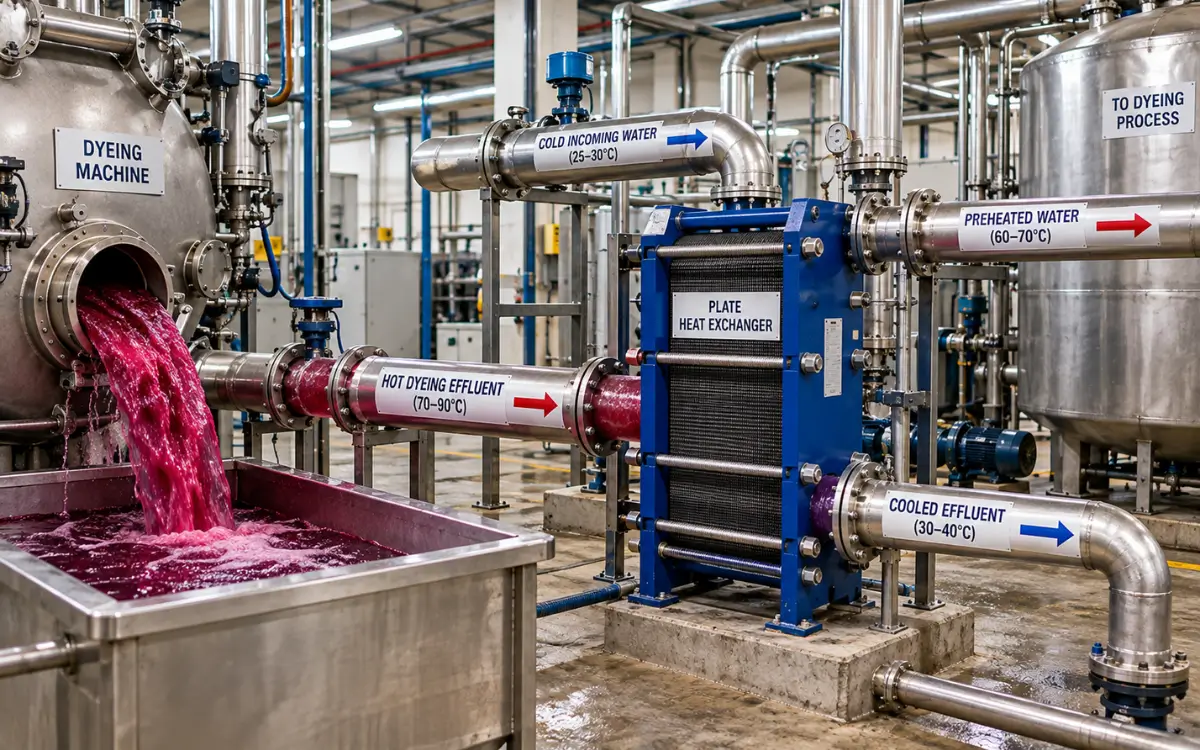
A heat exchanger recovers effluent heat by passing the hot outgoing effluent and cold incoming fresh water through separate channels in close thermal contact, typically through a plate heat exchanger design for this application, transferring heat from the hot effluent stream to the cold incoming stream without the two water streams physically mixing. The result is fresh process water entering the next batch already partially preheated, reducing the boiler steam or direct heating energy needed to bring that water up to process temperature.
Plate heat exchangers, built from a stack of thin, corrugated plates that maximize surface area for heat transfer in a compact footprint, are the common choice for this application, offering good heat transfer efficiency and a design that allows individual plates to be accessed for cleaning, an important practical consideration given the fouling challenges covered below.
The Fouling Problem
Dyeing effluent isn’t clean water. It carries dye residue, chemical auxiliaries, and sometimes fiber particles or other suspended material, and this composition creates a real fouling challenge for heat exchanger surfaces over time, as residue accumulates on the plates and progressively reduces heat transfer efficiency. A heat exchanger that isn’t cleaned on a proper maintenance schedule will see its recovery performance degrade steadily, sometimes without an obvious signal beyond a gradual reduction in preheated water temperature that’s easy to miss without active monitoring.
Managing fouling generally requires a defined cleaning schedule, appropriate to the specific effluent characteristics and heat exchanger design in use, along with pre-filtration in some installations to remove larger suspended particles before effluent reaches the heat exchanger plates, reducing the rate at which fouling accumulates in the first place. Plate heat exchanger designs that allow relatively straightforward disassembly for manual cleaning are generally preferred for this application specifically because fouling is an expected, ongoing maintenance reality rather than an occasional problem.
Condensate Heat Recovery: A Related but Distinct Opportunity
Separate from dyeing effluent heat recovery, condensate heat recovery, covered briefly in the steam trap survey article, captures heat from steam condensate returning through the boiler feedwater system. While both fall under the broader heat recovery umbrella, they’re distinct systems addressing different heat streams, dyeing effluent heat recovery targets the hot water discharged from dyeing machines, while condensate recovery targets the condensate formed as steam gives up its heat throughout the distribution and process system. A mill evaluating heat recovery opportunities benefits from considering both rather than treating “heat recovery” as a single project, since the equipment, payback calculation, and maintenance considerations differ between the two.
Beyond Boiler Feedwater: Other Uses for Recovered Heat
Preheating boiler feedwater, the application covered above, isn’t the only productive use for heat recovered from dyeing effluent. Recovered heat can also preheat water used directly in subsequent process baths, reducing the direct heating energy those processes would otherwise require independent of the boiler feedwater path entirely. In facilities with space heating needs during cooler months, recovered low-grade heat can sometimes offset a portion of that demand as well, though this application is more site-specific and less universally relevant than process water preheating given Bangladesh’s generally warm climate. Evaluating which specific use, or combination of uses, makes sense for a given mill’s layout and process flow is worth doing as part of the initial system design, since retrofitting a heat recovery system originally built for a single application to serve a second one later is considerably more expensive than designing the piping and control system to serve multiple recovery destinations from the outset.
Calculating Realistic Payback
A heat recovery system’s payback calculation starts with quantifying actual effluent volume and temperature for the specific dyeing processes it will serve, since these figures directly determine how much recoverable heat energy is actually available. From there, the achievable temperature rise in incoming fresh water depends on the heat exchanger’s efficiency and the temperature differential between hot effluent and cold incoming water, and this preheat effect translates into reduced steam or direct heating energy needed for the next batch, calculable using the same fuel cost and boiler efficiency figures covered in the boiler selection article.
Capital cost for the heat exchanger system, including installation and any pre-filtration equipment needed to manage fouling, gets divided by this annual energy saving to arrive at payback period. Systems serving high-volume, consistently hot dyeing processes, where effluent volume and temperature are both favorable, generally show a more attractive payback than systems serving lower-volume or lower-temperature processes, which is why heat recovery investment decisions benefit from being evaluated process by process rather than as a single blanket decision for a mill’s entire dyeing floor.
A Worked Payback Example
Say a dyeing floor discharges effluent at an average 70°C, with a total discharge volume of 15,000 liters per day across its typical batch schedule. A plate heat exchanger recovers heat from this effluent, preheating incoming fresh water from an ambient 25°C to 50°C before it enters the boiler feed or process supply, a 25°C rise achieved through heat exchange rather than direct fuel-fired heating.
Heat energy recovered per day: Using the standard relationship between water volume, temperature rise, and energy (specific heat of water is 4.186 kJ per kg per °C), recovering a 25°C rise across 15,000 liters (15,000 kg) works out to 15,000 × 4.186 × 25 ≈ 1,569,750 kJ per day, or roughly 436 kWh-equivalent of thermal energy per day.
Annual energy recovered: 436 × 300 operating days ≈ 130,800 kWh-equivalent per year.
Fuel cost avoided: Converting that recovered thermal energy back into avoided gas consumption at a realistic boiler efficiency (accounting for the same combustion and distribution losses covered in our boiler selection guide), and pricing it at an illustrative $0.35 per cubic meter of gas, might represent an annual fuel cost saving on the order of $9,000 to $11,000 depending on the specific boiler efficiency assumed.
Payback: Against an illustrative installed cost of $32,000 for the heat exchanger system, including pre-filtration to manage fouling, a $10,000 annual saving gives a payback period of roughly 3.2 years.
As with every worked example, treat these numbers as illustrations of the calculation method, not benchmarks for what your own mill should expect. Effluent temperature and volume, achievable preheat rise, and current fuel pricing all vary enough between mills that a real payback figure needs to be built from your own measured effluent characteristics and current utility costs.
Where Heat Recovery Fits in a Broader Efficiency Program
Heat recovery from dyeing effluent works best as part of a broader utility efficiency program rather than a standalone initiative, since its value depends partly on how well the rest of the mill’s steam and water systems are already performing. A mill still losing considerable energy to failed steam traps or poor insulation, covered in the steam trap survey article, will see a smaller relative benefit from effluent heat recovery than a mill that’s already addressed those more fundamental distribution losses, simply because the baseline energy cost effluent heat recovery is working to reduce is itself inflated by other unaddressed losses. Sequencing efficiency investments, addressing the more fundamental distribution and maintenance losses first, then layering in heat recovery once those are under control, generally produces a more accurate picture of what each individual investment is actually contributing to overall energy cost reduction.
Frequently Asked Questions
How much heat can actually be recovered from dyeing effluent?
It depends on effluent temperature and volume, but the worked example in this article shows a mid-sized dyeing floor recovering roughly 130,000 kWh-equivalent of thermal energy a year from a single heat exchanger installation.
What’s the biggest maintenance challenge with effluent heat exchangers?
Fouling from dye residue and suspended particles in the effluent, which progressively reduces heat transfer efficiency without a defined cleaning schedule and sometimes pre-filtration ahead of the exchanger.
Is heat recovery from dyeing effluent the same as condensate recovery?
No, they’re related but distinct systems. Effluent heat recovery targets hot water discharged from dyeing machines, while condensate recovery targets condensate formed as steam gives up its heat through the boiler feedwater system.
Does heat recovery investment make sense if a mill hasn’t fixed its steam trap losses yet?
It’s worth less in that order. A mill still losing considerable energy to failed traps or poor insulation sees a smaller relative benefit from effluent heat recovery, since the baseline cost it’s reducing is itself inflated by other unaddressed losses.