
Buyer claims in garment export are formal complaints from a buyer that an order did not meet the agreed terms, followed by a request for something in return, such as a price discount, a rework, a replacement or a refund of extra cost. Almost every exporter faces them sooner or later. A claim can come from poor stitching, a late shipment, a wrong carton count or a label that does not match the order. How the factory responds often decides whether the buyer keeps placing orders.
This guide explains what a buyer claim is, the common types, how claims reach the factory and what buyers may ask for. It then covers what happens in practice, how to respond step by step, the evidence to keep, how to negotiate a fair outcome and how to prevent claims. It is written for merchandisers, commercial staff and factory managers. It is general guidance and not legal advice. The terms of your own contract and purchase order always come first.
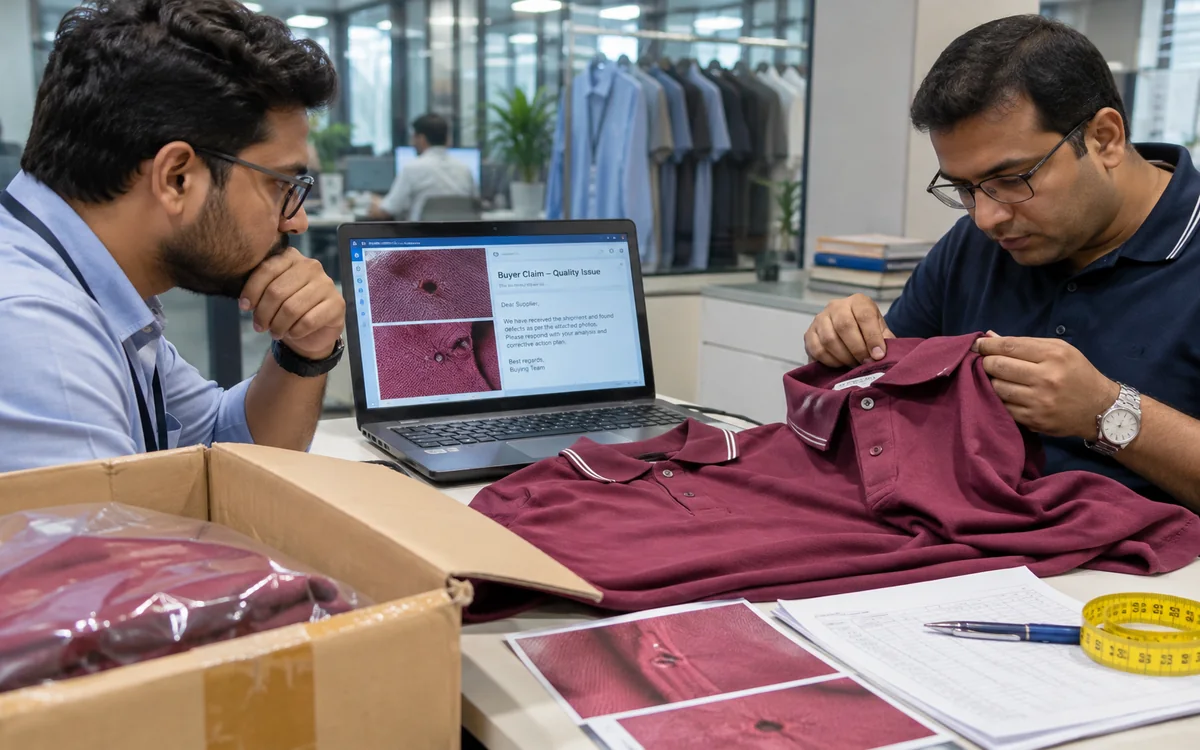
What a buyer claim is
A buyer claim is a complaint made after goods are shipped or received, saying that something about the order was not as agreed. It is usually made in writing, with details of the problem, and often with photos, inspection reports or a count of the affected pieces. The buyer then states what it wants, which may be a discount, a replacement, a credit note or a cost recovery.
Claims are different from small comments during production. A comment during sampling or inline checks can be fixed before shipping. A claim comes when the goods are already out, or about to be received, and the problem is harder and costlier to fix.
Common types of claims
Quality claims
The garments have defects, such as open seams, stains, holes, puckering, wrong shade, poor print, measurement out of tolerance or missing trims. These often come from a buyer inspection at the warehouse, a store check or a customer return. See pre shipment inspection in garments for the checks that try to catch them first.
Late shipment claims
The goods left the factory or arrived after the agreed date. The buyer may have missed a selling season, a promotion or a store launch. See lead time in garment manufacturing.
Short shipment claims
The quantity shipped is less than the order, or part of the cargo missed its vessel. Press reports from Bangladesh have noted that buyers may seek discounts when cargo is short shipped or delayed, and that exporters sometimes have to send goods by air, which costs far more than sea freight.
Wrong quantity, size or assortment
The cartons hold the wrong size ratio, the wrong colour mix or the wrong number of pieces. The buyer’s warehouse cannot use the goods as planned.
Labelling and packing claims
The labels, hang tags, barcodes, polybags, carton marks or packing method do not follow the buyer’s instruction. This can stop goods from being received or sold. See types of garment labels, garment packing methods and export garment carton packing specs.
Compliance and testing claims
A test report shows a fail, such as colour fastness, shrinkage or a restricted substance, or a safety check finds a problem, such as a broken needle or a metal detection failure. These can be serious, since they may lead to recalls. See garments test requirements of buyers.
Document claims
Wrong or missing documents delay customs clearance or payment, and the buyer asks to recover the cost. See garment export documents.
How claims reach the factory
Claims arrive in different ways, and the first message matters.
- From the buyer’s QC or merchandising team, by email, with photos and a count.
- From a buying house or agent, who passes on the buyer’s complaint.
- From an inspection or test report, after a warehouse or lab check.
- From a customer return or store complaint, collected by the buyer’s quality team.
- From a debit note, where the buyer deducts an amount from the payment, with an explanation.
Most buyers set out how they handle claims in their manual or in the purchase order terms. Read these before an order starts, not after a claim arrives.
What buyers may ask for
The request depends on the problem, the buyer and the contract. It might be one or more of the following.
- A price discount on the affected lot or on the whole order.
- Rework or sorting at the buyer’s warehouse, with the cost charged to the factory, or rework at the factory.
- Replacement of defective pieces, or a credit note for them.
- Return of the goods, with or without a refund.
- Recovery of extra costs, such as air freight, extra inspection, re labelling or storage.
- Cancellation of the order or of part of it, in serious cases.
- A corrective action report, explaining the cause and what will change.
- A warning, a lower score or a change in orders for future seasons.
Each of these depends on what the contract allows. Some buyers use a standard table of charges for common faults. Others negotiate each case. Always check the terms you signed.
What happens in practice
There is no single rule that covers every claim. The same report on short shipments said the outcome often depends on the relationship between buyer and exporter, and it did not give a fixed percentage for discounts. That matches what many exporters see. A buyer who has worked with a factory for years and trusts its quality may agree to a lower claim than a buyer on a first order.
What usually matters:
- The terms of the order. The purchase order, the contract, the buyer manual and any agreed penalty clauses set the starting point.
- The size of the problem. A few defective pieces are treated differently from a failed lot.
- The evidence. A clear record of what was produced, inspected and shipped helps both sides decide.
- The cause. If the delay came from the buyer’s late approval, the position is different from a delay caused by the factory.
- The relationship. Trust, past results and the value of future orders often shape the outcome.
- The speed and tone of the reply. A quick, calm and honest response often leads to a better result than a slow or defensive one.
If a claim is large or turns into a dispute, speak to the company’s commercial or legal adviser, and do not rely on general guidance like this.
Steps to respond to a claim
- Acknowledge quickly. Reply within a day if you can, saying you have received the claim and are looking into it. Do not argue or admit fault in the first message.
- Collect the facts. Get the claim details: the PO, the style, the lot, the quantity affected, the photos and the buyer’s report.
- Check your own records. Look at the inline and final inspection reports, the packing list, the shipping documents and any test reports for that lot.
- Find the cause. Use a proper method and not a quick guess. See root cause analysis in garments.
- Decide if the claim is valid. Compare the buyer’s complaint with the order terms, the approved samples and your records.
- Reply in writing with your findings. Agree what is right, and explain with evidence what you do not agree with.
- Offer a solution. This might be rework, replacement, a discount or another option. Check the cost before you offer.
- Agree the outcome in writing, including the amount, the action and the date, and what closes the claim.
- Carry out the corrective action and report back.
- Record the claim in a log, with the cause and the lesson learned.
Keep the same person responsible from start to finish, so replies are consistent.
Evidence to keep
A claim is easier to handle when the records are good. For each order, keep:
- the purchase order, contract and any changes,
- approved samples, fit and pre production approvals, with dates and comments,
- the tech pack and spec versions used,
- inline, end line and final inspection reports,
- pre shipment inspection reports from the buyer or a third party,
- test reports and certificates,
- packing lists, carton counts and the packing instruction,
- shipping documents, including the bill of lading or air waybill,
- the time and action calendar, and records of any delays and their reasons,
- emails and messages with the buyer on changes, delays or approvals,
- photos of the goods before shipment, where useful.
Store them in a way that you can find quickly, for each style and each shipment. Keep them for the period your company policy and the buyer require.
How to negotiate a fair outcome
- Stay calm and factual. Respond to the facts and not to the tone.
- Separate the cause from the cost. Agree on what went wrong first, then talk about the remedy.
- Show your evidence, and listen to the buyer’s.
- Offer options. For example, rework at the factory may cost less than a discount, or a part shipment by air may recover a late delivery.
- Look at the full cost. Include rework, freight, lost time and the effect on future orders when you compare options.
- Ask for details. If the buyer gives a charge, ask how it was worked out.
- Do not accept a deduction without agreement. If the buyer deducts an amount from a payment, ask for the explanation in writing.
- Keep it in writing. Verbal agreements are easy to forget or dispute.
- Think about the relationship. A fair solution that keeps trust can be worth more than winning a small point.
- Know when to escalate. If the claim is large, if it threatens the contract, or if it involves safety or the law, involve senior management and an adviser.
How to prevent claims
Most claims are cheaper to prevent than to settle.
- Read the buyer’s terms and manual at the start of each order, and share the key points with the merchandiser, the planner and the quality team.
- Plan a realistic lead time, with a buffer, and track it against a time and action calendar. See time and action calendar for garments.
- Control quality in every stage: inline checks, end line checks and a final audit before the buyer’s inspection. See garments quality inspection and the AQL sampling plan.
- Follow the packing and labelling instruction exactly, and check the first carton against the packing list.
- Test early. Send fabric and garment samples for the buyer’s tests before bulk starts.
- Keep samples and approvals on record, and make bulk match the approved sample. See fit approval process in garments.
- Report problems early. If a delay or a defect is likely, tell the buyer before they find out. Early notice gives more options, and buyers often value honesty.
- Check documents before they go out.
- Learn from each claim. Fix the root cause, and add the lesson to the style file and the checklist.
- Know your terms of sale. Who handles the freight and the risk affects what a buyer can claim. See FOB, CIF and EXW in garment export and CMT vs FOB garment manufacturing.
Learning from claims
A claim is bad news, but it is also information. Once a quarter, review the claim log.
- Group claims by type, such as quality, late, short, labelling or compliance.
- Look for repeats by style, line, buyer, fabric or supplier.
- Check the cause in each, and see which causes appear most often.
- Note the cost in discounts, rework, freight and lost time.
- Pick the top one or two causes and put a team on them.
- Share the results with merchandising, planning, production and quality, so everyone learns.
Over time, the number and the cost of claims should fall.
Final thoughts
Buyer claims in garment export come in many forms, such as quality, late shipment, short shipment, wrong quantity, labelling and compliance. What a buyer can ask for depends on the contract, the problem and the relationship. There is no fixed rule or percentage that fits every case.
Read your order terms early, keep good records, answer quickly and honestly, find the real cause, and agree the outcome in writing. Then put the lesson into your checklists, so the same claim does not come back. The best way to handle a claim is to have fewer of them.
Frequently asked questions
It is a formal complaint from a buyer that an order did not meet the agreed terms, followed by a request for a remedy such as a discount, replacement or cost recovery.
Quality defects, late shipment, short shipment, wrong quantity or size mix, labelling and packing errors, and failed tests or compliance checks.
A buyer may ask for a discount or deduct an amount if the contract or order terms allow it, or if both sides agree. Ask for the reason and the calculation in writing, and check the terms you signed.
A shipment where the quantity sent is less than the order, or where part of the cargo does not make the planned vessel. It can lead to discount requests or to a faster, costlier transport, such as air freight.
Acknowledge it quickly, collect the facts and your own records, and find the cause before you reply with a position. Keep the first message short and polite.
Read the buyer’s terms, plan realistic lead times, control quality at every stage, follow packing and labelling instructions, test early, report problems early and fix the root cause of each claim.
It depends on the order terms and the reason for the delay. Read the contract and the buyer’s manual, and agree the cost in writing before the goods move.