Secure drug test cups are a frontline tool for employers, clinics, DOT programs, and compliance teams that need fast, defensible screening. They combine rapid screening with design features that deter tampering, preserve sample integrity, and support a clear chain of custody. For businesses that manage employee safety programs, contractor vetting, or clinical testing, choosing the right secure drug test cup reduces legal risk, streamlines workflows, and protects reputations. This guide explains why secure drug test cups matter, what to look for, regulatory considerations, collection best practices, and common pitfalls to avoid.
Why Secure Drug Test Cups Matter
Organizations rely on drug testing to protect workplace safety, meet contractual obligations, and comply with regulations. But accuracy and defensibility aren’t just about the immunoassay on the strip: they begin with how the specimen is collected, sealed, and documented. Secure drug test cups matter because they:
- Reduce risk of adulteration and substitution by using tamper-evident designs and integrated integrity checks.
- Improve chain-of-custody reliability so results are admissible and defensible in disputes.
- Save time and cost by combining collection and initial screening in a single, standardized device.
- Enhance user trust and procedural consistency across locations and collectors.
For businesses operating at scale, staffing agencies, multi-site employers, or third-party administrators, these practical benefits translate directly into fewer retests, less litigation, and more predictable compliance outcomes. They also help vendors and resellers create product pages and content that convert, because buyers increasingly ask about tamper resistance and lab acceptance before purchase.
Key Features To Look For In Secure Test Cups
Not all drug test cups are created equal. When evaluating products, buyers should prioritize features that protect sample integrity and support defensible results.
Tamper-Evident Seals And Chain Of Custody
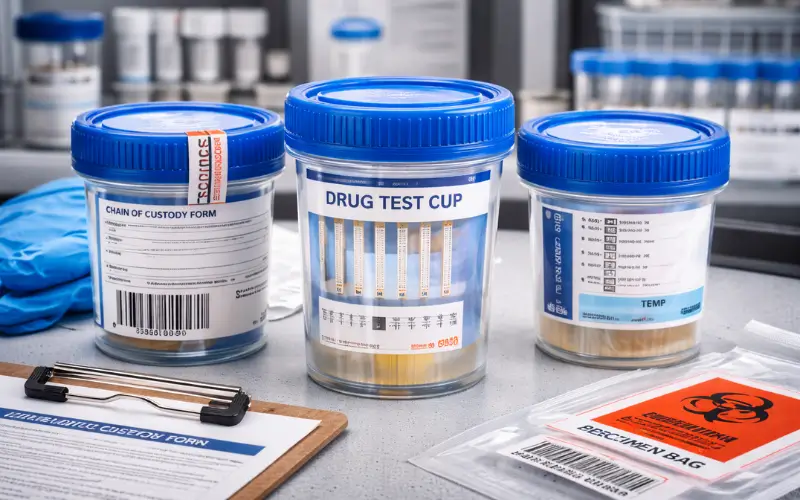
Tamper-evident seals are the first line of deterrence. High-quality cups use seals that irreversibly change or break when opened and leave visible evidence of manipulation. Paired with pre-printed, sequentially numbered chain-of-custody labels, these features create an auditable trail from collection to lab. Look for cups that allow the collector to attach the sample label without touching the specimen, that reduces handling errors and contamination risk.
Built-In Adulteration And Integrity Indicators
Modern secure cups often include built-in adulteration checks: temperature strips to confirm recent void, pH and specific gravity pads, and reagents that detect common chemical tampering. A temperature reading within the valid range (typically 90–100°F/32–38°C shortly after collection) plus acceptable pH and SG readings increases confidence that the specimen is fresh and unaltered. Devices that integrate these indicators into a clear visual window save time and make on-site decisions easier.
Material Quality, Shelf Life, And Storage Considerations
Cup materials should be leak-resistant and chemically inert to avoid reactions with the specimen or test reagents. Polypropylene and certain medical-grade plastics are common for their durability and low adsorption. Check manufacturer specs for shelf life: reagents and integrity pads can degrade over time, especially when exposed to heat or sunlight. For organizations ordering in bulk, proper rotation, climate-controlled storage, and batch tracking prevent expired or compromised supplies from entering the testing workflow.
Compliance And Regulatory Requirements
Selecting secure drug test cups means aligning product capabilities with legal and regulatory expectations. Compliance is both product- and process-driven.
Certifications, Laboratory Acceptance, And Standards
Buyers should confirm that cups and test devices meet applicable standards. For federally regulated programs, like DOT testing, collectors must follow agency-specific methods and use tests that laboratories will accept for confirmatory testing. Non-regulated workplace testing benefits from adherence to ISO 13485 manufacturing standards or CLIA-waived designations in some contexts. Also, reputable manufacturers provide validation studies and lab acceptance letters demonstrating that their devices are compatible with confirmatory GC-MS or LC-MS/MS testing when needed.
Privacy, Data Handling, And Recordkeeping Requirements
Compliance extends beyond the cup to how sample data and chain-of-custody records are handled. Organizations must carry out access controls, retain records per legal retention schedules, and ensure secure transmission when sharing electronic results. For employers subject to state or federal privacy laws, maintaining redacted summaries and limiting who can view sensitive health information reduces liability. Integration with electronic chain-of-custody (eCOC) systems can streamline compliance and audits, provided the vendor supports secure, encrypted data transfer.
Types Of Drug Test Cups And When To Use Each
Different collection matrices suit different programs. The two most common cup types are urine and oral fluid: each has pros and cons depending on detection window and setting.
Urine Test Cups: Pros, Cons, And Use Cases
Urine test cups are the industry workhorse. They:
- Pros: Offer a relatively long detection window for many drugs, support multiple-panel testing, and allow integrated adulteration checks. They’re cost-effective and familiar to collectors and labs.
- Cons: Require controlled collection to prevent substitution, can be invasive for donors, and usually necessitate restroom access and trained collectors.
- Use Cases: Pre-employment screening, random workplace testing, DOT programs, and clinical toxicology where detection of metabolites is essential.
Oral Fluid And Saliva Cups: Pros, Cons, And Use Cases
Oral fluid cups are gaining traction for on-site testing because they’re harder to adulterate and simpler to collect.
- Pros: Noninvasive, observed collection reduces substitution risk, and they better detect recent use (minutes to a few days). Collection is quick and doesn’t need a restroom.
- Cons: Shorter detection window for certain substances, some drugs show lower sensitivity in saliva, and not all labs accept saliva confirmatory specimens.
- Use Cases: Post-incident testing, workplace programs focused on recent impairment, and environments where restroom access or privacy is limited.
Best Practices For Collection, Handling, And Transport
Even the most secure cup won’t protect a specimen if collection and transport are sloppy. Robust protocols reduce errors and preserve legal defensibility.
Step-By-Step Sample Collection Protocols
- Verify donor identity with photo ID and record it on the chain-of-custody form.
- Explain the process to the donor to minimize confusion and delays.
- Use an observed or unobserved collection per program policy: when privacy is necessary, use integrity indicators to offset unobserved risks.
- For urine: have the donor void into the cup, read temperature within the specified time, and check adulteration pads. For oral fluid: follow manufacturer timing for swab saturation and sealing.
- Seal the cup immediately with its tamper-evident closure and affix the sequential label without contacting the specimen.
Labeling, Chain-Of-Custody Forms, And Secure Transport
Complete chain-of-custody forms legibly at the point of collection. Use barcoded, sequential labels to link the physical specimen, the digital record, and any consent forms. Place sealed cups into secondary transport containers (biohazard bags with tamper-evident tape) and maintain temperature requirements during transit. Choose carriers familiar with biological specimen handling and retain tracking until delivery confirmation to the laboratory.
Common Pitfalls And How To Avoid Them
Many testing failures trace back to avoidable mistakes in procurement, collection, or documentation. Address these common pitfalls proactively.
Interpreting Results, Confirmatory Testing, And False Positives
Rapid cup-based immunoassays are screening tools: they flag presumptive positives that require laboratory confirmation. Misinterpreting a screening result as definitive invites legal and HR missteps. Programs should establish clear policies: any non-negative screen goes for confirmatory GC-MS or LC-MS/MS, and results are reported only after confirmatory testing unless policy states otherwise. Awareness of cross-reactivity, certain over-the-counter medications or substances that can trigger false positives, is essential when counseling donors or making employment decisions.
Storage, Disposal, And Maintaining Legal Defensibility
Improper storage (extreme heat or freezing) can degrade samples and test reagents, compromising results. Disposal must follow biohazard regulations and local rules: don’t treat used cups as regular waste. Maintain documented chain-of-custody, retention of split specimens where required, and clear logs of who accessed samples. Those records are the difference between a defensible result and an outcome overturned in arbitration or court.
Practical steps to avoid problems include training collectors regularly, auditing supplies for expiration and damage, and having a documented confirmatory testing workflow with partnered laboratories.
Conclusion
Secure drug test cups are more than convenience items: they’re risk-management tools that influence the integrity of a testing program from collection to adjudication. For businesses that depend on reliable screening, employers, clinics, and program administrators, investing in cups with tamper-evident seals, integrated adulteration indicators, durable materials, and recognized validation reduces retests, defends results, and simplifies compliance. Pairing the right devices with tight collection protocols, robust chain-of-custody practices, and third-party laboratory confirmations ensures testing programs are both efficient and legally defensible. Organizations seeking to scale testing across multiple sites should also factor in training, inventory controls, and electronic records to maintain consistency and minimize risk.
For teams that manage procurement and compliance as part of broader operations, whether HR, safety, or third-party administrators, selecting the right secure drug test cup is a practical, high-impact step toward trustworthy, defensible results.