
Walk into a bedding shop and the number on the pack is hard to miss. 200. 400. 600. 1,000. Sellers present it as a quality score, and many shoppers treat it that way. But what does the number really count, and can you check it yourself? If you want to know how to calculate thread count of fabric, the good news is that the method is simple. You count the threads in one direction, count them in the other direction and add the two numbers together.
This guide explains what thread count is, how to count threads with a magnifier or a pick glass, how to convert between inches and centimetres, why plied yarns can inflate the number and what thread count can and cannot tell you about quality. A worked example near the end compares two sheets with different thread counts and shows how yarn fineness can reverse the result. If you are new to the two thread directions, read our guide to warp and weft in fabric first.
What is thread count?
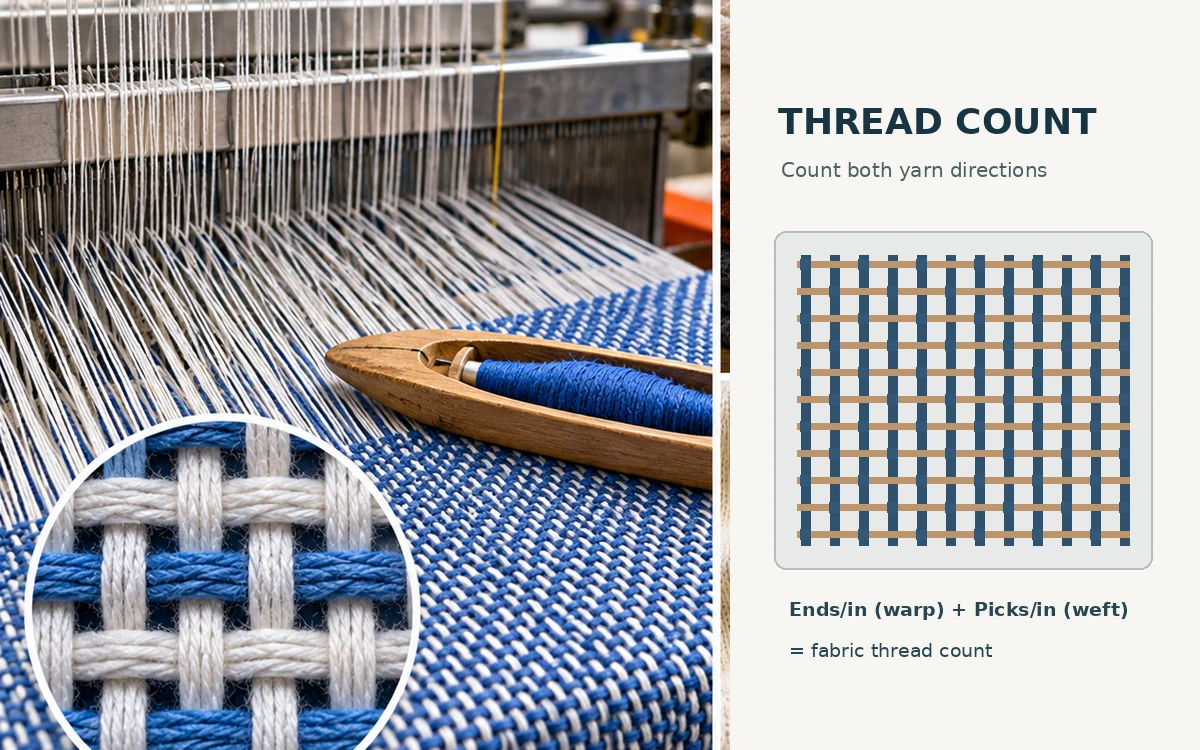
Thread count is the number of threads woven into one square inch of fabric. It adds the lengthwise threads (the warp, or ends) and the crosswise threads (the weft, or picks).
Thread count = ends per inch (EPI) + picks per inch (PPI)
A fabric with 100 ends and 100 picks per inch has a thread count of 200. A fabric with 150 ends and 150 picks has a thread count of 300.
The ASTM definition used for sheets and bedding describes thread count as the sum of the warp yarns and the filling yarns per unit distance, counted under zero tension and free of folds and wrinkles. It also says that each warp or filling yarn counts as one unit, whether it is a single or a plied yarn. A 2-ply yarn counts once, not twice. We return to this point below, because it explains many inflated numbers.
Thread count applies to woven fabric only. Knitted fabric is made from loops, not crossing threads, so it has no thread count. Instead, knits are described by gauge, wales and courses. See our guide on woven vs knit fabric for the difference.
What you need to count threads
- A pick glass (also called a linen tester or fabric counter). It is a small folding magnifier with a window that is exactly one inch or one centimetre wide.
- A needle or pin, to separate threads.
- A flat, well-lit surface.
- A sample of fabric that has no folds, wrinkles or stretch.
- A notebook, and a calculator.
If you do not have a pick glass, a ruler and a good magnifying glass work. Mark one inch on the ruler and count the threads that fall inside.
Step by step: how to count the threads
- Lay the fabric flat, without stretching it or pulling it. Smooth out wrinkles.
- Find the selvedge. The warp runs along it. This tells you which direction is which.
- Place the pick glass on the fabric, with one edge of the window along a thread in the warp direction.
- Count the warp threads (ends) that fall inside the one inch window. Count carefully, using a pin to move along each thread. This is your EPI.
- Turn the pick glass 90 degrees and count the weft threads (picks) inside one inch. This is your PPI.
- Repeat in at least three places on the fabric and take the average. Fabric is not perfectly even.
- Add the two numbers. EPI + PPI = thread count.
If your pick glass uses a centimetre window, count per centimetre and multiply by 2.54 to get a number per inch.
Which way to count if there is no selvedge?
If you have a cut piece with no selvedge, you can still estimate. In many fabrics, the warp has more threads per inch than the weft, and the warp yarn is often finer. Count in both directions and treat the higher number as the likely warp. Write down your assumption. It does not change the thread count total, since you add the two directions anyway.
Converting between units
| From | To | How |
|---|---|---|
| Threads per cm | Threads per inch | Multiply by 2.54 |
| Threads per inch | Threads per cm | Divide by 2.54 |
| Threads per 10 cm | Threads per inch | Multiply by 0.254 |
| Threads per inch | Threads per metre | Multiply by 39.37 |
Some mills and standards use metric counts, such as threads per 10 cm. When you compare reports from different countries, convert to the same unit first.
The big trap: counting plies
A ply is one strand in a plied yarn. A 2-ply yarn is made by twisting two single strands together.
Under the ASTM definition, a plied yarn counts as one thread. But some sellers count each ply as a separate thread. A fabric that has 150 two-ply yarns in each direction would then be sold as 600, though the true count under the standard is 300.
This does not mean plied yarn is bad. In fact, plied yarns can make a strong and smooth fabric. The problem is the label. One suggestion in the discussion of the ASTM definition is to disclose both the count and the ply. For example: “300 thread count, 2-ply yarn”. That tells the buyer the facts. A bare “600 thread count” on a 2-ply product can mislead.
When you read a claim, ask three questions:
- Was the count made according to the ASTM method (each yarn counted once)?
- Is the yarn single or plied?
- How fine is the yarn?
Why thread count is not the same as quality
A higher thread count can mean a denser cloth. But there is a limit to how many threads you can fit into a square inch. A thick yarn takes more space, so only a few can fit. A fine yarn takes less space, so more can be packed in. This means:
- A high thread count with fine yarn can produce a soft, light, smooth cloth.
- A high thread count with thick yarn is physically hard to achieve, which is another reason to question an extreme claim.
- A lower thread count with a good long-staple cotton can feel better and last longer than a higher count made with poor fibre.
Quality also depends on the fibre and its length, the yarn quality, the weave, the finishing and the weight. Our guide on yarn count explains the yarn side, and our page on GSM meaning and calculation covers weight. Different weaves also feel different at the same count. For example, a sateen weave packs long floats into the surface and feels smooth. See our comparison of sateen weave vs satin.
Typical use of thread count
| Product | How thread count is used |
|---|---|
| Bed sheets and pillowcases | Printed on the pack as a quality guide |
| Shirting | Ends × picks written in the spec, for example 100 × 80 |
| Canvas and workwear | Often described by weight (oz or GSM) and yarn count instead |
| Curtains and upholstery | Described by weight, weave and finish |
| Technical cloth | Ends and picks per inch or per 10 cm in the spec sheet |
In garments and technical textiles, buyers rarely quote a single total. They write the construction as ends × picks, along with the yarn counts, for example “80 × 70, 40s × 40s”. That says far more than one number.
A worked example: counting, converting and comparing
Let us work through three small problems. All numbers are examples.
Part 1: Counting with a centimetre window
A pick glass with a 1 cm window shows 60 ends and 55 picks in one centimetre.
- Ends per inch = 60 × 2.54 = 152.4
- Picks per inch = 55 × 2.54 = 139.7
- Thread count = 152.4 + 139.7 = 292.1, or about 292
That would be sold as a “300 thread count” sheet if rounded up, or labelled as 292 if the maker is exact.
Part 2: The effect of plying
A sheet is woven with 2-ply yarn. A pick glass shows 150 ends and 150 picks per inch, counting each plied yarn once.
- Thread count by the ASTM method = 150 + 150 = 300
- If each ply were counted separately, the count would be (150 × 2) + (150 × 2) = 600
The number doubled, though the cloth did not change. A label that says “600” with no mention of ply tells the reader very little.
Part 3: Does a higher thread count always mean a heavier or better cloth?
Compare two plain cotton sheets. Assume 7 percent crimp (extra yarn length used in bending) in both directions. For an English count (Ne), one gram of yarn is 1.693 × Ne metres long. Sheet A is 200 thread count and Sheet B is 300.
Sheet A: 100 ends × 100 picks, yarn Ne 30
- Ends per metre = 100 × 39.37 = 3,937
- Warp yarn per square metre = 3,937 × 1.07 = 4,212.6 m
- Weft yarn per square metre = 4,212.6 m (the same)
- Total yarn = 8,425 m
- Metres per gram at Ne 30 = 1.693 × 30 = 50.8
- Weight = 8,425 ÷ 50.8 = 165.9 g/m²
Sheet B: 150 ends × 150 picks, yarn Ne 60
- Ends per metre = 150 × 39.37 = 5,905.5
- Warp yarn per square metre = 5,905.5 × 1.07 = 6,319 m
- Weft yarn per square metre = 6,319 m
- Total yarn = 12,638 m
- Metres per gram at Ne 60 = 1.693 × 60 = 101.6
- Weight = 12,638 ÷ 101.6 = 124.4 g/m²
So the 300 thread count sheet is lighter (124.4 g/m²) than the 200 thread count sheet (165.9 g/m²), because its yarn is much finer. Sheet B is not “better” because of the number alone. It is a finer, lighter cloth. Whether you prefer it depends on feel, strength and use. The point is that thread count and weight tell different stories, and you need both, along with the yarn count.
Part 4: A shirting spec
A buyer writes “100 × 80, 50s × 50s”. That is 100 ends and 80 picks per inch, with Ne 50 yarn in both directions. The thread count is 100 + 80 = 180. The buyer gets more useful information from the full line than from the 180 alone.
How mills and labs test thread count
In a lab, the count is done on a conditioned sample with a pick glass or a microscope, or by taking images and counting threads on screen. The standard method names the sample size, how many places to count and how to report the average. Samples are taken away from the selvedge and from folds, and the result is the average of several counts. Our guide to fabric shrinkage testing shows another common test that uses a conditioned sample.
Remember also that finishing changes the count. A fabric that shrinks in finishing pulls the threads closer, so the count after finishing is higher than the count on the loom. Spec sheets should say which stage is meant.
Tips for shoppers
- Do not buy on thread count alone. Check the fibre, the weave and the weight.
- Ask whether the yarn is single or plied.
- Be careful of very high numbers on a low price. They may count plies.
- Look for a fibre quality note, such as long-staple or combed cotton. Our guide to how cotton is made into fabric explains where fibre quality comes from.
- Feel the cloth if you can. It should feel smooth and even, not stiff or papery.
- Wash a sample to see how it holds up.
Tips for buyers and mills
- Write the construction as ends × picks and add the yarn counts.
- Say whether the count is per inch or per centimetre.
- State the stage: greige or finished.
- Add a tolerance, such as plus or minus 3 percent.
- If you use the total for marketing, state the ply.
- Keep a record of weight in GSM, so the cloth can be checked against the spec. The page on fabric types, names, GSM and best uses gives typical weights for common cloths.
Final thoughts
To calculate thread count, count the ends and the picks in one inch of woven fabric, then add them. Use a pick glass, count in several places, convert from centimetres by multiplying by 2.54 and count each plied yarn once, as the ASTM definition says. A bigger number can mean a denser cloth, but it is not a guarantee of quality.
Our worked example turned 60 and 55 threads per centimetre into a count of about 292, showed a 2-ply sheet jumping from 300 to 600 when plies were counted separately and showed a 300 thread count sheet that weighed less than a 200 thread count sheet because of finer yarn. Use thread count as one clue, together with yarn count, fibre, weave and weight.
Frequently asked questions
Count the warp threads (ends) in one inch, count the weft threads (picks) in one inch, then add the two numbers. A fabric with 100 ends and 100 picks has a thread count of 200.
A pick glass, also called a linen tester, is a folding magnifier with a one-inch or one-centimetre window. A ruler and a magnifying glass also work.
Multiply by 2.54. For example, 60 threads per centimetre equals about 152 threads per inch.
Not always. Thread count is one clue. Fibre quality, yarn fineness, weave, finishing and weight also matter, and a very high number may count plies.
Under the ASTM definition, each yarn counts once, whether single or plied. Some sellers count each ply, which doubles the number without changing the cloth.
No. Thread count applies to woven fabric. Knits are made from loops and are described by gauge, wales and courses.
There is no single best number. It depends on the yarn, the weave and the feel you like. Check the ply, the fibre and the weight along with the count.


