Shirt cuffs may seem like a small detail, but they play a big role in defining the overall look, feel and formality of a dress shirt. When you slip on a shirt, the collar and cuffs are often the first things people notice — and the cuff style you choose can instantly change how polished, professional or stylish your outfit appears. That’s why understanding the different style of shirt cuff is essential for anyone who wants to dress with intention, whether for work, formal events or everyday smart-casual wear.
In this guide, we’ll explore every major type of shirt cuff, from the classic barrel cuff to the refined French cuff and even unique styles like cocktail and convertible cuffs. You’ll learn what makes each cuff distinct, when to wear them, how they affect the formality of your outfit and how to choose the right cuff style based on your wardrobe and personal style.
Whether you’re upgrading your dress shirts, building a versatile wardrobe or simply curious about menswear details, this comprehensive breakdown will help you make confident and stylish decisions — right down to the cuff.
Understanding Shirt Cuffs – The Basics
What Is a Shirt Cuff?
A shirt cuff is the band of fabric at the end of a shirt sleeve that fastens around your wrist. Although small in size, cuffs are structural elements that give the sleeve its shape, prevent fraying and add a refined finishing touch to the shirt. Traditionally, cuffs were elaborate and decorative — especially during the 16th to 18th centuries, when lace cuffs symbolized elegance and wealth. Over time, cuffs evolved into the clean, functional designs we know today, but their role in style and formality has remained just as important.
Why Cuff Style Matters
Even though cuffs make up a small portion of the shirt, they have a major impact on your overall look. Here’s why they matter:
1. They Define Formality
Some cuff styles — such as French cuffs — immediately signal formality and sophistication. Others, like the standard barrel cuff, offer a more relaxed or business-casual vibe. Choosing the right cuff ensures your shirt matches the occasion.
2. They Influence Your Style and Personality
The shape, number of buttons and fastening method all communicate subtle details about your taste. A rounded cuff looks softer and more traditional, while a mitered edge adds sharpness and structure. Cocktail cuffs, on the other hand, offer a bold, fashion-forward appeal.
3. They Affect Comfort and Fit
Cuffs control how the shirt sits on your wrist and how much of the sleeve shows beneath a jacket. A well-fitted cuff should rest comfortably without sliding too far up or down your arm. Stiff cuffs add crispness, while softer cuffs create a more relaxed appearance.
Construction & Fastening Basics
A cuff’s structure and fastening style determine how it behaves, how formal it looks and what accessories it pairs with.
Single vs. Double Layer
- Single cuffs use one layer of fabric and may close with buttons or cufflinks.
- Double cuffs (like French cuffs) fold back on themselves for added thickness and elegance.
Button Closures
Most shirts use button closures, with one or two buttons for adjustability. These are practical, easy to wear and great for everyday use.
Cufflink Holes
Cuffs designed for cufflinks — such as French or single cuffs — feature buttonholes on both sides instead of buttons. This allows cufflinks to fasten the layers together.
Fused vs. Unfused Interlining
- Fused cuffs use adhesive to create a crisp, firm shape.
- Unfused cuffs are softer, more flexible and often preferred in casual or high-end bespoke shirts.
Visibility Under a Jacket
As a rule of thumb, about ¼ to ½ inch of cuff should show beneath your jacket sleeve. This creates a balanced, intentional look and complements the outfit’s structure.
Major Styles of Shirt Cuffs
Shirt cuffs come in a wide variety of constructions, shapes and fastening methods. Each style not only affects the appearance of a shirt but also influences its formality, versatility and comfort. Below is a more detailed, expert-level breakdown of the key cuff styles you’ll encounter in modern menswear.
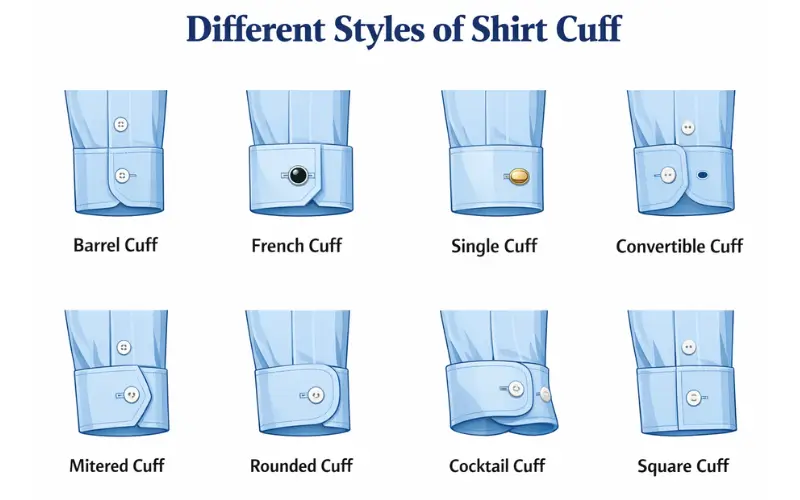
1. Barrel Cuff (Button Cuff)
The barrel cuff is the most common cuff style in the world. Its simplicity, comfort and practicality make it a go-to choose for business wear, smart casual outfits and even everyday shirts.
Detailed Features
- The cuff overlaps, forming a “barrel” shape when buttoned
- Held together by one, two or three buttons, although one and two are standard
- Designed for ease of use — no cufflinks required
- Available in multiple shapes, finishes and stiffness levels
Advanced Variations
One-Button Barrel Cuff
- Clean, minimal look
- Common on classic business shirts
- Works well with slim-fit or minimalist wardrobes
Two-Button Barrel Cuff
- Offers adjustable tightness
- Accommodates larger watches
- Adds a modern touch without appearing flashy
Three-Button Barrel Cuff
- Rare, often found on bespoke or fashion-driven shirts
- Adds drama and length visually
- Best for tall men or those with longer arms
Rounded Barrel Cuff
- Corners are curved for a softer appearance
- Traditional, conservative and timeless
- Often used by heritage menswear brands
Mitered Barrel Cuff
- Corners cut at a 45° angle
- Gives a sharp, tailored, architectural look
- Popular in European tailoring houses
Formality Level
Casual → Business Formal, depending on the cut and fabric.
Best Uses
- Office wear
- Daytime events
- Travel shirts
- Shirts paired with casual jackets
Pro Tips
- Choose a slightly stiffer cuff for business shirts
- For men with large watches: pick two-button cuffs
- Mitered cuffs pair best with structured suits
2. French Cuff (Double Cuff)
The French cuff is the gold standard of elegance in menswear. Known for its clean, folded-back design, it is always fastened with cufflinks and instantly elevates any outfit.
Detailed Features
- Double-length cuff folded back before fastening
- No buttons — only buttonholes
- Has a thicker, more luxurious appearance
- Originally popularized by aristocracy and formal dressers
Advanced Variations
Straight French Cuff
- Rectangular, straight edges
- The most formal and traditional variation
- Common in business formal and black-tie settings
Rounded French Cuff
- Soft, curved corners
- More contemporary and slightly warmer in appearance
- Great for elegant but not overly strict outfits
Tall French Cuff
- Taller fold-back section
- More dramatic, often used in bespoke tailoring
- Best paired with structured suits and tuxedos
Formality Level
High Formality → Ultra Formal
Best Uses
- Weddings
- Black tie and white tie events
- Executive or high-level business attire
- Evening wear
Pro Tips
- Match cufflinks to your watch and belt buckle
- Wear with crisp, high-quality fabrics like poplin or twill
- Ensure jacket sleeves are tailored to show the folded edge
3. Single Cuff (Link Cuff)
The single cuff is the most formal cuff style in existence, yet also the least common. Seen mostly in white-tie dress shirts, it uses cufflinks but does not fold back like French cuffs.
Detailed Features
- Single layer of fabric
- Secured with cufflinks
- Thinner and cleaner than French cuffs
- Traditional for formal tailcoats and ceremonial dress
Formality Level
Ultra-Formal (White Tie Standard)
Best Uses
- White tie events
- Formal galas
- Opera or ceremonial occasions
- High-end bespoke shirts
Pro Tips
- Keep cufflinks understated—mother-of-pearl or silver
- Should be paired with a stiff bib-front shirt
- Designed for stability under a waistcoat
4. Convertible Cuff
A convertible cuff is a hybrid that can be worn with buttons or cufflinks, making it one of the most flexible options available.
Detailed Features
- Features both a button and an additional buttonhole
- Can be styled as a barrel cuff or a link cuff
- Ideal for travel and day-to-evening transitions
Advantages
- Offers incredible versatility
- Great for people who aren’t ready to fully commit to French cuffs
- Works in both business casual and formal settings
Formality Level
Business Casual → Business Formal
Best Uses
- Day-to-night dressing
- Minimalist wardrobes
- Travel and business trips
Pro Tips
- Use cufflinks in the evening for instant elevation
- Choose shirts with reinforced stitching on the convertible holes
- Avoid overly flashy cufflinks when the shirt is in “business mode”
5. Cocktail Cuff (Turn-Back or James Bond Cuff)
Made famous by Sean Connery’s James Bond, the cocktail cuff blends elegance with personality. It turns back like a French cuff but fastens with buttons.
Detailed Features
- Fold-back design like a French cuff
- Secured with buttons instead of cufflinks
- Creates a wave-like or curved silhouette
- Has a soft, romantic, yet sophisticated feel
Advanced Variations
- Rounded turn-back (common in Italian tailoring)
- Straight turn-back (more British and structured)
- Diagonal turn-back (fashion-forward; dramatic curve)
Formality Level
Business Smart → Semi-Formal
Best Uses
- Cocktail events
- Fashion-forward workplaces
- Evening outings
- Iconic vintage-inspired styles
Pro Tips
- Best worn with slim, modern suits
- Use with smooth, fine cotton fabrics
- Avoid in conservative boardrooms
6. Additional Cuff Variations
a. Mitered Cuffs
- Corners cut at 45°
- Adds geometric sharpness
- Excellent on modern European shirts
b. Rounded Cuffs
- Soft, curved corners
- More traditional and approachable
- Works well with both business and casual styles
c. Square Cuffs
- Straight, rectangular edges
- Clean and minimalistic
- Common on high-end dress shirts
d. Two-Button Extended Cuffs
- Longer cuff placket and two vertically aligned buttons
- Gives a muscular, masculine wrist line
- Often found on athletic-fit shirts
e. Casual Cuffs
Often seen on:
- Denim shirts
- Oxford cloth button-downs
- Flannels, linens and chambray
Features:
- Softer construction
- Less interlining
- Sometimes roll-friendly
f. Contrast Cuffs
- Cuffs in a different pattern or color
- Popular in Italian and fashion shirts
- Adds a stylish pop when jackets are removed
7. Fashion/Trend Cuffs
Oversized Cuffs
- Extended length
- Seen on runway or editorial fashion
- Best for statement outfits
Double-Button Angled Cuffs
- Two-button closure with an angled overlap
- Adds athletic and modern flair
- Common in stylish, trendy menswear brands
Elastic or Stretch Cuffs (Modern Casual)
- Seen in tech wear or hybrid workwear
- Offers full mobility
- Not suitable for formal outfits
How to Choose the Right Cuff Style
Choosing the right cuff style isn’t just about fashion — it’s about formality, proportion, comfort and the message you want your outfit to send. This expanded guide will help you confidently select the perfect cuff for any occasion or wardrobe need.
1. Match the Formality of the Occasion
Every cuff style sits on a formality scale. Understanding this helps you avoid common dressing mistakes and ensures your outfit feels balanced and intentional.
Casual Settings
Best Cuffs:
- One-button barrel cuffs
- Soft, unfused cuffs
- Rounded cuffs
- Casual denim or flannel cuffs
Examples:
- Going out with friends
- Casual Fridays at work
- Smart-casual dinners
Why these work:
They’re comfortable, approachable and don’t look out of place with jeans, chinos or casual outerwear.
Business Casual Settings
Best Cuffs:
- Two-button barrel cuffs
- Mitered barrel cuffs
- Rounded or square barrel cuffs
Examples:
- Most office environments
- Company meetings
- Daytime professional events
Why these work:
They strike a balance — polished enough for professionalism but not overly formal.
Business Formal Settings
Best Cuffs:
- Crisp two-button barrel cuffs
- Mitered cuffs (sharp appearance)
- Convertible cuffs (button by day, cufflinks for events)
Examples:
- Client presentations
- Corporate conferences
- High-level business meetings
Why these work:
They maintain a high level of polish while allowing for personal style.
Semi-Formal or Evening Formal
Best Cuffs:
- French cuffs
- Cocktail cuffs
- Tall French cuffs
Examples:
- Evening dinners
- Weddings
- Awards events
Why these work:
They look elevated and pair perfectly with finer fabrics and tailored jackets.
Black Tie / White Tie
Best Cuffs:
- French cuffs (black tie)
- Single cuffs (white tie)
Examples:
- Galas, balls, opera events
- Diplomatic ceremonies
- Ultra-formal weddings
Why these work:
These are the traditional standards for elite formalwear.
2. Fit & Sleeve Length Considerations
Even a perfectly chosen cuff looks sloppy if the fit is wrong. Tailoring makes a huge difference here.
Cuff Fit
A cuff should:
- Sit comfortably at the wrist bone
- Not slide more than ½ inch when you raise your arm
- Not leave marks or feel constricting
- Have room for a wristwatch if needed
Pro Tip:
If you often wear a watch, choose two-button barrel cuffs so you can loosen the fit.
Sleeve Length
Correct sleeve length is one of the most overlooked parts of menswear.
If the sleeve is too long:
- The cuff swallows your wrist
- The shirt looks sloppy and unprofessional
If the sleeve is too short:
- Cuff rides up your arm
- Jacket shows too much cuff
- Shirt appears too small
The perfect sleeve length:
- Cuff sits exactly at your wrist break
- Jacket shows ¼ to ½ inch of cuff
Cuff Stiffness
- Fused cuffs (stiff): best for business, formal events, crisp silhouettes
- Unfused cuffs (soft): best for casual shirts, comfort and natural drape
Tailoring Insight:
High-end shirts often have semi-fused cuffs — a blend of structure and comfort.
3. Accessories & Pairing Considerations
Accessories must complement the cuff — not compete with it.
When Buttons Work Best
Buttons are ideal for:
- Office environments
- Everyday wear
- Casual outfits
- Travel
- Situations where convenience matters
Avoid:
Barrel cuffs at ultra-formal events.
When Cufflinks Work Best
Use cufflinks when:
- Wearing French or single cuffs
- Dressing for weddings or galas
- You want to elevate your outfit
- Wearing a formal dinner jacket or tuxedo
Types of Cufflinks
- Bullet Back: Easy and secure
- Whale Tail: Common and user-friendly
- Silk Knots: Casual, colorful and inexpensive
- Chain Link: Most traditional and high-end
- Stud Cufflinks: Required for black tie
Color Matching Rule:
Match metal with:
- Watch
- Belt buckle
- Tie bar (if worn)
Cuffs and Watches
Different cuffs accommodate different watch sizes.
Best for big watches:
- Two-button cuffs (adjustable)
- Rounded cuffs with more space
- Casual cuffs (softer fabric)
Best for slim dress watches:
- French cuffs
- Mitered cuffs
- Tall French cuffs
4. Fabric, Comfort & Personal Style
Fabric Choice Matters
Formal Fabrics (High Thread Count)
- Poplin
- Twill
- Broadcloth
Best with:
- French cuffs
- Mitered cuffs
- Structured two-button cuffs
These fabrics create a smooth, elegant, formal look.
Casual Fabrics
- Oxford cloth
- Chambray
- Linen
- Flannel
Best with:
- Barrel cuffs
- Rounded cuffs
- Soft, unfused cuffs
These fabrics drape naturally and pair well with relaxed silhouettes.
Comfort Preference
- If you move your arms a lot → choose softer, unfused cuffs
- If you prefer sharp lines → choose fused cuffs
- If you wear jewelry → choose slightly larger cuff openings
Personal Style Expression
Cuffs reveal subtle personality:
| Style | Personality | Best Setting |
| Rounded | Classic, traditional | Business/casual |
| Mitered | Sharp, modern | Professional |
| French | Elegant, formal | Events/formal |
| Cocktail | Bold, stylish | Evening/fashion |
| Convertible | Practical, versatile | Day-to-night |
5. Maintenance & Practical Considerations
Why Cuffs Wear Out Faster
- Constant wrist movement
- Friction against desk surfaces
- Sweat and oil contact
- Frequent washing and ironing
How to Prevent Damage
- Wash shirts inside out
- Spot treat stains on cuffs
- Avoid harsh detergents
- Use a steamer for delicate fabrics
- Consider shirts with replaceable cuffs
Button Care
- Reinforce loose buttons early
- Replace missing ones with matching material
- Upgrade to mother-of-pearl for luxury shirts
Cufflink Care
- Polish metal cufflinks
- Store in a soft pouch
- Avoid chemical contact
Common Cuff Mistakes and How to Avoid Them
Even the best dress shirt can look sloppy or mismatched if the cuffs aren’t styled correctly. Many people overlook cuff details entirely, leading to subtle but noticeable style issues. Below are the most frequent cuff mistakes—along with professional tailoring insights and actionable tips to correct them.
1. Wearing the Wrong Cuff for the Occasion
This is the most common and most visible cuff mistake.
Every cuff style carries a different level of formality. Wearing the wrong one can send the wrong message.
Common Examples
- Showing up at a wedding or gala in barrel cuffs → looks too casual
- Wearing French cuffs at a relaxed business-casual workplace → looks overly formal or out of place
- Wearing cocktail cuffs in a conservative office → can seem flashy or attention-seeking
- Wearing single cuffs (white tie only) to a semi-formal event → inappropriate for the dress code
The Fix
- Casual + business casual: barrel cuffs
- Business + formal: mitered or two-button barrel cuffs
- Semi-formal + evening formal: French or cocktail cuffs
- Black tie: French cuffs
- White tie: single cuffs
Pro Stylist Tip:
When in doubt, choose barrel cuffs. They work in almost every situation except black/white tie.
2. Wearing Shirts with Poor Sleeve or Cuff Fit
Fit is everything in menswear. Even a high-end cuff looks wrong if the shirt fit is off.
Signs of Bad Sleeve Length
- Sleeves cover part of the hand
- Sleeves rise too far up the forearm when you reach forward
- Cuffs disappear under the jacket sleeve
- Cuffs sit higher when wearing a watch (too tight)
Signs of Poor Cuff Fit
- Cuff digs into your wrist → too tight
- Cuff can slip past your palm → too loose
- Cuff can’t close when wearing a watch
- Cuff folds inward due to excess fabric
The Fix
- Have sleeves shortened or lengthened by a tailor
- Choose shirts with two-button cuffs for adjustability
- Ensure cuffs sit exactly at your wrist bone
- If your arms are long/short → order custom sleeve lengths
Tailoring Tip:
Most shirt cuffs cannot be lengthened, but sleeve length can always be shortened.
3. Not Showing the Proper Amount of Cuff Under a Jacket
One of the most refined details of good menswear is the amount of cuff that shows under your jacket sleeve.
Common Mistakes
- Jacket sleeves too long → shirt cuffs hidden (low-quality look)
- Jacket sleeves too short → more than 1 inch of cuff showing
- Wearing casual shirts with soft cuffs under structured jackets
- Wearing oversized watches that push cuffs up the sleeve
The Golden Rule
Show ¼ to ½ inch of shirt cuff.
This creates:
- Visual balance
- A clean transition from jacket to shirt
- A deliberate, tailored appearance
The Fix
- Tailor jacket sleeves to proper length
- Wear shirts with crisp cuffs under suits
- Choose two-button cuffs if wearing a large watch
4. Mismatching Accessories with the Cuff Style
Accessories and cuffs must complement each other. When mismatched, they create visual confusion.
Common Accessory Mistakes
- Wearing cufflinks on a barrel cuff (impossible unless it’s convertible)
- Wearing flashy cufflinks in conservative meetings
- Wearing silk-knot cufflinks to formal black tie (too casual)
- Mixing metals:
- Gold cufflinks + silver watch
- Rose gold tie bar + stainless steel bracelet
- Wearing a big watch with tight cuffs → fabric bunches and wrinkles
The Fix
- Use cufflinks only with French, single or convertible cuffs
- Match metals across:
watch → cufflinks → tie bar → belt buckle - Save bold cufflinks for evening events
- Wear slim dress watches with French cuffs
Stylist Tip:
For corporate settings, choose classic cufflinks:
- Silver
- Stainless steel
- Black onyx
- Mother of pearl
Avoid novelty cufflinks except for social occasions.
5. Poor Cuff Maintenance
Cuffs absorb friction and grime more than any other shirt area, meaning they wear out quickly.
Common Maintenance Mistakes
- Wearing shirts with frayed cuff edges
- Visible dirt or discoloration on the inside of cuffs
- Buttonholes becoming stretched
- Loose or missing buttons
- Ironing cuffs incorrectly, causing wrinkles or shiny patches
Why This Happens
- Desk friction
- Sweat and body oils
- Frequent washing
- Ignoring early signs of wear
The Fix
- Spot-clean cuffs before washing
- Wash shirts inside out
- Use gentle detergent to avoid yellowing
- Press cuffs on low heat to avoid fabric “shine”
- Replace worn buttons immediately
- Rotate shirts to prevent excessive wear
Bonus Tip: Replaceable Cuffs
High-end or custom shirts sometimes allow cuff replacement, extending the shirt’s life significantly.
6. Choosing Flashy Cuffs When Subtlety Is Needed
This applies especially to:
- Cocktail cuffs
- Contrast cuffs
- Oversized cuffs
- Extended plackets
- Designer statement cuffs
These are stylish but not universally appropriate.
The Fix
Use statement cuffs for:
- Fashion events
- Social gatherings
- Evening wear
- Personal-brand outfits
Avoid in:
- Corporate meetings
- Interviews
- Conservative offices
7. Ignoring Proportion
Cuffs must match:
- Your wrist size
- Your forearm shape
- Your suit silhouette
- Your height
Examples
- Men with narrow wrists → avoid oversized cuffs
- Men with muscular forearms → choose two-button adjustable cuffs
- Tall men → extended or taller cuffs look more proportional
8. Forgetting That Cuffs Must Work with Collars
Few people realize this, but collar style + cuff style must be harmonious.
Poor Combinations
- Formal spread collar + soft casual cuffs
- Button-down collar + French cuffs
- Wing collar + barrel cuffs
Best Matches
- Spread collar → French or mitered cuffs
- Button-down collar → barrel cuffs only
- Wing collar → single cuffs
Shirt cuffs may seem like small design elements, but they have an outsized impact on how a dress shirt looks, feels and performs. Whether you’re dressing for a boardroom meeting, a wedding, a cocktail event or simply elevating your everyday wardrobe, choosing the right cuff style helps you present a sharper and more intentional image.
Throughout this guide, we explored the different style of shirt cuff, from the essential barrel cuff to the refined French cuff, the ultra-formal single cuff and the stylish cocktail cuff. Each cuff type carries its own personality, history and purpose. The cuff you choose not only signals the formality of your outfit but also influences comfort, wrist mobility, sleeve visibility and how well your accessories pair with your shirt.
Remember, the perfect cuff style depends on a combination of factors:
- Occasion: Formal events demand elegant French or single cuffs, while everyday wear calls for the versatility of barrel cuffs.
- Fit: A well-fitted cuff should rest at the wrist bone, complement your sleeve length and offer comfort throughout the day.
- Personal Style: Whether you prefer classic and understated or bold and expressive, there’s a cuff style that aligns with your fashion identity.
- Functionality: Convertible and softer cuffs cater to practicality and comfort, while structured cuffs enhance professionalism.
- Accessories: Watches, cufflinks and jewelry must harmonize with your chosen cuff style.
By understanding all the nuances, you gain the power to refine your wardrobe with precision. A cuff isn’t just a functional closure — it’s a style statement, a mark of craftsmanship and a subtle detail that can dramatically elevate your entire look.
Whether you’re building a capsule wardrobe, shopping for special occasions or upgrading your dress shirts, paying attention to your cuff choice ensures every outfit feels complete and intentional. In menswear, it’s often the smallest details — like the cuff — that create the biggest impact.
FAQs
Below are enhanced FAQs with richer explanations, natural keyword integration and helpful, actionable insights for readers searching about shirt cuff styles.
1. What is the most versatile type of shirt cuff?
The barrel cuff is the most versatile and widely used cuff style. It works for business, casual settings, everyday office wear and smart-casual outfits. Its convenience, button fastening and variety of shapes (rounded, square, mitered) make it suitable for nearly every wardrobe.
2. Are French cuffs only for formal occasions?
French cuffs are strongly associated with formal and semi-formal attire, but they are not limited to black tie. You can wear them for:
- Business formal meetings
- Weddings
- Evening events
- Elegant dinners
However, they may feel too dressy for casual or business-casual environments.
3. Can I wear cufflinks with a barrel cuff?
Standard barrel cuffs do not accept cufflinks because they are designed with buttons. If you want the option to use cufflinks, choose a convertible cuff, which includes additional buttonholes specifically for cufflink use.
4. How much shirt cuff should show under my jacket?
Aim for ¼ to ½ inch of visible shirt cuff beneath your jacket sleeve. This creates a balanced, tailored appearance and complements the structure of your suit.
5. What’s the difference between single cuffs and French cuffs?
- Single cuffs are fastened with cufflinks but do not fold back. They are the most formal cuff and primarily used for white tie attire.
- French cuffs fold back onto themselves (double length) and are commonly worn with cufflinks for formal, business formal and semi-formal occasions.
6. Can casual shirts have French cuffs?
It’s unusual, but some designers create casual or fashion shirts with French cuffs. However, French cuffs typically pair better with structured textiles like poplin or twill and they may look out of place on denim, oxford or linen shirts.
7. How should a shirt cuff fit?
A well-fitted cuff should:
- Sit comfortably at the wrist bone
- Not slide too far when you move your arm
- Allow you to wear a watch without squeezing
- Stay in place without feeling tight
If your cuffs feel restrictive or loose, consider tailored adjustments or shirts with adjustable buttons.
8. What is a convertible cuff and when should I wear it?
A convertible cuff can be worn two ways — with buttons or cufflinks. It’s perfect for:
- Travelers
- People who transition from daytime business to evening events
- Those who want cufflink options without committing to French cuffs
It offers flexibility without sacrificing style.
9. Which cuff style is best for large watches?
Two-button barrel cuffs or rounded barrel cuffs offer extra room for wristwatches. French cuffs, while elegant, may feel too tight with oversized sports watches.
10. What cuff styles look best in corporate offices?
For corporate or conservative environments, choose:
- Mitered barrel cuffs
- Rounded barrel cuffs
- Two-button cuffs
They appear polished, professional and appropriate without drawing too much attention.
11. Are cocktail cuffs (turn-back cuffs) appropriate for work?
Cocktail cuffs are stylish and unique but may be considered too expressive for conservative workplaces. They are better suited for:
- Evening events
- Fashion-forward offices
- Cocktail parties
- Business dinners
They offer Bond-like sophistication but are not universal in corporate settings.
12. Why do my cuffs wear out faster than the rest of my shirt?
Cuffs experience:
- Constant wrist movement
- Friction from surfaces
- Sweat and natural oils
- Frequent bending and stretching
To increase longevity, rotate shirts, spot-clean cuffs and avoid excessive heat when ironing.
13. Should my cuff match my collar style?
Yes. Cuffs and collars work together to define your shirt’s formality. For example:
- Spread collars pair best with French or mitered cuffs
- Button-down collars pair best with barrel cuffs
- Wing collars require single cuffs for white tie
Matching the formality ensures a cohesive look.
14. Can cuffs be replaced on a dress shirt?
Some high-end or bespoke shirts allow cuff replacement, which can extend the shirt’s lifespan. This is especially useful if cuffs fray or discolor before the rest of the shirt wears out.
15. What are contrast cuffs and are they in style?
Contrast cuffs are cuffs made from a different color or pattern than the shirt body (often white cuffs on a colored shirt). They are stylish, bold and popular in Italian fashion. However, they may look too striking for conservative business settings.