Walk into a knit fabric mill and the first thing you notice is the noise. Rows of circular knitting machines turn slowly, and thin tubes of fabric drop from their bases in a steady stream. It looks simple, but a lot happens in a small space. Hundreds of needles move up and down, yarn feeds in at a set tension and rollers pull the finished fabric away. If you want to understand knit fabric faults, you need to know the parts of a knitting machine.
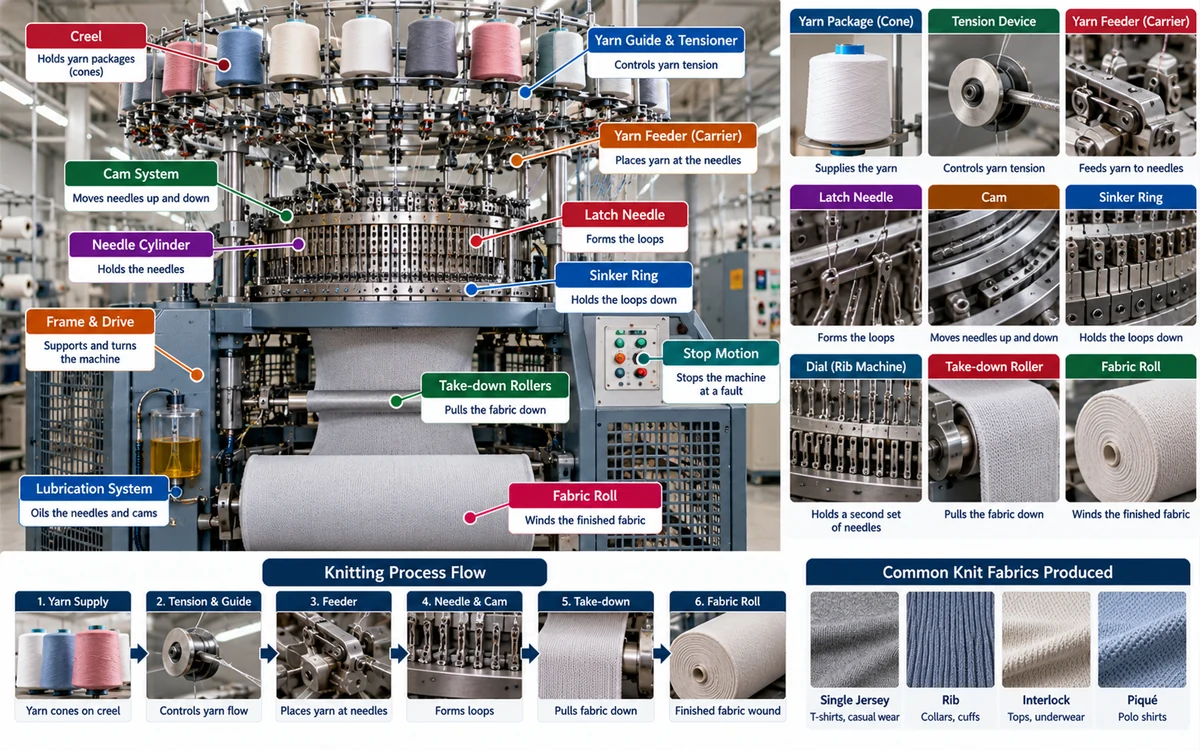
This guide focuses on the circular knitting machine, because it is the one that makes most of the single jersey, rib and interlock fabric used in t-shirts. The flat bed machine, used for sweaters and collars, shares most of the same ideas. We start with the yarn supply and follow the yarn through the machine. For the basic idea of knitted fabric, see our guide on what is knitted fabric.
How a knitting machine works
A knitting machine forms fabric by pulling loops of yarn through other loops. A needle hooks the yarn and draws a new loop through the old one. When many needles do this in order, they create rows and columns of loops. This structure is what gives knit fabric its stretch.
On a circular machine, the needles sit in a ring. The ring turns, or the cams turn around it, and each needle rises and falls in turn. Every full turn of the machine makes one course, which is one row of loops, for every yarn feeder on the machine. The more feeders there are, the more courses the machine makes in each turn, and the higher its output.
Parts of a knitting machine at a glance
| Part | Job |
|---|---|
| Creel | Holds yarn packages |
| Yarn guide and tension device | Control how yarn travels to the feeder |
| Yarn feeder (carrier) | Places yarn at the needles |
| Needle cylinder | Holds the needles |
| Latch needles | Form the loops |
| Cams | Move the needles up and down |
| Sinker ring | Holds the loops down |
| Dial (rib machines) | Holds a second set of needles |
| Take-down rollers | Pull the fabric down |
| Fabric roll | Winds the finished fabric |
| Stop motion | Stops the machine at a fault |
| Lubrication system | Oils the needles and cams |
| Frame and drive | Support and turn the machine |
Creel
The creel is a frame that holds the yarn packages, called cones or cheeses. On a circular machine, it can hold dozens of packages, one for each feeder. The creel stands beside or above the machine. A yarn path leads from each package, through a guide, to its feeder.
Creel layout affects yarn tension. If the yarn must travel too far or around sharp turns, it picks up extra tension, and the fabric shows streaks or uneven lines. A good creel keeps each yarn path short and smooth.
Yarn guides, tensioners and storage feeders
Between the cone and the needle, the yarn passes through several guides. Small ceramic eyelets are common because yarn slides over them without wearing them.
A tension device, usually a small disc or ball tensioner, puts a steady drag on the yarn. This keeps the yarn tight enough to feed smoothly. Too little tension makes loose, floppy loops. Too much makes tight loops and can break the yarn.
Many modern machines use a positive feed system, also called a storage feeder. A storage feeder winds a small amount of yarn onto a wheel and then feeds it to the needles at a fixed rate. This gives each course the same length of yarn. Constant loop length gives even fabric with uniform stitch size.
Yarn feeder
The yarn feeder, or carrier, is a small finger that places the yarn exactly where the needles can pick it up. It sits close to the needle bed. Its position is precise, usually within a millimeter or so. A feeder out of position causes missed stitches, holes or thin places in the fabric.
On a jacquard or striping machine, feeders can switch between different colored yarns.
Needle cylinder
The needle cylinder is a steel cylinder with vertical slots cut into its outer wall. Each slot holds one needle. The cylinder is the core of the machine. The number of slots depends on the machine diameter and the gauge.
Diameter
Diameter is the width of the cylinder in inches. Common sizes for apparel fabric run from around 26 to 34 inches, though larger and smaller machines exist. A bigger diameter makes a wider tube of fabric and uses more needles.
Gauge
Gauge is the number of needles per inch of cylinder circumference. A higher gauge means more needles per inch and a finer fabric. A lower gauge means fewer needles and a coarser fabric. Single jersey for t-shirts is often made in the range of 24 to 28 gauge, but this depends on the yarn count. Our guide on knitting machine gauge and fabric GSM explains how gauge ties to fabric weight.
Needles
Most modern knitting machines use latch needles. A latch needle has a hook at the top and a small hinged gate, called the latch. As the needle rises, the old loop pushes the latch open and slides down the needle stem. As the needle falls, the new yarn is caught in the hook, and the old loop pushes the latch closed. The old loop then slides off the needle’s head and over the new loop. The new loop becomes part of the fabric.
The parts of a latch needle include:
- Hook: Catches the yarn.
- Latch: A small hinged piece that opens and closes.
- Stem: The straight body of the needle.
- Butt: A small tab at the bottom that rides in the cam track.
- Tail: The end of the needle, sitting in the cylinder slot.
A bent latch or a worn hook causes dropped stitches and holes. Needles are replaced on a schedule, and changing a single needle is a regular maintenance task.
Cams
Cams are metal blocks with curved tracks arranged in a ring around the needle cylinder. The needle butts ride in these tracks. As the cylinder turns, the cams push the needles up or lower them, creating the knitting motion.
There are three main types.
- Knit cam: Lifts the needle to catch yarn and form a loop.
- Tuck cam: Raises the needle partway so it holds the old loop and catches the new yarn too.
- Miss or welt cam: Keeps the needle low so it does not take yarn.
By arranging these cams, a machine can make jersey, rib, interlock and many fancy structures. Each feeder position has its own cam set.
Stitch cam
The stitch cam sets how deep the needle goes down. A deeper pull makes a longer loop and a looser fabric. A shallower pull makes a shorter loop and a tighter fabric. Operators adjust the stitch cam to control fabric density and GSM.
Sinker ring and sinkers
Sinkers are thin metal blades that sit between the needles. They hold the old loops down while the needles rise. They also help form the loop. Together they sit in a ring, called the sinker ring.
Without sinkers, the fabric would lift with the needles. Sinkers keep it stable.
Dial and dial needles
A rib or interlock machine has a second set of needles, in a flat disc on top of the cylinder, called the dial. These needles are horizontal and face the cylinder needles. They make the second face of the fabric. The dial turns with the cylinder, and its own cams control its needle movement.
Single jersey machines have no dial. They use only the cylinder.
Take-down system
Fabric needs to be pulled away from the needles at a steady speed. A set of rollers below the machine does this. They hold the fabric tube and draw it down. The speed of the take-down controls the fabric’s length-wise density. Too slow, and the fabric piles up and looks dense. Too fast, and it stretches.
Some machines include a tensioning ring or a spreader to open the tube to a flat width. Others cut the tube open and wind it flat.
Fabric roll
The finished fabric is wound onto a roll below the machine. Roll size is limited by the machine’s capacity, often in the range of tens of kilograms per roll. Operators doff, or remove, a full roll and set a new tube core.
Careful handling avoids marks and creases. Fabric rolls should be labeled with machine number, lot, date and yarn batch for traceability. This helps trace faults back to their source.
Stop motions and sensors
Modern machines carry many sensors. They stop the machine when:
- A yarn breaks.
- A needle fault occurs.
- A knot or slub passes the yarn guide.
- Fabric rolls reach full size.
- A door or guard opens.
A yarn break sensor can save hours of faulty fabric. If a yarn breaks and the machine keeps running, it creates a hole or a vertical line of missing stitches.
Lubrication and cleaning
Needles, cams and sinkers need oil. A lubrication system sprays oil mist on the moving parts. If the oil is too much, it stains the fabric. If too little, it wears the needles and may cause dark marks from metal. An oil stain is a common fabric defect.
Machines also collect lint. Cleaning fans or blowers keep the area clear. In many mills, operators blow down machines at set intervals, and technicians use a vacuum system to avoid blowing lint into other equipment.
Frame, drive and controls
The machine frame holds everything in place. A motor turns the cylinder through a belt or gear system. A control panel lets the operator set the speed, feeder count, stitch length and patterns. Most modern machines use a computer to store pattern data.
Machine speed is measured in revolutions per minute (rpm). Single jersey machines may run at 25 to 35 rpm for large diameters and higher for small ones. The right speed depends on yarn quality, machine size and fabric type.
Flat bed knitting machine
Flat bed machines, used for sweaters and collars, hold needles in flat beds, not in a cylinder. They have a carriage that slides across the needle beds. The same core parts apply, such as yarn carriers, needles, cams, tensioners and take-down. The difference is that the carriage moves, not the needles. Flat bed machines can shape the fabric, which allows fully fashioned sweaters. For more information on how a sweater is built, see our guide on the parts of a sweater.
Common fabric faults tied to parts
| Fault | Related part |
|---|---|
| Holes | Broken needle, yarn break, dropped stitch |
| Needle lines | Bent needle or worn latch |
| Horizontal bars | Uneven yarn tension or feeder problem |
| Oil stain | Excess lubrication |
| Barre (stripes) | Yarn variation or uneven tension |
| Drop stitch | Bad needle or low tension |
| Fabric spirality | Yarn twist, machine feed |
| GSM variation | Stitch cam or take-down speed |
| Slub marks | Yarn knots or lint |
| Fly (lint) | Lint buildup and dirty machine |
Our guide to types of garments defects covers how these show up in cut parts.
Daily care checklist
- Check yarn path and clean guides.
- Look for bent or missing needles.
- Check oil level and flow.
- Clean lint from the cylinder area.
- Confirm stitch settings against the production sheet.
- Record GSM and width on the fabric roll.
- Check stop motions.
A short daily check often prevents hours of rework.
Final thoughts
A knitting machine turns yarn into fabric through a sequence of simple parts. The creel supplies yarn, the feeder places it, the needles form loops, the cams control them, the sinkers hold the fabric and the take-down pulls it away. Once you know that order, faults become easier to trace. If you see a line in the fabric, look at the needle. If you see stripes, look at the yarn and tension. If you see weight changes, look at the stitch cam and take-down. That habit will save you hours.
Frequently asked questions
The main parts are the creel, yarn guides and tensioners, yarn feeders, needle cylinder, needles, cams, sinkers, take-down rollers and fabric roll. Rib machines also have a dial.
A latch needle has a hook and a small hinged latch. As it moves up and down, the latch opens and closes so the needle can catch new yarn and cast off the old loop.
Gauge is the number of needles per inch on the machine. A higher gauge makes a finer fabric and a lower gauge makes a coarser one.
A circular machine knits a tube of fabric, using needles in a ring. A flat machine knits flat pieces, using needles in straight beds with a moving carriage.
Holes come from broken needles, broken yarn, missed stitches or low yarn tension. A yarn break sensor helps stop the machine early.
A dial is a disc of horizontal needles on top of the cylinder. It makes the second face of rib and interlock fabric.
Operators adjust the stitch cam depth and the take-down speed. The yarn count and gauge also play a part.