Understanding CMT vs FOB orders is one of the first jobs of a new merchandiser, because the two order types change almost everything: who buys the fabric, what price the factory quotes, how much money is tied up, and who carries the risk if the cloth is wrong. A factory that takes a CMT order and one that takes an FOB order are doing the same sewing work, but they are running very different businesses.
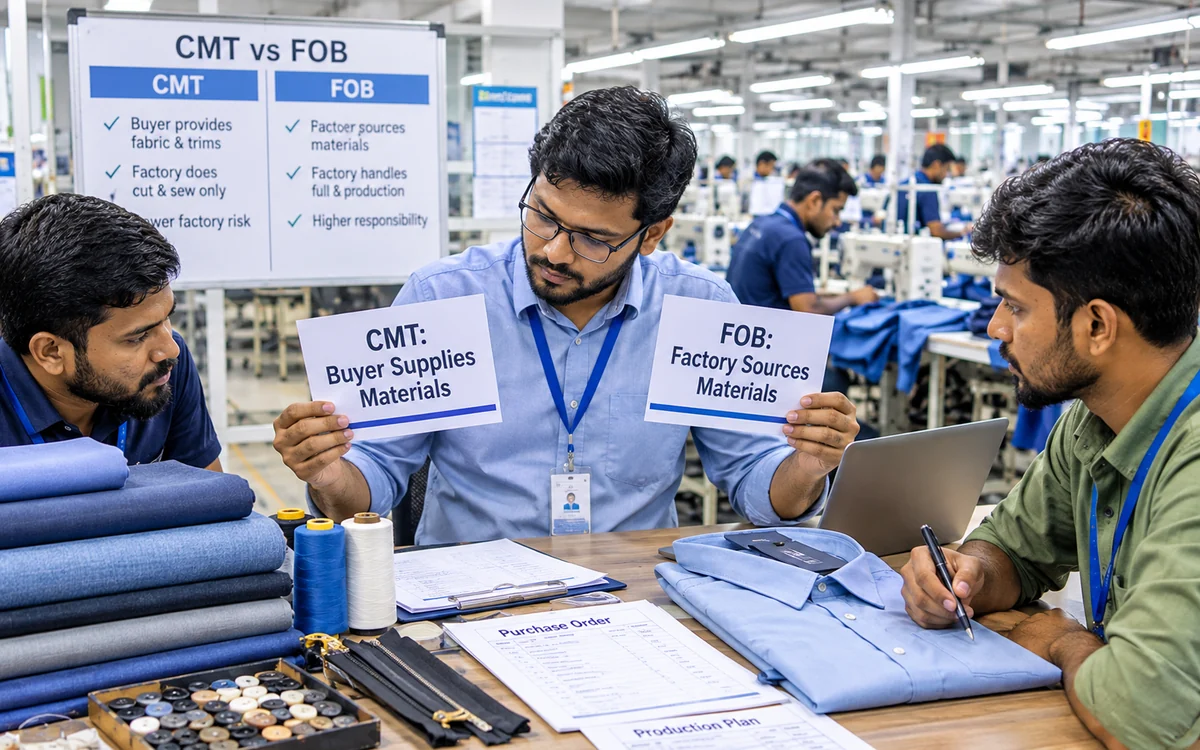
This guide explains each model in plain terms, with a price example, a comparison table and a look at the other terms you will hear, such as OEM, ODM and nominated suppliers. It also covers the confusion between the FOB order type and the FOB trade term, and how to choose the right model for your factory.
What CMT and CM mean
CMT stands for cut, make and trim. In a CMT order, the buyer, or the buyer’s agent, supplies the main materials. The factory contributes its labour, machines, space and know how. It cuts the fabric, sews the garments and does the trimming, finishing and packing work that the buyer asks for.
You will also hear CM, for cut and make. Different companies draw the line in different places. In some, CM means only cutting and sewing, and trimming and finishing are charged apart. In others, CM and CMT mean the same thing. Always ask what is included in the price: the trims, the thread, the poly bags, the cartons, the finishing and the testing.
In a CMT or CM order:
- The buyer supplies, and pays for, the fabric and often the trims.
- The factory is paid a cut and make charge for each garment.
- The factory takes no risk on the price of fabric.
- The factory has little or no material cost to finance.
What an FOB order means in this context
In garment trade language, an FOB order is one where the factory buys the materials as well as making the garment. It is often called a full package or full service order. The factory sources the fabric, trims and packing, produces the garment and delivers it to the port, with the price covering everything.
This usage comes from the trade term FOB, free on board, which is explained in our guide to FOB vs CIF vs EXW in garment export. That guide covers the Incoterm: who pays for transport and where the risk passes. The order type is a different idea, though the two are linked, because a full package order is usually priced FOB. A CMT order can also be shipped FOB. The words describe different things, so write both in the contract: the order type and the Incoterm.
In an FOB, or full package, order:
- The factory buys the fabric and trims, from its own suppliers or from suppliers the buyer names.
- The price covers materials, cut and make, overheads, commercial costs and profit.
- The factory finances the materials, often for months.
- The factory carries the risk of price changes and material problems.
How the price is built
FOB price
FOB price = fabric cost + trims and packing + cut and make + commercial costs + profit
See our guide on the costing sheet of garments manufacturing and the bill of materials for how each line is worked out.
CMT price
CMT price = cut and make cost + commercial costs + profit
The cut and make cost comes from the cost of making, which is the labour, factory overhead and finishing needed for each garment.
A price example
The figures are assumed. They show the shape of the two prices, not real market rates.
A basic woven shirt, ordered in 20,000 pieces.
| Cost item | FOB order (US dollars per piece) | CMT order (US dollars per piece) |
|---|---|---|
| Fabric | 2.30 | Supplied by buyer |
| Trims and packing | 0.55 | Supplied by buyer |
| Cut and make, including factory overhead | 0.85 | 0.85 |
| Commercial costs (bank, documents, inland transport) | 0.20 | 0.10 |
| Profit | 0.40 | 0.30 |
| Price to the buyer | 4.30 | 1.25 |
Check the sums: 2.30 + 0.55 + 0.85 + 0.20 + 0.40 = 4.30, and 0.85 + 0.10 + 0.30 = 1.25.
The numbers show several points at once.
- The FOB price is more than three times the CMT price, but most of the difference is the cost of materials passing through the factory, not extra earnings.
- Profit per piece is higher in FOB in this example, 0.40 against 0.30, because the factory takes more risk and does more work.
- Money tied up in materials. For 20,000 shirts, the materials cost (2.30 + 0.55) × 20,000 = 57,000 US dollars, which the factory must pay or finance before it is paid. Under CMT, this is zero.
- Return on money invested can look better under CMT, since the profit comes with almost no capital. Under FOB, the larger profit is earned on a larger investment and a larger risk.
Comparison table
| Point | CMT or CM | FOB or full package |
|---|---|---|
| Who buys the fabric | Buyer | Factory |
| Who buys the trims | Usually the buyer | Factory |
| What the factory sells | Labour and capacity | A finished garment |
| Price per piece | Low, covers making only | Higher, includes materials |
| Working capital | Small | Large |
| Price risk on materials | Buyer | Factory |
| Quality risk on materials | Shared, depends on contract | Factory |
| Lead time control | Depends on material arrival from the buyer | More control, but more to manage |
| Sourcing skill needed | Low | High |
| Profit per piece | Lower | Higher, with more risk |
| Payment to suppliers | Not needed for materials | Needed, often through a back to back LC |
| Dependence on the buyer | High | Lower, since the factory sources |
Risks to watch in each model
Risks in CMT
- Late materials. If the buyer’s fabric arrives late, the line waits, and the factory loses output and may miss the ship date. Agree who pays for idle time.
- Wrong or faulty materials. If the fabric is faulty, who pays for the extra work and the rejects? Agree a tolerance and a claims process in writing. The fabric inspection procedure and the 4 point system help here.
- Shortages. If fabric consumption is higher than planned, who supplies more? The cut order plan and marker efficiency matter. See marker efficiency and fabric utilization.
- Low margin. The charge per piece is low, and small cost overruns remove the profit.
- Dependence on one buyer. CMT work often comes from a few buyers.
Risks in FOB
- Material price changes. Fabric prices can rise between the quotation and the purchase.
- Supplier delays. Late fabric means a late shipment, and the factory pays the penalty or the air freight.
- Quality problems. The factory must handle fabric rejections and claims with its own suppliers.
- Cash flow. Materials must be paid for before the buyer pays. See back to back LC in RMG.
- Shade and test failures. If fabric fails buyer tests, the factory carries the cost.
- Minimums. Suppliers may require minimum order quantities that exceed the order.
Other terms you will meet
Nominated suppliers
In some FOB orders, the buyer nominates the fabric or trim supplier. The factory buys from them, but the buyer chooses and often negotiates the price. This takes the sourcing out of the factory’s hands, but the factory still pays and still carries some risk. Be clear on who is responsible if a nominated supplier is late or supplies bad material.
OEM
OEM stands for original equipment manufacturer. In apparel, an OEM order means the factory makes garments to the buyer’s design and specification, usually under the buyer’s brand. Most export garment orders from Bangladesh fall into this group, whether CMT or FOB. The tech pack comes from the buyer. See the tech pack for clothing.
ODM
ODM stands for original design manufacturer. Here the factory designs and develops the garment, often with its own design team and fabric library, and the buyer chooses from the range or asks for changes. ODM suits factories with strong design and development skill, and can bring higher margins, but it costs more in sampling and development. See types of garment samples.
Private label
A product made to a retailer’s own brand, usually OEM or ODM.
Buying house or agent
Many buyers work through a buying house, which places orders with factories and handles sampling, follow up and inspection, for a commission. The buying house may be part of the price chain. See duties of a garments buying house technician.
How the models connect to the factory’s operation
Planning
A CMT order depends on the arrival date of the buyer’s materials, so the planner must track it. An FOB order depends on the factory’s own purchase lead times. Both belong in the time and action calendar.
Costing
Under FOB, costing must be accurate across materials and making. A small error in consumption is multiplied by a large fabric price. Under CMT, the cost of making and the SMV dominate.
Capacity
CMT is sometimes used to fill spare capacity. A factory that is not full can take CMT work at a lower price to cover fixed costs. See garment factory capacity calculation.
Quality
Under FOB, the factory controls the fabric and trims and can fix problems at the source. Under CMT, the buyer’s materials set the starting quality, and the factory must protect itself with incoming inspection and records.
Compliance
Buyers audit factories under both models. For compliance points, see the compliance checklist for the garments industry.
Which model suits which factory
There is no single best model.
- A smaller or newer factory with little cash, or with limited sourcing skill, may do better with CMT, which gives steady work with little capital.
- An established factory with good supplier relations, a strong merchandising team and access to finance can earn more under FOB.
- A factory with spare capacity can mix, using CMT to fill gaps.
- A vertically integrated group, with its own fabric mill, gains most under FOB, because it earns on the fabric as well as on making.
Many factories run both. The mix changes with the market, the exchange rate and the buyer’s own policy.
How to decide on an offer
When a buyer offers an order, work through these questions.
- What is the order type? CMT, FOB, or a mix with nominated suppliers.
- Who supplies what? List fabric, trims, labels, packing, and thread.
- What does the price include? Check for testing, inspection, finishing and packing.
- What is the lead time, and does it fit your calendar and your capacity?
- What are the payment terms, and how long will your money be tied up?
- Who bears the risk of late materials, faulty materials and shortages?
- What is the Incoterm? See FOB vs CIF vs EXW in garment export.
- Does the margin cover the risk, after you cost the order properly?
Write the answers into the purchase order or the contract.
Common mistakes
- Mixing up the FOB order type with the FOB Incoterm. Write both.
- Quoting CMT without checking what is included. Trims, packing and finishing often get left out.
- Accepting nominated suppliers without clear responsibility. Late nominated fabric is a common cause of penalty disputes.
- Underestimating working capital under FOB. Interest on materials is a real cost.
- Using wrong consumption. Fabric is the largest cost in FOB. A small error costs a lot.
- No claim process for faulty buyer material under CMT. Agree it before the order starts.
- Ignoring the exchange rate. Imported materials and export earnings may move in different directions.
Final thoughts
CMT vs FOB in garment manufacturing comes down to who owns the materials and the risk that goes with them. In CMT, the buyer supplies the fabric and the factory earns a making charge with little capital. In FOB, the factory buys the materials and sells a finished garment, with a higher price, a higher profit and a higher risk. In our example, the same shirt cost 1.25 dollars on CMT and 4.30 on FOB, with the factory financing 57,000 dollars of materials for the FOB order.
Cost each offer properly, name the order type and the Incoterm in the contract, and be clear on who carries each risk. The right model is the one your cash, skills and capacity can support.
Frequently asked questions
In CMT, the buyer supplies the materials and the factory is paid to cut, make and trim. In an FOB or full package order, the factory buys the materials and sells a finished garment.
Cut, make and trim.
In garment trade language, an FOB order usually means a full package order, where the factory sources materials. FOB is also an Incoterm that tells where delivery and risk pass, so check what the contract means.
FOB usually gives a higher profit per piece but needs more capital and carries more risk. CMT gives a lower profit with little capital. The better return depends on the factory’s cash, skills and risks.
It is a fabric or trim supplier chosen by the buyer. The factory buys from them, but must agree who is responsible for delays and quality.
OEM means the factory makes to the buyer’s design. ODM means the factory designs and develops the product, and the buyer chooses from it.
Usually not for materials, because the buyer supplies them. FOB orders with imported fabric often use a back to back LC to pay the fabric supplier.