Run your hand across a carpet. What you feel is the carpet pile. It is the layer of yarn that stands up from the backing, and it is the part you walk on, vacuum and see every day. The same word applies to velvet, terry towels and many other cloths. In each case, pile means loops or cut ends of yarn that stand up from a base fabric. This guide covers the types of carpet pile and how to choose the right one for your room.
This guide explains what carpet pile is, how the main types differ, how pile is measured and why two carpets that look alike can wear very differently. It includes a worked example of face weight and density, with a room-size calculation of how much yarn goes into a carpet. If you are curious about pile in other fabrics, our guide on GSM in towels shows how loop pile works in a towel.
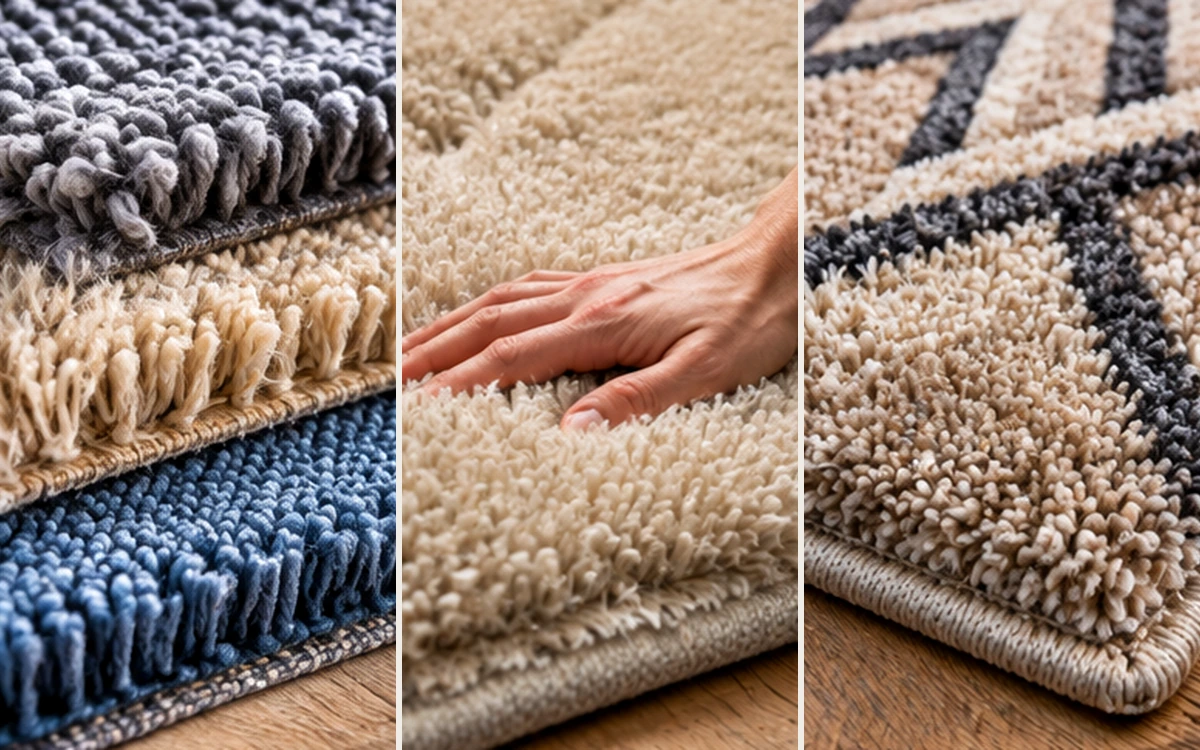
What is carpet pile?
A carpet has two main layers.
- The pile (face). The visible surface made of yarn loops or tufts. It gives the carpet its look and feel.
- The backing. A woven or nonwoven base that holds the pile yarn in place, often with a second layer and an adhesive coating.
Many carpets today are made by tufting. Needles push yarn through the primary backing, forming loops. The loops are then left as they are or cut open. Other carpets are woven on a loom, with the pile yarns woven into the backing as the carpet is made. For the weaving idea, read our guide on the weaving process from yarn to fabric.
The two basic types of pile
| Type | How it is made | Look and feel |
|---|---|---|
| Cut pile | The loops are cut, leaving upright yarn ends | Soft, dense, smooth or textured |
| Loop pile | The loops stay uncut | Firm, textured, flat |
| Cut and loop | Both cut and uncut loops in one carpet | Patterned or sculpted surface |
Everything else, from plush to Berber, is a variation on these three. Yarn thickness, twist, pile height, the number of tufts in each square inch and the way the yarn is heat set all change how a carpet looks and how long it lasts, which is why two carpets with the same basic name can feel and wear quite differently. Keep that in mind. Names are only a start.
Common carpet pile styles
Plush (velvet)
Plush is a cut pile with a smooth, even surface and a soft, luxurious feel. It looks elegant in bedrooms and formal rooms. Its smooth surface shows footprints and vacuum marks more easily.
Saxony
Saxony is a cut pile with slightly twisted, dense yarns. It has a tailored look. Like plush, it tends to show shading and footprints, so it fits lower-traffic, formal spaces.
Frieze (twist)
Frieze is a cut pile with tightly twisted yarns that curl at the tips. The twist resists matting and hides footprints and vacuum marks well. It is a practical choice for busy family rooms.
Level loop and Berber
Level loop pile has uncut loops of the same height. The surface is smooth and textured at the same time, and it resists crushing. Berber is a loop carpet. The name comes from carpets made of undyed wool with dark flecks. Modern Berber is often made from nylon or olefin (polypropylene), in flecked or solid colours. It is durable and often stain resistant, though coarser types can feel rough underfoot.
Cut and loop
This style mixes cut and loop yarns to create patterns such as geometric shapes, florals or stripes. It is good at hiding dirt, and low-profile versions can handle heavy use, for example on stairs and in hallways.
Multi-level loop
This is a loop pile with loops at different heights, used for dimensional patterns. Durability is usually moderate.
Pile fibres
The yarn in the pile matters as much as the style. Common fibres are:
| Fibre | Typical traits |
|---|---|
| Nylon | Strong, resilient and good at springing back after being crushed |
| Polyester | Soft and bright in colour, though it can crush in heavy traffic |
| Polypropylene (olefin) | Resists moisture and stains, often used in loop styles |
| Wool | Natural, warm and long lasting, and it costs more |
You can read about the fibres in our guides to nylon 6 vs 66, polypropylene fibre, polyester fibre and man-made fibres.
Face weight, pile height and density
Three numbers help you judge a carpet beyond how it looks.
- Face weight. The weight of the pile yarn per square yard of carpet, in ounces. It leaves out the backing and adhesive. More face weight means more yarn.
- Pile height. How tall the pile is, measured from the backing to the tip.
- Density. A simple index found by dividing face weight by pile height:
Density = face weight (oz/yd²) ÷ pile height (inches)
A higher number means the yarn is packed more tightly, and denser carpets generally resist crushing better.
Rough guides used in the carpet trade:
| Face weight | Level | Typical use |
|---|---|---|
| Under 30 oz/yd² | Light | Bedrooms, low traffic |
| 30 to 50 oz/yd² | Medium | Living areas, moderate traffic |
| Over 50 oz/yd² | Heavy | Stairs, high traffic, commercial |
For density, values above about 70 to 80 are generally seen as good for homes, and above about 100 is often suggested for busy areas. These are rules of thumb, not formal standards, so treat them as a starting point.
A worked example: face weight, density and yarn use
Let us compare three carpets for a family room and then work out how much yarn the best one uses. All numbers are examples.
Step 1: Calculate density
Density = face weight ÷ pile height
| Carpet | Face weight | Pile height | Density |
|---|---|---|---|
| A | 40 oz/yd² | 0.75 in | 40 ÷ 0.75 = 53.3 |
| B | 40 oz/yd² | 0.50 in | 40 ÷ 0.50 = 80.0 |
| C | 48 oz/yd² | 0.50 in | 48 ÷ 0.50 = 96.0 |
Carpets A and B have the same amount of yarn, but B packs it into a shorter pile, so it is much denser. Carpet C has more yarn and is denser still. For a busy room, C looks best on paper, and A looks weakest even though it has the tallest pile.
Step 2: Convert face weight to grams
1 oz/yd² = 33.906 g/m².
Carpet C: 48 × 33.906 = 1,627 g/m² of pile yarn.
Step 3: How much yarn goes into a room?
Suppose the room is 4 m × 5 m = 20 m².
- 1 m² = 1.196 yd², so the area = 20 × 1.196 = 23.92 yd²
- Pile yarn = 23.92 × 48 oz = 1,148 oz
- In pounds: 1,148 ÷ 16 = 71.8 lb
- In kilograms: 1,148 × 0.02835 = 32.5 kg
Check with grams: 1,627 g/m² × 20 m² = 32,540 g = 32.5 kg. The two routes agree.
So the pile of Carpet C in this room is about 32.5 kg of yarn, before cutting waste and before the backing is counted. A factory orders more to cover waste.
Step 4: Compare with Carpet A
Carpet A’s face weight is 40 oz/yd². Yarn for the same room = 23.92 × 40 = 956.8 oz = 27.1 kg. Carpet C uses 32.5 ÷ 27.1 = about 20 percent more yarn (48 ÷ 40 = 1.2). That extra yarn usually means higher price and better resilience.
Remember: density is only one clue. Fibre type, how the yarn is twisted, how well the pile is heat set and the backing also change how a carpet wears.
Crushing, matting and shading
Carpet does not simply wear out. It changes in three ways, and they are worth telling apart.
- Crushing. The pile gets pressed flat under furniture or foot traffic. It is often reversible with time, brushing or gentle steam.
- Matting. The yarn tips tangle together and stay that way. Low density and weak twist make it more likely.
- Shading. Parts of the carpet look lighter or darker because the pile leans in different directions and reflects light differently. Plush and Saxony show it most. It is a trick of light, not a defect in the yarn, though shoppers often mistake it for stains.
A dense, well-twisted pile resists all three. A loop pile resists crushing well, but a snagged loop can run.
Twist and heat setting
Twist matters in cut pile. Tighter twist keeps the yarn tips from untwisting and opening up, and it helps the carpet look new for longer. Frieze carpets use a high twist for this reason. Manufacturers often heat set the yarn to lock the twist. A carpet with poor twist and heat setting may look fine in the shop and then look worn after a year.
You can learn the basics of twist in our guide to twist in yarn, TPI and twist multiplier.
How to choose a carpet pile
- Pick the room first. Hallways and stairs need durable loop or twisted cut pile. Bedrooms can use softer plush.
- Check face weight and density. Ask for both numbers, not only pile height.
- Look at the fibre. Nylon and wool wear well, and polypropylene resists stains and moisture.
- Think about pets and children. Frieze and loop styles hide marks well.
- Test a sample. Press it, rub it and look at it in natural light.
- Read the warranty. Warranties often cover wear, but conditions apply.
What about underlay?
Underlay, also called padding, sits under the carpet. It adds comfort, cuts noise and cushions the pile against crushing. It is not part of the pile, and it does not change face weight. Even so, a good carpet on a poor underlay can feel thin, and a firm underlay helps a plush carpet keep its shape. Ask the retailer which underlay the carpet maker recommends. Short, simple advice, but often skipped.
Care of carpet pile
- Vacuum regularly. Dirt acts like fine sand that wears the yarn.
- Clean spills at once by blotting, not rubbing.
- Use door mats to catch grit at the entrance.
- Move furniture a little from time to time to avoid permanent dents.
- Have a deep clean from time to time, following the maker’s advice.
- Be careful with loop pile, since a snag can pull a loop. Trim loose loops instead of pulling them.
Pile in other fabrics
The idea of pile reaches beyond carpet.
- Towels have loop pile that holds water.
- Velvet and velveteen have cut pile that feels soft and looks rich.
- Corduroy has cut pile in lengthwise ridges.
- Faux fur and fleece have fibres standing up from a knitted base.
Our page on what GSM means in towels shows how weight and pile affect towel quality. For a general view of fabric weight, see GSM meaning and calculation.
Final thoughts
Carpet pile is the visible yarn surface, and it comes as cut pile, loop pile or a mix of both. Plush and Saxony look smooth and elegant, frieze and Berber suit busy homes and cut and loop styles hide dirt well. Face weight, pile height and density tell you far more about wear than the name of the style.
Our worked example showed three carpets with densities of 53.3, 80 and 96, and a 20 m² room needing about 32.5 kg of pile yarn at 48 oz/yd². Ask for those numbers, match the style to the room and test a sample before you buy.
Frequently asked questions
Carpet pile is the surface layer of yarn loops or cut tufts that stands up from the backing. It is the part you see and walk on.
Cut pile has the loops cut so the yarn ends stand upright. Loop pile keeps the loops uncut, which gives a firmer, more textured surface.
It is the weight of the pile yarn per square yard, in ounces, without the backing. A higher face weight means more yarn.
Divide the face weight in ounces per square yard by the pile height in inches. A carpet with 48 oz face weight and 0.5 inch pile has a density of 96.
Dense, twisted cut pile such as frieze, or durable loop pile such as level loop and Berber, usually suits busy areas. Fibre and density matter too.
No. A tall pile with low face weight can be less dense and mat more quickly than a shorter, denser one.
Pile is a surface of loops or cut yarn ends standing up from a base fabric, as in carpet, velvet and towels.