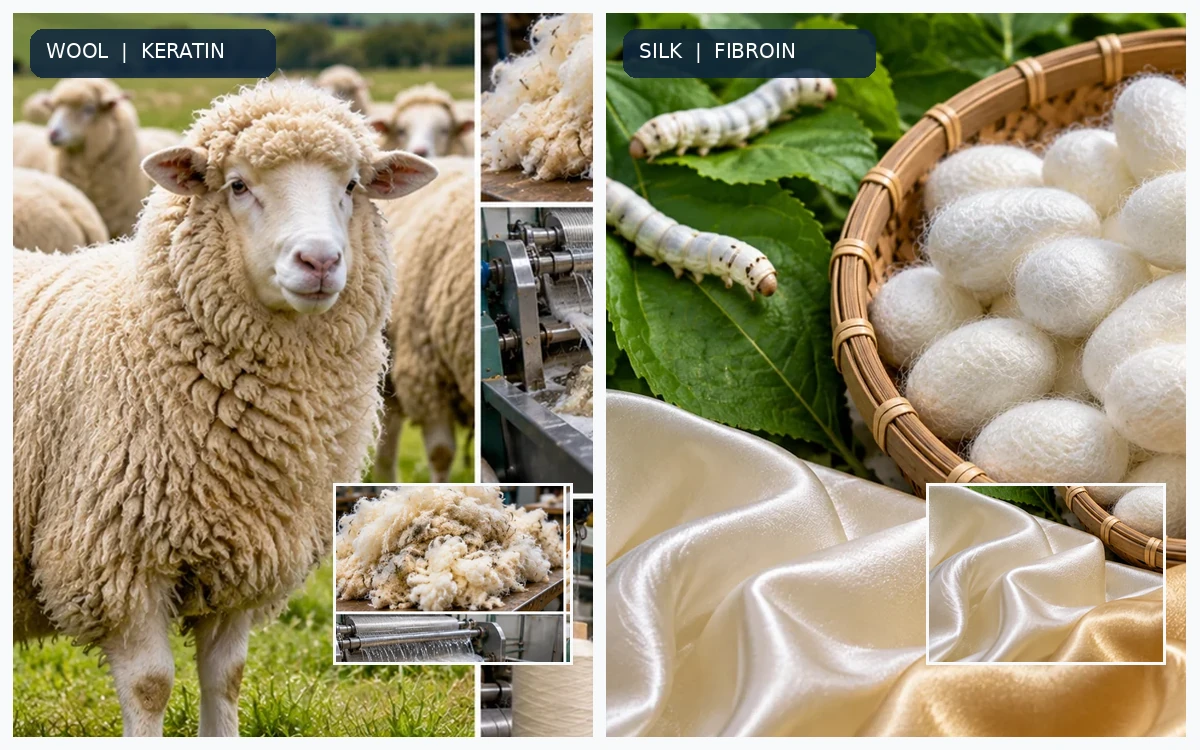
Two of the most prized materials in clothing, wool and silk, look nothing alike. One is warm, springy and slightly fuzzy. The other is smooth, cool and shiny. Yet they belong to the same family. Both are protein fibres, which means they are made of long chains of amino acids, the same building blocks that make up hair, nails and muscle.
This guide explains what protein fibres are, where they come from, how their chemistry gives them their special properties, and how they compare with cotton and synthetic fibres. You will find a table of the main examples, a comparison of wool and silk, tips for dyeing and care and a worked example that counts how many fibres sit in a wool yarn. If you want to place protein fibres in the bigger picture, our guide on the classification of textile fibres shows where they fit.
What are protein fibres?
Protein fibres are natural fibres of animal origin, made of proteins. A protein is a long chain of amino acid units joined by peptide links. In textile terms, protein fibres are usually grouped as:
- Hair or fur fibres. Wool from sheep, and speciality hair such as cashmere, mohair, alpaca, camel hair and angora.
- Secretion fibres. Silk, which is a thread produced by the silkworm and other insects to make cocoons.
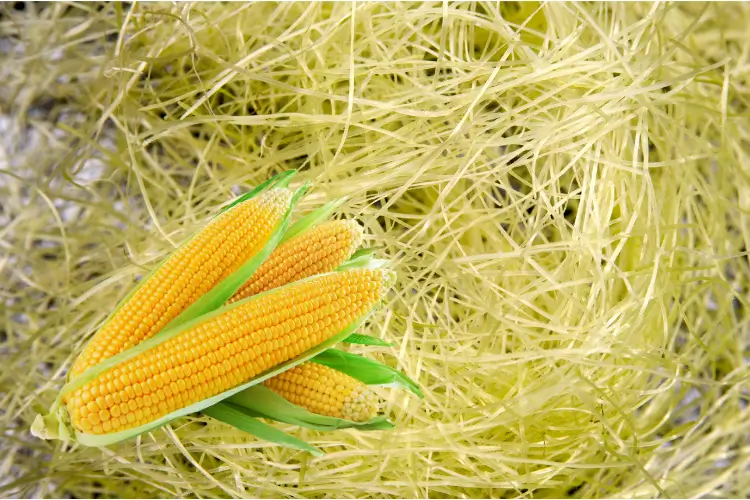
There is also a small group of regenerated protein fibres, made from proteins taken from milk (casein), soya beans or maize and spun into fibre. They are man-made and not widely used, but they appear in niche markets. See our article on milk fibre and casein fabric for one example.
Main protein fibres and where they come from
| Fibre | Source | Main protein | Typical features |
|---|---|---|---|
| Wool | Sheep fleece | Keratin | Warm, elastic, crimped |
| Cashmere | Cashmere goat undercoat | Keratin | Very fine, soft, light |
| Mohair | Angora goat | Keratin | Lustrous, strong, springy |
| Alpaca | Alpaca | Keratin | Soft, warm, silky |
| Camel hair | Camel undercoat | Keratin | Soft, warm, golden colour |
| Angora | Angora rabbit | Keratin | Very soft, fluffy, light |
| Silk (mulberry) | Silkworm cocoon | Fibroin, with a sericin coating | Smooth, lustrous, strong |
| Wild silk (tussah) | Wild silkworm cocoon | Fibroin | Coarser, tan colour |
Do not confuse angora rabbit hair with mohair from the angora goat. Both names come from the Turkish city of Ankara, but they are different animals and different fibres.
The chemistry in plain words
Keratin in wool and hair
Keratin is rich in an amino acid called cystine. Cystine has sulphur in it, and two cystine units can link to each other through a strong sulphur-sulphur bond. These cross-links tie neighbouring protein chains together. They give wool its strength and its ability to stretch and recover. Heat and moisture can break and reform some of these bonds, which is why wool can be set into a new shape in steam, and why it can also shrink and felt.
The surface of a wool fibre is covered with overlapping scales, a bit like roof tiles. These scales help the fibres grip each other in yarn, and they are also the reason wool felts when it is rubbed in warm, wet conditions. For more on how wool is processed, see our guide to wool processing from shearing to scouring.
Fibroin in silk
Silk fibroin is made mainly of three small amino acids: glycine, alanine and serine. Small side groups let the chains pack very closely in neat sheets. This makes silk strong and smooth. A natural gum called sericin coats the raw silk thread. It is removed by a process called degumming, which gives silk its soft hand and shine. Our article on silk fibre production explains how silk is formed and reeled, and our page on what silk is made of goes into the chemistry.
General properties of protein fibres
Protein fibres share a few features that set them apart from cellulose fibres like cotton and from synthetics.
| Property | Protein fibres in general |
|---|---|
| Moisture absorption | High. Wool about 13.6% and silk about 11% standard regain |
| Comfort | Soft, warm in cold, breathable, good moisture handling |
| Elasticity | Wool is very elastic. Silk is moderately elastic |
| Strength | Wool is weak but flexible. Silk is strong |
| Heat | Chars rather than melts. Wool resists flame fairly well |
| Burning smell | Burning hair or feathers |
| Alkali | Damaged. Wool is attacked quickly by hot alkali |
| Acid | Fairly resistant to dilute acids |
| Chlorine bleach | Damages and yellows protein fibres |
| Sunlight | Silk weakens in prolonged sunlight |
| Moths and beetles | Wool and silk can be eaten by larvae |
| Dyeing | Take acid dyes, metal-complex dyes, reactive dyes and some natural dyes |
| Static | Low to moderate |
These are general figures. Real values vary with the breed, the climate, the grade and processing. For wider comparisons, see our overview of the properties of textile fibres.
Wool and silk compared
| Point | Wool | Silk |
|---|---|---|
| Form | Short staple, crimped | Very long continuous filament |
| Surface | Scaly | Smooth |
| Handle | Warm, bouncy, soft to prickly | Smooth, cool, fluid |
| Lustre | Low | High |
| Strength | Low to moderate | High for a natural fibre |
| Elasticity | Very good | Fair |
| Insulation | Excellent | Good, light |
| Typical fabrics | Knitwear, suiting, coats, blankets | Sarees, shirts, scarves, linings, eveningwear |
| Main weakness | Felting, moths, alkali | Sunlight, perspiration, water spots |
| Typical care | Gentle wash, dry flat | Dry clean or hand wash, low iron |
Wool keeps you warm because of its crimp and trapped air. If you want that story in more detail, read why we wear woolen clothes in winter.
A worked example: how many fibres are in a wool yarn?
Wool spinners judge yarn quality partly by how many fibres sit in the yarn cross-section. Too few and the yarn is weak and uneven. This calculation uses fibre diameter and yarn count.
Given
- Wool fibre diameter: 20 micrometres (a common merino-type value)
- Wool density: 1.31 g/cm³ = 1,310 kg/m³
- Yarn count: Nm 48 (metric count, meaning 48 km of yarn weigh 1 kg)
Step 1: Cross-section area of one fibre.
Assume a round fibre. Area = π ÷ 4 × d²
d = 20 × 10⁻⁶ m
Area = 0.7854 × (20 × 10⁻⁶)² = 0.7854 × 4 × 10⁻¹⁰ = 3.14 × 10⁻¹⁰ m²
Step 2: Linear density of one fibre in tex.
Mass per metre = area × density = 3.14 × 10⁻¹⁰ × 1,310 = 4.115 × 10⁻⁷ kg/m
Tex means grams per 1,000 m, or kilograms per 1,000,000 m. So multiply kg per metre by 10⁶:
Fibre tex = 4.115 × 10⁻⁷ × 10⁶ = 0.41 tex (about 4.1 dtex)
Step 3: Linear density of the yarn.
Tex = 1,000 ÷ Nm = 1,000 ÷ 48 = 20.83 tex
Step 4: Number of fibres in the cross-section.
Fibres = yarn tex ÷ fibre tex = 20.83 ÷ 0.4115 = about 51 fibres
A common rule is that ring spun yarn needs at least 30 to 40 fibres in the cross-section to be spinnable and reasonably even. So an Nm 48 single yarn from 20 micron wool, at 51 fibres, is comfortably spinnable. If the spinner wanted a finer yarn of Nm 80, the tex would be 1,000 ÷ 80 = 12.5, and the fibres would be 12.5 ÷ 0.4115 = 30. That is near the lower limit, so a finer wool of 17 to 18 micron would be better for that count.
This is why fine yarns for light suiting and knitwear need finer wool. Fibre diameter limits how thin a yarn can be.
Moisture and trade weight
Wool trading uses a standard conditioned weight. Commercial regain for scoured wool top is often taken as 18.25 percent. So 1,000 kg of dry wool is traded at 1,000 × 1.1825 = 1,182.5 kg. A buyer paying by trade weight must therefore know the moisture basis in the contract. Compare this with the standard regain of 13.6 percent used in textile testing. If 100 kg of dry wool is conditioned at standard regain, the weight is 100 × 1.136 = 113.6 kg.
Uses of protein fibres
Wool and hair fibres
- Sweaters, cardigans, socks, hats and gloves
- Suits, jackets and coats
- Blankets, rugs and carpets
- Felt, for hats, crafts and industrial use
- Insulation and soundproofing
- Base layers and outdoor wear, using fine merino
Silk
- Sarees, scarves, ties and shirts
- Evening dresses and linings
- Bed linen and pyjamas
- Embroidery thread and surgical sutures
- Parachute cloth in the past, and some technical uses today
Speciality fibres
- Cashmere for luxury knitwear
- Mohair for shiny, textured jackets and yarns
- Alpaca for soft, warm scarves and sweaters
- Angora for very soft knits, often blended
Dyeing protein fibres
Protein fibres have both acidic and basic groups along the chain, so they can be dyed in acidic baths. The common dye classes include:
- Acid dyes. The standard choice for wool and silk. They bond with the basic groups on the fibre in an acid bath. Our guide on acid dyes: examples, properties and uses covers this class.
- Metal-complex dyes. Give deep shades with better fastness.
- Reactive dyes. Used on wool and silk for bright colours with good wash fastness.
- Natural dyes. Plant and insect dyes were used for centuries on wool and silk. See our page on natural dyes: sources and examples.
Dyeing temperature matters. Wool is usually dyed near the boil, but it must be heated gradually and not agitated too much, to avoid felting. Silk is dyed at lower temperatures, and care is taken to avoid fibre damage and uneven dyeing.
Care of protein fibres
- Read the label. Some wool is machine washable, but much is not.
- Use cool or lukewarm water and a mild, pH-neutral detergent. Alkaline detergents damage protein fibres.
- Avoid rubbing and twisting. These cause felting and distortion.
- Do not use chlorine bleach. It can dissolve or yellow wool and silk.
- Dry flat and away from direct sun and heat.
- Iron on low heat with a cloth, or steam.
- Store clean items in breathable bags with moth protection. Moths lay eggs in soiled wool.
- Dry clean delicate items as advised.
Our guide to care labels and wash symbols can help you decode the instructions.
How to recognise a protein fibre
A small burn test gives a quick hint (do this safely and only on a scrap):
- Protein fibres burn slowly, may self-extinguish when the flame is removed and smell like burning hair or feathers.
- The ash is a brittle black bead or crushable residue.
- By contrast, cotton burns quickly to soft grey ash, and polyester melts into a hard bead.
For a firm identification, laboratories use microscopes. Wool shows scales, and silk shows smooth, structureless filaments.
Another common lab method is the solubility test. Wool dissolves in hot sodium hydroxide solution, while cotton does not. Chlorine bleach also attacks wool and silk badly, but it hardly touches polyester.
Environmental points
Protein fibres are renewable and biodegradable, and they last a long time when well cared for. But they have costs. Sheep farming involves land use and methane emissions. Silk production involves the death of the pupae in many systems, which some buyers object to, and there are alternatives such as peace silk. Cashmere has raised concerns about overgrazing. Look for certifications for animal welfare, traceability and responsible farming when these matter to you. Compare these with natural and synthetic fibres to see the wider trade-offs.
Final thoughts
Protein fibres are made of amino acids, and that chemistry gives them a special mix of warmth, softness, elasticity and moisture handling. Wool and hair fibres are built on keratin, and silk is built on fibroin. They take acid dyes well, resist flame fairly well, and need gentle care because alkalis, chlorine, heat and moths can damage them.
Our worked example showed why fibre diameter matters: a 20 micron wool gives about 51 fibres in an Nm 48 yarn, which is easy to spin, but an Nm 80 yarn from the same wool would be near the limit. When you buy or specify protein fibres, think about the fibre diameter, the moisture basis of the trade weight and the care the final garment will need.
Frequently asked questions
Protein fibres are natural fibres made from animal proteins. The main examples are wool and other hair fibres, made of keratin, and silk, made of fibroin.
Yes. Wool is made mostly of keratin, the same protein found in human hair and nails.
Yes. Silk is made of the protein fibroin, produced by the silkworm to make its cocoon, and coated with a gum called sericin.
Silk is stronger. It is one of the strongest natural fibres. Wool is weaker but much more elastic.
Because they contain similar proteins, they release a similar smell when they burn. They also burn slowly and often self-extinguish.
Alkaline detergents, heat, chlorine bleach and rubbing can damage protein fibres. Wool can also felt and shrink when it is agitated in warm, wet conditions.
Yes. Regenerated protein fibres, made from casein in milk, soya or maize, exist, but they are not widely used compared with wool and silk.