Look at the label of a good bath towel and you will often see a number followed by the letters GSM. It might say 450, 600 or even 800. Shops describe a high number as “thick” and “luxury,” and a low number as “light” and “quick-drying.” But what is GSM in towels, exactly, and does a bigger number always mean a better towel?
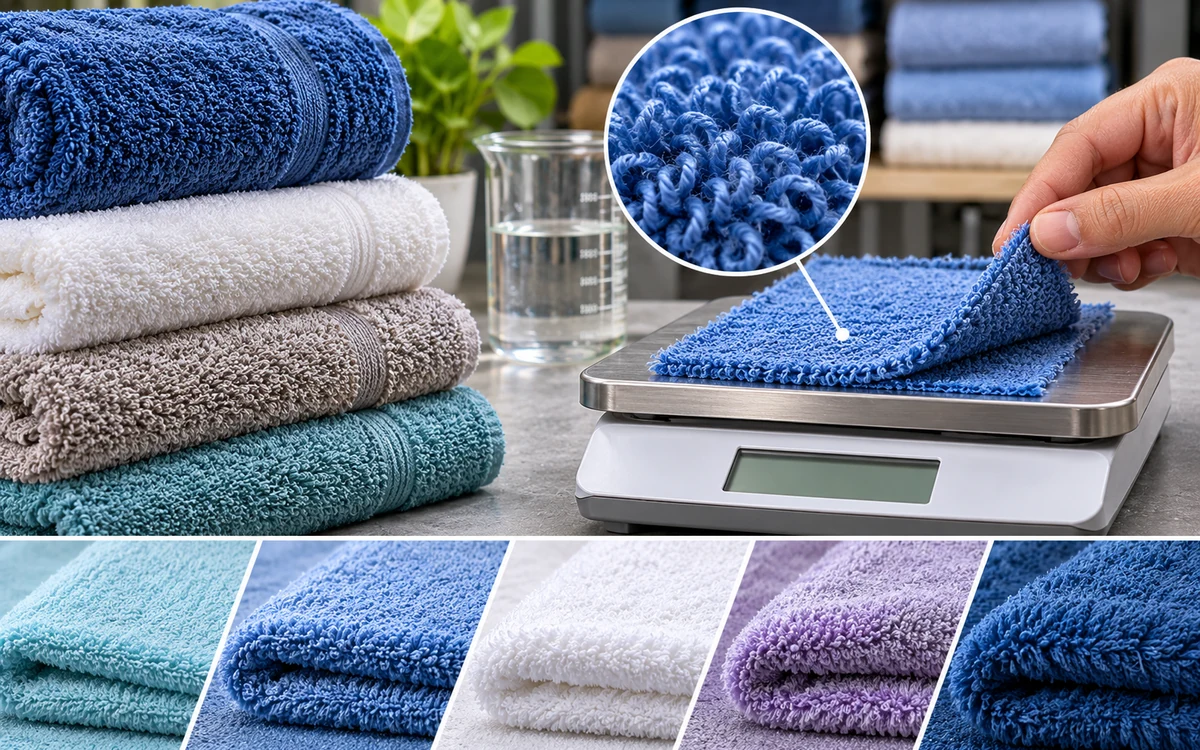
GSM stands for grams per square metre. It tells you how much a square metre of the towel fabric weighs. In this guide, we explain how that number works, what the usual ranges mean, how to calculate GSM yourself with a tape and a scale, and what else decides whether a towel feels soft, absorbs well and lasts. There are worked examples you can try with a towel at home. If you want the general idea of GSM across all fabrics, see our guide to GSM in fabric.
The short answer
GSM in towels is the weight of the towel fabric per square metre, measured in grams. A higher GSM means a heavier, denser and usually thicker towel. A lower GSM means a lighter, thinner towel that dries faster. Most bath towels fall between about 400 and 700 GSM. But GSM alone does not guarantee quality, because the type of cotton, the yarn and the way the loops are made matter just as much.
How towel fabric is made
To understand GSM in towels, it helps to know what a towel is made of. Most towels are woven with a special structure called terry. Terry fabric has two sets of warp yarns and one set of weft yarns.
- Ground warp. Tight yarns that form the flat base of the towel and give it strength.
- Pile warp. Looser yarns that form the loops on the surface.
- Weft. The yarns that run across and lock the loops into the base.
During weaving, the loom pushes groups of weft yarns forward so the slack pile warp bunches up into loops on one or both faces. In a common method called three-pick terry, three weft picks are inserted before they are all beaten up together against the fabric. The first two stay slightly short of the cloth, and the third pushes all three forward, making the loops. Because loops hold a lot of air and water between them, a terry towel absorbs far more than a flat weave of the same fibre.
If you want to understand the weaving steps, our overview of the weaving process from yarn to fabric is a good start.
Since loops are extra yarn, terry fabric weighs a lot more per square metre than plain fabric. A normal cotton shirting is around 100 to 130 GSM. A terry towel is often four or five times heavier.
What GSM ranges mean
The ranges below are general rules of thumb. Brands and countries use them a little differently.
| GSM range | Description | Typical use | Feel and behaviour |
|---|---|---|---|
| Under 300 | Very light | Kitchen towels, hand towels, travel towels | Thin, dries very quickly |
| 300 to 400 | Light | Gym, beach, guest towels | Dries fast, packs small |
| 400 to 500 | Medium | Everyday bath towels, hotels | Balanced absorbency and drying time |
| 500 to 600 | Medium-heavy | Quality bath towels | Plush, absorbs well |
| 600 to 700 | Heavy | Luxury bath towels | Thick, soft, slow to dry |
| 700 to 900 | Very heavy | Spa and bathrobe fabric, luxury towels | Very plush, heavy to wash and dry |
Light towels are not poor towels. A 350 GSM beach towel is a good choice because it is easy to carry and dries in the sun. A 750 GSM bath towel may feel luxurious, but it can take a long time to dry in a small, damp bathroom, and it can stay damp enough to grow a smell.
How to calculate GSM
GSM is simple arithmetic.
GSM = weight of the towel in grams ÷ area of the towel in square metres
Worked example 1: from the weight and size of a towel
You have a bath towel that measures 75 cm × 150 cm. You weigh it on a kitchen scale and it reads 650 g.
Step 1: Convert the size to metres.
75 cm = 0.75 m and 150 cm = 1.5 m.
Step 2: Find the area.
Area = 0.75 × 1.5 = 1.125 m²
Step 3: Divide the weight by the area.
GSM = 650 ÷ 1.125 = 577.8, about 578 GSM
So this is a medium-heavy towel in the table above.
Note that this method includes the borders, hems and any woven design, which can differ from the main body of the towel. A lab test cuts a sample of the main terry area for a cleaner number. For a home check, the whole towel is fine.
Worked example 2: from GSM to weight
A hotel orders bath towels of 70 cm × 140 cm at 500 GSM. How much will each towel weigh?
Step 1: Area.
0.70 × 1.40 = 0.98 m²
Step 2: Weight.
0.98 × 500 = 490 g per towel
For an order of 1,000 towels, the total is 490 kg. The buyer can use this to check shipping weight, and the mill can plan how much yarn to use.
Worked example 3: comparing the price by weight
Two towels of the same size, 70 cm × 140 cm, are on sale.
- Towel A: 400 GSM, price 6.00
- Towel B: 600 GSM, price 8.00
Step 1: Find the weight of each.
Area = 0.98 m².
- Towel A: 0.98 × 400 = 392 g = 0.392 kg
- Towel B: 0.98 × 600 = 588 g = 0.588 kg
Step 2: Find the price per kilogram.
- Towel A: 6.00 ÷ 0.392 = 15.31 per kg
- Towel B: 8.00 ÷ 0.588 = 13.61 per kg
Towel B costs more in total, but it gives about 50 percent more fabric for a third more money. It is better value per gram of cotton. Whether you need the extra weight depends on how you will use it. A heavy towel is slower to dry, and some people prefer a lighter one for that reason.
What GSM does not tell you
GSM is a useful number, but it can mislead. Two towels with the same GSM can be very different in quality.
The cotton and the yarn
Longer cotton fibres make smoother, stronger yarn. Towels from combed, ring spun yarn feel softer and last longer than towels from short, carded, open end yarn. Premium cotton, such as long staple types, adds to this. See our comparison of Supima and Egyptian cotton for details on fine cottons.
Twist level
Normal yarn has twist to hold the fibres together. Twist makes yarn firmer and a little less absorbent at first. Zero-twist or low-twist yarn, sometimes sold as “hygro” cotton, has almost no twist, so it is very soft and quick to absorb water. The trade-off is lower strength and more lint at first.
Pile height and density
How tall are the loops, and how close are they? A towel with dense, tall loops feels thick and absorbs well. A towel made heavy with thick ground yarns and short loops may feel flat and hard even at a high GSM. Check by pinching the loops and looking at the back.
Fibre blend
Pure cotton is the standard. Blends with viscose from bamboo, modal or microfibre can feel silky and dry in a different way. Microfibre towels, made from polyester and polyamide, are light and quick-drying but absorb in a different way.
Weaving quality and finishing
A towel that is washed well, softened lightly and finished with strong hems will last longer. Cheap towels may have loose loops that pull out, uneven edges and a stiff hand from heavy sizing.
Dyeing
Towels dyed with poor colour fastness bleed in the wash. Yarn-dyed towels with woven borders can have strong colours that last, but piece-dyed towels are also common and fine. Our guide on colour fastness tests shows how mills check this.
Does higher GSM mean more absorbent?
Often, but not always. A heavier towel has more yarn, so it can hold more water in its loops. But absorbency also depends on:
- Fibre type. Cotton and viscose absorb well. Polyester does not absorb much inside the fibre.
- Finishing. New towels may have silicone softener on them that repels water, which is why many new towels seem less absorbent until washed a few times.
- Twist. Low-twist yarn takes water up faster.
- Pile structure. Taller, more open loops carry more water between them.
For everyday use, a medium GSM towel made from good cotton can easily outperform a very heavy towel made from poor yarn.
How to choose the right GSM
Here is a simple guide.
- For daily bath towels: 450 to 600 GSM suits most people.
- For a spa-like feel: 600 to 700 GSM. Be ready for longer drying times.
- For the gym or travel: 300 to 400 GSM. Light and quick to dry.
- For the beach or pool: 350 to 450 GSM. Easy to carry and dry.
- For hand towels and face cloths: 350 to 500 GSM.
- For a hotel or guest use: 450 to 550 GSM. Balanced for laundering and durability.
- For babies and sensitive skin: Soft, low-twist cotton at 400 to 500 GSM.
Also consider the climate. In humid places, a lighter towel dries faster and is less likely to smell. In cold, dry places, a thicker towel feels warmer.
Care tips to keep a towel soft and absorbent
- Wash new towels before use. This removes finishing chemicals and helps absorbency.
- Use a normal amount of detergent. Too much leaves residue.
- Skip fabric softener, or use it rarely. It coats the loops and cuts absorbency.
- Do not overload the machine. Towels need room to move.
- Dry fully. Use medium heat or hang in the sun. Damp towels can smell.
- Fluff at the end. Shake out the towel to lift the loops.
- Wash dark and light towels separately until the dye stops bleeding.
For help with symbols, see our guide to care labels and wash symbols.
Buying checklist
- Check the GSM, and the size, so you can estimate the weight.
- Read the fibre content. Look for 100 percent cotton or a clear blend.
- Ask about yarn: combed, ring spun, low-twist.
- Feel the loops. They should be dense and springy.
- Look at the hems and borders for neat, strong stitching.
- Check the back of the towel to see how well the loops are anchored.
- Do the white cloth test: rub the towel on a white cloth to see if dye comes off.
- Compare the price per kilogram, as in the worked example.
If you are buying cotton products in bulk, our tips for buying the right cotton fabric apply here as well.
Final thoughts
So, what is GSM in towels? It is the weight of the terry fabric in grams per square metre. It helps you judge how thick, heavy and plush a towel will be. Most good bath towels sit between 450 and 650 GSM, light towels suit travel and sport, and very heavy ones suit spas.
But do not buy on GSM alone. The cotton, the yarn, the pile and the finish decide how a towel feels and how long it lasts. Use the simple weight-and-area formula from this guide to check what you are paying for, then choose the weight that matches how and where you will use the towel.
Frequently asked questions
GSM means grams per square metre. It is the weight of one square metre of the towel fabric. A higher GSM generally means a heavier, thicker and denser towel.
Most people like bath towels between 450 and 600 GSM. This range gives a good balance of softness, absorbency and drying time.
Not always. A high GSM towel is plush and thick, but it dries slowly and can be heavy to wash. A medium GSM towel made from good cotton can be just as good for daily use.
Weigh the towel in grams and divide by its area in square metres. For example, a 75 cm by 150 cm towel that weighs 650 g has an area of 1.125 m², so its GSM is about 578.
Many people choose 350 to 450 GSM. These towels are light to carry and dry quickly in the sun.
New towels often carry softeners or finishing chemicals that repel water. Washing them a few times without fabric softener usually restores absorbency.
No. GSM tells you the weight, but the cotton, the yarn type, the twist and the pile structure decide softness and durability. Check these as well as the GSM.