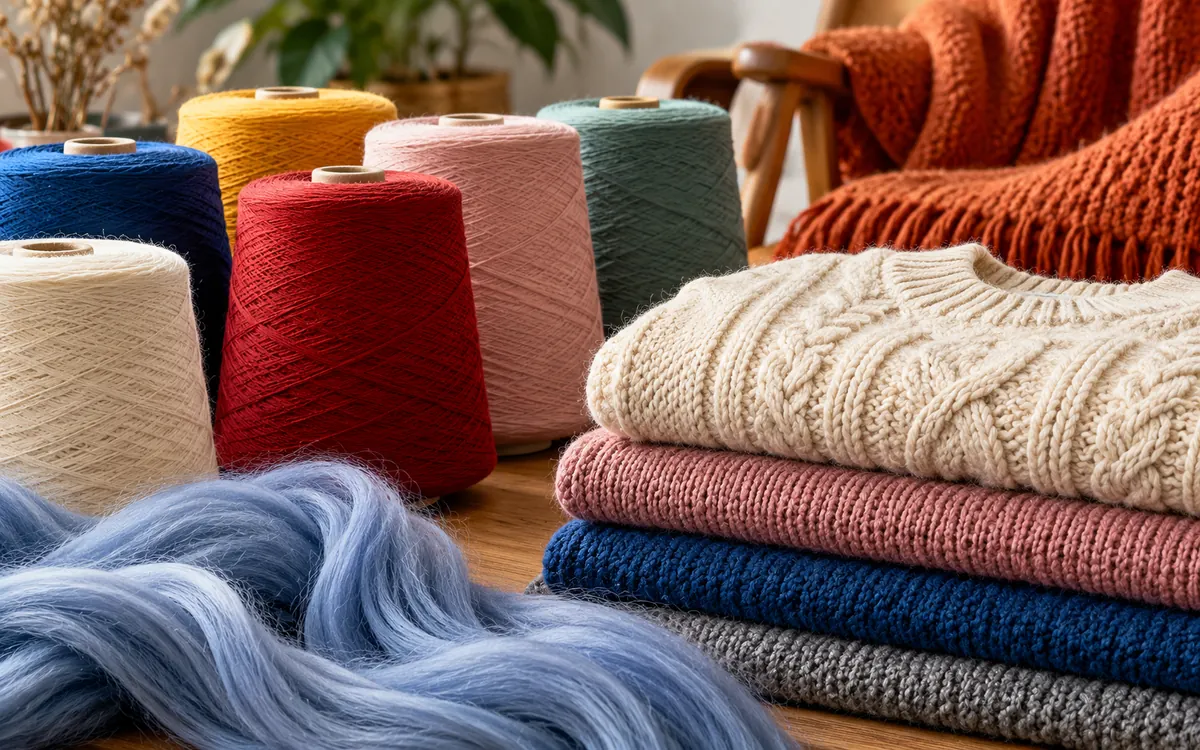
Pick up a bright, soft sweater that costs very little, or a thick blanket that feels like wool but washes easily. There is a good chance it is made of acrylic fibre. Acrylic was created as a lower-cost fibre that behaves much like wool. It is light, warm, colourful and easy to care for, which has made it a staple of knitwear, blankets and soft furnishings for decades.
This guide explains what acrylic fibre is, how it is made and what its main properties are. You will also find its uses, strengths and weaknesses, how it is dyed, a worked blend calculation and care tips. For the wider family of man-made fibres, see our overview of the types of synthetic fibres.
What is acrylic fibre
Acrylic fibre is a synthetic fibre made from a polymer called polyacrylonitrile (PAN). By a common legal definition, such as the one used in textile labelling rules in many countries, a fibre is called acrylic if at least 85 percent of the polymer by weight is acrylonitrile units. A fibre with 35 to 85 percent acrylonitrile is called modacrylic. Modacrylic is used where flame resistance is needed, for instance in faux fur and protective clothing.
Acrylic was first produced commercially in the 1940s and 1950s. It became popular as a wool substitute because it feels soft and warm, and it does not attract moths.
How acrylic fibre is made
The raw material is acrylonitrile, a chemical made from petrochemical sources such as propylene and ammonia. The main steps are:
- Polymerisation. Acrylonitrile is joined with small amounts of other monomers, called comonomers. One comonomer, such as methyl acrylate, makes the polymer softer and easier to spin. Another, which carries acid groups such as a sulfonate, gives the fibre sites that attract dyes.
- Dissolving. The polymer does not melt cleanly, so it is dissolved in a solvent to make a thick spinning solution, called the dope.
- Spinning. The dope is pushed through the tiny holes of a spinneret.
- In wet spinning, the filaments go into a liquid bath where they solidify.
- In dry spinning, the filaments pass through hot air that evaporates the solvent.
- Washing and drawing. The filaments are washed and stretched to line up the molecules, which adds strength.
- Crimping and cutting. For staple fibre, the tow is crimped and cut into short lengths. Crimp gives the fibre bulk, much like wool.
- Finishing. A light finish is applied for spinning and handling.
The cross-section depends on the method. Wet-spun fibre is often round or bean-shaped. Dry-spun fibre often has a dog-bone shape, which affects lustre and feel.
Properties of acrylic fibre
| Property | Typical value or description |
|---|---|
| Polymer | Polyacrylonitrile (at least 85 percent acrylonitrile) |
| Density | About 1.17 g/cm³, lighter than cotton and wool |
| Appearance | Bright, can be made dull, semi-dull or lustrous |
| Handle | Soft, warm, wool-like |
| Tenacity | Moderate, usually 2 to 3.5 g/den |
| Elongation at break | About 20 to 50 percent |
| Elastic recovery | Fair to good for small stretches |
| Moisture regain | Low, about 1.5 to 2 percent |
| Dyeability | Takes basic (cationic) dyes very well, in bright shades |
| Heat | Softens at high temperature, sticks and glazes under a hot iron |
| Sunlight resistance | Excellent, among the best of common fibres |
| Chemical resistance | Good against acids and many solvents, weaker against strong alkali |
| Resistance to moths and mildew | Very good |
| Abrasion resistance | Fair to moderate |
| Static | Builds up in dry air |
| Pilling | High tendency, especially in loose knits |
| Flammability | Burns, with a sooty flame, melts and drips. Modacrylic resists fire better |
The numbers vary with the grade, the denier and the process. Use them as a general guide.
Why acrylic feels like wool
Acrylic has a bulky, crimped structure and traps air, which gives warmth for its weight. It is also light. A sweater in acrylic can weigh less than a wool one of the same size. Unlike wool, it does not absorb much water, so it dries fast. The downside is that it holds less moisture vapour, so it can feel less comfortable than wool when you sweat.
Dyeing acrylic fibre
Acrylic carries negative sites in its structure. These attract positively charged basic dyes, also called cationic dyes. The match gives very bright, deep shades with good light fastness. See our guide on basic dyes for the dye class.
Key points for dyeing:
- Acrylic has a glass transition near 80 to 100 degrees Celsius, depending on the grade. Below it, the fibre takes up little dye. Above it, dye enters fast.
- The critical range, often between about 75 and 95 degrees Celsius, needs slow heating, around 1 degree per minute or slower, or the dye will rush in and give uneven colour. A retarder is added to slow the uptake.
- Typical pH is 4.0 to 5.5, set with acetic acid, with sodium acetate as a buffer.
- Dyeing is carried out near the boil, 98 to 100 degrees Celsius, for 45 to 60 minutes.
- Cool slowly to about 70 degrees before draining, to avoid creases and loss of bulk.
Worked example: a dye recipe for 50 kg of acrylic yarn
- Liquor ratio: 1:10
- Basic dye: 1.0 percent owf (on weight of fibre)
- Retarder: 1.5 percent owf
- Acetic acid (80 percent): 1.0 g/L
- Sodium acetate: 0.5 g/L
Quantities
- Water = 50 × 10 = 500 litres
- Dye = 50 × 0.01 = 0.5 kg
- Retarder = 50 × 0.015 = 0.75 kg
- Acetic acid = 500 × 1.0 = 500 g
- Sodium acetate = 500 × 0.5 = 250 g
Time
- Heating from 40 to 98 degrees: if the rate is 2 degrees per minute up to 75, then 0.8 per minute through the critical range from 75 to 95, then 1 per minute to 98, the time is (75 − 40) ÷ 2 + (95 − 75) ÷ 0.8 + (98 − 95) ÷ 1 = 17.5 + 25 + 3 = 45.5 minutes.
- Holding at 98 degrees for 50 minutes and cooling for 25 minutes gives about 120 minutes of cycle time.
This is a starting point. Always run a lab trial for the dye and the grade of fibre.
Uses of acrylic fibre
- Knitwear: sweaters, cardigans, scarves, hats, gloves and socks
- Blankets and throws: soft, warm and easy to wash
- Carpets and rugs: often blended with wool or nylon
- Faux fur and pile fabrics: modacrylic and acrylic are used for toy fur and coat linings
- Upholstery and curtains: good sun resistance
- Awnings and outdoor fabrics: solution-dyed acrylic holds colour in strong sun
- Craft yarn: hand knitting and crochet
- Industrial uses: filters and, as a precursor, PAN fibre is turned into carbon fibre by heating
Blending acrylic with other fibres
Acrylic is often blended to balance cost, feel and performance.
| Blend | Why it is used |
|---|---|
| Acrylic and wool | Lower cost than pure wool, still warm and soft |
| Acrylic and cotton | Soft, bulky knits with easy care |
| Acrylic and polyester | Dimensional stability and low cost |
| Acrylic and viscose | Fluffy, soft surface |
| Acrylic and nylon | Strength for carpet and socks |
Worked example: commercial weight of a blend
A yarn is made from 70 percent acrylic and 30 percent wool by dry weight. Standard moisture regains used for trade are around 1.5 percent for acrylic and 13.6 percent for wool. Rules differ by country and standard, so check the one in your contract.
- Blend regain = (0.70 × 1.5) + (0.30 × 13.6) = 1.05 + 4.08 = 5.13 percent
- For 100 kg of dry yarn, commercial weight = 100 × (1 + 0.0513) = 105.13 kg
So a buyer who buys 105.13 kg of this yarn at standard conditions pays for 100 kg of fibre plus the allowed moisture. If the buyer tested a different blend, for example 50/50, the regain would be 0.5 × 1.5 + 0.5 × 13.6 = 7.55 percent. Wool content raises the figure a lot, because wool takes up far more moisture.
Advantages of acrylic fibre
- Soft, warm and light, with a wool-like feel
- Lower cost than wool and many other fibres
- Bright, strong colours
- Excellent sunlight resistance
- Quick-drying
- Resists moths, mildew and many chemicals
- Easy to care for
- Holds shape well in most knits
Limitations of acrylic fibre
- Pills easily, which makes sweaters look worn
- Builds static
- Low moisture absorption, so it can feel clammy
- Softens under high heat and can melt if ironed too hot
- Burns and melts, which is a concern for some uses
- Is made from petroleum-based chemicals
- Sheds microfibres in washing, as other synthetic fibres do
- Not easy to recycle at scale in many places
Care of acrylic garments
- Wash in cool or lukewarm water, on a gentle cycle, inside out.
- Use a mild detergent and avoid chlorine bleach.
- Do not wring. Squeeze out the water.
- Lay flat to dry, or tumble dry on low heat.
- Iron on a low setting with a cloth, or skip it.
- To reduce pilling, remove the pills gently with a fabric shaver or comb. Do not pull them by hand.
- Store folded, not on hangers, for heavy knits.
Our guide on how to prevent clothes from shrinking has more on heat and drying. For comparison with other synthetics, read about polyester fibre and nylon fibre.
Acrylic compared with wool and polyester
| Point | Acrylic | Wool | Polyester |
|---|---|---|---|
| Source | Synthetic, petrochemical | Natural, animal | Synthetic, petrochemical |
| Feel | Soft, bulky | Soft, springy | Smooth, can be made soft |
| Warmth | Good | Very good | Moderate |
| Moisture absorption | Low | High | Very low |
| Pilling | High | Medium | Medium to high |
| Dyeing | Basic dyes, bright | Acid dyes | Disperse dyes |
| Price | Low | Higher | Low |
| Sun resistance | Excellent | Fair | Good |
| Moth resistance | Yes | No | Yes |
| Care | Easy | Needs care | Easy |
How to identify acrylic fibre
Check the care label first. For a quick test in a lab or classroom, a small burn test gives clues. Do it with tweezers, over a metal tray and away from anything flammable.
| Clue | What acrylic shows |
|---|---|
| Near the flame | Shrinks away and softens |
| In the flame | Burns with a flickering, sooty flame and may sputter |
| Smell | Sharp, acrid, sometimes described as like burning fish or meat |
| Residue | Hard, black, irregular bead that is hard to crush |
| Under a microscope | Round, bean or dog-bone cross-section, smooth surface |
Burn tests only point in a direction. A blended yarn gives mixed results, so use a proper lab method such as solubility or infrared testing when a buyer needs proof of the content.
Buying tips
- Read the content label. Ask for the percentage of acrylic, wool or other fibres.
- Feel the knit. A tight, even knit pills less than a loose, fluffy one.
- Ask whether the yarn is high-bulk or regular. High-bulk acrylic is softer but can pill more.
- Look for low-pill grades if you make sweaters. Suppliers offer fibre types made to resist pilling.
- Check colour fastness for dark shades, since the dye is strong.
- For outdoor use, ask for solution-dyed acrylic, where the colour is added to the dope before spinning.
- For children’s sleepwear or places where fire safety matters, check the flame rules for your market. Modacrylic or a treated fabric may be needed.
Environmental notes
Acrylic is made from fossil fuel materials and the production uses chemical solvents, so factories need good control of emissions and waste. Acrylic garments shed tiny fibres during washing. A filter bag or a washing machine filter can reduce the release. Buying less but better, and caring for garments so they last, lowers the impact of any fibre. Recycled acrylic exists in small amounts, but it is not yet widely available. Ask your supplier for evidence if a product claims to be recycled or low impact.
Final thoughts
Acrylic fibre gives the look and warmth of wool at a modest price, with bright colour and easy care. It also pills, builds static and does not breathe as well as natural fibres. Choose it for knitwear, blankets and outdoor fabrics where light weight, colour and sun resistance matter, care for it gently, and be open about its limits when you design or sell products made from it.
Frequently asked questions
It is made from polyacrylonitrile, a polymer produced from acrylonitrile, which comes from petrochemical raw materials.
No. Acrylic is synthetic and wool is natural. Acrylic imitates the soft, warm feel of wool at a lower price.
Yes. It traps air in its bulky structure and is light, so it feels warm for its weight.
Not much in normal washing, but heat can distort it. Wash cool and dry on low heat or flat.
Short loose fibres rub together on the surface and form small balls. Acrylic fibres are strong enough to hold the pills on the fabric.
Basic (cationic) dyes, which give bright shades and good light fastness.
Acrylic has at least 85 percent acrylonitrile. Modacrylic has 35 to 85 percent and offers better flame resistance.